Have you ever stopped while writing a message and wondered whether to use “weeks” or “week’s”? You are not alone. Many students, office workers, bloggers, and even native English speakers get confused about these two words.
You may see this confusion in school assignments, social media posts, emails, text messages, and workplace documents. For example, someone may write:
- “I need two week’s notice.”
- “The project took three weeks.”
- “Next week’s meeting is canceled.”
At first glance, both words look almost the same. The only difference is the apostrophe (’). But that tiny mark changes the meaning completely.
People search for “weeks or week’s” because English punctuation can feel tricky. Using the wrong form may make your writing look unprofessional or confusing. Learning the correct usage helps you write clearly in daily life, school, business, and online communication.
In this guide, you’ll learn the meaning, examples, usage, differences, common mistakes, and simple explanations in easy English.
Weeks or Week’s – Quick Answer
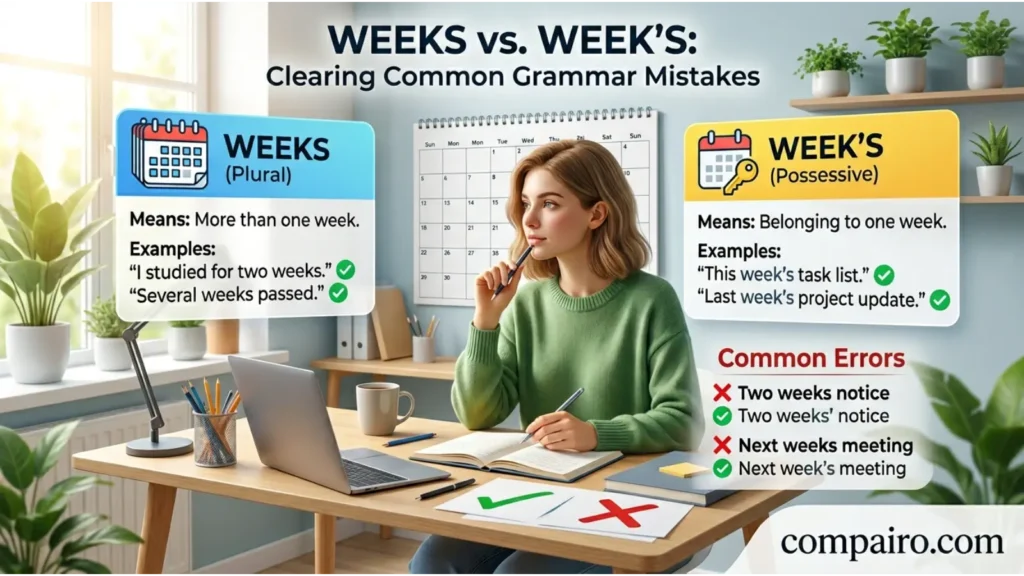
👉 Weeks = plural form of “week”
👉 Week’s = something belongs to one week
Examples
✅ “I worked for three weeks.”
✅ “Next week’s exam is difficult.”
✅ “She finished the course in two weeks.”
Simple Rule
👉 Weeks = more than one week
👉 Week’s = belonging to one week
Easy memory trick:
If you can replace it with “of the week,” use week’s.
Example:
“Next week’s meeting” = “meeting of the next week”
The Origin of Weeks or Week’s
The word “week” comes from old Germanic and Old English languages. It has been used for hundreds of years to describe a seven-day period.
The form “weeks” simply means more than one week. English adds “s” to make many nouns plural.
The form “week’s” uses an apostrophe to show possession. This grammar rule became common in written English many centuries ago.
Today, people often confuse these forms because apostrophes are one of the most difficult punctuation rules in English grammar.
British English vs American English Usage
There is no major difference between British English and American English for weeks and week’s. Both follow the same grammar rules worldwide.
| Feature | British English | American English | Notes |
|---|---|---|---|
| Plural form | Weeks | Weeks | Same usage |
| Possessive form | Week’s | Week’s | Same usage |
| Grammar rule | Same | Same | No spelling difference |
| Apostrophe use | Same | Same | Standard English rule |
Which One Should You Use?
Use weeks when talking about more than one week.
Use “weeks” for:
- Time duration
- Plural meaning
- Informal and formal writing
Examples:
- “I waited four weeks.”
- “The training lasts six weeks.”
Use week’s when something belongs to one week.
Use “week’s” for:
- Possession
- Schedules
- Events
- Deadlines
Examples:
- “This week’s homework”
- “Next week’s meeting”
Common Mistakes With Weeks or Week’s
Mistake 1
❌ “I worked here for two week’s.”
✔ Correct: “I worked here for two weeks.”
Explanation:
“Two” means plural, so use weeks.
Mistake 2
❌ “Next weeks meeting is online.”
✔ Correct: “Next week’s meeting is online.”
Explanation:
The meeting belongs to next week, so use week’s.
Mistake 3
❌ “The project took three week’s to finish.”
✔ Correct: “The project took three weeks to finish.”
Explanation:
This sentence talks about time duration, not possession.
Mistake 4
❌ “This weeks schedule is busy.”
✔ Correct: “This week’s schedule is busy.”
Explanation:
The schedule belongs to this week.
Weeks or Week’s in Everyday Examples
Work
✅ “The manager gave us two weeks to finish the task.”
✅ “Next week’s presentation is important.”
School
✅ “Our exams start in three weeks.”
✅ “This week’s homework is easy.”
Social Media
✅ “I stayed offline for two weeks.”
✅ “Check out this week’s trending video.”
Daily Life
✅ “We went on vacation for two weeks.”
✅ “Next week’s weather looks rainy.”
Text Messages
✅ “I’ll see you in two weeks.”
✅ “Can we move next week’s plan?”
Weeks or Week’s – Google Trends & Usage Data
Many people search for “weeks or week’s” because apostrophe mistakes are very common in English.
Students often get confused during:
- Essay writing
- Grammar lessons
- Online exams
- Email writing
The keyword is popular in countries where English is widely used or studied, including:
- United States
- United Kingdom
- India
- Pakistan
- Canada
- Australia
Searches increase during school seasons and English learning trends online. Social media posts and texting habits also create confusion because many people skip punctuation.
Grammar-related searches remain popular because clear writing matters in education and professional life.
Comparison Table: Weeks vs Week’s
| Word | Meaning | Usage Type | Example |
|---|---|---|---|
| Weeks | More than one week | Plural noun | “I waited two weeks.” |
| Week’s | Belonging to one week | Possessive noun | “This week’s news” |
| Weeks | Time duration | General use | “Four weeks later” |
| Week’s | Ownership/connection | Formal & informal | “Next week’s class” |
Weeks or Week’s in Professional Life

Using the correct form is important in workplaces because grammar mistakes can affect professionalism.
Common workplace examples:
- “Two weeks notice”
- “This week’s report”
- “Next week’s deadline”
Correct grammar helps:
- Emails look professional
- Reports stay clear
- Communication becomes easier
- Writing mistakes decrease
In business writing, small punctuation errors can sometimes confuse readers.
Weeks or Week’s for Students or Beginners
Many beginners struggle because apostrophes seem confusing.
Common learner confusion:
- Knowing when to add apostrophes
- Mixing plural and possessive forms
- Writing quickly during exams
Easy learning tips:
- Ask yourself: “Does it belong to something?”
- If yes → use week’s
- If talking about many weeks → use weeks
Practice with short sentences every day.
Signs or Characteristics Related to Weeks or Week’s
Signs you should use “weeks”
- Talking about time
- More than one week
- Numbers before the word
- Duration examples
Examples:
- Two weeks
- Five weeks
- Several weeks
Signs you should use “week’s”
- Something belongs to the week
- Describing events or schedules
- Talking about plans
Examples:
- Week’s schedule
- Week’s news
- Week’s assignment
Simple Trick to Remember Weeks or Week’s
👉 Weeks = many weeks
👉 Week’s = belongs to a week
Think of it this way:
- “Three weeks” = counting weeks
- “This week’s test” = the test of this week
Another easy trick:
If you can say:
👉 “of the week”
Then use:
👉 week’s
Example:
- “This week’s plan”
- “Plan of this week”
Both mean the same thing.
FAQS:
1. Is “weeks” plural?
Yes. “Weeks” means more than one week.
2. What does “week’s” mean?
“Week’s” shows possession or connection to one week.
3. Which is correct: two weeks or two week’s?
✅ “Two weeks” is correct.
4. Is there a grammar difference between UK and US English?
No. Both use the same grammar rules.
5. Why do people confuse weeks and week’s?
Because apostrophes can be difficult in English grammar.
6. Can I use “week’s” for time duration?
No. Use “weeks” for duration.
Example:
✅ “Three weeks”
7. How can I remember the difference easily?
Use this rule:
👉 Many weeks = weeks
👉 Belongs to a week = week’s
Conclusion
The difference between weeks and week’s is simple once you understand the grammar rule.
Use weeks when talking about more than one week. Use week’s when something belongs to a week.
Many people make this mistake in school, work, texting, and online writing. But with practice, it becomes easy to spot the correct form.
Final easy memory rule:
👉 Weeks = plural
👉 Week’s = possession
Keep this simple trick in mind, and your English writing will become clearer and more professional.

Sara Taylor is a passionate English content writer who specializes in word meanings, spelling comparisons, and modern slang explanations. She creates easy-to-understand articles that help readers avoid common English mistakes and improve their writing skills. Her content focuses on simple learning, real-life examples, and clear explanations for everyday readers.