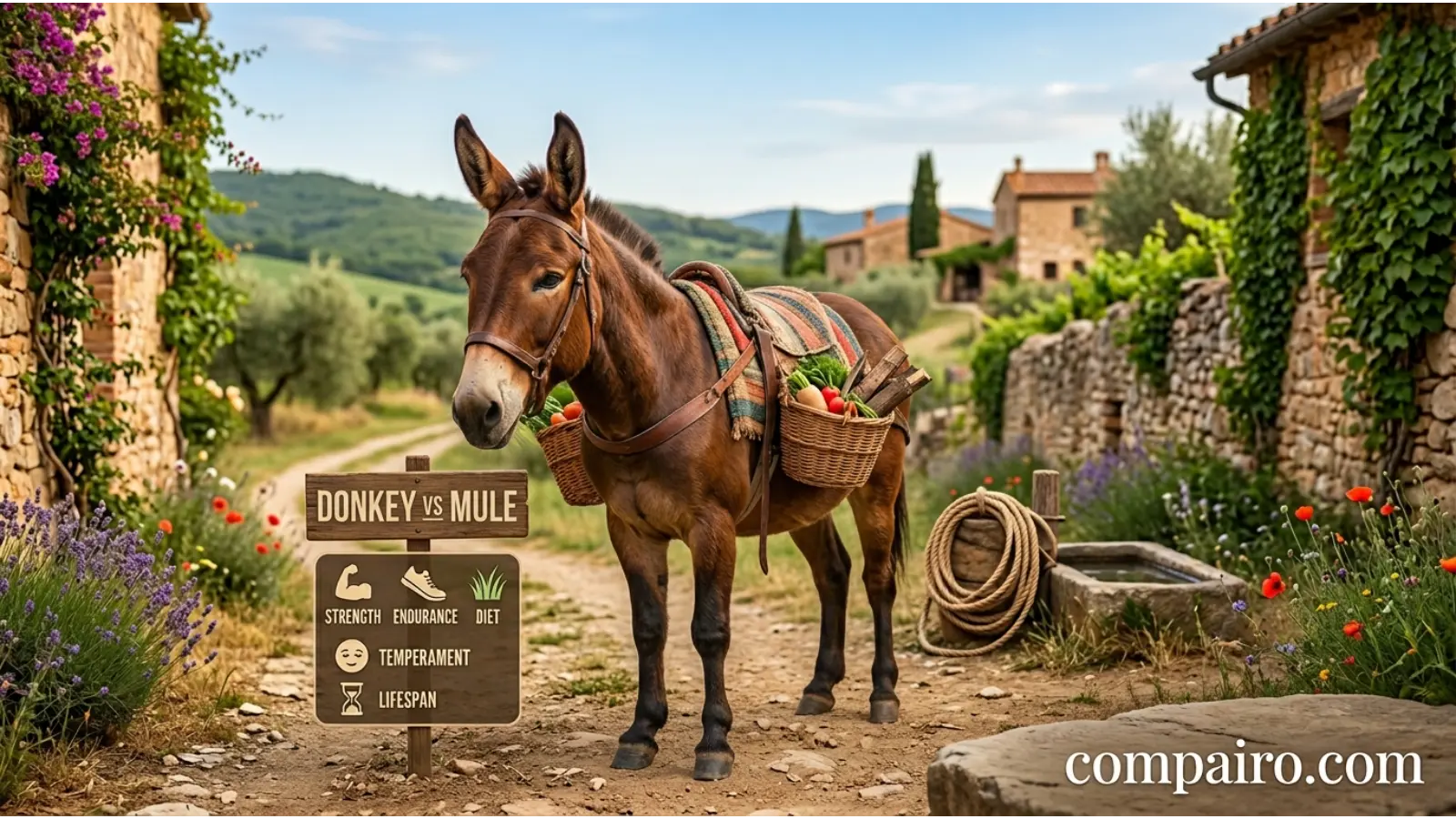
Have you ever seen a donkey and a mule and thought they look almost the same? Many people get confused when they see these two animals, especially in farms, zoos, or videos on social media. Some even use the words “donkey” and “mule” like they mean the same thing—but they are actually different.
This confusion is very common in schools, daily conversations, and even online searches. People often ask questions like: What is a donkey or mule? Are they the same animal? Why do they look alike? These questions come up because both animals are strong, used for carrying loads, and have similar body shapes.
But here’s the simple truth: a donkey and a mule are related but not the same. One is a natural species, and the other is a mix of two animals. Understanding the difference helps you learn better biology basics and improves your general knowledge.
You may also hear these words in jokes, stories, or even in social media captions. So knowing the correct meaning is actually very useful in everyday life.
In this guide, you’ll learn the meaning, examples, usage, differences, common mistakes, and simple explanations in easy English.
DONKEY OR MULE – QUICK ANSWER
👉 Donkey = a small, strong animal from the horse family used for carrying loads and riding.
👉 Mule = a hybrid animal born when a male donkey and a female horse have a baby.
Examples:
- The donkey is carrying wood up the hill. ✅
- The mule is used for heavy farm work. ✅
- A mule cannot usually have babies. ✅
Simple rule:
👉 Donkey = natural animal
👉 Mule = mix of donkey + horse
THE ORIGIN OF DONKEY OR MULE
The word “donkey” became popular in English a long time ago. It originally came from old slang words used in Britain. Over time, it became the official name of the animal.
The word “mule” comes from Latin language roots. It has been used for centuries, especially in farming communities where people needed strong animals for carrying goods.
Mules became very popular because they are stronger than donkeys and more hardworking in rough areas like mountains.
Today, both words are commonly used in biology, farming, and everyday English.
BRITISH ENGLISH VS AMERICAN ENGLISH USAGE
Good news: there is no major difference in how these words are used in British and American English.
Both regions use “donkey” and “mule” the same way.
| Feature | British English | American English | Notes |
|---|---|---|---|
| Donkey | Same meaning | Same meaning | No difference |
| Mule | Same meaning | Same meaning | No difference |
| Usage | Farming + education | Farming + education | Global use |
WHICH ONE SHOULD YOU USE?
It depends on what you are talking about:
- Use donkey when talking about a natural animal species
- Use mule when talking about a mixed hybrid animal
- Use in school science topics for biology learning
- Use in farming or animal discussions
- Use in casual talk when describing animals in stories or videos
👉 In simple words:
Use the correct term based on the animal you see or describe.
COMMON MISTAKES WITH DONKEY OR MULE
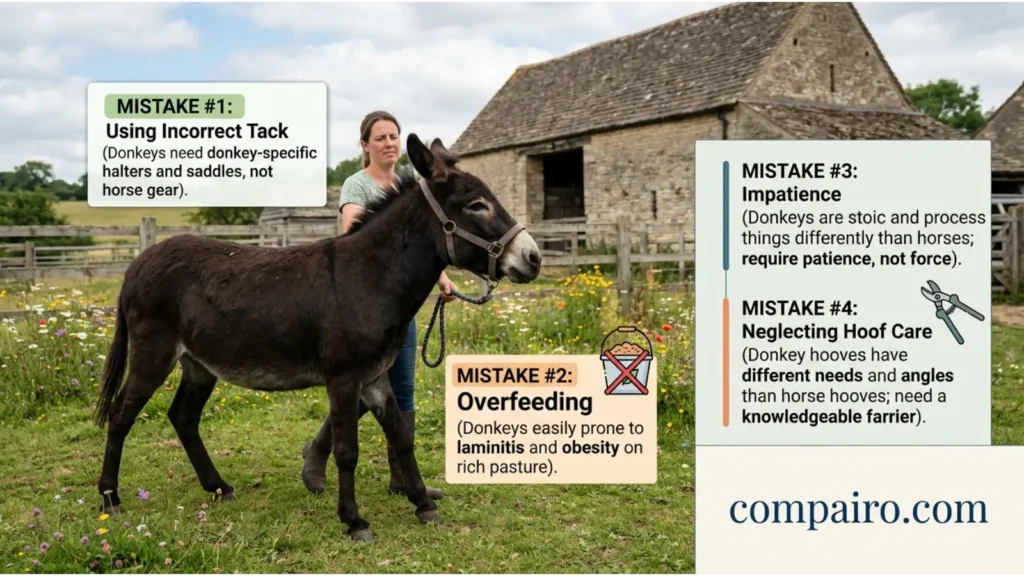
Mistake 1
❌ “A mule is the same as a donkey.”
✔ They are different animals. A mule is a mix of donkey and horse.
Mistake 2
❌ “Donkeys are born from horses.”
✔ Donkeys are a separate natural species.
Mistake 3
❌ “Mules can always reproduce.”
✔ Most mules cannot have babies.
Mistake 4
❌ “Donkey and mule have the same strength.”
✔ Mules are usually stronger and more hardworking.
DONKEY OR MULE IN EVERYDAY EXAMPLES
Work:
- Farmers use a donkey to carry goods in villages.
- A mule helps in carrying heavy loads in mountains.
School:
- Students learn about donkey or mule in biology class.
Social Media:
- “This hike felt like I was carrying loads like a mule 😅”
Daily Life:
- In rural areas, donkeys help people transport goods.
Text Messages:
- “That trip was tough, I felt like a mule today!”
DONKEY OR MULE – GOOGLE TRENDS & USAGE DATA
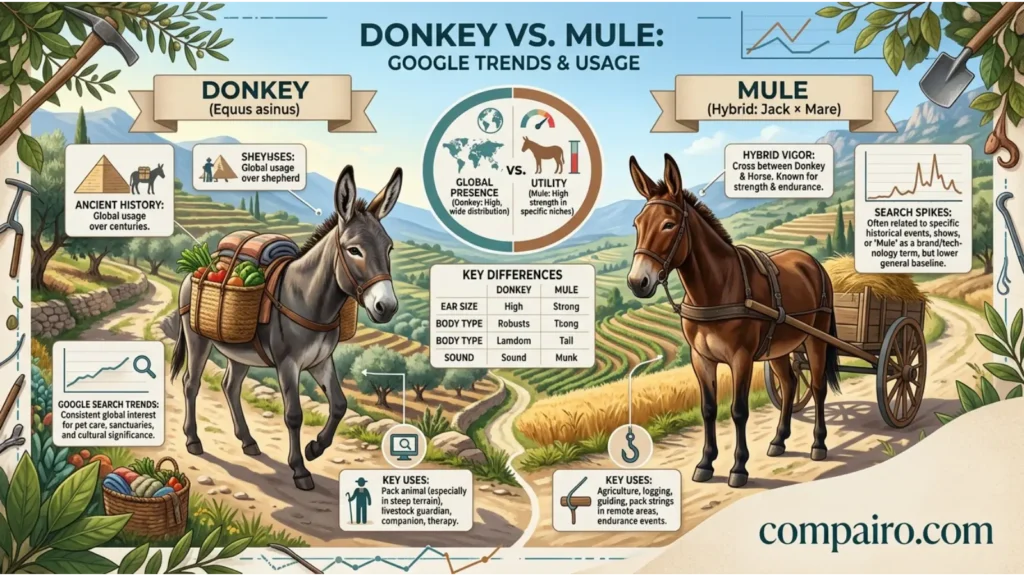
People search “donkey or mule” because they are curious about animal differences.
Common search countries:
- United States
- United Kingdom
- India
- Pakistan
- Canada
- Australia
Why people search it:
- School homework help
- Biology questions
- Animal comparison curiosity
- Social media memes and jokes
Many users get confused because both animals look very similar in pictures and videos.
COMPARISON TABLE: DONKEY VS MULE
| Feature | Donkey | Mule |
|---|---|---|
| Type | Natural species | Hybrid animal |
| Parents | Donkey family | Donkey + Horse |
| Strength | Medium | Stronger |
| Reproduction | Can reproduce | Usually cannot reproduce |
| Use | Farming, transport | Heavy work, transport |
| Personality | Calm and stubborn | Strong and hardworking |
DONKEY OR MULE IN PROFESSIONAL LIFE
In professional fields like farming, agriculture, and animal science, understanding donkey or mule is important.
- Farmers use donkeys for daily transport tasks
- Mules are used in construction areas or mountains
- Veterinarians study both animals for health care
- Biology students learn hybrid animal concepts
This knowledge helps in better animal management and farming decisions.
DONKEY OR MULE FOR STUDENTS OR BEGINNERS
Beginners often get confused because both animals look similar.
Common confusion:
- Shape and size look alike
- Both carry loads
- Both are strong animals
Easy tip:
- Learn the parent animals
- Remember that mule is always a “mix” animal
- Compare pictures to understand better
SIGNS OR CHARACTERISTICS RELATED TO DONKEY OR MULE
Donkey:
- Long ears
- Calm behavior
- Strong for its size
- Used in villages
Mule:
- Strong body
- Very hardworking
- Faster than donkey
- Used in mountains
SIMPLE TRICK TO REMEMBER DONKEY OR MULE
👉 Donkey = “Do-naturally born animal”
👉 Mule = “Mix animal (horse + donkey)”
Think of it this way:
A donkey is like a natural student, and a mule is like a “combined result” of two different animals working together.
FAQS:
1. What is donkey or mule?
A donkey is a natural animal, while a mule is a mix of donkey and horse.
2. Are donkey and mule the same?
No, they are different animals with different origins.
3. Which is stronger, donkey or mule?
Mules are usually stronger than donkeys.
4. Can mules reproduce?
Most mules cannot have babies.
5. Where are donkeys commonly found?
Donkeys are common in farms and rural areas.
6. Why are mules used?
They are used for heavy work and transport.
7. Do donkeys and mules look the same?
They look similar but have different features and origins.
CONCLUSION
Understanding donkey or mule is simple once you know the basic difference. A donkey is a natural animal, while a mule is a mix of a donkey and a horse. Both are strong and useful in farming and transport, but they are not the same.
The easiest way to remember:
👉 Donkey = natural animal
👉 Mule = hybrid animal
With this simple rule, you will never get confused again.