Is it etc or ect? This is a very common question that many people ask when writing emails, school assignments, social media posts, or even text messages.
Imagine you are finishing a list in a sentence. You write something like “apples, bananas, oranges, ect.” It looks right at first glance, but then you wonder if the spelling is correct. Many people face this same confusion every day.
The reason people search for is it etc or ect is simple. The two forms look very similar, and because people often say the abbreviation quickly, it can be difficult to remember the correct order of the letters.
You may see this question in schools, workplaces, online forums, social media discussions, and grammar websites. Students want to avoid mistakes in assignments, while professionals want their writing to look accurate and polished.
Understanding the difference matters because spelling errors can affect clarity and credibility. Even small grammar mistakes can leave a poor impression in formal writing.
In this guide, you’ll learn the meaning, examples, usage, differences, common mistakes, and simple explanations in easy English.
Is It Etc or Ect – Quick Answer
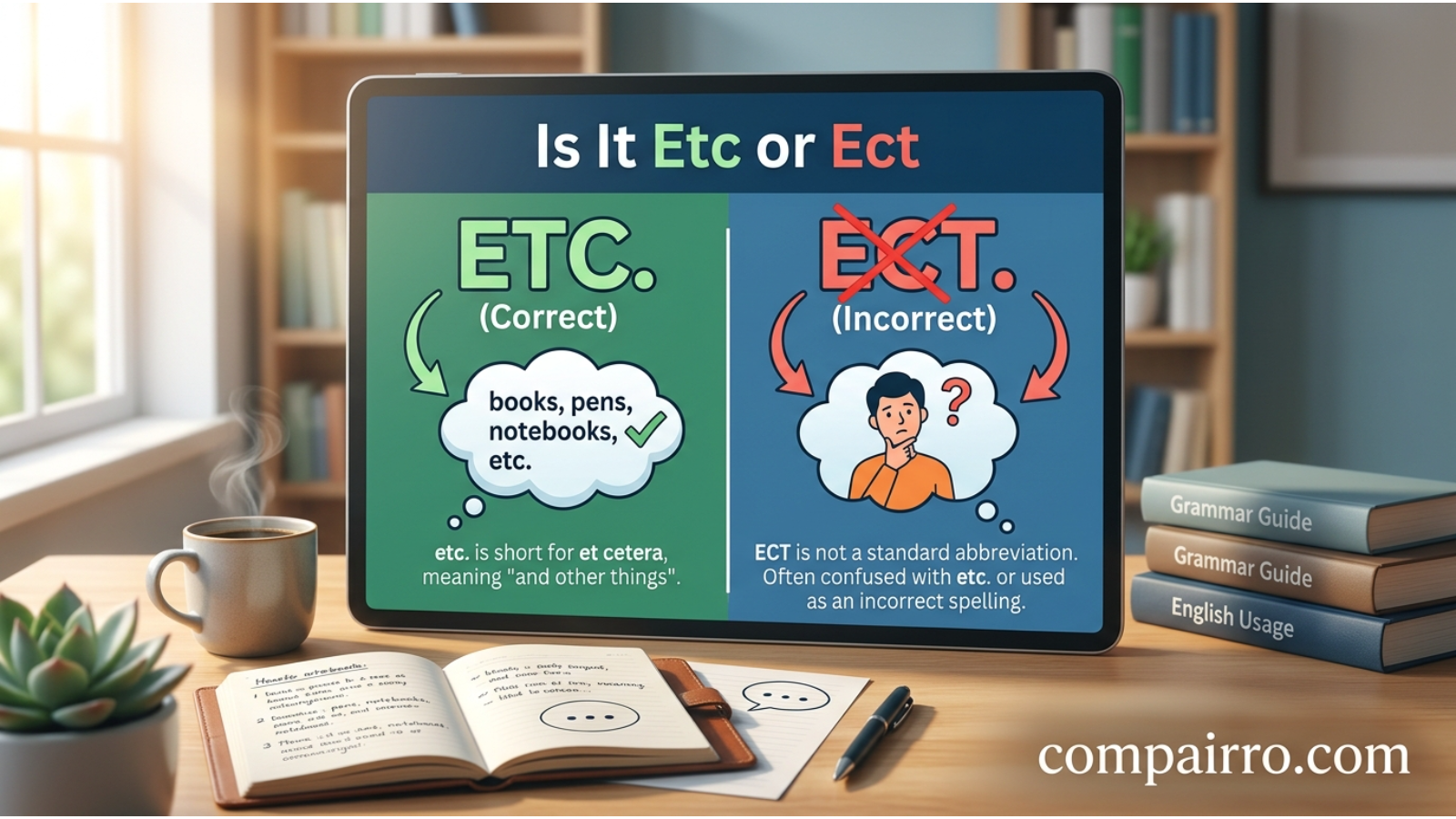
👉 The correct form is “etc.”
Etc. is an abbreviation of the Latin phrase et cetera, which means “and other similar things” or “and so on.”
❌ ect = Incorrect spelling
✅ etc. = Correct abbreviation
Examples
1 We bought bread, milk, eggs, etc.
2 You can use pens, pencils, markers, etc.
3 The course covers grammar, vocabulary, pronunciation, etc.
Simple Rule
👉 Remember: ETC = ET Cetera
The letters come from et cetera, not ec tetera, so etc. is always correct.
THE ORIGIN OF IS IT ETC OR ECT
The abbreviation etc. comes from the Latin phrase et cetera.
- Et means “and.”
- Cetera means “the rest” or “other things.”
People have used this phrase for hundreds of years in writing. Over time, writers shortened it to etc. because it was quicker and easier to use.
Today, it appears in:
- Books
- Academic papers
- Emails
- Business documents
- Websites
- Social media posts
The spelling ect became common because many people hear the word spoken but never learn its original spelling.
BRITISH ENGLISH VS AMERICAN ENGLISH USAGE
The usage of etc. is the same in British English and American English.
| Feature | British English | American English | Notes |
|---|---|---|---|
| Correct abbreviation | etc. | etc. | Same spelling |
| Meaning | And so on | And so on | Same meaning |
| Formal writing | Common | Common | Widely accepted |
| Incorrect form | ect | ect | Wrong everywhere |
There is no regional difference between the two forms.
WHICH ONE SHOULD YOU USE?
You should always use etc.
Use etc. when:
- Ending a list of similar items
- Writing emails
- Completing school assignments
- Writing reports
- Posting on social media
- Sending text messages
Formal Writing
✅ The report includes sales data, customer feedback, market trends, etc.
Informal Writing
✅ Bring snacks, drinks, games, etc.
Avoid
❌ Bring snacks, drinks, games, ect.
No matter the situation, etc. is the correct choice.
COMMON MISTAKES WITH IS IT ETC OR ECT
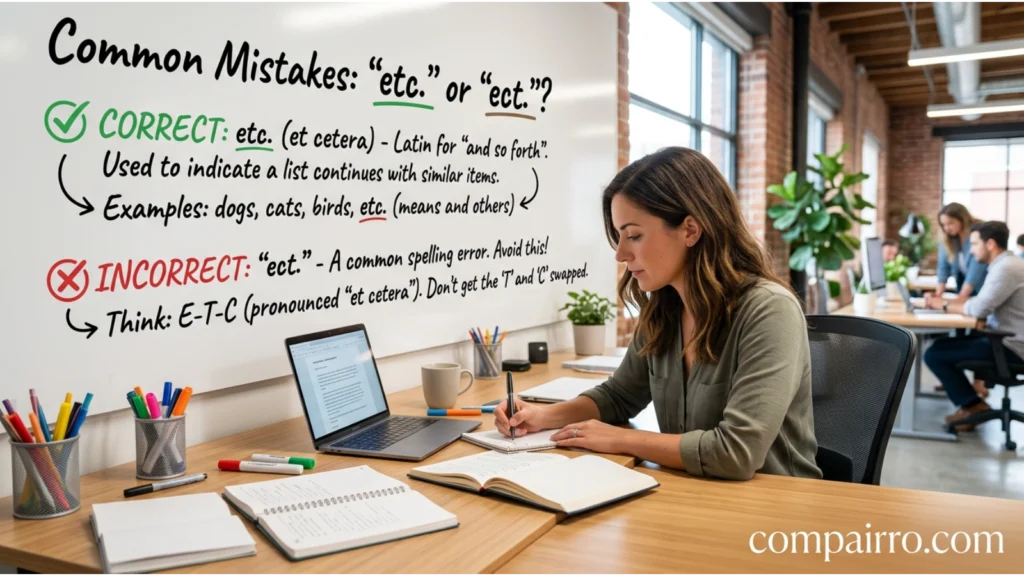
Mistake 1
❌ I bought apples, bananas, ect.
✔ The correct spelling is etc.
Mistake 2
❌ Etc means “extra things.”
✔ Etc. comes from et cetera, meaning “and other similar things.”
Mistake 3
❌ And etc.
✔ Since “et” already means “and,” writing and etc. is usually unnecessary.
Better:
✅ Books, magazines, newspapers, etc.
Mistake 4
❌ Etc etc etc
✔ Avoid repeating it too many times.
Better:
✅ We discussed budgets, schedules, resources, etc.
Mistake 5
❌ Using etc. after a complete list
✔ Use etc. only when similar items continue.
Example:
❌ There are seven days in a week: Monday through Sunday, etc.
✅ There are seven days in a week: Monday through Sunday.
IS IT ETC OR ECT IN EVERYDAY EXAMPLES
Work
✅ Please bring reports, spreadsheets, presentations, etc.
School
✅ Students need notebooks, textbooks, calculators, etc.
Social Media
✅ I love movies, music, gaming, etc.
Daily Life
✅ We bought vegetables, fruits, snacks, etc.
Text Messages
✅ Bring chips, drinks, cookies, etc.
These examples show how commonly etc. appears in everyday communication.
IS IT ETC OR ECT – GOOGLE TRENDS & USAGE DATA
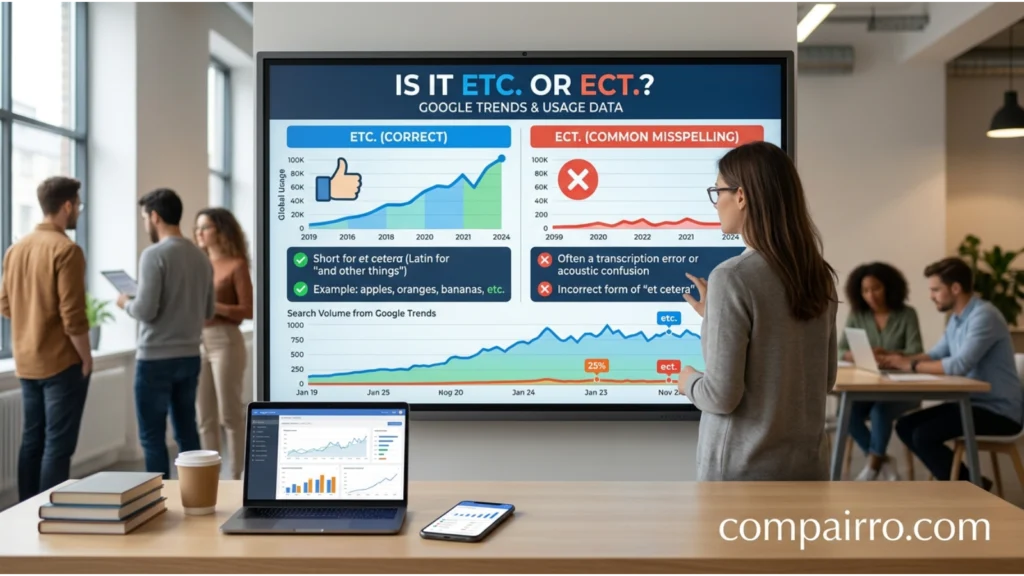
Many people search is it etc or ect because it is one of the most common spelling mistakes in English.
Why People Search It
- They see both versions online
- They hear the word more than they write it
- They want correct grammar
- They need help with assignments or emails
Popular Countries Searching This Topic
- United States
- United Kingdom
- India
- Pakistan
- Canada
- Australia
Search Trend
The search remains popular because:
- Students frequently encounter the abbreviation
- Professionals use it in reports and emails
- Social media users often spell it incorrectly
- Grammar learners want quick answers
The confusion continues because the letters in etc. are easy to reverse accidentally.
COMPARISON TABLE: IS IT ETC OR ECT
| Feature | Etc. | Ect |
|---|---|---|
| Correct spelling | ✅ Yes | ❌ No |
| Dictionary accepted | ✅ Yes | ❌ No |
| Used in formal writing | ✅ Yes | ❌ No |
| Used in academic writing | ✅ Yes | ❌ No |
| Means “and so on” | ✅ Yes | ❌ No |
| Recommended usage | Always | Never |
IS IT ETC OR ECT IN PROFESSIONAL LIFE
Professional writing requires accuracy.
Using etc. correctly helps make documents look polished and trustworthy.
Common Professional Uses
- Emails
- Reports
- Presentations
- Meeting notes
- Project plans
Example:
✅ The training covers communication, leadership, teamwork, etc.
Using ect in professional documents may make writing appear careless.
IS IT ETC OR ECT FOR STUDENTS OR BEGINNERS
Students often struggle with this abbreviation because it is usually learned through listening rather than reading.
Common Confusions
- Reversing the letters
- Forgetting the Latin origin
- Assuming ect sounds correct
Easy Learning Tips
- Remember “et cetera”
- Think “ETC = ET Cetera”
- Practice writing it correctly
- Check your spelling before submitting work
The more you use etc., the easier it becomes to remember.
SIGNS OR CHARACTERISTICS RELATED TO IS IT ETC OR ECT
Characteristics of Correct Usage (Etc.)
- Ends a list of similar items
- Means “and so on”
- Accepted in formal writing
- Common in everyday communication
- Comes from Latin
Characteristics of Incorrect Usage (Ect)
- Misspelled abbreviation
- Not accepted in dictionaries
- Not appropriate for academic writing
- Common typing mistake
- Often caused by letter reversal
SIMPLE TRICK TO REMEMBER IS IT ETC OR ECT
👉 ETC = ET Cetera
👉 ECT = Error Commonly Typed
Think of it this way:
If the original phrase starts with ET, then the abbreviation must also start with ET.
Example:
- Et cetera → Etc. ✅
- Et cetera → Ect ❌
Another easy trick:
👉 The letters stay in the same order:
ET + C = ETC
Never switch the T and C.
FAQs:
1. Is ect ever correct?
No. Ect is considered a spelling mistake.
2. What does etc. mean?
It means “and other similar things” or “and so on.”
3. Why do people write ect instead of etc.?
Many people accidentally reverse the letters when typing.
4. Does etc. need a period?
Yes. Traditionally it is written as etc. because it is an abbreviation.
5. Can I use etc. in formal writing?
Yes. It is accepted in formal and professional writing.
6. What is the full form of etc.?
The full phrase is et cetera.
7. Is etc. used worldwide?
Yes. English speakers around the world use etc. with the same meaning.
CONCLUSION
If you have ever wondered is it etc or ect, the answer is simple: etc. is correct and ect is incorrect.
The abbreviation etc. comes from the Latin phrase et cetera, meaning “and so on” or “and other similar things.” It is accepted in schools, workplaces, professional writing, and everyday communication.
The easiest memory rule is:
👉 ETC = ET Cetera
Whenever you are unsure, remember the original phrase and keep the letters in the same order. Doing this will help you avoid one of the most common spelling mistakes in English.

Sara Taylor is a passionate English content writer who specializes in word meanings, spelling comparisons, and modern slang explanations. She creates easy-to-understand articles that help readers avoid common English mistakes and improve their writing skills. Her content focuses on simple learning, real-life examples, and clear explanations for everyday readers.