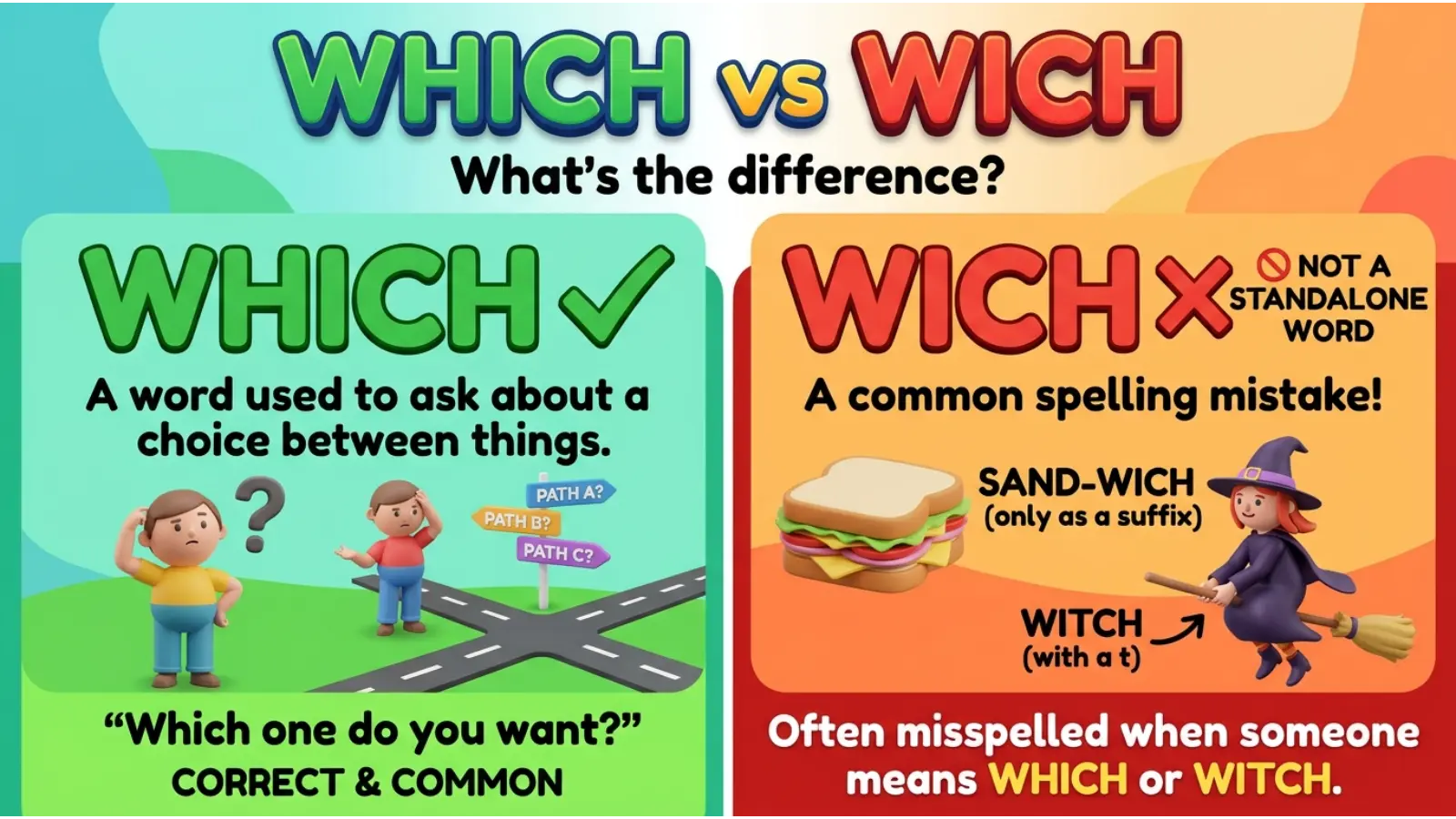
Have you ever written a message, completed an English assignment, or searched for something online and wondered whether to write “wich” or “which”? You are not alone. Many English learners make this mistake because both words sound almost the same when spoken.
However, there is an important difference between them. “Which” is the correct English spelling, while “wich” is usually a spelling mistake. Learning this small difference can help you write better sentences and avoid common grammar errors.
You may see this confusion at school, in workplace emails, in text messages, on social media, and during everyday conversations. For example, someone might write, “Wich book do you want?” when the correct sentence is, “Which book do you want?”
Although the mistake looks small, correct spelling makes your writing easier to understand. It can also help you feel more confident when writing essays, answering exam questions, sending professional messages, or creating website content.
In this guide, you will learn the difference between wich and which, how to use which correctly, where the word comes from, and how to avoid common spelling mistakes. You will also find simple examples, comparison tables, and easy memory tips.
In this guide, you’ll learn the meaning, examples, usage, differences, common mistakes, and simple explanations in easy English.
Wich or Which – Quick Answer
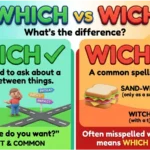
Which is the correct spelling in standard English. It is used to ask about a choice, identify something, or add information about a person or thing.
“Wich” is not the standard spelling of this common English word. It may appear as a typo, a username, a name, or part of another word.
Examples:
- Correct: Which color do you like?
- Correct: Which one is yours?
- Incorrect: Wich movie should we watch?
Simple rule: Remember that which contains the letter h after the letter w.

The Origin of Wich or Which
The word “which” has a long history in the English language. It comes from Old English hwilc, which was used to ask about or identify a person or thing.
Over time, the spelling changed into the modern form “which.” Today, it is a common word in spoken and written English.
The spelling “wich” is often the result of typing too quickly, forgetting the letter “h,” or not knowing the correct spelling.
The confusion is understandable because the “h” does not create a strong, separate sound in the word. However, it must still be included when writing standard English.
The word “wich” can also appear in place names and surnames, or as part of words such as “sandwich.” These uses do not make “wich” a correct replacement for “which.”
British English vs American English Usage
There is no spelling difference between British and American English when using this word.
Both forms of English use “which” for questions and for adding information to sentences. “Wich” is generally incorrect in both.
| Feature | British English | American English | Notes |
|---|---|---|---|
| Correct spelling | Which | Which | Same spelling |
| Incorrect form | Wich | Wich | Usually a typo |
| Asking a question | Which bus is yours? | Which bus is yours? | Same usage |
| Adding information | My car, which is blue… | My car, which is blue… | Same grammar |
| Formal writing | Which | Which | Use the correct spelling |
For example, a student in the UK and a student in the US should both write, “Which answer is correct?”
Which One Should You Use?
You should use “which” whenever you want to ask about a choice or refer to a specific person or thing.
Here are the main situations where you can use it.
1. When Asking a Question
Use “which” when asking someone to choose between options or identify something.
Examples:
- Which shirt should I wear?
- Which school do you attend?
- Which road leads to the market?
2. When Identifying Something
Use “which” to make clear which person or thing you are talking about.
Examples:
- I forgot which room we booked.
- She knows which answer is correct.
- Please tell me which file to open.
3. When Adding Extra Information
You can also use “which” to add more details about something already mentioned.
Examples:
- I bought a new phone, which has a great camera.
- We visited the park, which was very quiet.
- He missed the bus, which made him late.
4. In Formal and Informal Writing
Use “which” in both formal and informal situations.
- School: Which chapter should we study?
- Workplace: Which report should I send?
- Texting: Which movie are we watching?
- Social media: Which picture do you like best?
There is no need to use “wich” in casual messages. Correct spelling is useful even when you are chatting with friends.

Common Mistakes With Wich or Which
Many people make spelling mistakes when writing quickly. Here are four common errors and how to correct them.
Mistake 1: Forgetting the Letter H
❌ Incorrect: Wich color do you prefer?
✔ Correct: Which color do you prefer?
Explanation: Always include the letter “h” in the word “which.”
Mistake 2: Using Wich in a School Assignment
❌ Incorrect: Wich answer is right?
✔ Correct: Which answer is right?
Explanation: School assignments and exams require standard spelling. Writing “wich” may result in a spelling error.
Mistake 3: Using Wich in a Professional Email
❌ Incorrect: Please tell me wich document you need.
✔ Correct: Please tell me which document you need.
Explanation: Correct spelling helps keep professional messages clear and polished.
Mistake 4: Thinking Both Spellings Are Acceptable
❌ Incorrect: Both “wich” and “which” are correct spellings of the same word.
✔ Correct: “Which” is the standard spelling of the word used in questions and sentences.
Explanation: The two forms are not interchangeable in standard English.

Wich or Which in Everyday Examples
The easiest way to understand the correct spelling is to see how people use “which” in daily life.
At Work
- Which meeting should I attend?
- Which file contains the latest information?
- Do you know which customer called?
These sentences help people ask clear questions and share information at work.
At School
- Which subject do you like most?
- Which page should we read?
- Which answer did the teacher explain?
Students can use “which” in homework, essays, exams, and classroom discussions.
On Social Media
- Which picture looks better to you?
- Which song should I use for my video?
- Which caption do you like best?
When writing comments or captions, remember to spell “which” correctly.
In Daily Life
- Which bus goes to the city center?
- Which shop sells fresh fruit?
- Which key opens this door?
These examples show how useful the word is in everyday conversations.
In Text Messages
People often shorten words or type quickly when chatting. However, “which” does not need a special abbreviation.
Example conversation:
Friend A: Which movie should we watch tonight?
Friend B: Let’s watch the comedy movie.
Incorrect text: “Wich movie should we watch?”
Correct text: “Which movie should we watch?”
Even in casual messages, using the correct spelling makes your meaning clear.
Wich or Which – Google Trends and Usage Data
People search for “wich or which” because the words sound similar, and they want to know which spelling is correct.
The question is especially useful for English learners, students, writers, and people who want to improve their grammar.
Why Do People Search for This Keyword?
Common reasons include:
- They are unsure whether the letter “h” is required.
- They want to correct a school assignment or email.
- They are learning English as a second language.
- They want to improve their spelling.
- They have seen “wich” online and want to check whether it is correct.
Search Interest in Different Countries
English spelling questions can be relevant to people in the United States, United Kingdom, India, Pakistan, Canada, and Australia.
- US: Students and everyday writers may look for quick spelling help.
- UK: Learners may search for correct spelling and grammar.
- India: English learners may compare similar-sounding words.
- Pakistan: Students and bloggers may search for simple English explanations.
- Canada: Writers may check standard English spelling.
- Australia: Students and professionals may look for grammar guidance.
These are possible audiences, not verified rankings of search volume.
Are Search Trends Increasing?
There is no verified live Google Trends data provided here to confirm whether searches for “wich or which” are increasing or which country has the highest search interest.
To check actual interest, use Google Trends and compare the search terms over a selected period. Remember that a spelling question can receive attention without either spelling becoming a new trend.
Comparison Table: Wich vs Which
This table gives you a quick way to understand the difference.
| Feature | Wich | Which |
|---|---|---|
| Standard spelling | No, not for this meaning | Yes |
| Used in questions | Incorrect in standard English | Correct |
| Used in formal writing | Avoid as a typo | Yes |
| Used in text messages | Usually a spelling mistake | Yes |
| Example | Wich book is yours? | Which book is yours? |
| Best choice | Do not use as a replacement | Use this spelling |
Remember: If you are asking a question such as “Which one do you want?”, the correct word is always “which.”
Which in Professional Life
Correct spelling matters in professional communication because it helps people understand your message without distraction.
For example, imagine sending an email to your manager:
❌ “Please confirm wich report is final.”
✔ “Please confirm which report is final.”
The second sentence is clearer and uses standard English spelling.
If you work in SEO, content writing, digital marketing, or website management, spelling is especially important. A small spelling error in a blog post, heading, email, or website page can make the content look less polished.
Before publishing an article or sending a message, check for common typing errors. You can also use a spellchecker to catch missing letters.
However, remember that spellcheckers may not catch every mistake. Reading your sentence again is still a useful habit.
Wich or Which for Students and Beginners
English learners sometimes struggle with “which” because the written form does not match how they expect the word to look or sound.
The good news is that you only need to remember a simple spelling rule.
Easy Learning Tips
- Read examples: Practice sentences such as “Which book is yours?”
- Write the word: Write “which” several times to remember its spelling.
- Check your questions: Look for the word whenever you ask someone to choose something.
- Use a spellchecker: Check essays, assignments, and emails before submitting them.
- Practice daily: Write three sentences using “which” every day.
Try This Practice Exercise
Choose the correct word to complete each sentence.
- ___ bus goes to Lahore?
- ___ color do you prefer?
- Can you tell me ___ answer is correct?
Answers:
- Which
- Which
- Which
All three sentences require “which” because they ask about or identify a particular choice or answer.
Signs or Characteristics Related to Wich or Which
How can you recognize the correct form? Look at these simple features.
- Correct spelling: “Which” contains five letters: W, H, I, C, H.
- Question word: It can ask someone to identify or choose something.
- Choice between options: It often appears when several possibilities exist.
- Extra information: It can add details about something already mentioned.
- Common typing error: “Wich” often appears when someone accidentally leaves out the letter “h.”
- Formal and informal use: “Which” is suitable for schoolwork, business writing, social media, and everyday messages.
One important point: “Which” does not always require a question mark. For example, “I know which road to take” is a statement, not a direct question.
Simple Trick to Remember Wich or Which
Here is an easy memory trick:
WHICH = W + H + I + C + H
Remember that the first “h” belongs in the word. Do not remove it when writing.
Think of it this way:
- Which = the correct English word used to ask or identify.
- Wich = usually a spelling mistake when you mean “which.”
For example, imagine choosing between two phones. You ask your friend, “Which phone should I buy?”
You would not write, “Wich phone should I buy?” in standard English.
Another useful trick is to remember the question: “Which one?” Both words in this phrase are short, and “which” always keeps its “h.”
Practice this phrase whenever you are unsure about the spelling.
FAQs:
1. Is it wich or which?
“Which” is the correct spelling in standard English when asking about a choice or identifying something. “Wich” is usually a spelling mistake.
2. What does which mean?
“Which” is a word used to ask about a particular person or thing, choose between options, or add information to a sentence.
3. Why do people write wich instead of which?
People may forget the letter “h” while typing quickly or because the word sounds similar to how it is spelled.
4. Is wich ever a correct word?
“Wich” can appear in names, place names, or as part of other words. However, it is not the standard spelling of “which.”
5. Is which used in British and American English?
Yes. Both British and American English use the spelling “which.” There is no difference in the standard spelling.
6. How do I use which in a sentence?
You can write, “Which book do you want?” or “I know which book you want.” The correct use depends on the sentence.
7. How can I remember the spelling of which?
Remember the phrase “Which one?” and keep the letter “h” after “w.” Practicing a few sentences each day can also help.
Conclusion
When deciding between “wich or which,” the answer is simple: “Which” is the correct spelling in standard English. It is used to ask questions, identify things, choose between options, and add information to sentences.
The spelling “wich” is usually a typing or spelling mistake when used in place of “which.” This mistake can happen to anyone, especially when writing quickly.
To improve your English, practice sentences such as “Which book is yours?”, “Which answer is correct?”, and “Which road should we take?”
The easiest memory rule is to remember the H in WHICH. With regular practice, you can avoid this common mistake and write with greater confidence at school, at work, and online.

Sara Taylor is a passionate English content writer who specializes in word meanings, spelling comparisons, and modern slang explanations. She creates easy-to-understand articles that help readers avoid common English mistakes and improve their writing skills. Her content focuses on simple learning, real-life examples, and clear explanations for everyday readers.