Have you ever looked at a world map and wondered if Russia is in Europe or Asia? You are not alone. Russia is the largest country in the world, and its huge size makes its location interesting to understand.
When students study geography at school, they often learn that Europe and Asia are two different continents. However, these continents share a large landmass, and Russia stretches across both of them. This is why people sometimes feel confused when they see Russia on a map.
The question “Is Russia Europe or Asia?” is also common in online searches, classroom discussions, travel conversations, and social media posts. Some people think Russia is a European country because Moscow, its capital, is in Europe. Others believe it is an Asian country because most of its land lies in Asia.
The truth is that Russia is part of both Europe and Asia. Its western region is in Europe, while its much larger eastern region is in Asia. However, most of its population lives in the European part.
Understanding Russia’s location helps you learn about its history, culture, population, and relationship with neighboring countries. It also makes world maps easier to understand.
In this guide, you’ll learn the meaning, examples, usage, differences, common mistakes, and simple explanations in easy English.
Is Russia Europe or Asia? – Quick Answer
Russia is both European and Asian because it stretches across two continents. The western part of Russia is in Europe, while the eastern and much larger part is in Asia.
Russia covers approximately 17.1 million square kilometers, making it the world’s largest country by land area.
Here are three important facts:
- European Russia: Includes Moscow and St. Petersburg, two of the country’s best-known cities.
- Asian Russia: Includes Siberia and the Russian Far East.
- Largest land area: Most of Russia’s territory lies in Asia, even though much of its population lives in Europe.
Simple rule: Russia’s land is mostly in Asia, but its capital and most of its people are in Europe.
The Origin of Russia’s Location
Russia’s position across Europe and Asia comes from its large geographic size. It developed over many centuries, growing from a smaller state around Moscow into a vast country covering northern Eurasia.
The boundary between Europe and Asia is not marked by an ocean along its entire length. Instead, geographers commonly use the Ural Mountains, the Ural River, the Caspian Sea, and parts of the Caucasus region to describe the boundary.
The Ural Mountains are especially important because they separate much of European Russia from Asian Russia.
Historically, Russia also developed connections with European and Asian societies through trade, migration, politics, and cultural exchange. These connections helped shape its diverse history.
Today, Russia’s location across two continents remains an important part of its identity and international relations.
British English vs. American English Usage
The answer to “Is Russia Europe or Asia?” does not change between British and American English. Both use the same basic geographic understanding: Russia spans Europe and Asia.
The differences are mainly related to spelling and everyday language, not Russia’s location.
| Feature | British English | American English | Notes |
|---|---|---|---|
| Continent name | Europe | Europe | Same spelling |
| Continent name | Asia | Asia | Same spelling |
| Country name | Russia | Russia | Same spelling |
| Geographic term | European Russia | European Russia | Same meaning |
| Geographic term | Asian Russia | Asian Russia | Same meaning |
| Spelling | Centre | Center | A general spelling difference |
In both forms of English, Russia is described as a transcontinental country. This means it extends across more than one continent.
Which One Should You Use: Europe or Asia?
If you are writing about Russia, the correct answer depends on what you want to explain. Russia belongs to both continents, so calling it only European or only Asian can leave out important information.
Use these guidelines:
- For geography homework: Write that Russia is a transcontinental country in Europe and Asia.
- When discussing land area: Explain that most of Russia’s territory lies in Asia.
- When discussing population: Mention that most Russians live in the European part of the country.
- When discussing Moscow: Identify Moscow as a city in European Russia.
- When discussing Siberia: Explain that Siberia is a large region of Asian Russia.
- For general knowledge questions: Answer “both Europe and Asia.”
In formal writing, the term “transcontinental country” is useful. In everyday conversation, saying “Russia is in both Europe and Asia” is clear and correct.
Common Mistakes About Russia’s Location
Many people misunderstand Russia’s geography because they focus on only one part of the country. Here are four common mistakes to avoid.
Mistake 1: Saying Russia is only in Europe
❌ Incorrect: Russia is entirely in Europe.
✔ Correct: Russia extends across Europe and Asia. Only its western portion lies in Europe.
Mistake 2: Saying Russia is only in Asia
❌ Incorrect: Russia is an Asian country with no territory in Europe.
✔ Correct: Most of Russia’s land lies in Asia, but its western region is part of Europe.
Mistake 3: Assuming Moscow is in Asia
❌ Incorrect: Moscow is located in Asian Russia.
✔ Correct: Moscow is in European Russia, west of the Ural Mountains.
Mistake 4: Thinking most Russians live in Asia
❌ Incorrect: Most of Russia’s population lives in Siberia.
✔ Correct: Most of Russia’s population lives in the European part, where many of its largest cities are located.
Remember that land area and population are two different things. A country can have most of its land in one region while most of its people live in another.
Russia in Everyday Examples
Understanding Russia’s location becomes easier when you see how the information is used in daily life.
At school
A geography teacher might ask, “Is Russia Europe or Asia?”
A good answer is: “Russia is in both Europe and Asia because it stretches across the two continents.”
At work
A person preparing a report about international markets may describe Russia as a country that connects European and Asian regions geographically.
On social media
Someone might post a map of Russia and ask why it appears across two continents. You can explain that the Ural Mountains form a commonly used part of the Europe–Asia boundary.
In daily conversations
If a friend asks whether Moscow is in Europe, you can say, “Yes, Moscow is in the European part of Russia.”
In text messages
A simple conversation could look like this:
Friend: “Is Russia European or Asian?”
You: “Both! Most of its land is in Asia, but most people live in European Russia.”
These examples show that one short explanation can clear up a common geography question.
Is Russia Europe or Asia? – Google Trends and Usage Data
People search for “Is Russia Europe or Asia?” because Russia is unusually large and crosses a commonly recognized continental boundary.
However, without current Google Trends data, it would not be accurate to claim that this keyword is rising or provide exact search volumes for individual countries.
The question may interest people in several parts of the world:
- United States: Students and general readers may search for Russia’s continental location.
- United Kingdom: Geography learners may want to understand the Europe–Asia boundary.
- India: Students may look for simple explanations of world geography.
- Pakistan: School students and general knowledge learners may search for the correct answer.
- Canada: Readers may want to understand Russia’s size and location.
- Australia: Geography learners may compare the world’s continents and countries.
Search interest can change with school topics, news events, international discussions, and public interest in world geography.
Social media maps and educational videos can also encourage people to ask this question. The main confusion usually comes from the difference between Russia’s total land area and the location of its population centers.
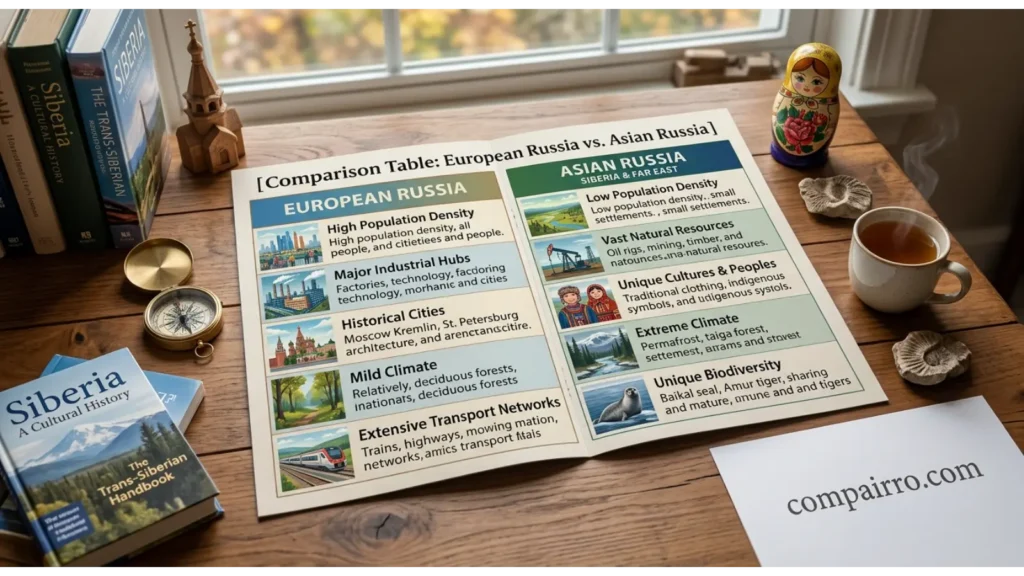
Comparison Table: European Russia vs. Asian Russia
Russia’s two continental regions have different geographic features and population patterns.
| Feature | European Russia | Asian Russia |
|---|---|---|
| Location | West of the commonly used continental boundary | East of the boundary |
| Land area | Smaller share of Russia’s total area | Larger share of Russia’s total area |
| Population | Contains most of Russia’s population | Much more sparsely populated overall |
| Major places | Moscow, St. Petersburg | Novosibirsk, Vladivostok |
| Natural features | Eastern European Plain and other landscapes | Siberia, mountain ranges, forests, and vast open areas |
| Climate | Varies from north to south | Often very cold in northern and inland regions |
| Importance | Government, business, and major population centers | Natural resources, transport routes, and links to the Pacific |
These are broad regional comparisons. Both parts of Russia contain varied landscapes, climates, cities, and local cultures.
Russia’s Location in Professional Life
Russia’s position across Europe and Asia matters in several fields.
Trade and business: Russia’s geography connects regions of northern Europe and northern Asia. Its location can affect transport routes, trade planning, and regional business studies.
Travel and tourism: Travelers need to understand that Moscow and St. Petersburg are in European Russia, while Vladivostok is in the Russian Far East.
Education and research: Geographers study Russia to understand continental boundaries, climate zones, population distribution, and the use of natural resources.
International relations: Russia’s geographic position is relevant to its relationships with countries in Europe and Asia. However, geography alone does not determine its political or cultural identity.
Knowing the difference between European and Asian Russia can make maps, reports, and travel information easier to understand.
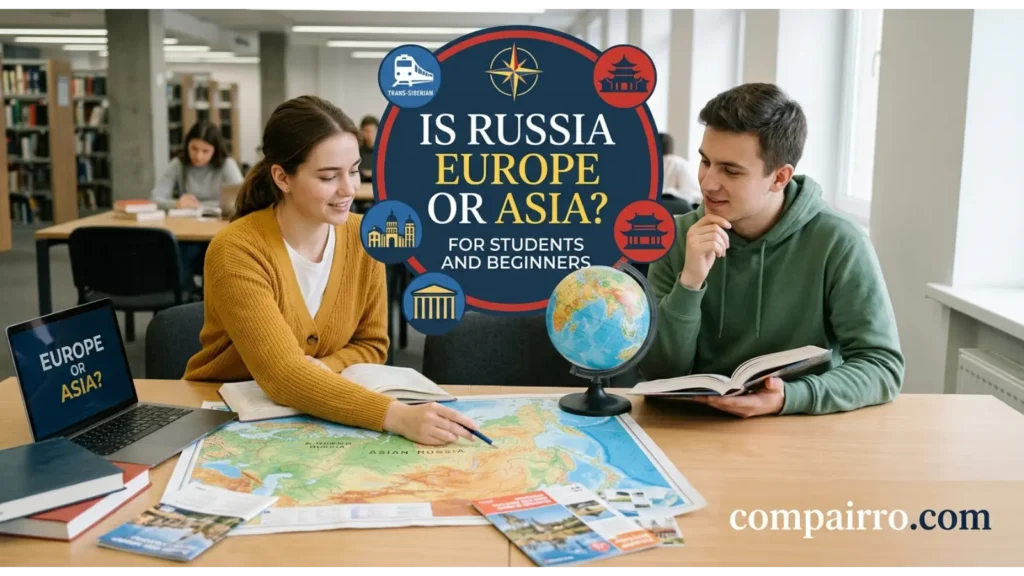
Is Russia Europe or Asia for Students and Beginners?
Students sometimes struggle with this question because textbooks may show Europe and Asia as separate continents. Russia, however, crosses the commonly accepted boundary between them.
Here are a few easy learning tips:
- Find Russia on a world map.
- Locate the Ural Mountains, which form a major part of the Europe–Asia boundary.
- Look for Moscow on the western side.
- Find Siberia to the east of the Ural region.
- Remember that Russia’s land is mostly in Asia, while most of its population lives in Europe.
You do not need to memorize every Russian region to answer the basic question correctly.
For exams, a short answer such as “Russia is a transcontinental country located in both Europe and Asia” is usually the best starting point. Add the land-area and population details if the question asks for more information.
Signs or Characteristics That Russia Belongs to Both Continents
Several geographic facts explain why Russia is considered a transcontinental country.
- Two-continent location: Russian territory extends across Europe and Asia.
- Large land area: Russia is the world’s largest country by total area.
- A recognized boundary: The Ural Mountains and other geographic features help define the Europe–Asia boundary.
- European population centers: Moscow and St. Petersburg are located in European Russia.
- Asian regions: Siberia and the Russian Far East occupy a large part of Asian Russia.
- Different landscapes: Russia includes plains, forests, mountains, tundra, and many other natural environments.
- Wide time-zone range: The country stretches across many time zones because of its enormous east–west distance.
Together, these features make Russia one of the clearest examples of a country that spans two continents.
Simple Trick to Remember Russia’s Location
Here is an easy memory trick:
Russia = Europe + Asia
Think of Russia as a country with two geographic parts:
- West = Europe
- East = Asia
Now remember two more facts:
- Most of Russia’s land is in Asia.
- Most of Russia’s population lives in Europe.
Think of it this way: Imagine a huge country stretching from the European side of the Ural Mountains all the way to the Pacific Ocean. Its western region is European, and its eastern region is Asian.
This simple picture will help you remember the answer during school tests, quizzes, and everyday conversations.
FAQs:
1. Is Russia in Europe or Asia?
Russia is in both Europe and Asia. It is a transcontinental country because its territory crosses the boundary between the two continents.
2. Is Russia mostly in Europe or Asia?
Russia is mostly in Asia by land area. However, most of its population lives in the European part of the country.
3. Is Moscow in Europe or Asia?
Moscow is in Europe. It is located in the western part of Russia, west of the Ural Mountains.
4. Is Siberia in Europe or Asia?
Siberia is in Asia. It covers a vast region of northern Asia within Russia.
5. Why is Russia considered part of two continents?
Russia stretches across the commonly accepted boundary between Europe and Asia. Its territory includes land on both sides of that boundary.
6. Is Russia the largest country in Europe?
Russia is the world’s largest country by area and has territory in Europe. If considering European countries, Russia is the largest when its full national territory is counted, although only part of Russia lies in Europe.
7. Do most Russians live in Europe or Asia?
Most Russians live in European Russia. This region includes Moscow, St. Petersburg, and many other major population centers.
Conclusion
So, is Russia Europe or Asia? The correct answer is both. Russia is a transcontinental country that stretches across Europe and Asia.
Most of its land area lies in Asia, but most of its population lives in European Russia. Moscow, the capital, is also located in Europe, while Siberia lies in Asia.
NTY Meaning in Text: What Does NTY Mean in Texting? The most important thing to remember is that a country’s land area and population do not always follow the same pattern.
Easy memory rule: Russia is mostly Asian by land area but mostly European by population. This simple fact will help you answer the question confidently in geography lessons, general knowledge tests, and everyday conversations.

Sara Taylor is a passionate English content writer who specializes in word meanings, spelling comparisons, and modern slang explanations. She creates easy-to-understand articles that help readers avoid common English mistakes and improve their writing skills. Her content focuses on simple learning, real-life examples, and clear explanations for everyday readers.