Imagine you are studying chemistry and your teacher asks, “Is CCl4 polar or nonpolar?” You know that carbon and chlorine have different electronegativities, but you are not sure if the whole molecule is polar. This is a common question for students learning about chemical bonds and molecular shapes.
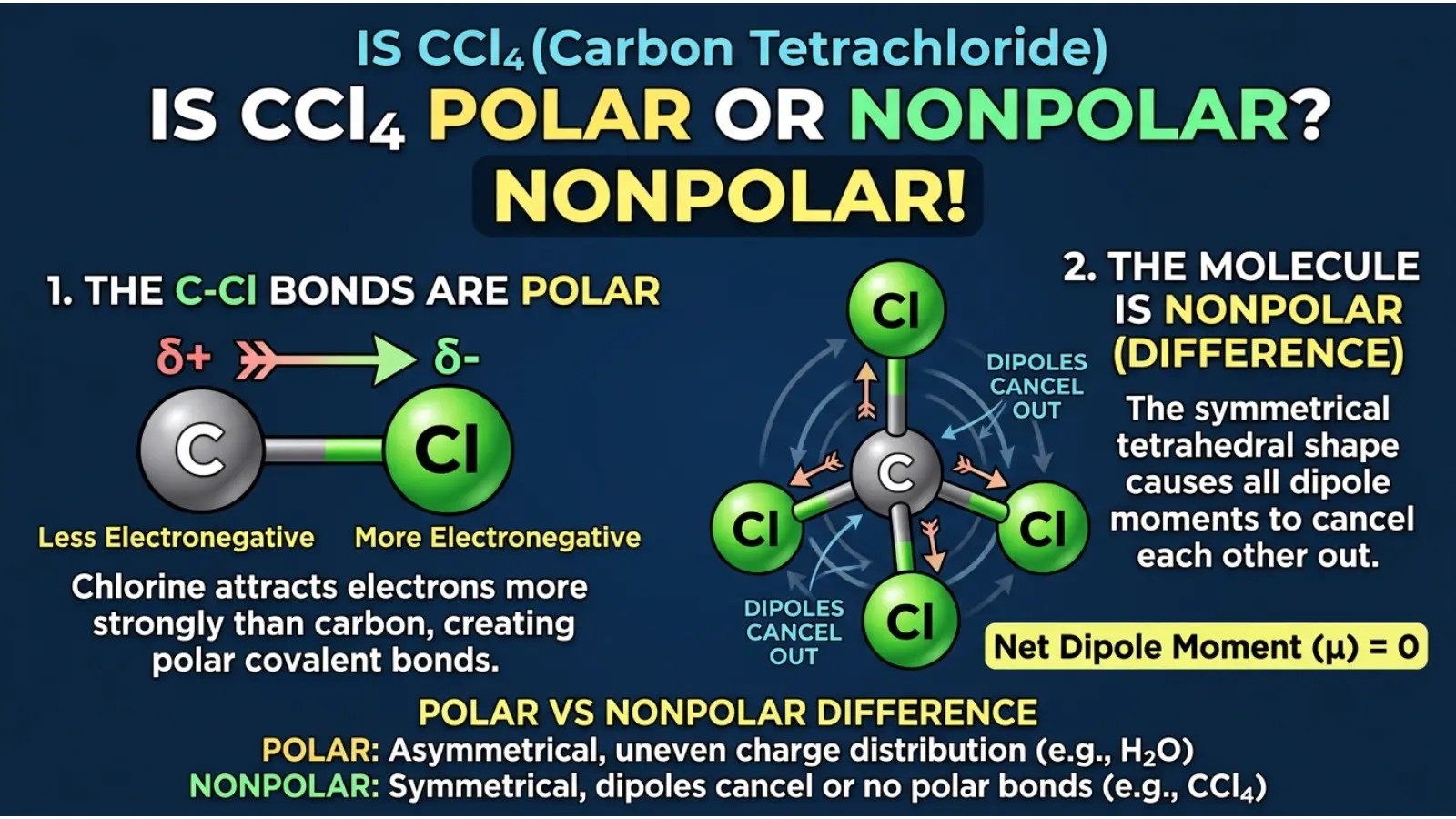
CCl4 stands for carbon tetrachloride. It is a chemical compound made of one carbon atom and four chlorine atoms. Each carbon–chlorine bond is polar because chlorine attracts shared electrons more strongly than carbon. However, the entire CCl4 molecule is nonpolar.
Why does this happen? The answer depends on the molecule’s shape. CCl4 has a symmetrical tetrahedral structure, which means the polar bonds are arranged evenly around the central carbon atom. Their dipole moments cancel each other out.
Understanding this idea can help you solve chemistry questions in school, prepare for exams, and understand other topics related to molecular polarity. You may also come across this question in textbooks, online lessons, science videos, and internet searches.
The most important point is that a molecule can contain polar bonds but still be nonpolar overall. You must consider both bond polarity and molecular shape to find the correct answer.
In this guide, you’ll learn the meaning, examples, usage, differences, common mistakes, and simple explanations in easy English.
Is CCl4 Polar or Nonpolar? – Quick Answer
CCl4 is nonpolar. Although each carbon–chlorine bond is polar, the molecule has a symmetrical tetrahedral shape. As a result, the bond dipole moments cancel each other out, leaving no net dipole moment.
CCl4 is also known as carbon tetrachloride.
Here are three important facts:
- Chemical formula: CCl4
- Molecular shape: Tetrahedral
- Overall polarity: Nonpolar
Examples to understand the concept:
- CCl4: Nonpolar molecule because its bond dipoles cancel.
- H2O (water): Polar molecule because its bond dipoles do not cancel.
- CO2 (carbon dioxide): Nonpolar molecule because its two bond dipoles cancel in a straight-line structure.
Simple rule: Always check the bond polarity and the molecular shape before deciding whether a molecule is polar or nonpolar.
The Origin of CCl4 and Its Chemical Background
CCl4 is the chemical formula for carbon tetrachloride. Its name comes from its composition:
- Carbon (C): One carbon atom.
- Tetra (four): Four chlorine atoms.
- Chloride: Refers to chlorine in this compound.
The compound has one central carbon atom connected to four chlorine atoms through single covalent bonds.
Carbon tetrachloride has been used as an industrial solvent and in some older fire-extinguishing products. However, its use is now heavily restricted in many places because it is harmful to human health and contributes to ozone depletion.
In chemistry education, CCl4 is especially useful for explaining covalent bonding, molecular geometry, and polarity.
Its symmetrical shape makes it a clear example of how polar bonds can form a nonpolar molecule.
British English vs American English Usage
There is no meaningful difference between British and American English when discussing the polarity of CCl4. Both use the same chemical formula and the same scientific principles.
The main difference may be in spelling or pronunciation of related scientific terms, not in the chemistry itself.
| Feature | British English | American English | Notes |
|---|---|---|---|
| Chemical formula | CCl4 | CCl4 | Identical |
| Compound name | Carbon tetrachloride | Carbon tetrachloride | Same name |
| Molecular shape | Tetrahedral | Tetrahedral | Same geometry |
| Polarity | Nonpolar | Nonpolar | Same scientific result |
| Electronegativity | Electronegativity | Electronegativity | Same concept |
Students in the UK, US, Pakistan, India, Canada, and Australia can use the same explanation.

Which One Should You Use: Polar or Nonpolar?
If you are answering the question “Is CCl4 polar or nonpolar?”, the correct answer is nonpolar.
Use this explanation in different situations:
- School assignments: Write that CCl4 is nonpolar because its symmetrical tetrahedral structure causes the bond dipoles to cancel.
- Chemistry exams: Mention both the polar C–Cl bonds and the zero net dipole moment.
- Multiple-choice questions: Select nonpolar.
- Scientific explanations: Discuss electronegativity, bond dipoles, and molecular geometry.
- Beginner-level learning: Remember that the overall shape matters as much as the bonds.
A short exam answer could be:
“CCl4 is a nonpolar molecule. Although its C–Cl bonds are polar, the tetrahedral shape is symmetrical, so all bond dipole moments cancel and the net dipole moment is zero.”
This answer is short, clear, and scientifically accurate.
Common Mistakes With CCl4 Polarity
Students often confuse bond polarity with the polarity of an entire molecule. Here are four common mistakes and how to avoid them.
Mistake 1: Assuming CCl4 is polar because C–Cl bonds are polar
❌ Incorrect: CCl4 must be polar because carbon and chlorine have different electronegativities.
✔ Correct: The individual bonds are polar, but their dipole moments cancel because the molecule is symmetrical.
Mistake 2: Ignoring molecular shape
❌ Incorrect: Only the atoms determine whether a molecule is polar.
✔ Correct: Both the types of bonds and the three-dimensional arrangement of atoms determine molecular polarity.
Mistake 3: Thinking all molecules with polar bonds are polar
❌ Incorrect: Every molecule containing a polar bond must be polar.
✔ Correct: Some molecules, such as CCl4 and CO2, contain polar bonds but are nonpolar overall.
Mistake 4: Confusing CCl4 with water
❌ Incorrect: CCl4 and H2O are both polar because they contain bonds between different elements.
✔ Correct: CCl4 is nonpolar because its tetrahedral structure is symmetrical. Water is polar because its bent shape prevents its bond dipoles from cancelling.
The easiest way to avoid these mistakes is to draw the molecular shape and examine the direction of each bond dipole.
CCl4 in Everyday Examples
Carbon tetrachloride is not a common household chemical today, but its polarity helps explain several important chemistry concepts.
1. School and classroom
A teacher may ask students to compare CCl4 with H2O.
- CCl4: Nonpolar.
- H2O: Polar.
This comparison shows why molecular shape matters.
2. Chemistry homework
A question may ask you to explain why CCl4 has no net dipole moment.
The answer is that the four equal C–Cl bond dipoles point in directions that balance one another in the symmetrical tetrahedral structure.
3. Science websites and educational videos
Online lessons often use CCl4 to show the difference between polar bonds and polar molecules.
Three-dimensional diagrams help students see how the bond dipoles cancel.
4. Solubility lessons
CCl4 is nonpolar, while water is polar. This difference helps explain why the two liquids do not mix well.
A useful general chemistry rule is that substances with similar polarity often mix more easily. However, solubility also depends on other factors, including intermolecular forces and temperature.
5. Chemistry exams
A multiple-choice question might ask you to identify the nonpolar molecule among H2O, NH3, and CCl4.
CCl4 is the correct answer because its molecular symmetry makes its net dipole moment zero.
CCl4 – Google Trends and Usage Data
People search for “is CCl4 polar or nonpolar” mainly to understand molecular polarity and prepare for chemistry tests.
The keyword is an educational search query rather than a social media trend. Its popularity may rise around school examinations, homework deadlines, and university chemistry courses.
Students in the following countries may encounter this question in chemistry classes and online learning resources:
- United States: High school and college chemistry courses.
- United Kingdom: Chemistry lessons and exam preparation.
- India: School science and entrance exam preparation.
- Pakistan: Chemistry textbooks, board examinations, and online study materials.
- Canada: Secondary school and university chemistry.
- Australia: Science classes and chemistry assessments.
These are likely educational audiences, not verified search-volume rankings. Without current Google Trends data, it would be inaccurate to claim which country searches for this exact keyword the most.
Common reasons for searching include:
- Confusion about polar bonds and nonpolar molecules.
- Questions about tetrahedral molecular geometry.
- Preparation for chemistry tests.
- Learning how to calculate or understand dipole moments.
- Comparing CCl4 with compounds such as CO2, CH4, and H2O.

Comparison Table: CCl4 and Other Molecules
Comparing CCl4 with other common molecules makes polarity easier to understand.
| Molecule | Molecular Shape | Bond Polarity | Overall Polarity |
|---|---|---|---|
| CCl4 | Tetrahedral | Polar C–Cl bonds | Nonpolar |
| CO2 | Linear | Polar C=O bonds | Nonpolar |
| H2O | Bent | Polar O–H bonds | Polar |
| NH3 | Trigonal pyramidal | Polar N–H bonds | Polar |
| CH4 | Tetrahedral | Very weakly polar C–H bonds, often treated as nonpolar | Nonpolar |
| CH3Cl | Tetrahedral around carbon | Polar C–Cl bond | Polar |
Notice that CCl4 and CH4 both have tetrahedral shapes and are nonpolar. However, CH3Cl has one chlorine atom and three hydrogen atoms attached to carbon. This arrangement is not symmetrical in the same way as CCl4, so the bond dipoles do not cancel completely.
This comparison shows why you should never decide molecular polarity by looking only at the chemical formula.

CCl4 Polarity in Professional Life
Understanding CCl4 polarity is useful in chemistry, materials science, and laboratory education.
Chemists use molecular polarity to help predict how substances interact with other materials. Polarity can affect solubility, intermolecular forces, and the behavior of chemical mixtures.
For example, the nonpolar nature of CCl4 helps explain why it interacts differently with water than a polar substance would.
However, polarity is only one factor in chemical behavior. A complete scientific assessment may also consider molecular size, intermolecular forces, temperature, and chemical reactions.
Carbon tetrachloride is toxic, so it should not be handled casually or used for home experiments. Its polarity can be studied safely through diagrams, simulations, and classroom examples.
CCl4 for Students or Beginners
If you are new to chemistry, molecular polarity may seem confusing at first. The main challenge is understanding that a bond and a whole molecule can have different polarity results.
Here are a few simple learning tips:
- Learn electronegativity: Chlorine attracts shared electrons more strongly than carbon.
- Identify polar bonds: Each C–Cl bond is polar.
- Learn the shape: CCl4 has a tetrahedral molecular shape.
- Check symmetry: Four identical chlorine atoms are arranged evenly around the central carbon atom.
- Find the net dipole: The four bond dipoles cancel, so the molecule is nonpolar.
You can also compare CCl4 with water. Water has polar O–H bonds, but its bent shape means the dipoles do not cancel.
Practice drawing these structures and marking the direction of each bond dipole. This will help you understand many other chemistry questions.
Signs or Characteristics Related to CCl4 Polarity
CCl4 has several important characteristics that explain why it is nonpolar.
- Four chlorine atoms: Each molecule contains one carbon atom bonded to four chlorine atoms.
- Polar individual bonds: Each C–Cl bond has a difference in electronegativity.
- Tetrahedral geometry: The four chlorine atoms form a three-dimensional arrangement around carbon.
- Symmetrical structure: The four identical outer atoms are arranged evenly.
- Zero net dipole moment: The individual bond dipoles cancel each other.
- Nonpolar molecule: The molecule has no overall permanent dipole moment.
- Poor mixing with water: CCl4 and water have different polarity, so they do not mix well under ordinary conditions.
The most important characteristic is its symmetry. Without considering the shape, it is easy to reach the wrong conclusion.
Simple Trick to Remember CCl4 Polarity
Here is an easy memory trick:
Polar bonds + symmetrical shape = potentially nonpolar molecule.
Think of it this way:
Imagine four people pulling equally in four balanced directions. If their forces balance, there is no overall pull in one direction.
The same idea applies to CCl4. Its four C–Cl bond dipoles balance because of the molecule’s symmetrical tetrahedral shape.
Remember these examples:
- CCl4 = Nonpolar: Symmetrical tetrahedral structure.
- CO2 = Nonpolar: Symmetrical linear structure.
- H2O = Polar: Bent structure.
- NH3 = Polar: Trigonal pyramidal structure.
One important note: symmetry causes cancellation when the surrounding atoms and bond dipoles are arranged appropriately. Not every symmetrical-looking drawing guarantees a nonpolar molecule.
FAQs:
1. Is CCl4 polar or nonpolar?
CCl4 is nonpolar because its symmetrical tetrahedral shape causes the four C–Cl bond dipoles to cancel.
2. Why is CCl4 nonpolar even though its bonds are polar?
Each C–Cl bond is polar, but the four bond dipoles balance one another. Therefore, the molecule has no net dipole moment.
3. What is the molecular shape of CCl4?
CCl4 has a tetrahedral shape, with the central carbon atom connected to four chlorine atoms.
4. Does CCl4 have a dipole moment?
Individual C–Cl bonds have dipole moments, but the overall dipole moment of the molecule is zero because the bond dipoles cancel.
5. Is CCl4 more polar than water?
No. CCl4 is nonpolar, while water is polar because its bent molecular shape produces a net dipole moment.
6. Is CCl4 soluble in water?
CCl4 does not mix well with water under ordinary conditions because CCl4 is nonpolar and water is polar.
7. How can I remember that CCl4 is nonpolar?
Remember that CCl4 has four identical chlorine atoms arranged symmetrically around carbon. Their bond dipoles cancel, making the whole molecule nonpolar.
Conclusion
So, is CCl4 polar or nonpolar? CCl4 is nonpolar. Although each carbon–chlorine bond is polar, the molecule’s symmetrical tetrahedral shape causes the bond dipoles to cancel.
This is an important chemistry concept because bond polarity and molecular polarity are not always the same. A molecule can have polar bonds without having an overall dipole moment.
When solving similar questions, follow three steps: identify the polar bonds, determine the molecular shape, and check whether the bond dipoles cancel.
Final memory rule: CCl4 has polar bonds but a nonpolar molecule because of its symmetrical tetrahedral shape.

Sara Taylor is a passionate English content writer who specializes in word meanings, spelling comparisons, and modern slang explanations. She creates easy-to-understand articles that help readers avoid common English mistakes and improve their writing skills. Her content focuses on simple learning, real-life examples, and clear explanations for everyday readers.