OC meaning in text can be confusing when you see these two letters in a message, social media comment, or online conversation. You might receive a message containing “OC” and wonder if the person is agreeing with you, talking about original content, or using another internet abbreviation. Like many texting terms, OC can have different meanings depending on the situation.
One common interpretation in casual texting is “of course,” which people use to show agreement or confirm something. However, OC can also mean “original content” or “original character” in online communities. These meanings are especially common when discussing posts, artwork, stories, and creative projects.
Understanding the surrounding conversation is the easiest way to identify the correct meaning.
Quick Answer:
In casual texting, OC can mean “of course.” On social media, it commonly means “original content,” while in creative communities it can mean “original character.” The context determines the intended meaning.
What Does OC Mean in Text?
The abbreviation OC has several meanings in digital communication. Its interpretation depends on the topic, platform, and conversation.
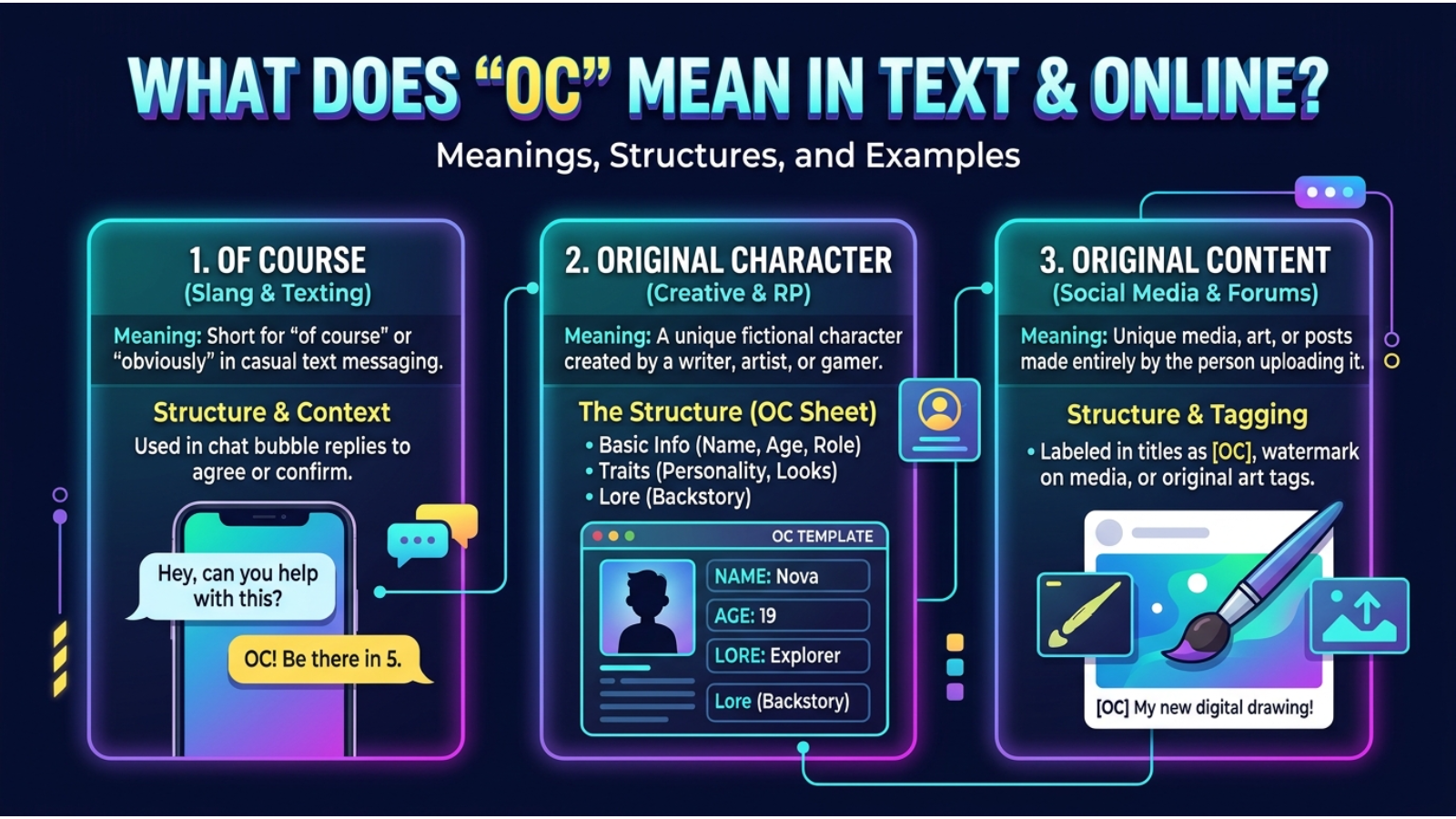
Here are three common meanings:
- Of Course: Used to agree with someone or confirm a request.
- Original Content: Refers to something created by the person posting it.
- Original Character: Refers to a fictional character created by an artist, writer, or creator.
For example:
Person A: “Can you help me with this?”
Person B: “OC!”
In this example, the sender may intend to say “Of course!”
However, this is not a universal texting definition. The other meanings are also widely recognized in their respective online communities.
OC Full Form and Definition
If you are searching for the OC full form, remember that there is no single definition for every situation.
The three common expansions are:
| OC Full Form | Meaning | Where It Is Used |
|---|---|---|
| Of Course | Agreement or confirmation | Casual texting |
| Original Content | Something created by the poster | Social media |
| Original Character | A fictional character created by someone | Art and storytelling |
The abbreviation may also have specialized meanings in gaming, workplaces, and other communities.
Therefore, always consider the subject of the conversation before choosing a definition.
OC Meaning in Different Contexts
1. OC Meaning as Of Course
In casual conversations, someone may use OC as a short way of saying “of course.”
For example:
Friend: “Will you come to the party?”
You: “OC!”
The intended message is that you are happy to confirm.
However, unlike more established abbreviations such as OFC, OC is less universally recognized as a shortened form of “of course.”
2. OC Meaning as Original Content
On social media, OC commonly stands for Original Content.
It describes something created or produced by the person sharing it rather than copied from another creator.
Examples include:
- An original photograph
- A personally written article
- A handmade artwork
- An original video
- A unique social media post
For example:
“OC: I created this digital artwork myself.”
Here, OC tells readers that the artwork is original.
3. OC Meaning as Original Character
In creative communities, OC means Original Character.
An original character is a fictional person or personality created by an artist, writer, or storyteller.
For example:
“Meet my new OC! I designed this character for my fantasy story.”
The creator is introducing a character they invented.
4. OC in Gaming
In gaming communities, OC may refer to an original character, especially when discussing character designs, role-playing, or fan-created stories.
Its meaning can also depend on the particular game or community.
5. OC in Professional Conversations
In professional settings, OC may have industry-specific meanings. It is not always a texting abbreviation.
For clarity, avoid using unexplained abbreviations in business emails, official documents, or workplace communication.
Is OC Rude, Offensive, or Neutral?
Generally, OC is a neutral abbreviation. None of its common meanings is automatically rude or offensive.
Its tone depends on how someone uses it.
- Friendly: “OC, I can help you!”
- Casual: “That’s my OC.”
- Creative: “I made an OC for my new story.”
- Social media: “Thanks for sharing your OC!”
If someone uses OC to mean “of course,” it can sound friendly and positive. When it means original content or original character, it is simply describing something.
However, using abbreviations without explaining them can confuse people who are unfamiliar with internet slang.
Where Is OC Commonly Used?
You can encounter OC across several online platforms and communities.
Some common places include:
- Instagram posts and comments
- TikTok videos
- Snapchat conversations
- WhatsApp messages
- Facebook groups
- Reddit discussions
- Discord communities
- Online gaming chats
- Digital art communities
The meaning often changes depending on the platform.
For example, OC under an artwork may mean Original Content, while OC in a casual conversation may be intended as Of Course.
Real-Life Conversation Examples
Here are some examples showing how OC can be understood in different situations.
Friendly Example
Friend: “Can you help me prepare for tomorrow?”
You: “OC, no problem!”
Meaning: Of course!
Casual Example
Person A: “Are you coming with us?”
Person B: “OC!”
Meaning: Of course!
Social Media Example
Creator: “Here’s some OC from my latest project.”
Meaning: The creator is sharing original content.
Creative Example
Artist: “I finally finished designing my OC.”
Friend: “The character looks interesting!”
Meaning: The artist has created an original character.
Argumentative Example
Person A: “Did you actually create this picture?”
Person B: “Yes, it’s my OC.”
Meaning: The person is explaining that the content is original.
Emotional and Psychological Meaning of OC
OC does not have one fixed emotional or psychological meaning.
However, its intended meaning can communicate different things:
- Agreement: When used as “of course,” it can show willingness or confirmation.
- Creativity: When used as “original content,” it can highlight personal effort.
- Identity: When used as “original character,” it can reflect someone’s imagination and creative expression.
- Ownership: It can help distinguish personally created work from someone else’s work.
Remember that an abbreviation alone cannot tell you exactly how someone feels. The complete conversation provides better clues.
Origin and Background of OC
OC developed through the wider use of internet abbreviations and online communities.
As digital communication became more popular, people started shortening common expressions to make messages quicker and easier to type.
The meanings of Original Content and Original Character became familiar in online creative communities, where people share artwork, stories, photographs, and other creations.
The use of OC for “of course” is less standardized, and people may use OFC more commonly for that expression.
Today, OC remains a context-dependent abbreviation with several recognized meanings.
OC vs. Similar Texting Abbreviations
Understanding similar abbreviations can help you avoid confusion.
| Slang | Full Form | Meaning |
|---|---|---|
| OC | Of Course | Agreement (in some chats) |
| OFC | Of Course | Confirmation or agreement |
| OMW | On My Way | Someone is travelling |
| TBH | To Be Honest | Giving an honest opinion |
| IMO | In My Opinion | Sharing a personal view |
| FR | For Real | Agreement or emphasis |
| OP | Original Poster | Person who started an online post |
Important: OC and OFC are not equally established as abbreviations for “of course.” OFC is the more widely recognized texting form.
When Should You Use OC?
You can use OC when the meaning is clear to the person receiving your message.
For example:
- When casually confirming something, if your friend understands OC.
- When sharing artwork you created yourself.
- When introducing a fictional character.
- When discussing original videos or photographs.
- When communicating with people familiar with the same online community.
Always consider the conversation before using it.
When Should You Avoid Using OC?
Avoid using OC when its meaning could confuse the reader.
It may be better to avoid unexplained abbreviations in:
- Professional emails
- Job applications
- School assignments
- Official documents
- Formal conversations
- Messages to people unfamiliar with internet slang
Instead, write the complete phrase, such as “of course,” “original content,” or “original character.”
Polite Alternatives to OC
If you want to communicate clearly, you can use these alternatives.
If OC means Of Course:
- Absolutely
- Certainly
- Sure
- Definitely
- No problem
- Without a doubt
If OC means Original Content:
- My original work
- Personally created content
- My own creation
If OC means Original Character:
- My fictional character
- My custom character
- A character I created
These expressions make your meaning easier to understand.
Why Do People Use OC?
People use abbreviations like OC because they make digital communication shorter and more convenient.
Some common reasons include:
- Saving time while typing.
- Keeping messages short.
- Following online communication trends.
- Identifying original creative work.
- Discussing fictional characters.
- Communicating with people in the same online community.
The main benefit is convenience, but the meaning must still be clear.
Impact of Using OC in Communication
Using OC can make conversations quicker, especially when everyone understands the abbreviation.
However, using it without considering the audience can create misunderstandings.
For example, someone who sees OC in a casual message may think it means “of course,” while someone in an art community may understand it as “original character.”
Clear communication is always more important than using trendy abbreviations.
Is OC Safe for Social Media?
Yes, OC is generally safe to use on social media.
It is not inherently offensive or inappropriate. However, you should understand its meaning before using it.
For example:
- Use OC when identifying your original artwork.
- Use OC when introducing a fictional character.
- Use OFC if you want to clearly say “of course.”
- Avoid unexplained abbreviations in professional posts.
Using the correct meaning helps your audience understand your message.
Common Misunderstandings About OC
People sometimes misunderstand OC because it has several meanings.
Here are some common mistakes:
1. Thinking OC always means Of Course: This is not correct because OC also commonly means Original Content and Original Character.
2. Confusing OC with OFC: OFC is the more established abbreviation for “of course.”
3. Assuming OC is offensive: Its common meanings are generally neutral.
4. Ignoring the topic: A conversation about artwork will likely use OC differently from a conversation between friends.
Variations and Types of OC
OC can appear in different forms depending on the platform and writing style.
- OC: Standard uppercase abbreviation.
- oc: Lowercase informal version.
- My OC: Usually refers to an original character or creation.
- OC art: Artwork featuring an original character.
- OC content: Content created by the person sharing it.
Capitalization usually does not change the intended meaning. The surrounding words are more important.
How to Respond When Someone Uses OC
Your response should depend on what the sender means.
If OC means Of Course:
Them: “Can you join us?”
You: “Thanks! See you soon.”
If OC means Original Content:
Them: “This is my OC.”
You: “That’s great! Did you create it yourself?”
If OC means Original Character:
Them: “Meet my new OC.”
You: “Nice! What’s the character’s story?”
If you are confused, simply ask:
“What do you mean by OC?”
Regional and Cultural Usage
Internet slang can vary between countries, age groups, and online communities.
In English-speaking social media communities, OC is widely recognized for Original Content and Original Character. Its use as “of course” is less consistent.
People in Pakistan, India, the United States, the United Kingdom, and other countries may encounter these abbreviations through social media and international online conversations.
However, not everyone uses them in the same way. Always consider the context.
FAQs About OC Meaning in Text
1. What does OC mean in texting?
OC can mean “of course” in some casual chats. It can also mean Original Content or Original Character, depending on the conversation.
2. What is the full form of OC?
Common full forms include Of Course, Original Content, and Original Character. The correct meaning depends on the context.
3. Does OC mean Original Content?
Yes. On social media, OC commonly stands for Original Content, meaning something created by the person sharing it.
4. Does OC mean Original Character?
Yes. In art, gaming, and storytelling communities, OC commonly means Original Character, a fictional character created by someone.
5. Is OC the same as OFC?
Not exactly. OFC is the more widely recognized texting abbreviation for “of course.” OC has several other common meanings.
6. Is OC rude or inappropriate?
No. OC is generally neutral. Its common meanings are not inherently offensive, although the context determines its tone.
Conclusion
The oc meaning in text depends on the situation in which it appears. In casual texting, it may mean “of course,” while on social media it commonly stands for “original content.” In creative communities, it often means “original character.”
Understanding the complete conversation is the best way to identify the correct definition. If someone uses OC and you are unsure what they mean, ask for clarification instead of making assumptions.
Use familiar alternatives such as “absolutely,” “sure,” or “of course” when you want to make your message clearer. Remember, internet slang makes communication shorter, but understanding the context makes communication better.

Sara Taylor is a passionate English content writer who specializes in word meanings, spelling comparisons, and modern slang explanations. She creates easy-to-understand articles that help readers avoid common English mistakes and improve their writing skills. Her content focuses on simple learning, real-life examples, and clear explanations for everyday readers.