Have you ever typed a message, school assignment, or social media post and stopped to wonder whether it should be “opened” or “openned”? You are not alone. Many English learners and even native speakers get confused about this spelling.
This confusion usually happens because some English words double the last letter before adding “-ed.” For example, “stop” becomes “stopped.” So people often think “open” should become “openned.” But English spelling rules can be tricky.
You may see this question in school homework, workplace emails, online chats, grammar quizzes, and Google searches. Students often search it while writing essays, and professionals may double-check the spelling before sending important documents.
Understanding the correct spelling matters because spelling mistakes can make writing look less professional. Using the right word also helps improve your grammar and communication skills.
In this guide, you’ll learn the meaning, examples, usage, differences, common mistakes, and simple explanations in easy English.
Opened or Openned – Quick Answer
👉 Opened is the correct spelling.
👉 Openned is incorrect and not used in standard English.
The word “opened” is the past tense of “open.”
Examples
✅ I opened the door.
✅ She opened her book in class.
✅ They opened a new shop yesterday.
❌ I openned the window.
❌ He openned the email.
Simple Rule
👉 If a verb ends with two vowel sounds before the final consonant, you usually do not double the last letter.
“Open” becomes:
- Open + ed = Opened ✅
- Not openned ❌
The Origin of Opened or Openned
The word “open” comes from Old English. It has been used for hundreds of years to describe something that is not closed.
Over time, English grammar created rules for changing verbs into past tense forms. Most regular verbs simply add “-ed.”
Examples:
- Walk → Walked
- Jump → Jumped
- Open → Opened
The spelling “openned” became common mainly because learners tried to apply other spelling rules incorrectly. Online typing mistakes and autocorrect errors also helped spread the confusion.
Today, dictionaries and grammar experts accept only “opened” as correct.
British English vs American English Usage
There is no spelling difference between British and American English for this word.
| Feature | British English | American English | Notes |
|---|---|---|---|
| Correct spelling | Opened | Opened | Same worldwide |
| Incorrect spelling | Openned | Openned | Incorrect everywhere |
| Pronunciation | Similar | Similar | Very small accent differences |
👉 Both the UK and the US use “opened.”
Which One Should You Use?
You should always use opened.
Best situations for using “opened”
- ✅ School assignments
- ✅ Workplace emails
- ✅ Text messages
- ✅ Social media captions
- ✅ Business writing
- ✅ Academic writing
- ✅ Daily conversations
Avoid using “openned”
- ❌ It is considered a spelling mistake
- ❌ It may look unprofessional
- ❌ Grammar tools usually mark it as wrong
Formal vs Informal Usage
| Situation | Correct Choice |
|---|---|
| Formal writing | Opened |
| Informal texting | Opened |
| Academic work | Opened |
| Business emails | Opened |
Common Mistakes With Opened or Openned
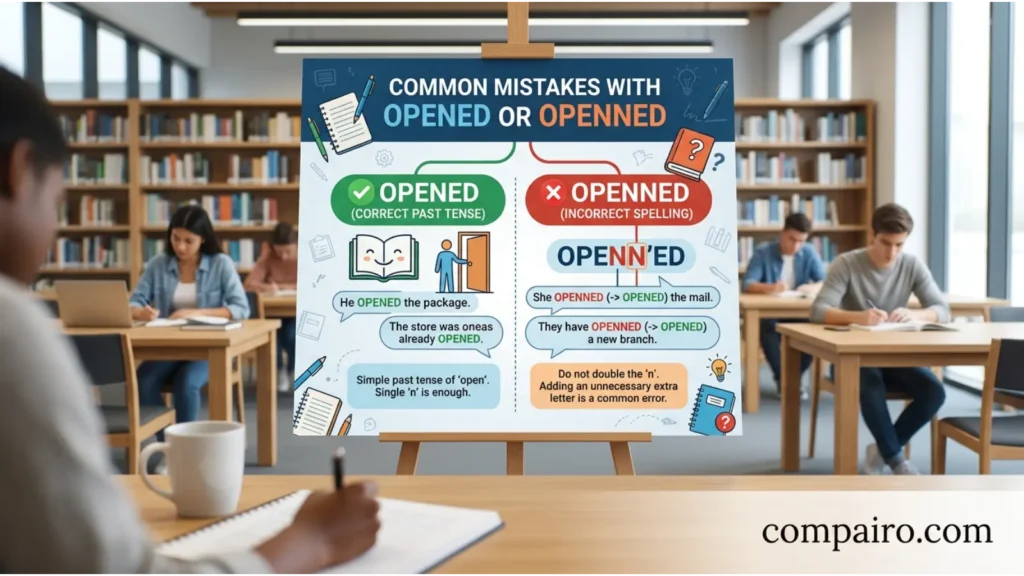
Mistake 1
❌ She openned the package.
✔ The correct spelling is “opened.”
✅ She opened the package.
Mistake 2
❌ We openned the app yesterday.
✔ “Open” does not double the “n.”
✅ We opened the app yesterday.
Mistake 3
❌ He has openned the file already.
✔ Use “opened” for past tense and past participle.
✅ He has opened the file already.
Mistake 4
❌ Why is openned wrong?
✔ Because English spelling rules do not require doubling the “n” in “open.”
✅ “Opened” follows the correct grammar rule.
Opened or Openned in Everyday Examples
Work
✅ I opened the meeting link.
✅ The manager opened the office early.
School
✅ The teacher opened the lesson with a quiz.
✅ Sarah opened her notebook quickly.
Social Media
✅ He opened my message but did not reply.
✅ She opened a new Instagram account.
Daily Life
✅ Dad opened the front gate.
✅ I opened the fridge for water.
Text Messages
✅ “Did you open the email?”
✅ “Yes, I opened it this morning.”
Opened or Openned – Google Trends & Usage Data

Many people search “opened or openned” because English spelling rules can feel confusing.
Words like:
- stopped
- planned
- grabbed
double the final letter before adding “-ed.” Because of this, learners think “open” should follow the same pattern.
Countries where people often search this keyword
- United States
- United Kingdom
- India
- Pakistan
- Canada
- Australia
Why the keyword is popular
- Students learning grammar
- ESL learners
- Typing mistakes
- School homework
- Writing correction tools
- Online grammar searches
Social media and texting also increase spelling confusion because people type quickly and do not always check grammar.
Comparison Table: Opened vs Openned
| Feature | Opened | Openned |
|---|---|---|
| Correct spelling | ✅ Yes | ❌ No |
| Dictionary accepted | ✅ Yes | ❌ No |
| Used in formal writing | ✅ Yes | ❌ No |
| Used in school writing | ✅ Yes | ❌ No |
| Grammar approved | ✅ Yes | ❌ No |
| Common typing mistake | ❌ No | ✅ Yes |
Opened or Openned in Professional Life
Correct spelling is important in professional communication.
Imagine sending an email that says:
❌ “I openned the document.”
This may look careless to employers or clients.
Using correct spelling helps you:
- Look professional
- Communicate clearly
- Improve writing confidence
- Avoid misunderstandings
Professionals use “opened” in:
- Emails
- Reports
- Business chats
- Customer support
- Presentations
Opened or Openned for Students or Beginners
Many beginners struggle with this word because English spelling rules are not always simple.
Common confusion
Students often compare:
- Open → Opened
- Stop → Stopped
They wonder why one doubles the last letter and the other does not.
Easy learning tips
- Learn common verb patterns
- Practice writing simple sentences
- Use grammar tools
- Read English books and articles
- Remember that “open” keeps one “n”
Helpful tip
👉 If the stress is not strongly on the last syllable, the final consonant usually does not double.
“Open” has stress on the first syllable:
O-pen
So it becomes:
Opened ✅
Signs or Characteristics Related to Opened or Openned
Characteristics of Correct Usage (“Opened”)
- Used in dictionaries
- Accepted worldwide
- Grammatically correct
- Common in books and media
- Used by teachers and professionals
Characteristics of Incorrect Usage (“Openned”)
- Spelling mistake
- Not accepted in grammar rules
- Often typed by beginners
- Marked wrong by spell checkers
- Rare in professional writing
Simple Trick to Remember Opened or Openned
👉 “Open” only needs one “n.”
Think of it this way:
- Open the door → Opened ✅
- No extra “n” needed
Easy Memory Phrase
👉 “One door, one N.”
If the word is “open,” keep only one “n” before adding “-ed.”
FAQS:
1. Is “openned” a real English word?
No. “Openned” is not correct English spelling.
2. What is the correct past tense of “open”?
The correct past tense is “opened.”
3. Why do people write “openned”?
People confuse it with words that double the final letter, like “stopped.”
4. Is “opened” used in British English?
Yes. Both British and American English use “opened.”
5. Can I use “openned” in school writing?
No. Teachers will usually mark it as incorrect.
6. How can I remember the correct spelling?
Remember this simple rule:
👉 “Open” keeps one “n.”
7. Is “opened” formal or informal?
It works in both formal and informal writing.
Conclusion
The correct spelling is always opened, not “openned.” While many people get confused because of English spelling rules, “open” simply adds “-ed” without doubling the “n.”
Using the correct spelling helps your writing look clearer and more professional in school, work, texting, and daily communication.
Here’s the easiest rule to remember:
👉 “Open” has one “n,” so “opened” also has one “n.”
Once you remember that simple trick, you will never confuse “opened or openned” again.

Sara Taylor is a passionate English content writer who specializes in word meanings, spelling comparisons, and modern slang explanations. She creates easy-to-understand articles that help readers avoid common English mistakes and improve their writing skills. Her content focuses on simple learning, real-life examples, and clear explanations for everyday readers.