Have you ever seen the words upon and apon and wondered which one is correct? This is a common question for students, writers, and people learning English. You might see these words while reading books, writing emails, doing school assignments, or searching online.
Many people accidentally type apon instead of upon because the words sound similar. Others may think both spellings are accepted in English. This confusion often leads to spelling mistakes in essays, workplace documents, social media posts, and everyday conversations.
Understanding the difference is important because using the correct spelling helps your writing look professional and clear. Whether you are a student, a job seeker, a content writer, or simply improving your English, knowing the correct form can help you avoid common errors.
The good news is that the answer is very simple. One spelling is correct in standard English, while the other is usually considered a mistake.
In this guide, you’ll learn the meaning, examples, usage, differences, common mistakes, and simple explanations in easy English.
Upon or Apon – Quick Answer
👉 Upon is the correct English word.
👉 Apon is generally an incorrect spelling of upon in modern English.
Meaning of Upon
Upon means:
- On
- On top of
- Immediately after
- Based on something
Examples
1 The book is upon the table.
2 Upon arriving home, she called her friend.
3 Success depends upon hard work.
Simple Rule
👉 If you mean on, after, or based on, use upon.
👉 Remember: “Upon” is correct; “apon” is usually a spelling mistake.
The Origin of Upon or Apon
The word upon comes from Old English. It developed from combining words that meant “up” and “on.”
For hundreds of years, upon has been used in books, literature, legal writing, and everyday English.
The spelling apon occasionally appeared in some old regional writings or as a misspelling, but it never became the standard form of the word.
Today, dictionaries, schools, publishers, and grammar guides recognize upon as the correct spelling.
British English vs American English Usage
There is no major difference between British English and American English for this word.
Both countries use upon and consider apon incorrect.
| Feature | British English | American English | Notes |
|---|---|---|---|
| Correct spelling | Upon | Upon | Same worldwide |
| Use in writing | Common | Common | Accepted everywhere |
| Formal usage | Yes | Yes | Used in formal writing |
| Apon accepted? | No | No | Usually a spelling error |
Which One Should You Use?
You should always use upon in standard English.
Best situations for using “upon”
- Academic writing
- School assignments
- Workplace documents
- Business emails
- Formal speeches
- Books and articles
Formal vs Informal
Formal:
✅ Upon receiving your application, we will contact you.
Informal:
✅ Upon seeing the movie, I texted my friend.
Although upon sounds slightly more formal than on, both are correct in many situations.
Common Mistakes With Upon or Apon
Mistake 1
❌ I placed the keys apon the desk.
✔ The correct spelling is upon.
✅ I placed the keys upon the desk.
Mistake 2
❌ Apon arrival, please sign in.
✔ Use upon arrival.
✅ Upon arrival, please sign in.
Mistake 3
❌ The decision depends apon the results.
✔ The standard phrase is depends upon.
✅ The decision depends upon the results.
Mistake 4
❌ Apon hearing the news, she smiled.
✔ Replace apon with upon.
✅ Upon hearing the news, she smiled.
Upon or Apon in Everyday Examples

Work
✅ Upon completion of the project, the team celebrated.
✅ The bonus depends upon performance.
School
✅ Upon finishing the test, students left the classroom.
✅ Upon reading the chapter, answer the questions.
Social Media
✅ Upon seeing the post, thousands of users shared it.
✅ Upon opening the app, I saw the notification.
Daily Life
✅ Upon waking up, I drank water.
✅ The cat jumped upon the chair.
Text Messages
✅ Upon reaching home, text me.
✅ Upon checking my phone, I saw your message.
Upon or Apon – Google Trends & Usage Data
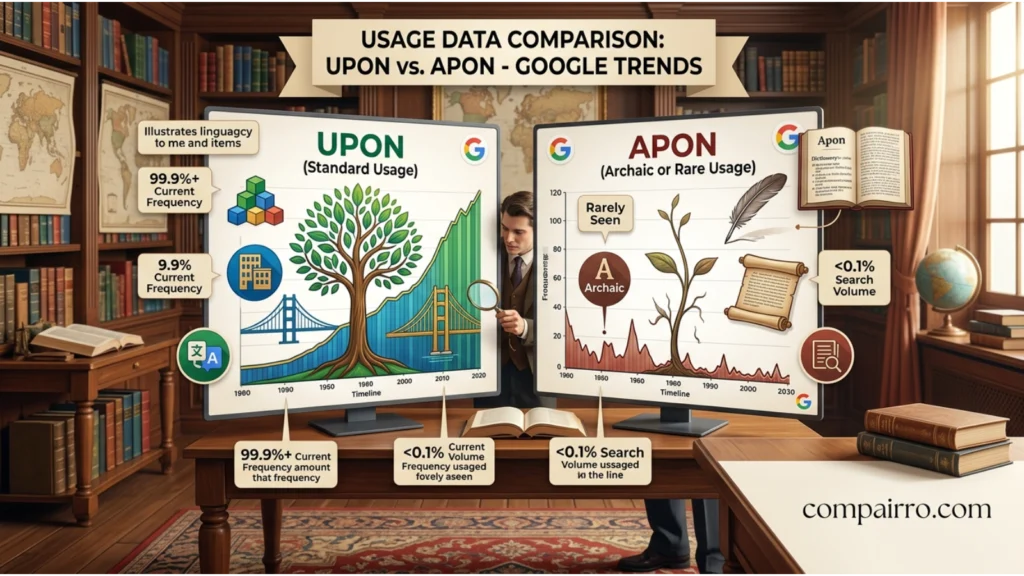
Many people search for upon or apon because they are unsure about the correct spelling.
Common search queries include:
- Is apon a word?
- Upon meaning
- Upon vs apon
- How to use upon
- Upon in a sentence
Popular Countries Searching This Topic
People often search this topic in:
- United States
- United Kingdom
- India
- Pakistan
- Canada
- Australia
Why the Confusion Happens
- Similar pronunciation
- Typing mistakes
- English learners checking spellings
- Autocorrect errors
- Social media usage
Because English spelling can be confusing, many users search online to confirm whether apon is correct.
Comparison Table: Upon or Apon
| Feature | Upon | Apon |
|---|---|---|
| Correct English spelling | Yes | No |
| Found in dictionaries | Yes | Usually No |
| Used in schools | Yes | No |
| Accepted in professional writing | Yes | No |
| Common online searches | Very common | Often searched as a mistake |
| Recommended usage | Always | Avoid |
Upon or Apon in Professional Life
In professional settings, correct spelling matters.
Using upon correctly helps make your writing look polished and trustworthy.
Examples:
✅ Upon review of your application, we will respond soon.
✅ Payment will be processed upon approval.
Using apon in workplace communication may create a negative impression because it appears as a spelling error.
Upon or Apon for Students or Beginners
Many students struggle with this word because English pronunciation does not always match spelling.
Common Confusion
- Thinking apon and upon are both correct
- Hearing the word and guessing the spelling
- Typing quickly without checking
Easy Learning Tips
- Read books and articles regularly.
- Use spell-check tools.
- Practice writing sentences with upon.
- Remember that dictionaries use upon, not apon.
Signs or Characteristics Related to Upon
Features of the Word “Upon”
- Correct English spelling
- Used in formal and informal writing
- Means on, after, or based on
- Common in books and documents
- Recognized worldwide
Common Uses
- Upon arrival
- Upon request
- Upon completion
- Depends upon
- Upon hearing the news
Learning Patterns
- Often confused with apon
- Frequently searched by students
- Appears in grammar lessons
- Common in professional communication
Simple Trick to Remember Upon or Apon
👉 Upon = Correct
👉 Apon = Incorrect
Think of it this way:
The word upon contains the word on.
UP + ON = UPON
Examples:
- Upon arrival = After arrival
- Upon request = When requested
- Upon success = After success
If you remember “on”, you can easily remember “upon.”
FAQs:
1. Is apon a real English word?
No. In modern standard English, apon is generally considered a spelling mistake.
2. Which is correct, upon or apon?
Upon is the correct spelling.
3. What does upon mean?
It can mean on, after, or based on, depending on the sentence.
4. Is upon formal English?
Yes. It is often used in formal writing, but it also appears in everyday English.
5. Can I use on instead of upon?
In many situations, yes. However, upon may sound more formal.
6. Why do people write apon?
Usually because of pronunciation confusion or typing errors.
7. Is upon used in business writing?
Yes. It is commonly used in emails, contracts, reports, and official documents.
Conclusion
The difference between upon or apon is simple. Upon is the correct and accepted English spelling, while apon is generally a spelling mistake. Whether you are writing for school, work, social media, or daily communication, using upon will help keep your writing accurate and professional.
The easiest rule to remember is:
👉 Upon = Correct English
👉 Apon = Incorrect spelling
Keep this simple tip in mind, and you will never confuse these words again.

Sara Taylor is a passionate English content writer who specializes in word meanings, spelling comparisons, and modern slang explanations. She creates easy-to-understand articles that help readers avoid common English mistakes and improve their writing skills. Her content focuses on simple learning, real-life examples, and clear explanations for everyday readers.