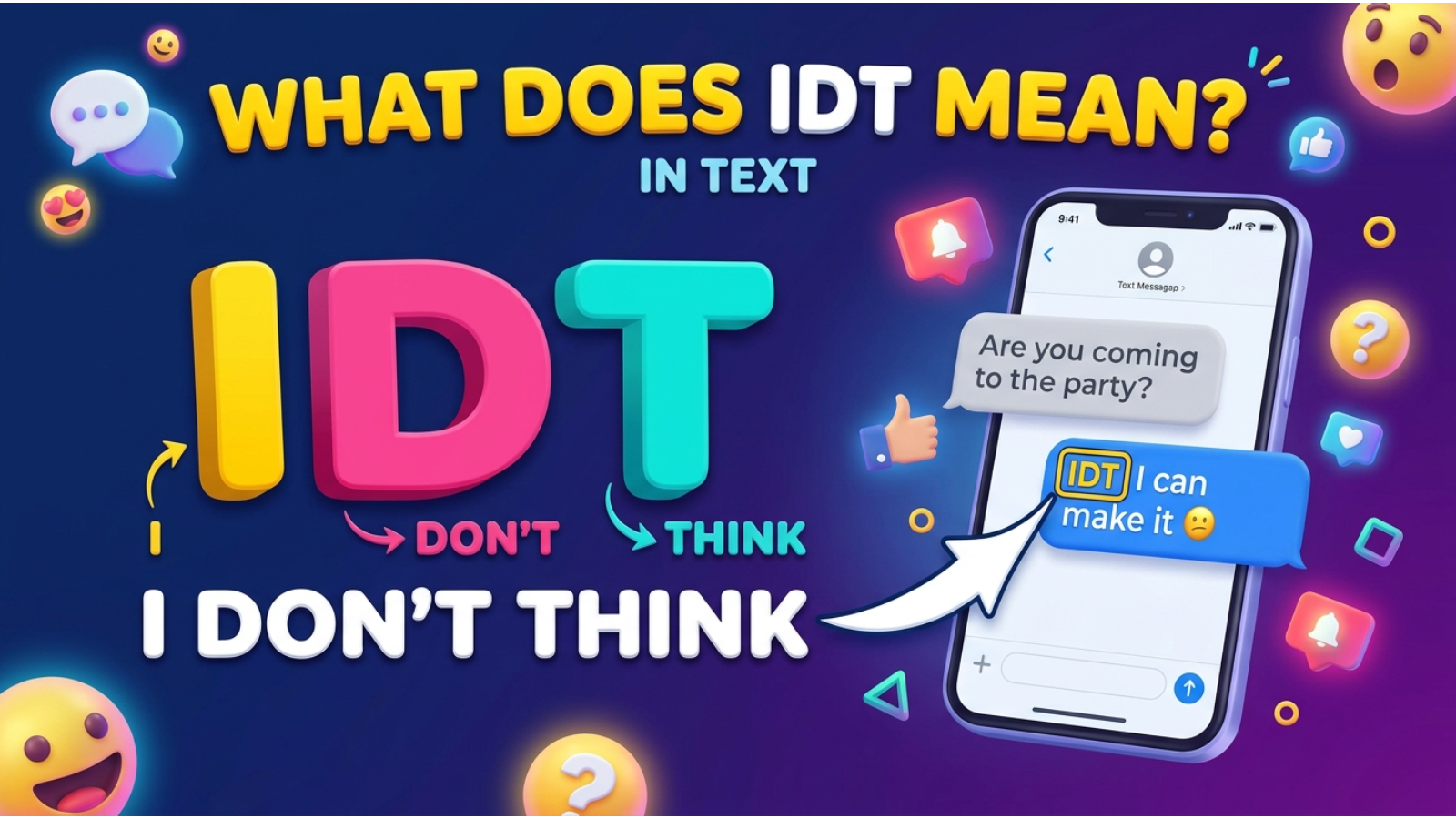
idt meaning in text is something people often search for when they receive this abbreviation in a text message or social media conversation. You might see someone write “IDT,” “IDT that’s true,” or “IDT we should go” and wonder what they are trying to say. Internet slang makes conversations faster, but unfamiliar abbreviations can sometimes create confusion.
In texting, IDT commonly stands for “I don’t think.” People use it to express doubt, share an opinion, or politely disagree with someone. However, its exact meaning can depend on the sentence and conversation. It is especially common in informal digital communication, where people prefer short expressions instead of typing complete sentences.
Quick Answer:
IDT usually means “I don’t think” in texting. It is used to express an opinion, uncertainty, or disagreement in casual conversations.
What Does IDT Mean in Text?
The most common meaning of IDT in texting is “I don’t think.” It is a short abbreviation people use when they want to share an opinion or express doubt about something.
For example:
Person A: “Will it rain tomorrow?”
Person B: “IDT.”
Here, IDT means “I don’t think so.” The person believes rain is unlikely.
Another example:
Friend: “Do you think this movie is worth watching?”
You: “IDT it’s that good.”
In this message, the sender is expressing a personal opinion about the movie.
IDT helps people communicate quickly without typing the entire phrase. However, readers should always consider the surrounding words to understand the intended meaning.
IDT Full Form and Definition
The common IDT full form in texting is “I Don’t Think.”
It can communicate different ideas depending on the situation, including:
- Doubt about something
- A personal opinion
- Uncertainty about an event
- Disagreement with an idea
- A belief that something is unlikely
For example, if someone asks, “Will he come today?” and you reply “IDT,” you are saying that you do not think he will come.
In some situations, people write “IDT so” as a shortened version of “I don’t think so.”
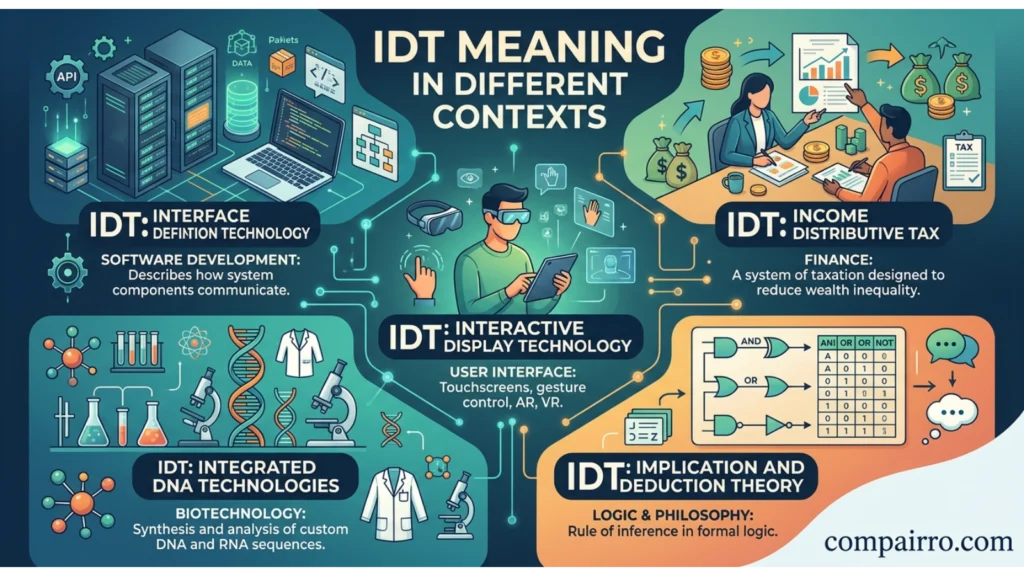
IDT Meaning in Different Contexts
IDT can be understood in several ways depending on the conversation.
1. IDT in Text Messages
In everyday texting, IDT is commonly used to express a thought or opinion.
Example:
“IDT we have enough time to finish this.”
Meaning: “I don’t think we have enough time to finish this.”
2. IDT on Instagram and Snapchat
People may use IDT in direct messages, stories, and comments when sharing quick opinions.
Example:
Friend: “Should I buy this jacket?”
You: “IDT you need another one 😂”
Here, the sender is casually suggesting that another jacket may not be necessary.
3. IDT in WhatsApp Conversations
On WhatsApp, IDT can make conversations shorter and more natural.
Example:
Person A: “Are you coming to the party?”
Person B: “IDT, I have some work.”
The sender means they do not think they will attend.
4. IDT in Professional Conversations
IDT is generally better suited to informal messages than professional communication.
In business emails or formal discussions, writing the complete phrase sounds clearer.
Instead of:
“IDT this plan will work.”
Write:
“I don’t think this plan will work.”
Is IDT Rude, Offensive, or Neutral?
IDT is generally a neutral texting abbreviation. It does not contain offensive language or profanity.
However, its tone can change depending on the message.
- Friendly: Sharing an opinion with a friend.
- Neutral: Expressing uncertainty about a situation.
- Disagreeing: Politely showing that you have a different opinion.
- Serious: Explaining why you believe something may not happen.
For example:
“IDT that’s a good idea.”
This may sound like a simple disagreement, but it is not automatically rude.
If you want to sound more polite, you can add a few words to explain your opinion.
Where Is IDT Commonly Used?
IDT is mainly used in informal digital communication.
You may see it on:
- WhatsApp messages
- Instagram DMs
- Snapchat chats
- TikTok comments
- Facebook Messenger
- Discord conversations
- Online gaming chats
- SMS text messages
It is particularly useful when people want to share their thoughts quickly.

Real-Life Conversation Examples of IDT
Here are some simple examples showing how people use IDT in different situations.
1. Friendly Conversation
Alex: “Do you think we should go shopping today?”
Sam: “IDT, the weather looks bad.”
Meaning: Sam does not think shopping is a good idea today.
2. Casual Conversation
Friend: “Is this restaurant expensive?”
You: “IDT, the prices look reasonable.”
Meaning: You do not think the restaurant is expensive.
3. Serious Conversation
Person A: “Do you think he will complete the project on time?”
Person B: “IDT so. There is still a lot of work left.”
Meaning: The person doubts that the project will be completed on time.
4. Argumentative Conversation
Person A: “This is definitely the best solution.”
Person B: “IDT that’s the right approach.”
Meaning: The second person disagrees with the suggestion.
5. Social Media Conversation
Friend: “Do you think this trend will become popular?”
You: “IDT, but let’s see.”
Meaning: You are not sure the trend will become popular.
Emotional and Psychological Meaning of IDT
IDT does not represent one particular emotion. Instead, it helps people communicate their thoughts, doubts, and opinions.
Depending on the situation, it may express:
- Uncertainty: The sender is not completely sure.
- Disagreement: The sender has a different opinion.
- Caution: The sender does not want to make a definite prediction.
- Honesty: The sender is sharing what they genuinely think.
- Politeness: The sender may be using a softer way to disagree.
Remember that an abbreviation alone cannot tell you exactly how someone feels. The full message and conversation provide better clues.
Origin and Background of IDT
IDT developed as part of the broader culture of internet abbreviations and text messaging.
As mobile phones and online messaging became more popular, people started shortening common phrases to save time and typing effort.
Expressions such as LOL, BRB, IDK, TBH, and IDT became part of informal digital communication.
There is no single confirmed inventor of IDT. Like many texting abbreviations, it spread through everyday online conversations rather than being created by one specific person.
IDT vs. Similar Texting Abbreviations
IDT is sometimes confused with other short forms because they are used in similar conversations.
| Abbreviation | Full Form | Meaning |
|---|---|---|
| IDT | I Don’t Think | Expressing doubt or an opinion |
| IDK | I Don’t Know | Showing lack of knowledge |
| IMO | In My Opinion | Sharing a personal opinion |
| TBH | To Be Honest | Giving an honest thought |
| IDC | I Don’t Care | Showing a lack of concern |
| FR | For Real | Expressing agreement or emphasis |
| WDYT | What Do You Think? | Asking for someone’s opinion |
Although these abbreviations are related to everyday communication, they do not mean the same thing.
For example, IDK means you do not know something, while IDT means you do not think something is true or likely.

When Should You Use IDT?
IDT is suitable for informal conversations where the other person understands texting slang.
You can use it when:
- Sharing your opinion with friends.
- Expressing doubt about a plan.
- Discussing movies, games, or activities.
- Responding to casual questions.
- Politely disagreeing with someone’s suggestion.
Example:
“IDT we should leave this early.”
This is a short and natural way to express your opinion in a casual chat.
When Should You Avoid Using IDT?
Although IDT is easy to understand for many internet users, it is not suitable for every situation.
Avoid using it in:
- Formal business emails
- Job applications
- Academic assignments
- Official documents
- Professional meetings
- Important messages where clarity matters
In these situations, writing the complete phrase is more appropriate.
Polite Alternatives to IDT
If you want to express the same idea in clearer or more professional language, try these alternatives:
- I don’t think so.
- I am not sure about that.
- I don’t believe that’s correct.
- I have a different opinion.
- That might not be the best option.
- I don’t think that will work.
- I am not convinced.
These phrases help you communicate your thoughts without relying on abbreviations.
Why Do People Use IDT?
People use IDT because it makes online conversations quicker and easier.
Some common reasons include:
- Saving time while typing.
- Keeping messages short.
- Sharing opinions quickly.
- Expressing uncertainty.
- Making casual conversations feel natural.
- Following common internet communication styles.
For regular texters, abbreviations can become a natural part of everyday messaging.
Impact of Using IDT in Communication
Using IDT can make casual communication faster. It also allows people to express their opinions without writing long sentences.
However, abbreviations can sometimes confuse people who are unfamiliar with internet slang.
For example, someone who does not know IDT may misunderstand the message or ask for clarification.
Therefore, using complete sentences is often better when communicating with new people or discussing important matters.
Is IDT Safe for Social Media?
Yes, IDT is generally safe for social media because it does not contain offensive or harmful language.
You can use it in casual conversations, comments, and private messages.
However, keep your audience in mind. If you are communicating with a professional audience or writing an important public post, complete words are usually clearer.
Common Misunderstandings About IDT
Some people confuse IDT with IDK because both begin with the words “I don’t.”
However, their meanings are different.
- IDT: I don’t think.
- IDK: I don’t know.
Another common mistake is assuming that IDT always means disagreement. It can also express uncertainty or a simple personal opinion.
The sentence surrounding the abbreviation is the best way to understand its meaning.
Variations and Types of IDT
IDT may appear in different forms during online conversations.
| Variation | Intended Meaning |
|---|---|
| IDT | I don’t think |
| IDT so | I don’t think so |
| IDT that’s true | I don’t think that’s true |
| IDT it will happen | I don’t think it will happen |
These are informal texting forms. Their exact wording and use can vary between individuals.
How to Respond When Someone Uses IDT
Your response depends on what the other person is discussing.
Here are some simple replies:
If they disagree:
- “That’s okay.”
- “I understand your point.”
- “Why do you think so?”
When they express doubt:
- “Maybe you’re right.”
- “Let’s see what happens.”
- “I hope it works out.”
If you don’t understand:
- “What do you mean by IDT?”
- “Can you explain that?”
A simple clarification can prevent unnecessary misunderstandings.
Regional and Cultural Usage
IDT is mainly associated with informal English-language texting. Its meaning is generally understood by people familiar with online abbreviations.
However, texting habits can differ between countries, age groups, and online communities.
In Pakistan, India, the United States, the United Kingdom, and other English-speaking online communities, people may use abbreviations such as IDK, TBH, and IDT in casual conversations.
Not everyone uses the same slang, so it is always helpful to consider the person’s communication style.
FAQs About IDT Meaning in Text
1. What does IDT mean in texting?
IDT commonly means “I don’t think.” People use it to express doubt, uncertainty, or a personal opinion.
2. What is the full form of IDT?
The common texting full form of IDT is I Don’t Think. Its exact interpretation depends on the sentence.
3. What does IDT mean from a girl?
If a girl sends IDT in a casual conversation, she usually means “I don’t think.” It does not automatically indicate a romantic interest or a particular emotion.
4. Is IDT the same as IDK?
No. IDT means “I don’t think,” while IDK means “I don’t know.” They are different abbreviations.
5. Is IDT rude or offensive?
No, IDT is generally neutral and not offensive. However, the complete sentence can affect how the message sounds.
6. How do you reply to IDT?
You can respond with “Why do you think so?”, “That’s okay,” or “I understand.” Your reply should match the conversation.
Conclusion
The idt meaning in text is commonly “I don’t think.” It is a popular type of informal abbreviation used to express doubt, uncertainty, opinions, or disagreement in digital conversations.
You may see IDT in WhatsApp messages, Instagram DMs, Snapchat, TikTok comments, and other online chats. It is generally neutral and suitable for casual communication.
Remember that IDT and IDK have different meanings, so do not confuse them. If you want to communicate professionally, use the complete phrase instead of the abbreviation.
Ultimately, understanding the IDT meaning slang is simple when you pay attention to the sentence, conversation, and tone. Context always helps you understand what someone is trying to say.

Sara Taylor is a passionate English content writer who specializes in word meanings, spelling comparisons, and modern slang explanations. She creates easy-to-understand articles that help readers avoid common English mistakes and improve their writing skills. Her content focuses on simple learning, real-life examples, and clear explanations for everyday readers.