CHCl3 Polar or Nonpolar is a common chemistry question among students learning about molecular polarity, chemical bonds, and molecular geometry. CHCl3, also known as chloroform, contains one carbon atom, one hydrogen atom, and three chlorine atoms. Its molecular structure may look balanced at first, but its bond arrangement makes a significant difference in polarity.
One molecule that often confuses students is CHCl3. Its chemical name is chloroform, and it contains carbon, hydrogen, and chlorine atoms. When students first look at its chemical formula, they may think it is nonpolar because its shape is similar to other molecules with four bonds around a central carbon atom.
However, the answer depends on how the atoms are arranged and how electrons are shared between them. The different atoms in CHCl3 do not pull electrons with equal strength. This creates an uneven distribution of electrical charge.
Understanding whether CHCl3 is polar or nonpolar is important for chemistry homework, school exams, laboratory studies, and molecular structure lessons. It also helps students understand how molecular geometry affects polarity.
In this guide, you will learn the polarity of CHCl3, its molecular shape, bond differences, common mistakes, and simple examples. You will also discover an easy way to remember why this molecule is polar.
CHCl3 Polar or Nonpolar – Quick Answer
Correct answer: Polar
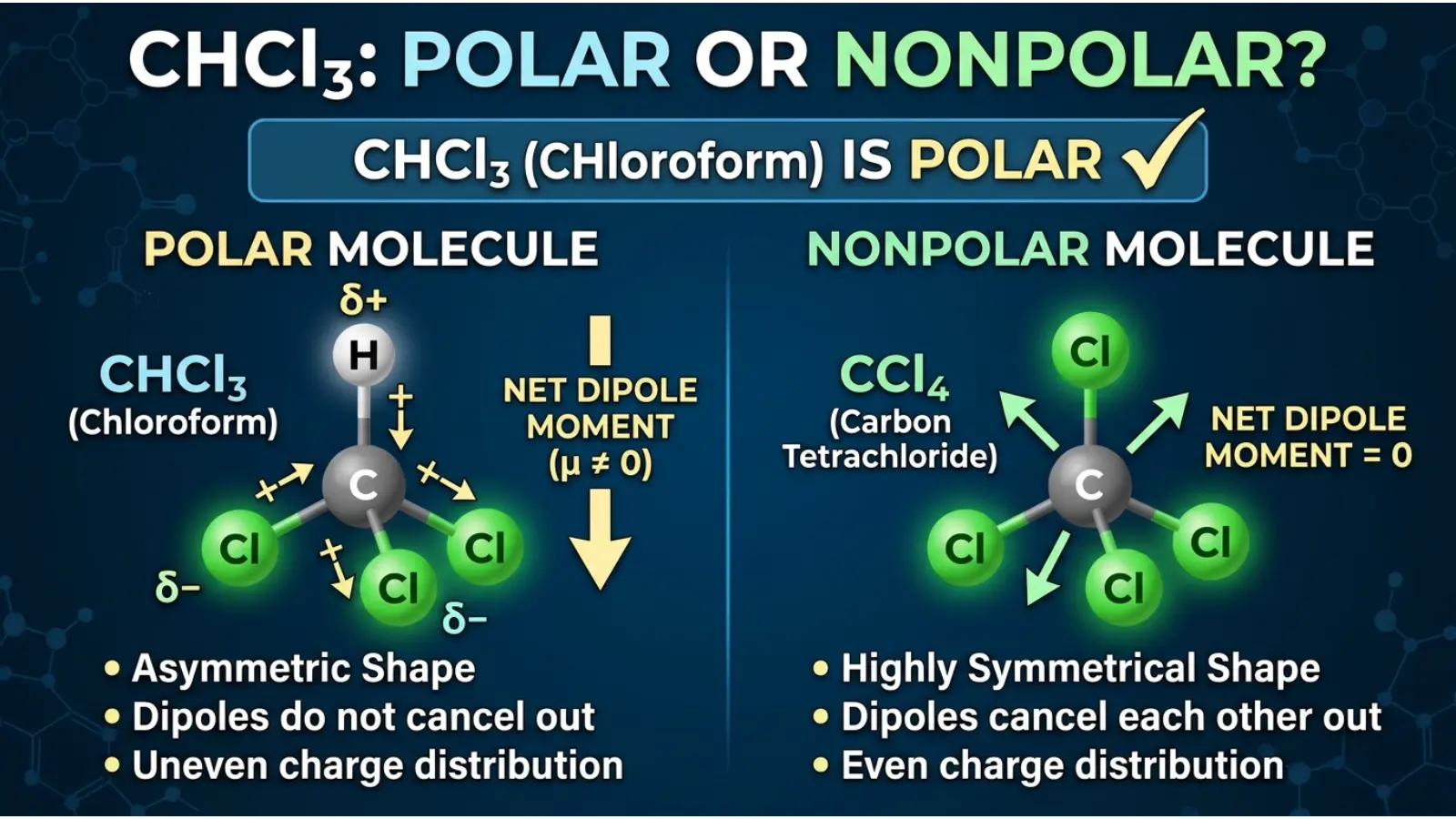
CHCl3 is a polar molecule. Its chemical name is chloroform. It has a tetrahedral molecular shape, but its atoms are not arranged symmetrically enough to cancel all the bond dipoles.
The chlorine atoms attract shared electrons more strongly than carbon and hydrogen. As a result, the molecule has an uneven distribution of electrical charge.
Simple explanation:
- CHCl3 = Polar molecule.
- Chemical name = Chloroform.
- Molecular shape = Tetrahedral.
- Bond arrangement = Three C–Cl bonds and one C–H bond.
- Net dipole moment = Approximately 1.0 D.
Examples:
- CHCl3 is polar because its bond dipoles do not cancel completely.
- CH4 is nonpolar because its bond dipoles cancel due to its symmetrical structure.
- CHCl3 has a net dipole moment, which shows that it is polar.
Simple rule:
If a molecule has an uneven charge distribution and a net dipole moment, it is polar.
The Origin of CHCl3
CHCl3 is the chemical formula for chloroform. It is an organic chemical compound made from carbon, hydrogen, and chlorine.
Chloroform was first prepared in the 19th century. It became well known because of its past use in medicine as an anesthetic.
Today, chloroform is mainly discussed in chemistry, scientific research, and industrial studies. Its molecular structure makes it a useful example when learning about polarity.
The formula CHCl3 tells us that one molecule contains:
- One carbon atom.
- One hydrogen atom.
- Three chlorine atoms.
These atoms form a tetrahedral arrangement around the central carbon atom.
British English vs American English Usage
There is no difference between British and American English when discussing CHCl3 polarity.
Both use the same chemical formula, scientific name, and chemistry rules.
| Feature | British English | American English | Notes |
|---|---|---|---|
| Chemical formula | CHCl3 | CHCl3 | Same |
| Chemical name | Chloroform | Chloroform | Same |
| Polarity | Polar | Polar | Same |
| Molecular shape | Tetrahedral | Tetrahedral | Same |
| Scientific spelling | Polarity | Polarity | Same |
The word chloroform is used worldwide in chemistry textbooks and scientific discussions.

Which One Should You Use: Polar or Nonpolar?
When answering the question “CHCl3 polar or nonpolar,” you should use polar.
Here is why:
- For school exams: Write that CHCl3 is a polar molecule.
- For chemistry homework: Explain that its bond dipoles do not cancel.
- For molecular geometry: Mention its tetrahedral shape.
- For scientific explanations: Include its net dipole moment.
- For beginner learning: Remember that different atoms create an uneven charge distribution.
Although CHCl3 has a tetrahedral shape, it is not perfectly symmetrical because one hydrogen atom replaces one of the four chlorine atoms found in CCl4.
This difference is important because molecular symmetry affects polarity.
Common Mistakes With CHCl3
Students sometimes make mistakes when deciding whether a molecule is polar or nonpolar. Here are five common mistakes and their correct explanations.
Mistake 1: Thinking CHCl3 is nonpolar because it is tetrahedral.
❌ Incorrect: Every tetrahedral molecule is nonpolar.
✔ Correct: Tetrahedral molecules can be polar or nonpolar depending on their atoms and bond arrangement.
Mistake 2: Looking only at the chemical formula.
❌ Incorrect: CHCl3 contains four atoms around carbon, so it must be nonpolar.
✔ Correct: You must consider electronegativity, molecular shape, and bond dipoles.
Mistake 3: Ignoring the C–H bond.
❌ Incorrect: Only C–Cl bonds affect molecular polarity.
✔ Correct: All bond dipoles contribute to the overall molecular dipole.
Mistake 4: Confusing CHCl3 with CCl4.
❌ Incorrect: CHCl3 and CCl4 have the same polarity.
✔ Correct: CHCl3 is polar, while CCl4 is nonpolar because its symmetrical bond dipoles cancel.
Mistake 5: Confusing bond polarity with molecular polarity.
❌ Incorrect: A polar bond always makes the whole molecule polar.
✔ Correct: Molecular polarity depends on the combined effect of all bond dipoles.

CHCl3 in Everyday Examples
CHCl3 is mainly a chemistry topic, but understanding it can help you learn several scientific ideas.
1. At School
A chemistry teacher may ask:
“Is CHCl3 polar or nonpolar?”
Correct answer: CHCl3 is polar because its bond dipoles do not cancel.
2. In Chemistry Class
Students study CHCl3 to understand electronegativity, molecular geometry, and dipole moments.
3. In Laboratory Studies
Chloroform is discussed as an organic solvent. Its molecular polarity helps explain some of its chemical properties.
Chloroform is toxic and requires professional safety controls. It should not be handled outside an appropriate laboratory.
4. In Text Messages
Students may discuss the topic in a study group:
- Student A: Is CHCl3 polar?
- Student B: Yes, it is polar.
- Student A: Why?
- Student B: Because its bond dipoles do not cancel.
5. In Daily Learning
Comparing CHCl3 with CH4 and CCl4 makes it easier to understand how different atoms affect molecular polarity.
CHCl3 – Google Trends & Usage Data
People search for “CHCl3 polar or nonpolar” because they want a quick and clear answer about the molecule’s polarity.
Common reasons include:
- Preparing for chemistry exams.
- Completing school assignments.
- Understanding molecular geometry.
- Learning electronegativity.
- Comparing polar and nonpolar molecules.
- Studying dipole moments.
Students in the United States, United Kingdom, India, Pakistan, Canada, and Australia may encounter this question through chemistry lessons and online educational searches.
However, exact country rankings and search volumes should not be assumed without checking current Google Trends data.
The keyword is an educational chemistry search rather than a social media trend. Its search interest is likely connected to school and university study periods, but this pattern would need current data to confirm.
Comparison Table: CHCl3 Polar or Nonpolar?
The best way to understand CHCl3 polarity is to compare it with other common molecules.
| Molecule | Molecular Shape | Polarity | Reason |
|---|---|---|---|
| CHCl3 | Tetrahedral | Polar | Bond dipoles do not cancel |
| CH4 | Tetrahedral | Nonpolar | Symmetrical structure |
| CCl4 | Tetrahedral | Nonpolar | Dipoles cancel |
| NH3 | Trigonal pyramidal | Polar | Uneven charge distribution |
| H2O | Bent | Polar | Bond dipoles do not cancel |
| CO2 | Linear | Nonpolar | Opposite bond dipoles cancel |
This table shows that molecular shape and the types of atoms both matter when deciding polarity.
CHCl3 in Professional Life
Understanding CHCl3 polarity is useful in chemistry and scientific fields.
Some important applications include:
1. Chemistry Research
Scientists study molecular polarity to understand how compounds interact with other substances.
2. Organic Chemistry
Chloroform is an example of a halogen-containing organic compound. Its structure helps students understand carbon bonding.
3. Chemical Education
Teachers use CHCl3 to explain molecular geometry, electronegativity, and dipole moments.
4. Laboratory Science
Its physical and chemical properties are relevant to professional laboratory studies. Because chloroform is toxic, trained professionals must follow strict safety procedures.

CHCl3 for Students or Beginners
Students sometimes struggle to understand why CHCl3 is polar even though it has a tetrahedral structure.
The main reason is that they focus only on molecular shape and forget about the atoms attached to the central carbon.
Here are some easy learning tips:
- First, identify the central atom. In CHCl3, it is carbon.
- Next, count the atoms attached to carbon.
- Learn the molecular shape. CHCl3 is tetrahedral.
- Compare the electronegativity of the atoms.
- Check whether the bond dipoles cancel.
- If they do not cancel, the molecule is polar.
Helpful learning example:
Compare CHCl3 and CCl4.
Both have tetrahedral structures, but CHCl3 has one hydrogen atom and three chlorine atoms, while CCl4 has four chlorine atoms.
CCl4 is symmetrical, so its bond dipoles cancel. CHCl3 is not symmetrical in the same way, so it has a net dipole moment.
Signs or Characteristics Related to CHCl3
Here are the main characteristics that help identify CHCl3 as a polar molecule.
- Chemical formula: CHCl3.
- Common name: Chloroform.
- Central atom: Carbon.
- Attached atoms: One hydrogen and three chlorine atoms.
- Molecular geometry: Tetrahedral.
- Electron geometry: Tetrahedral.
- Bond types: C–H and C–Cl.
- Molecular polarity: Polar.
- Net dipole moment: Approximately 1.0 D.
- Charge distribution: Uneven.
- Molecular symmetry: Not symmetrical enough to cancel all bond dipoles.
These characteristics explain why CHCl3 has an overall molecular dipole.
Simple Trick to Remember CHCl3 Polarity
Here is an easy trick for remembering whether CHCl3 is polar or nonpolar.
CHCl3 = Polar
CCl4 = Nonpolar
Think of it this way:
- CHCl3 has three chlorine atoms and one hydrogen atom.
- CCl4 has four chlorine atoms.
- CCl4 has a symmetrical arrangement.
- CHCl3 has an uneven arrangement of different atoms.
Therefore, CHCl3 is polar, while CCl4 is nonpolar.
Easy memory rule:
Different surrounding atoms can create an uneven charge distribution, while identical surrounding atoms in a symmetrical molecule can cancel their bond dipoles.
FAQs:
1. Is CHCl3 polar or nonpolar?
CHCl3 is polar because its bond dipoles do not cancel completely, creating a net dipole moment.
2. Why is CHCl3 a polar molecule?
It contains three C–Cl bonds and one C–H bond. Their combined dipoles create an uneven charge distribution.
3. What is the molecular shape of CHCl3?
CHCl3 has a tetrahedral molecular shape, with carbon as its central atom.
4. Is CHCl3 more polar than CH4?
Yes. CHCl3 is polar, while CH4 is nonpolar because its symmetrical structure allows the bond dipoles to cancel.
5. What is the chemical name of CHCl3?
The chemical name of CHCl3 is chloroform. It is also known as trichloromethane.
6. Does CHCl3 have a dipole moment?
Yes. CHCl3 has a net dipole moment of approximately 1.0 Debye, which confirms that it is polar.
7. Is CCl4 polar or nonpolar?
CCl4 is nonpolar because it has a symmetrical tetrahedral structure, allowing its four C–Cl bond dipoles to cancel.
Conclusion
So, is CHCl3 polar or nonpolar? The correct answer is CHCl3 is polar.
Its molecular shape is tetrahedral, but its different surrounding atoms create an uneven distribution of electrical charge. As a result, its bond dipoles do not cancel completely.
Remember that CHCl3 is polar, while CH4 and CCl4 are nonpolar.
Final memory rule: CHCl3 = Polar because its bond dipoles do not cancel.

Sara Taylor is a passionate English content writer who specializes in word meanings, spelling comparisons, and modern slang explanations. She creates easy-to-understand articles that help readers avoid common English mistakes and improve their writing skills. Her content focuses on simple learning, real-life examples, and clear explanations for everyday readers.