Have you ever been walking outside, sitting in your garden, or enjoying a picnic when suddenly you feel a tiny pinch on your skin? You look down and see a small ant crawling on your arm. Now you may wonder: Do ants bite or sting? Can such a tiny insect really cause pain?
This is a common question because ants are found almost everywhere. You may see them in your home, garden, school, workplace, or even around food. Although most ants look harmless, some can bite, while others can also sting.
The confusing part is that not all ants behave in the same way. Some ants use their strong jaws to bite the skin. Other types use a special body part called a stinger to inject venom. A few species can do both.
Understanding the difference between an ant bite and an ant sting can help you recognize what happened and know how to respond. It is also useful for parents, students, gardeners, and anyone who spends time outdoors.
In this guide, you’ll learn the meaning, examples, usage, differences, common mistakes, and simple explanations in easy English.
Do Ants Bite or Sting? – Quick Answer
Yes, ants can both bite and sting. However, it depends on the species of ant.
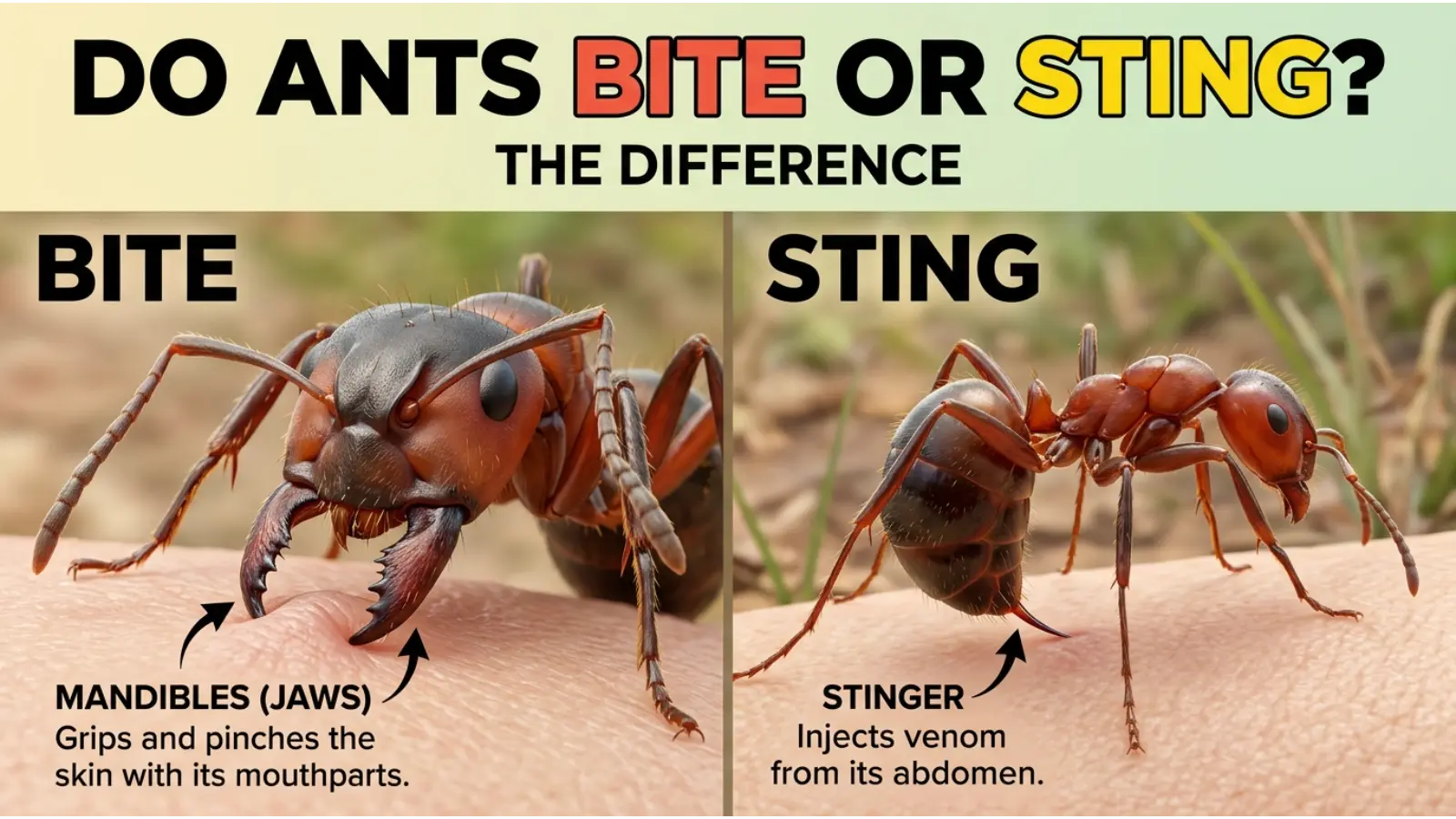
- Ant bites: Ants use their jaws, called mandibles, to grab or pinch the skin.
- Ant stings: Some ants use a special stinger to inject venom, which can cause pain, redness, and swelling.
- Both: Certain ants bite first and then use their stinger.
Examples:
- Carpenter ants can bite using their strong jaws.
- Fire ants can bite and sting, often causing a painful burning feeling.
- Some ordinary household ants may bite but rarely cause serious problems.
Simple rule: Biting means using the jaws, while stinging means using a stinger.
The Origin of Ant Bites and Stings
Ants belong to a large insect family called Formicidae. They have lived on Earth for millions of years and have developed different ways to protect themselves.
Their bites and stings are mainly used for defense, catching food, and protecting their colonies.
Ants have strong jaws that help them carry food, build nests, and defend themselves. Some species also have stingers that can deliver venom when they feel threatened.
Over time, people have noticed that different ants cause different reactions. This is why questions about ant bites and stings are common in science, gardening, and everyday life.
British English vs American English Usage
The terms “ant bite” and “ant sting” have the same meanings in British and American English.
There is no major spelling difference between the two varieties. However, people may use slightly different words when describing the pain.
| Feature | British English | American English | Notes |
|---|---|---|---|
| Ant bite | Ant bite | Ant bite | Same meaning |
| Ant sting | Ant sting | Ant sting | Same meaning |
| Swelling | Swelling | Swelling | Same word |
| Painful reaction | Painful reaction | Painful reaction | Same meaning |
| Fire ant | Fire ant | Fire ant | Same name |
Both British and American speakers use these terms in daily conversations.
Which One Should You Understand: Ant Bite or Ant Sting?
It is important to understand both terms because they describe different actions.
Here is when each term is useful:
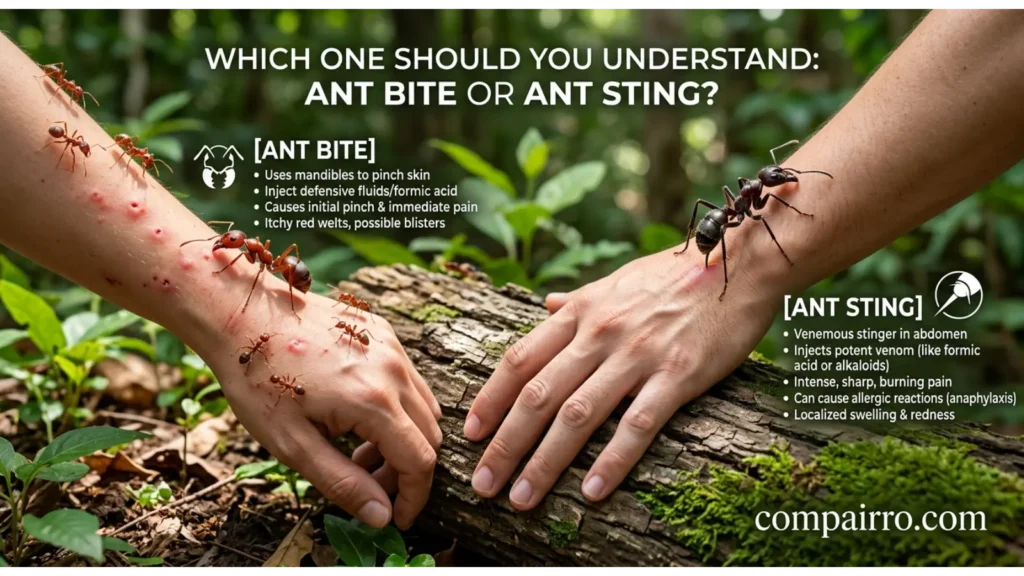
- Use ant bite when an ant uses its jaws to pinch or break the skin.
- Use ant sting when an ant uses its stinger to inject venom.
- Use both terms when describing species that can bite and sting.
For example, if a carpenter ant grabs your skin with its jaws, it is a bite. If a fire ant uses its stinger, it is a sting.
In science books and school lessons, these words help explain how different insects defend themselves.
Common Mistakes About Ant Bites and Stings
Many people confuse ant bites with ant stings. Here are five common mistakes and their correct explanations.
Mistake 1: Thinking all ants sting
❌ All ants have stingers.
✔ Not all ants have working stingers. Some species mainly use their jaws to bite.
Mistake 2: Thinking bites and stings are the same
❌ An ant bite and an ant sting are exactly alike.
✔ A bite involves jaws, while a sting involves a special stinging organ.
Mistake 3: Believing every ant bite is dangerous
❌ Every ant bite needs emergency treatment.
✔ Most ant bites cause mild reactions, although some can cause more serious symptoms.
Mistake 4: Thinking only large ants can bite
❌ Small ants cannot hurt people.
✔ Even small ants can bite or sting, depending on their species.
Mistake 5: Assuming every red mark comes from an ant
❌ Every small red bump on the skin is an ant sting.
✔ Other insects can also cause similar skin reactions. The appearance alone may not identify the insect.
Do Ants Bite or Sting in Everyday Situations?
Ant encounters can happen in many everyday places. Here are some simple examples.
1. At Work
You may notice ants around food in an office kitchen.
Example: “An ant bit my hand while I was eating lunch.”
2. At School
Students may see ants near trees, playgrounds, or classroom windows.
Example: “Our teacher explained why some ants can sting.”
3. On Social Media
People often share pictures and videos of fire ants, carpenter ants, and other species.
Example: “This video shows how painful a fire ant sting can be.”
4. In Daily Life
You may find ants in your garden, kitchen, or near outdoor plants.
Example: “I felt a small pinch when an ant crawled on my leg.”
5. In Text Messages
People may use these expressions when telling friends about an insect encounter.
Example:
- “I think an ant bit me.”
- “Something stung my foot outside.”
- “My hand feels itchy after an ant sting.”
Do Ants Bite or Sting? – Google Trends and Usage Data
People search for “do ants bite or sting” because they want to understand ant behavior and identify the cause of a painful or itchy skin reaction.
Some common reasons behind these searches include:
- Understanding whether ants can hurt humans.
- Learning the difference between bites and stings.
- Identifying dangerous ant species.
- Finding out why fire ant stings burn.
- Understanding what to do after an ant encounter.
Search interest in different countries
This topic has worldwide interest because ants live in many different environments.
- United States: People often look for information about fire ants and their painful stings.
- United Kingdom: Searches may focus on common garden ants and household ants.
- India: People may search about ant bites in homes and outdoor areas.
- Pakistan: Ant encounters are common in homes, gardens, and outdoor spaces.
- Canada: People may look for information about carpenter ants and other local species.
- Australia: People may search about aggressive ant species and painful stings.
Search interest can change with seasons, weather, and local ant activity. However, exact country rankings and search volumes should be checked through Google Trends rather than assumed.
Comparison Table: Ant Bite vs Ant Sting
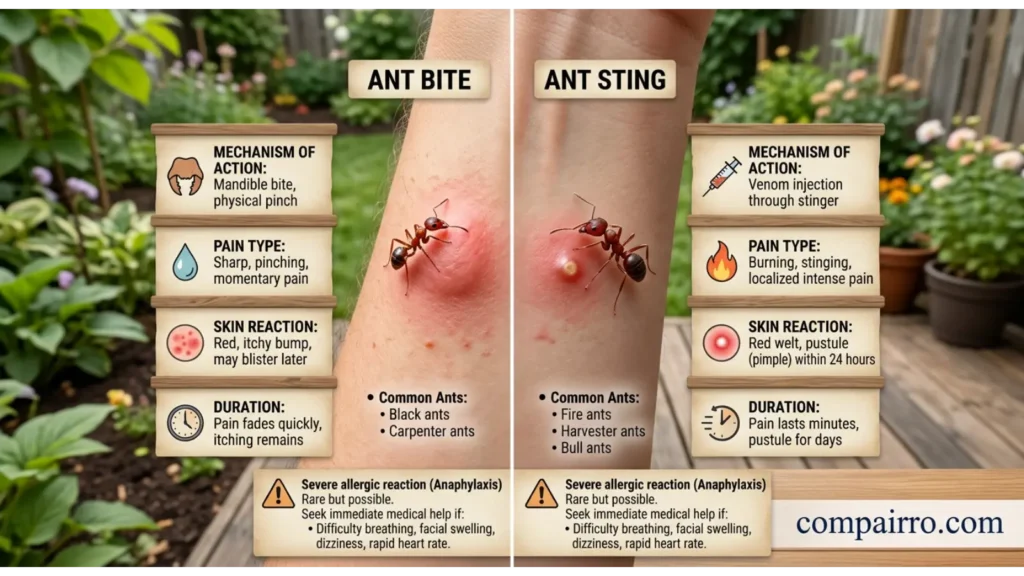
The easiest way to understand the difference is to compare how ants use their body parts.
| Feature | Ant Bite | Ant Sting |
|---|---|---|
| Body part | Jaws | Stinger |
| Main action | Pinches or bites skin | Injects venom |
| Pain | Mild to painful | Can be sharp or burning |
| Skin reaction | Redness or irritation | Redness, swelling, or a burning feeling |
| Venom | Not necessarily involved | Usually involves venom |
| Example | Carpenter ant | Fire ant |
| Purpose | Defense and gripping | Defense |
Important: Some ants, such as fire ants, can use both biting and stinging actions.
Do Ants Bite or Sting in Professional Life?
Ant bites and stings are also important in certain professions.
People who work outdoors may come into contact with ants more often than people who work indoors.
These include:
- Gardeners: May find ants while working with plants and soil.
- Farmers: Can encounter ants while working in fields.
- Construction workers: May disturb ant nests during outdoor projects.
- Pest control workers: Need to identify different ant species safely.
- Researchers: Study ant behavior, species, and defense systems.
Knowing which ants bite or sting helps these workers understand possible risks and take suitable precautions.

Do Ants Bite or Sting? A Guide for Students and Beginners
Students often learn about ants in science classes, but they may find it difficult to understand the difference between biting and stinging.
The easiest way to learn is to remember that ants have different body parts for different jobs.
Why beginners get confused:
- Both bites and stings can cause pain.
- Different ant species have different defense systems.
- Skin reactions can look similar.
- People often use the words interchangeably.
Easy learning tips:
- Remember that jaws are used for biting.
- Remember that a stinger is used for stinging.
- Learn a few examples of common ant species.
- Understand that not all ants are dangerous.
- Avoid touching unknown ants or disturbing their nests.
These simple points make the topic easier to understand.
Signs or Characteristics Related to Ant Bites and Stings
An ant bite or sting can cause different skin reactions. The symptoms depend on the ant species and the person’s sensitivity.
Common signs of an ant bite:
- Small red marks on the skin.
- Mild pain or pinching.
- Itching around the affected area.
- Slight swelling.
Common signs of an ant sting:
- Burning or sharp pain.
- Redness around the affected area.
- Local swelling.
- Itching.
- Sometimes, a small fluid-filled blister, especially after a fire ant sting.
Signs of a serious allergic reaction:
Some people can have a severe allergic reaction to an insect sting.
Warning signs include:
- Difficulty breathing.
- Swelling of the tongue or throat.
- Feeling faint or suddenly weak.
- Widespread hives.
Important health advice: Seek emergency medical help immediately if someone develops signs of a serious allergic reaction.
For a mild reaction, gently wash the area with soap and water and apply a cool compress. Avoid scratching it. If symptoms become worse or do not improve, contact a healthcare professional.
Simple Trick to Remember Do Ants Bite or Sting
Here is an easy way to remember the difference:
- Bite = Jaws
- Sting = Stinger
Think of it this way:
An ant uses its jaws like tiny pincers to grab or bite something. However, an ant with a stinger uses it to deliver venom for protection.
Simple examples:
- Carpenter ant = Mainly bites.
- Fire ant = Can bite and sting.
- Some other ant species = May only bite or have different defense methods.
This simple trick will help you remember the difference whenever you see an ant.
FAQs:
1. Do all ants bite humans?
No, not all ants bite humans. Some species may bite when they feel threatened, while others usually avoid people.
2. Do all ants sting?
No, only certain ant species have working stingers. Many ants defend themselves mainly with their jaws.
3. Do black ants bite or sting?
Some black ants can bite, but their behavior depends on the species. Their color alone does not tell you whether they can sting.
4. Do red ants bite or sting?
Some red ants, especially fire ants, can both bite and sting. Their stings may cause burning pain and swelling.
5. Why do ant bites itch?
Ant bites or stings can cause skin irritation and an immune response. This may lead to itching, redness, and swelling.
6. Are ant bites dangerous?
Most ant bites are mild. However, some stings can cause strong reactions, and allergic reactions may require emergency medical care.
7. What should I do after an ant bite or sting?
Wash the area with soap and water and use a cool compress. Avoid scratching it, and seek medical help if symptoms become serious.
Conclusion
So, do ants bite or sting? The simple answer is that ants can do both, depending on their species. Some ants use their jaws to bite, while others use a stinger to inject venom. Certain species, such as fire ants, can use both methods.
Understanding the difference helps you recognize ant behavior and respond properly when an ant comes into contact with your skin.
Remember this easy rule: Ant bites use jaws, while ant stings use stingers. Although most ant encounters are harmless, it is always better to avoid disturbing ant nests and be careful around unfamiliar species.

Sara Taylor is a passionate English content writer who specializes in word meanings, spelling comparisons, and modern slang explanations. She creates easy-to-understand articles that help readers avoid common English mistakes and improve their writing skills. Her content focuses on simple learning, real-life examples, and clear explanations for everyday readers.