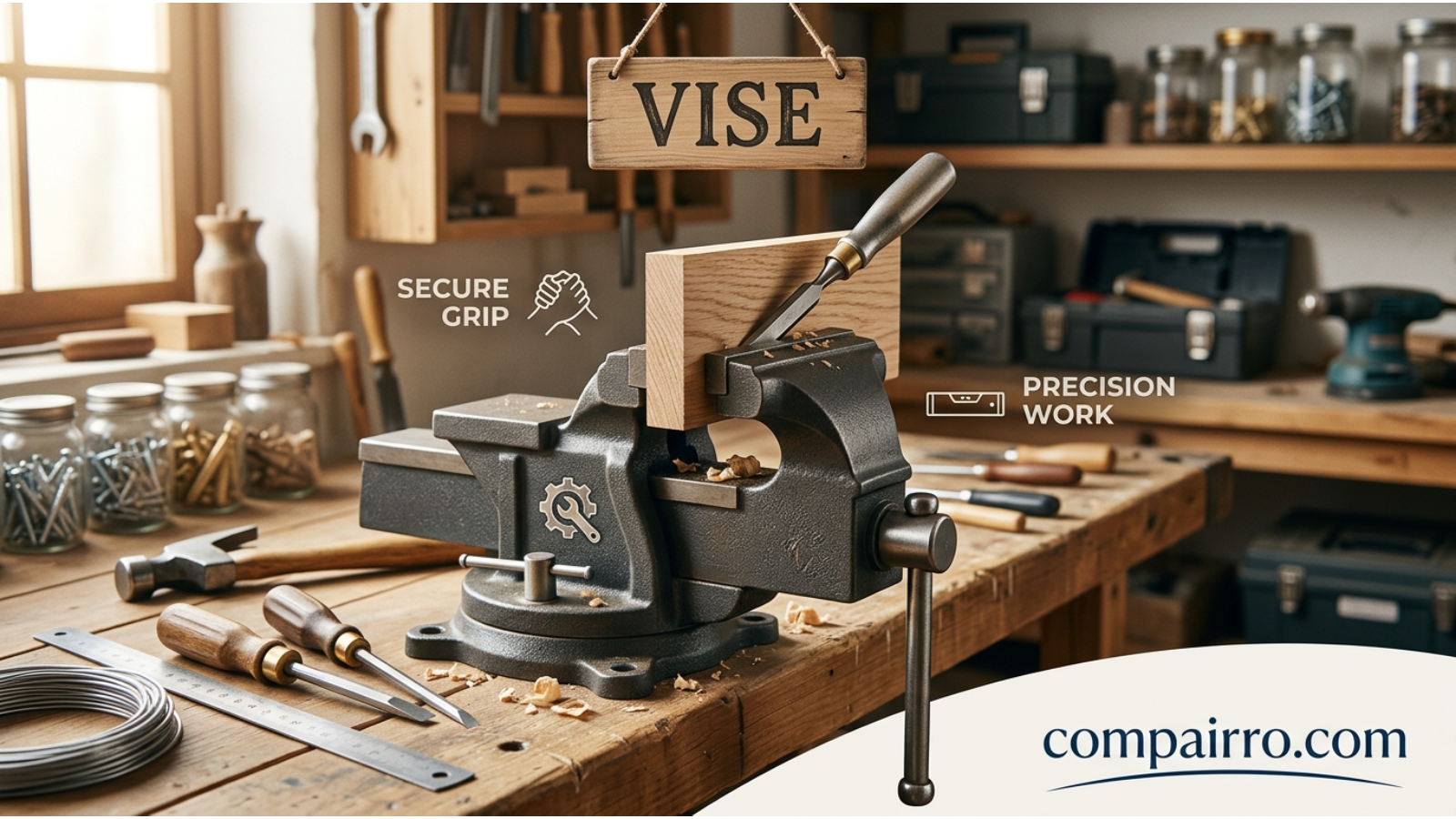
Have you ever seen the words vice and vise and wondered which one is correct? You are not alone. Many people get confused because these two words sound exactly the same when spoken. However, they have different meanings and are used in different situations.
You may come across these words in school assignments, workplace documents, online articles, social media posts, or everyday conversations. Some people use vice when talking about bad habits, while others use vise when discussing tools and equipment. The similar pronunciation often causes spelling mistakes.
Understanding the difference between vice or vise is important because using the wrong word can change the meaning of your sentence completely. Whether you are a student, writer, professional, or English learner, knowing when to use each word can improve your communication skills.
In this guide, you’ll learn the meaning, examples, usage, differences, common mistakes, and simple explanations in easy English.
Vice or Vise – Quick Answer
👉 Vice usually means a bad habit, immoral behavior, or a secondary position such as “vice president.”
👉 Vise is a mechanical tool used to hold objects firmly while working on them.
Examples
1 Smoking is considered a vice by many people.
2 She was promoted to vice president of the company.
3 The carpenter secured the wood in a vise before cutting it.
Simple Rule
👉 Vice = bad habit or position
👉 Vise = tool that grips objects
The Origin of Vice or Vise
The word vice comes from the Latin word vitium, meaning fault, defect, or wrongdoing. Over time, it became associated with bad habits and immoral behavior.
The word vise developed from older English and French words related to gripping or tightening. It became the standard name for the tool used to hold materials firmly in place.
Although both words sound alike, they evolved separately and have different meanings today.
British English vs American English Usage
One interesting fact about vice or vise is that regional spelling differences exist.
In British English, vice is often used for both meanings. In American English, the distinction is clearer.
| Feature | British English | American English | Notes |
|---|---|---|---|
| Bad habit | Vice | Vice | Same meaning |
| Deputy position | Vice | Vice | Same meaning |
| Gripping tool | Vice | Vise | Main spelling difference |
| Pronunciation | Same | Same | Both sound alike |
So, if you are writing for an American audience, use vise for the tool. For British audiences, vice may be acceptable for the tool as well.
Which One Should You Use?
Use the correct word based on the meaning you want.
select Vice When:
- Talking about bad habits
- Discussing immoral behavior
- Referring to a secondary position
- Writing about leadership roles
- Using terms like vice president
Use Vise When:
- Referring to a workshop tool
- Talking about carpentry
- Discussing engineering work
- Describing equipment that holds objects tightly
Formal and Informal Usage
- Vice is common in both formal and informal writing.
- Vise is mostly used in technical, professional, and practical contexts.
Common Mistakes With Vice or Vise
Mistake 1
❌ I put the metal piece in a vice. (American English tool reference)
✔ In American English, the correct spelling is vise when referring to the tool.
Mistake 2
❌ Smoking is a vise.
✔ Smoking is a vice because it refers to a bad habit.
Mistake 3
❌ She became the vise president.
✔ She became the vice president.
Mistake 4
❌ The mechanic tightened the part in a vice grip tool. (American English spelling)
✔ The mechanic tightened the part in a vise.
Vice or Vise in Everyday Examples
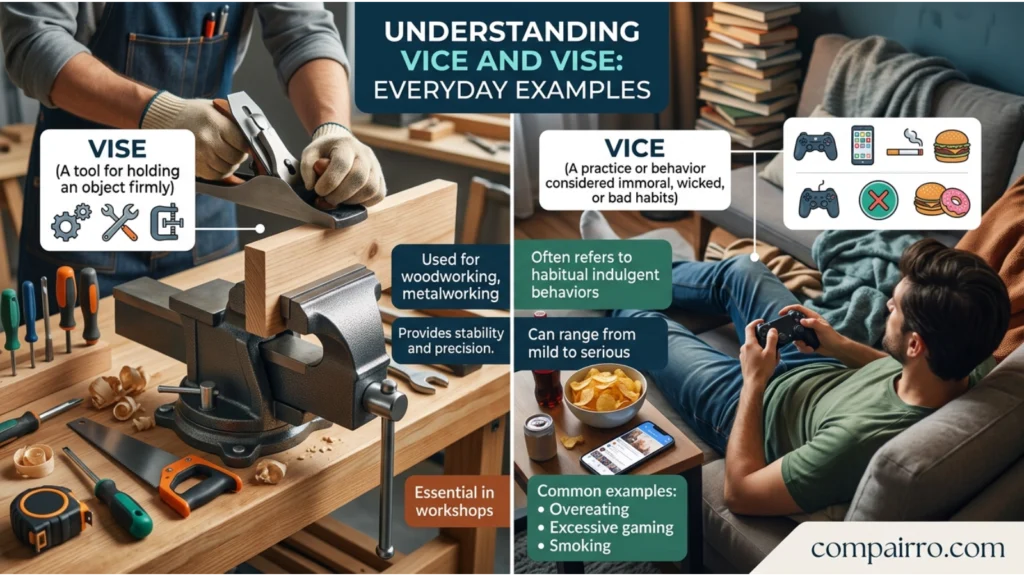
Work
- The company appointed a new vice president.
- The technician used a vise to secure the equipment.
School
- Students learn about the dangers of harmful vices.
- The workshop teacher showed how to use a vise safely.
Social Media
- People often discuss gambling as a vice.
- DIY creators frequently show projects involving a vise.
Daily Life
- Many people try to overcome personal vices.
- A vise helps hold objects during repairs.
Text Messages
- “I’m trying to quit one of my biggest vices.”
- “Do you have a vise I can borrow for my project?”
Vice or Vise – Google Trends & Usage Data
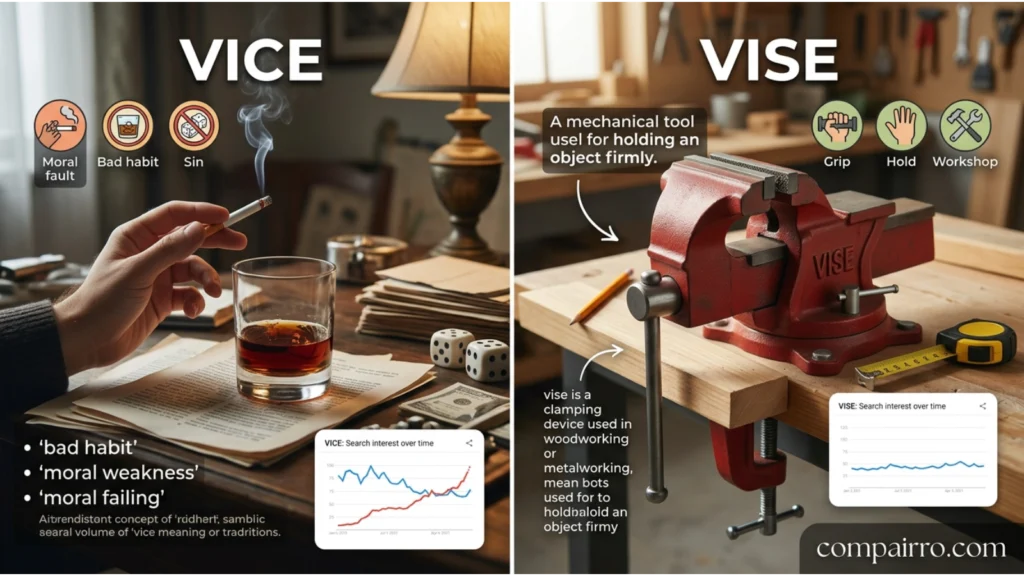
The keyword vice or vise receives steady search interest because many English learners are confused by the spelling difference.
People commonly search it because:
- The words sound identical.
- Spell-check tools may not catch the mistake.
- Students encounter both words in reading materials.
- Writers want to avoid grammar errors.
- DIY enthusiasts search for the tool spelling.
Popular countries searching this topic include:
- United States
- United Kingdom
- India
- Pakistan
- Canada
- Australia
Search activity often increases during school terms, writing projects, and English language learning courses.
Comparison Table: Vice or Vise
| Feature | Vice | Vise |
|---|---|---|
| Meaning | Bad habit or secondary position | Mechanical holding tool |
| Part of Speech | Noun | Noun |
| Common Context | Morality, business, leadership | Workshops, repairs, construction |
| Example | Vice president | Bench vise |
| American English | Vice | Vise |
| British English | Vice | Often vice |
| Pronunciation | Vais | Vais |
Vice or Vise in Professional Life
Both words appear in professional settings but in different industries.
Vice in Professional Life
- Vice president
- Vice chairman
- Vice principal
- Corporate leadership roles
Vise in Professional Life
- Manufacturing
- Carpentry
- Engineering
- Metalworking
- Mechanical workshops
Professionals must choose the correct spelling to maintain credibility and accuracy.
Vice or Vise for Students or Beginners
Many beginners struggle because both words sound exactly the same.
Common Confusion
- Same pronunciation
- Different meanings
- Regional spelling differences
Easy Learning Tips
- Connect vice with “vice president.”
- Connect vise with tools and workshops.
- Read example sentences regularly.
- Practice writing both words correctly.
With a little practice, remembering the difference becomes much easier.
Signs or Characteristics Related to Vice or Vise
Characteristics of a Vice
- Considered a bad habit
- Often difficult to stop
- Can affect health or behavior
- May involve temptation
- Common in social discussions
Characteristics of a Vise
- Holds objects firmly
- Made from metal
- Used in workshops
- Improves safety during work
- Found in construction and repair settings
Simple Trick to Remember Vice or Vise
👉 Vice = Vice President or Bad Habit
👉 Vise = Workshop Tool
Think of it this way:
If you can replace the word with vice president, use vice.
Example:
- She became vice president. ✅
- Smoking is a vice. ✅
If you can imagine a tool holding something tightly, use vise.
Example:
- The wood is locked in a vise. ✅
A simple memory trick:
👉 Vice affects people.
👉 Vise holds objects.
FAQs:
1. Is vice or vise correct?
Both are correct, but they have different meanings.
2. What does vice mean?
Vice usually means a bad habit or a secondary leadership position.
3. What does vise mean?
A vise is a tool used to hold objects firmly while working.
4. Why do vice and vise sound the same?
They are homophones, which means they have the same pronunciation but different meanings.
5. Is vise used in British English?
British English often uses vice for the tool instead of vise.
6. What is an example of vice?
Smoking, gambling, and excessive drinking are often called vices.
7. What is an example of vise?
A carpenter may use a vise to hold wood while cutting it.
Conclusion
Understanding vice or vise is easier once you know their meanings. Vice refers to a bad habit or a secondary position such as vice president. Vise refers to a tool used to hold objects firmly during work.
The most important thing to remember is that although the words sound the same, they are used in completely different situations.
Final memory rule:
👉 Vice = people, habits, and positions
👉 Vise = tools and workshops
Once you remember that simple difference, choosing the correct spelling becomes easy.

Sara Taylor is a passionate English content writer who specializes in word meanings, spelling comparisons, and modern slang explanations. She creates easy-to-understand articles that help readers avoid common English mistakes and improve their writing skills. Her content focuses on simple learning, real-life examples, and clear explanations for everyday readers.