Have you ever been writing an email, school assignment, or social media post and wondered whether to use while or whilst? Many English learners and even native speakers get confused by these two words because they have very similar meanings.
You may see while in American books, websites, business emails, and everyday conversations. On the other hand, whilst often appears in British English, novels, academic writing, and formal content. Because both words can often be used in the same sentence, people frequently search online to learn which one is correct.
This topic is especially important for students, writers, bloggers, professionals, and anyone learning English. Choosing the right word can make your writing sound more natural for your audience. It can also help you understand the differences between British and American English.
Whether you are writing a school essay, sending a work email, posting on social media, or improving your grammar skills, understanding while or whilst can make your English clearer and more effective.
In this guide, you’ll learn the meaning, examples, usage, differences, common mistakes, and simple explanations in easy English.
While or Whilst – Quick Answer
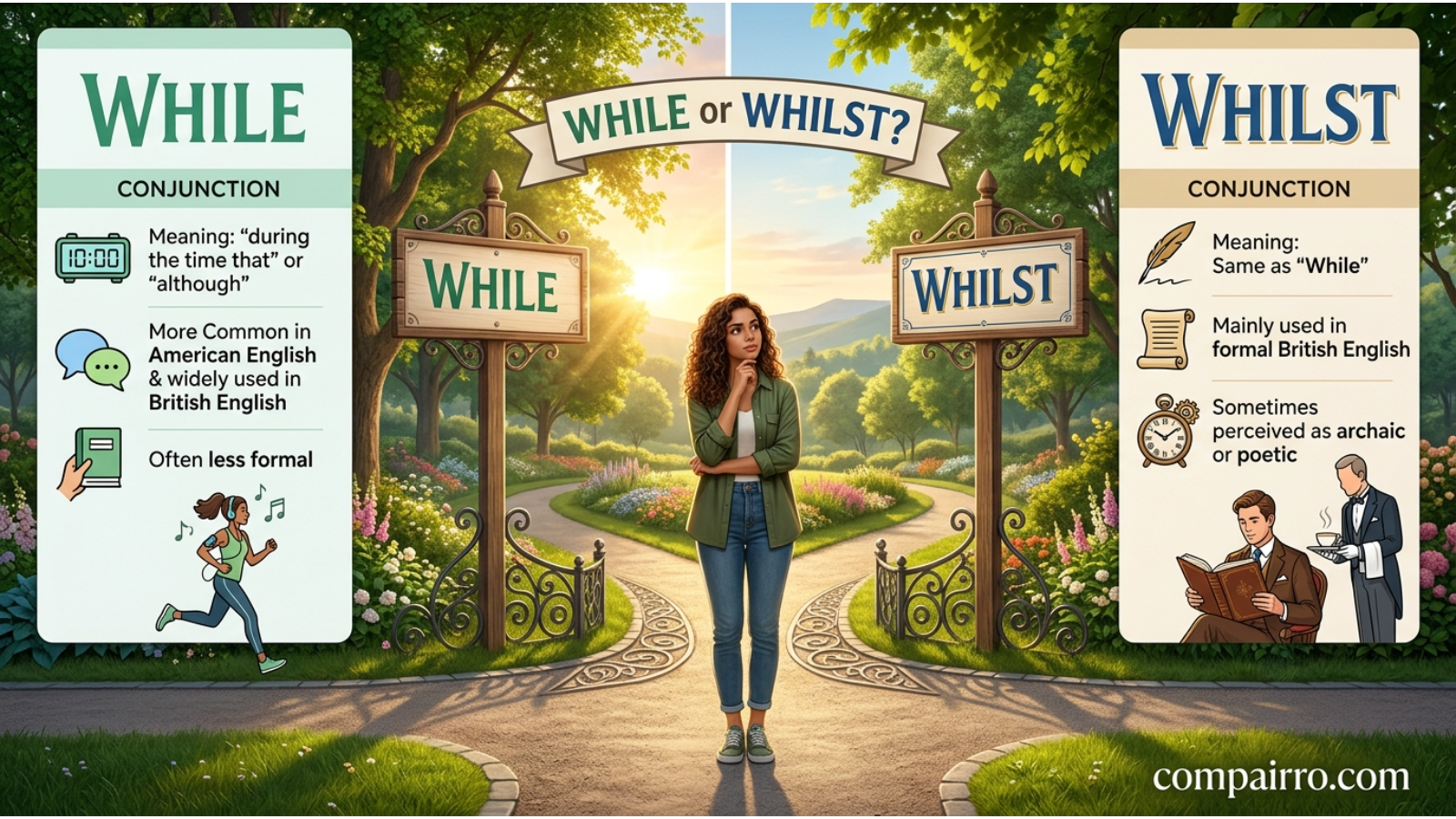
👉 While and whilst both mean during the time that or at the same time as something else happens.
Examples
1 I listened to music while doing homework.
2 She smiled whilst talking to her friend.
3 He checked his phone while waiting for the bus.
Simple Rule
👉 While is common in both American and British English.
👉 Whilst is mostly used in British English and sounds more formal.
The Origin of While or Whilst
Both while and whilst come from Old English.
The word while has been used for hundreds of years to show a period of time or actions happening at the same time.
Whilst developed later as a variation of while. It became popular in Britain and remained common there, especially in formal writing.
Today, both words are understood by English speakers around the world. However, while is much more common globally, especially online and in American English.
British English vs American English Usage
One of the biggest differences between while and whilst is where they are commonly used.
| Feature | British English | American English | Notes |
|---|---|---|---|
| While | Very common | Very common | Accepted everywhere |
| Whilst | Common | Rare | Sounds formal or old-fashioned in the US |
| Formal Writing | Used | Used less often | Depends on style |
| Everyday Speech | Sometimes used | Rarely used | While is preferred |
Key Point
If you are writing for an international audience, while is usually the safest choice.
Which One Should You Use?
The best choice depends on your audience and writing style.
Use while when:
- Writing for American readers
- Sending business emails
- Posting online content
- Writing school assignments
- Using everyday English
Use whilst when:
- Writing in British English
- Creating formal content
- Matching a traditional writing style
- Following a specific style guide
Formal vs Informal
- While = neutral and natural
- Whilst = slightly formal or traditional
Common Mistakes With While or Whilst
Mistake 1
❌ I was studying whilst I completed my homework yesterday.
✔ Make sure the sentence sounds natural and the actions happen together.
✅ I was studying while doing my homework.
Mistake 2
❌ Using whilst in every sentence to sound smarter.
✔ Overusing whilst can make writing sound unnatural.
✅ Use while for most situations.
Mistake 3
❌ Thinking whilst and while have different meanings.
✔ Both words usually mean the same thing.
✅ Choose based on style and audience.
Mistake 4
❌ Using whilst in casual American texting.
✔ Most Americans prefer while.
✅ “I watched TV while eating dinner.”
While or Whilst in Everyday Examples

Work
✅ I answered emails while attending the meeting.
✅ She took notes whilst listening to the presentation.
School
✅ Students talked while waiting for class to start.
✅ He learned new words whilst reading a book.
Social Media
✅ I saw your post while scrolling through Instagram.
✅ She replied whilst watching a video.
Daily Life
✅ My mother cooked while talking on the phone.
✅ He cleaned his room whilst listening to music.
Text Messages
✅ “I’ll call you while I’m on the way.”
✅ “I was texting you while waiting.”
While or Whilst – Google Trends & Usage Data

Many people search for while or whilst because they want to know which word is correct.
Why People Search It
- Grammar confusion
- British vs American English differences
- Academic writing questions
- Professional writing needs
- English learning purposes
Popular Countries
The topic is commonly searched in:
- United States
- United Kingdom
- India
- Pakistan
- Canada
- Australia
Search Trends
The word while receives much more usage worldwide than whilst.
People often discover whilst when reading British books, articles, or websites and wonder if it is different from while.
Social Media Usage
- While dominates social media posts.
- Whilst appears more often in British content.
Comparison Table: While or Whilst
| Feature | While | Whilst |
|---|---|---|
| Meaning | During the time that | During the time that |
| Correct English | Yes | Yes |
| American English | Very common | Rare |
| British English | Common | Common |
| Formality | Neutral | Slightly formal |
| Social Media Use | Very common | Less common |
| Business Writing | Preferred | Less common |
| Easy for Beginners | Yes | Sometimes confusing |
While or Whilst in Professional Life
In professional settings, clarity is important.
Most companies, businesses, and international organizations prefer while because it is familiar to readers worldwide.
Examples:
✅ Please review the report while checking the data.
✅ Employees can attend training while working remotely.
Using while helps communication stay simple and professional.
While or Whilst for Students or Beginners
Many learners struggle because both words appear correct.
Common Confusion
- Do they mean different things?
- Is one more correct?
- Which word should be used in exams?
Easy Learning Tips
- Learn while first.
- Use while in everyday writing.
- Understand that whilst is mainly a style choice.
- Read examples from British and American sources.
For most learners, using while is enough in nearly every situation.
Signs or Characteristics Related to While or Whilst
Characteristics of “While”
- Common worldwide
- Easy to understand
- Used in speech and writing
- Preferred in business communication
- Popular in American English
Characteristics of “Whilst”
- Mostly British usage
- Slightly formal tone
- Often found in literature
- Less common in everyday conversation
- Can sound traditional
Shared Features
- Same basic meaning
- Grammatically correct
- Used to connect actions
- Show events happening at the same time
Simple Trick to Remember While or Whilst
👉 While = Worldwide
👉 Whilst = British Style
Think of it this way:
If you want everyone to understand your writing easily, choose while.
Example:
✅ I listened to music while studying.
If you are writing in a British style or formal tone, whilst may fit better.
Example:
✅ She smiled whilst reading the letter.
A simple memory rule:
While works almost everywhere. Whilst is mostly a British style choice.
FAQs:
1. Is while or whilst correct?
Both are correct English words and usually have the same meaning.
2. Which is more common, while or whilst?
While is much more common around the world.
3. Is whilst old-fashioned?
Not exactly. It is still used today, especially in British English, but it can sound formal.
4. Can I use whilst in American English?
Yes, but it is uncommon and may sound unusual to American readers.
5. Do while and whilst have different meanings?
In most situations, they mean the same thing.
6. Which word should students use?
Students can safely use while in most assignments and exams.
7. Is whilst more formal than while?
Yes. Many people consider whilst slightly more formal or traditional.
Conclusion
The difference between while or whilst is mainly about style and regional preference, not meaning. Both words usually mean “during the time that” and can often be used in the same sentence.
However, while is the more common choice in modern English, especially in the United States, business communication, online content, and everyday writing. Whilst remains popular in British English and often sounds a little more formal.
The easiest rule to remember is:
👉 Use “while” for most situations. Use “whilst” when you want a British or more formal style.
Once you understand this simple difference, choosing between while or whilst becomes easy.

Sara Taylor is a passionate English content writer who specializes in word meanings, spelling comparisons, and modern slang explanations. She creates easy-to-understand articles that help readers avoid common English mistakes and improve their writing skills. Her content focuses on simple learning, real-life examples, and clear explanations for everyday readers.