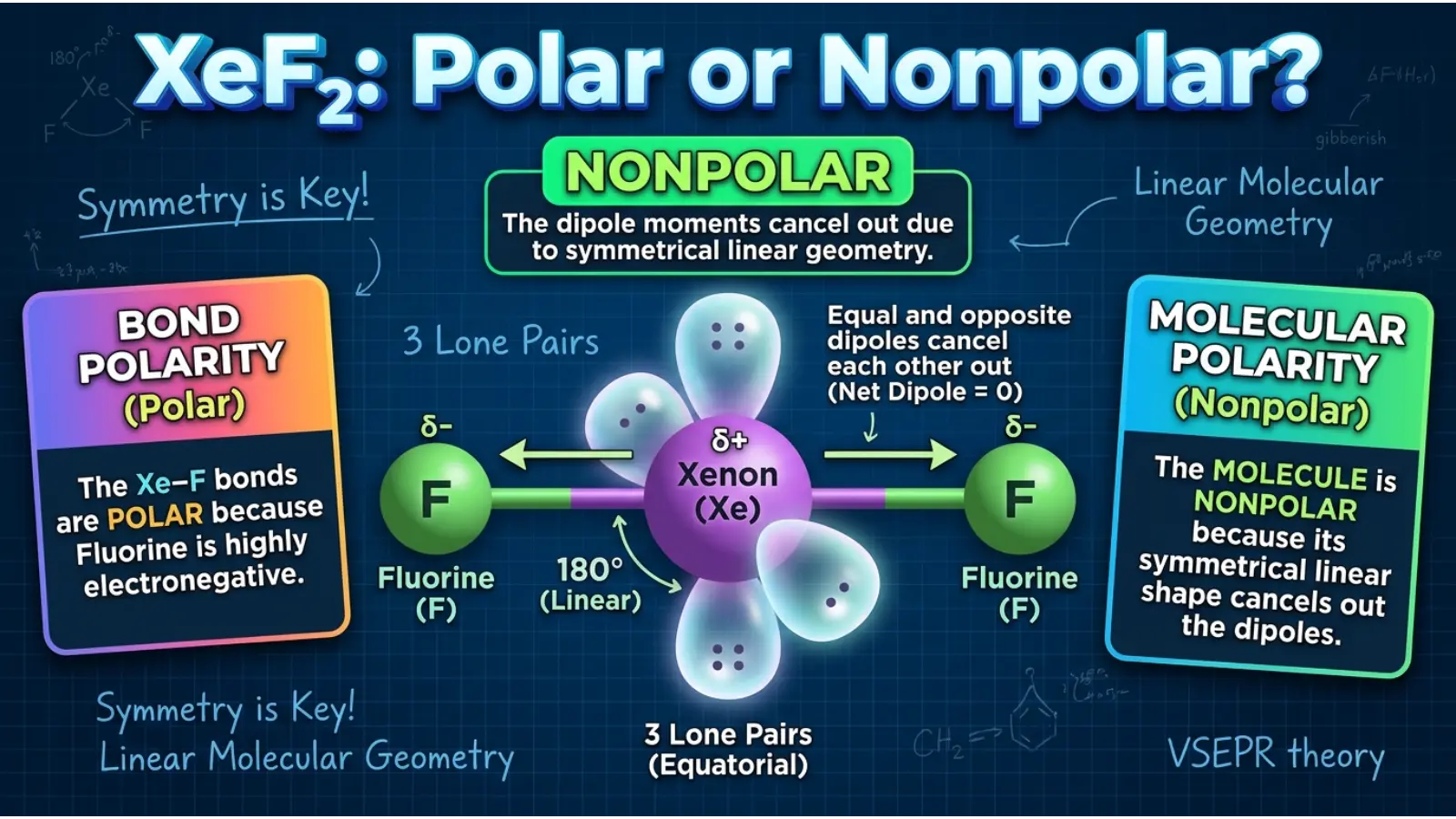
XeF₂ Polar or Nonpolar is a common chemistry question for students learning about molecular polarity, bond dipoles, and molecular geometry. Xenon difluoride (XeF₂) contains xenon and fluorine atoms, which have different electronegativities. However, the polarity of a molecule depends on more than just the differences between its atoms. So, is XeF₂ polar or nonpolar?
One common question students ask is, is XeF₂ polar or nonpolar? XeF₂ stands for xenon difluoride, a chemical compound made of one xenon atom and two fluorine atoms. Although fluorine attracts electrons more strongly than xenon, the molecule has a special shape that affects its overall polarity.
This is where many students get confused. They may think that if a molecule contains polar bonds, the whole molecule must also be polar. However, this is not always true. The shape of a molecule plays an important role in deciding if its bond dipoles cancel each other.
You may come across XeF₂ in school chemistry lessons, college assignments, exams, molecular geometry exercises, and online science searches. Knowing its polarity can also help you understand other molecules with similar shapes.
The good news is that you do not need to memorize a long list of complicated rules. Once you understand the Lewis structure, bond polarity, and molecular geometry of XeF₂, the answer becomes much easier to remember.
In this guide, you’ll learn the meaning, examples, usage, differences, common mistakes, and simple explanations in easy English.
XeF₂ Polar or Nonpolar – Quick Answer
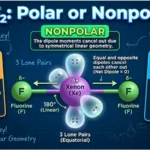
XeF₂ is nonpolar. XeF2 Bond Polarity or xenon difluoride, has a linear molecular shape. Its two Xe–F bonds are polar, but their bond dipoles point in opposite directions and cancel each other.
In simple words, the molecule has no overall dipole moment.
- Chemical name: Xenon difluoride
- Chemical formula: XeF₂
- Molecular shape: Linear
- Bond polarity: Polar bonds
- Overall molecular polarity: Nonpolar
Examples:
- XeF₂ is nonpolar because its bond dipoles cancel.
- CO₂ is nonpolar because its two bond dipoles cancel in a linear shape.
- H₂O is polar because its bent shape prevents its bond dipoles from canceling completely.
Simple rule: A molecule with polar bonds can still be nonpolar if its shape makes the bond dipoles cancel.

The Origin of XeF₂
XeF₂ is the chemical formula for xenon difluoride. The name has two parts: “xenon” refers to the element xenon, while “di” means two, referring to the two fluorine atoms.
Xenon is a noble gas. For many years, noble gases were thought to form very few compounds because they are generally unreactive. However, scientists discovered that xenon can form compounds with highly reactive elements such as fluorine.
Xenon difluoride was first reported in 1962. It became an important example in chemistry because it showed that noble gases can form chemical compounds under suitable conditions.
Today, XeF₂ is studied for its chemical bonding, molecular structure, and reactivity. Its linear shape also makes it a useful example when learning about molecular polarity.
British English vs American English Usage
There is no meaningful difference between British and American English when discussing XeF₂ polarity. Both use the same chemical formula, scientific concepts, and molecular structure.
| Feature | British English | American English | Notes |
|---|---|---|---|
| Chemical formula | XeF₂ | XeF₂ | Same formula |
| Chemical name | Xenon difluoride | Xenon difluoride | Same name |
| Molecular shape | Linear | Linear | Same geometry |
| Polarity | Nonpolar | Nonpolar | Same scientific answer |
| Common term | Bond dipole | Bond dipole | Same meaning |
Some chemistry textbooks may use different formatting or spelling conventions for general scientific terms. However, these differences do not change the answer to “XeF₂ polar or nonpolar?”
Which One Should You Use? Understanding XeF₂ Polarity
When answering a chemistry question about XeF₂, you should distinguish between the polarity of its bonds and the polarity of the entire molecule.
Here is what you need to know:
- For bond polarity: Each Xe–F bond is polar because fluorine attracts shared electrons more strongly than xenon.
- For molecular polarity: XeF₂ is nonpolar because the two bond dipoles cancel.
- For molecular geometry: XeF₂ has a linear shape, with a bond angle of 180°.
- For exams: Write that XeF₂ is nonpolar due to its symmetrical linear structure and zero net dipole moment.
- For Lewis structures: Show xenon in the center, two fluorine atoms on opposite sides, and three lone pairs on the xenon atom.
Remember that bond polarity and molecular polarity are related, but they are not the same thing.
Common Mistakes With XeF₂ Polarity
Students often make small mistakes when deciding whether XeF₂ is polar or nonpolar. Here are four common ones and how to avoid them.
Mistake 1: Thinking polar bonds always make a polar molecule
❌ Incorrect: XeF₂ must be polar because its Xe–F bonds are polar.
✔ Correct: XeF₂ is nonpolar because its two bond dipoles cancel due to its linear shape.
Mistake 2: Ignoring molecular geometry
❌ Incorrect: The types of atoms alone determine molecular polarity.
✔ Correct: Both electronegativity and molecular geometry matter when determining polarity.
Mistake 3: Giving the wrong molecular shape
❌ Incorrect: XeF₂ has a bent shape because xenon contains lone pairs.
✔ Correct: XeF₂ has a linear molecular shape. Its three lone pairs occupy positions around xenon that allow the two fluorine atoms to remain opposite each other.
Mistake 4: Confusing bond dipoles with the net dipole moment
❌ Incorrect: XeF₂ has a net dipole moment because each Xe–F bond has a dipole.
✔ Correct: The two equal and opposite bond dipoles cancel, so the net dipole moment is zero.
XeF₂ in Everyday Examples
XeF₂ is not a common household substance, but its polarity is useful in school, college, and scientific learning.
1. School Chemistry
A student may be asked to classify XeF₂ as polar or nonpolar in a chemistry test.
Example: “Explain why XeF₂ is nonpolar.”
Answer: XeF₂ has a linear shape. Its two equal Xe–F bond dipoles point in opposite directions and cancel, making the molecule nonpolar.
2. College Chemistry
College students may study XeF₂ to understand the VSEPR theory, which helps predict molecular shapes.
Example: A student uses the Lewis structure to predict the geometry of XeF₂.
The central xenon atom has five electron domains: two bonding pairs and three lone pairs. These electron domains arrange themselves to reduce repulsion, producing a linear molecular shape.
3. Online Learning
Students searching for “XeF₂ polar or nonpolar” may be trying to check an answer or understand a confusing chemistry concept.
A useful learning approach is to study the Lewis structure, identify the molecular shape, and then check whether the bond dipoles cancel.
4. Laboratory Chemistry
XeF₂ is a reactive chemical compound used in certain specialized applications, including silicon etching in semiconductor processing.
Its chemical properties and reactivity are important in these applications, while its nonpolar molecular structure is a separate concept used to understand its bonding.
5. Homework and Exam Preparation
Example question: What is the net dipole moment of XeF₂?
Answer: Its net dipole moment is zero because the two equal and opposite bond dipoles cancel.
XeF₂ – Google Trends and Usage Data
People search for “XeF₂ polar or nonpolar” mainly to understand molecular polarity, check homework answers, and prepare for chemistry examinations.
However, exact search popularity and country rankings cannot be confirmed without current Google Trends data.
Common reasons for searching this topic include:
- Understanding why polar bonds can form a nonpolar molecule.
- Learning the molecular geometry of XeF₂.
- Preparing for school and college chemistry exams.
- Reviewing VSEPR theory and Lewis structures.
- Comparing XeF₂ with other molecules, such as CO₂ and H₂O.
Students in the United States, United Kingdom, India, Pakistan, Canada, and Australia may encounter this topic through school chemistry courses, college materials, and online educational websites.
Search interest can change during examination periods and throughout the academic year. Still, the main learning question remains the same: how does molecular shape affect polarity?
For accurate regional interest, use Google Trends and compare the search term across the countries you want to study.

Comparison Table: XeF₂ Polar or Nonpolar?
The following table compares XeF₂ with other familiar molecules.
| Molecule | Molecular Shape | Bond Polarity | Overall Polarity |
|---|---|---|---|
| XeF₂ | Linear | Polar bonds | Nonpolar |
| CO₂ | Linear | Polar bonds | Nonpolar |
| H₂O | Bent | Polar bonds | Polar |
| NH₃ | Trigonal pyramidal | Polar bonds | Polar |
| BF₃ | Trigonal planar | Polar bonds | Nonpolar |
| HCl | Linear diatomic | Polar bond | Polar |
The table shows an important rule: a molecule’s overall polarity depends on the arrangement of its bonds and the cancellation of their dipoles.
For example, CO₂ and XeF₂ are both linear and nonpolar. However, H₂O is bent, so its bond dipoles do not cancel completely.
XeF₂ in Professional Life
Understanding molecular polarity is useful in chemistry, materials science, and related technical fields.
Although the polarity of XeF₂ alone does not explain all its chemical properties, learning about its molecular structure helps students build a foundation for more advanced chemistry.
Some related areas include:
- Chemical research: Scientists study molecular structures to understand how atoms bond.
- Semiconductor processing: XeF₂ is used in specialized silicon etching processes.
- Chemical education: Teachers use XeF₂ to explain molecular geometry and bond dipoles.
- Materials science: Understanding molecular interactions helps scientists study how substances behave.
In professional settings, it is important to distinguish between a molecule’s shape, polarity, and chemical reactivity. These properties are connected, but they describe different things.

XeF₂ for Students or Beginners
If you are new to molecular polarity, XeF₂ may seem confusing at first. The main challenge is understanding why polar bonds do not always produce a polar molecule.
Use these simple learning tips:
- Learn the Lewis structure. Xenon is the central atom, bonded to two fluorine atoms.
- Count the electron domains. Xenon has two bonding pairs and three lone pairs.
- Identify the shape. The molecular shape is linear, with a 180° bond angle.
- Check the bond dipoles. Fluorine attracts electrons more strongly than xenon.
- Check cancellation. The two equal and opposite bond dipoles cancel.
- Write the final answer. XeF₂ is nonpolar.
A useful exam tip is to explain the reason instead of writing only “nonpolar.” Mentioning the linear shape and zero net dipole moment makes your answer clearer.
Signs or Characteristics Related to XeF₂ Polarity
XeF₂ has several features that help explain why it is nonpolar.
- Linear molecular shape: The xenon atom sits between two fluorine atoms in a straight line.
- 180° bond angle: The two Xe–F bonds point in opposite directions.
- Polar individual bonds: Fluorine attracts shared electrons more strongly than xenon.
- Three lone pairs on xenon: These affect the arrangement of electron domains and help explain the molecular geometry.
- Symmetrical bond arrangement: The two Xe–F bond dipoles have equal magnitude and opposite directions.
- Zero net dipole moment: The bond dipoles cancel, making the whole molecule nonpolar.
The key characteristic is the cancellation of the two bond dipoles. The presence of polar bonds does not change this result.
Simple Trick to Remember XeF₂ Polarity
Here is an easy way to remember the answer:
XeF₂ = Linear + Opposite Dipoles + Zero Net Dipole = Nonpolar
Think of it this way: imagine two people pulling an object with equal force in opposite directions. If both pulls are equal, their effects cancel.
The two Xe–F bond dipoles work in a similar way. They point in opposite directions and have equal magnitudes, so their combined effect is zero.
Compare these examples:
- XeF₂: Linear shape, dipoles cancel, nonpolar.
- CO₂: Linear shape, dipoles cancel, nonpolar.
- H₂O: Bent shape, dipoles do not cancel, polar.
For exam revision, remember this simple rule: Always check the molecular shape before deciding whether a molecule is polar or nonpolar.
FAQs:
1. Is XeF₂ polar or nonpolar?
XeF₂ is nonpolar because it has a linear molecular shape and its two Xe–F bond dipoles cancel each other.
2. Why is XeF₂ nonpolar even though its bonds are polar?
Each Xe–F bond is polar, but the bonds point in opposite directions with equal dipole magnitudes. Therefore, the net dipole moment is zero.
3. What is the molecular shape of XeF₂?
XeF₂ has a linear molecular shape with a bond angle of 180°.
4. What is the hybridization of Xe in XeF₂?
In the traditional school-level bonding model, xenon in XeF₂ is described as sp³d hybridized. Modern bonding theories can explain hypervalent molecules without relying on this hybridization picture.
5. What is the Lewis structure of XeF₂?
The Lewis structure has xenon in the center, single bonds to two fluorine atoms, three lone pairs on xenon, and three lone pairs on each fluorine atom.
6. Does XeF₂ have a dipole moment?
XeF₂ has no net permanent dipole moment because its two equal and opposite Xe–F bond dipoles cancel.
7. What is the difference between polar bonds and a polar molecule?
A polar bond has an uneven distribution of shared electrons. A polar molecule has an overall uneven charge distribution, resulting in a nonzero net dipole moment. Molecular shape determines whether individual bond dipoles cancel.
Conclusion
So, is XeF₂ polar or nonpolar? XeF₂ is nonpolar. It contains two polar Xe–F bonds, but its linear molecular shape makes their dipoles cancel each other.
The most important points to remember are that XeF₂ has a 180° bond angle, three lone pairs on its central xenon atom, and a zero net dipole moment.
If you are preparing for a chemistry test, focus on the Lewis structure, VSEPR theory, and the difference between bond polarity and molecular polarity.
Final memory rule: Polar bonds do not always mean a polar molecule. For XeF₂, the linear shape makes the bond dipoles cancel, so the molecule is nonpolar.

Sara Taylor is a passionate English content writer who specializes in word meanings, spelling comparisons, and modern slang explanations. She creates easy-to-understand articles that help readers avoid common English mistakes and improve their writing skills. Her content focuses on simple learning, real-life examples, and clear explanations for everyday readers.