Imagine you are buying a new television, smartphone, laptop, or monitor. You see two options: one offers HD resolution, while the other supports 4K. Both look attractive, but you may wonder which one provides better picture quality.
This is a common question because modern devices come with different screen resolutions. Some people prefer HD because it is affordable and works well for everyday use. Others choose 4K because they want sharper pictures, more details, and a better viewing experience.
However, choosing between HD and 4K is not always easy. A 4K screen has more pixels, but that does not automatically mean everyone needs it. Your screen size, viewing distance, internet speed, budget, and the type of content you watch also matter.
You may see HD and 4K options on Netflix, YouTube, smart TVs, gaming monitors, laptops, and mobile phones. Understanding their differences can help you avoid spending extra money on features you may not need.
So, is HD or 4K better for everyday entertainment? Which one offers better value? And is 4K worth the extra cost?
In this guide, you’ll learn the meaning, examples, usage, differences, common mistakes, and simple explanations in easy English.
Is HD or 4K Better? – Quick Answer
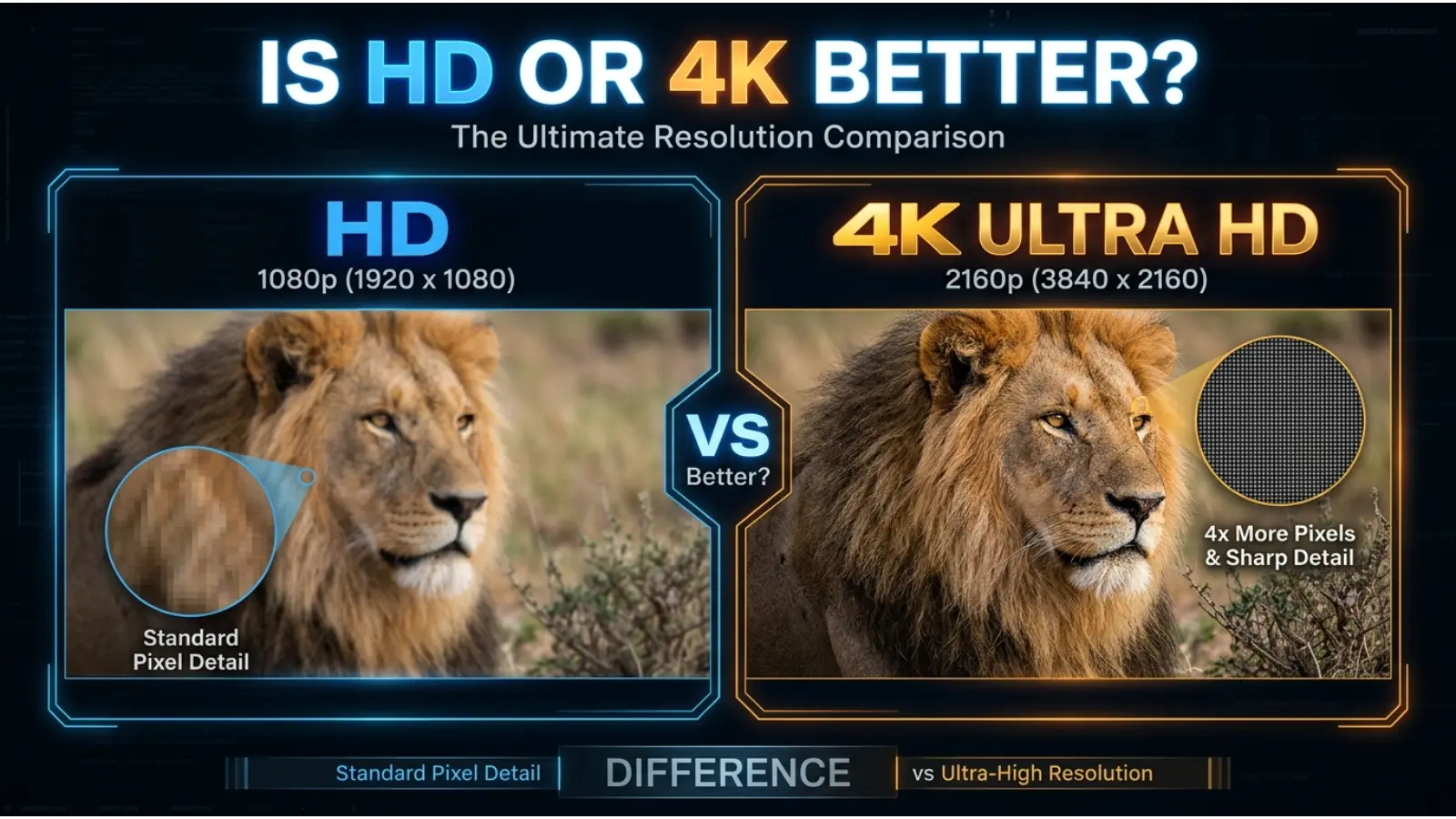
4K is generally better than HD because it offers a higher resolution, sharper images, and more picture details. However, HD can be a better choice for smaller screens, basic viewing, and people who want to save money.
Here is a simple explanation:
- HD: Usually refers to 1280 × 720 pixels (720p), although Full HD (1080p) is also commonly included in the HD family.
- 4K: Usually refers to 3840 × 2160 pixels (4K UHD).
- Picture quality: 4K provides more details than standard HD.
- Price: HD devices and services are often more affordable.
- Internet: 4K streaming generally requires more internet bandwidth.
Examples:
- Watching YouTube on a small phone? HD may be enough.
- Watching movies on a large television? 4K can provide a better experience.
- Playing modern games? 4K can offer sharper visuals if your hardware supports it.
Simple rule: Choose HD for basic viewing and 4K for higher picture quality.
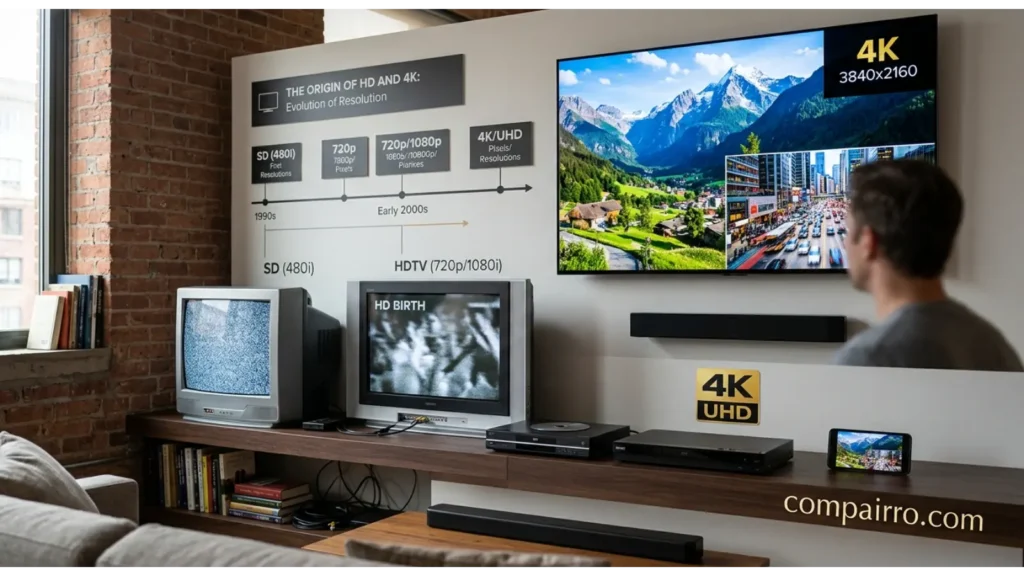
The Origin of HD and 4K
HD stands for High Definition. It became popular as television technology improved and viewers wanted clearer pictures than older standard-definition television could provide.
Later, Full HD (1080p) became common in televisions, computers, and other devices.
4K developed as display technology continued to improve. It became popular in professional video production, digital cinema, televisions, cameras, and streaming platforms.
The name 4K refers to a resolution with approximately 4,000 horizontal pixels. The common consumer version, called 4K UHD, has 3840 × 2160 pixels.
Today, both technologies are widely used in entertainment and digital devices.
British English vs American English Usage
There is no meaningful difference between British and American English when using HD and 4K.
Both terms have the same meaning in the UK, US, Canada, Australia, Pakistan, and other English-speaking regions.
| Feature | British English | American English | Notes |
|---|---|---|---|
| HD | HD | HD | Same meaning |
| 4K | 4K | 4K | Same meaning |
| Resolution | Resolution | Resolution | Same meaning |
| Picture quality | Picture quality | Picture quality | Same meaning |
| Full HD | Full HD | Full HD | Same meaning |
You can use these terms in the same way regardless of which English style you follow.
Which One Should You Use?
Choosing between HD and 4K depends on your needs. Both have benefits, but they are designed for different viewing experiences.
Choose HD if:
- You use a small television or computer screen.
- You mainly watch everyday videos.
- You have a limited budget.
- Your internet connection is not very fast.
- You do not need extremely detailed pictures.
- You want to save storage space when recording videos.
Choose 4K if:
- You own a large television.
- You enjoy watching movies and high-quality videos.
- You play games with a device that supports 4K.
- You want more details and sharper images.
- You regularly watch 4K content.
- You want a higher-resolution screen for supported professional tasks.
What about formal and informal usage?
HD and 4K are technical terms, not formal or informal expressions. You can use them in product descriptions, online discussions, professional reviews, and everyday conversations.
Common Mistakes With HD and 4K
People often misunderstand the differences between these two technologies. Here are some common mistakes to avoid.
Mistake 1: Thinking HD and Full HD are exactly the same.
❌ HD always means 1080p.
✔ HD can refer to 720p, while Full HD specifically refers to 1080p.
Mistake 2: Thinking every 4K video looks better.
❌ Every video looks amazing just because it is 4K.
✔ Video quality also depends on lighting, camera quality, compression, and other factors.
Mistake 3: Believing a 4K television automatically plays everything in 4K.
❌ A 4K TV makes all videos true 4K.
✔ Lower-resolution videos may be upscaled, but upscaling does not create all the original details of native 4K content.
Mistake 4: Ignoring internet speed.
❌ Any internet connection can stream 4K smoothly.
✔ 4K streaming generally needs a faster and more stable internet connection.
Mistake 5: Thinking 4K is always necessary.
❌ Everyone needs a 4K television.
✔ HD can still be a good choice for smaller screens and everyday entertainment.
HD or 4K in Everyday Examples
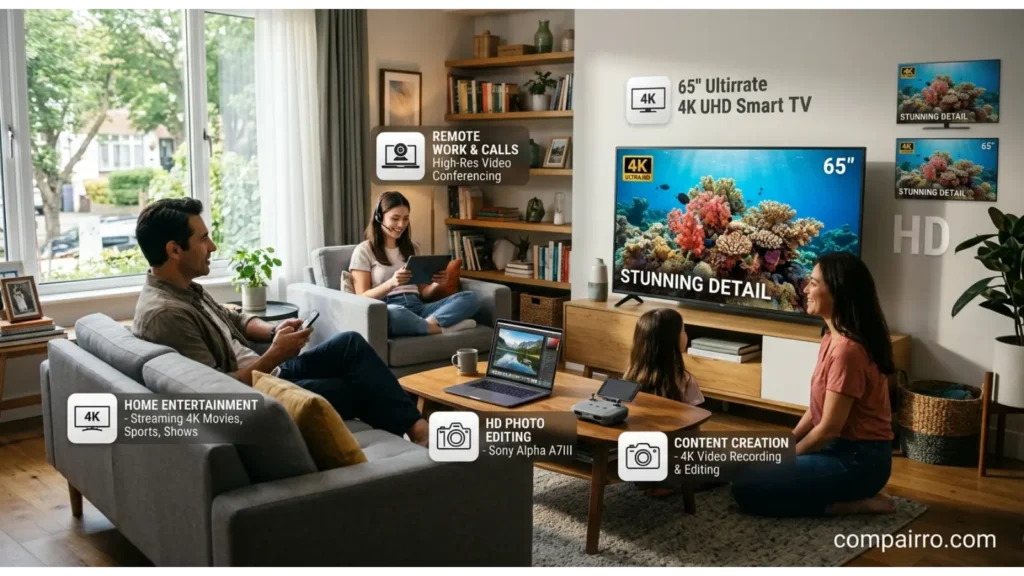
Let’s understand how these resolutions work in real-life situations.
1. Work
If you use a computer for writing, browsing websites, sending emails, and working with documents, HD or Full HD may be enough.
However, a 4K monitor can provide more screen space and sharper text when properly configured.
2. School
Students often use laptops and tablets for online classes, educational videos, and reading.
Full HD is usually suitable for these activities. A 4K screen is optional rather than necessary.
3. Social Media
Platforms such as YouTube, Instagram, and TikTok support different video qualities depending on their features and settings.
For everyday viewing, HD is often sufficient. However, 4K can provide more details when the original video and platform support it.
4. Daily Life
Imagine watching a movie on a large television.
A 4K screen can make small details, backgrounds, and textures look sharper. On a smaller screen, the difference may be less noticeable.
5. Gaming
HD gaming requires less graphical power than 4K gaming in many situations.
On the other hand, 4K gaming can offer detailed graphics, especially on larger displays. However, you need compatible hardware to run games smoothly at that resolution.
HD or 4K – Google Trends and Usage Data
People search for “is HD or 4K better” because they want to understand which resolution offers better value.
Some common reasons include:
- Buying a new television.
- Comparing HD and 4K monitors.
- Choosing video quality on YouTube.
- Understanding Netflix streaming plans.
- Learning about smartphone camera settings.
- Comparing gaming screen resolutions.
Popular countries and search interest
People in the following countries may search for HD and 4K comparisons:
- US: Consumers compare television quality, streaming options, and gaming displays.
- UK: People often explore television resolutions and home entertainment devices.
- India: Smartphone displays, smart TVs, and affordable streaming options are common interests.
- Pakistan: Buyers compare television prices, internet requirements, and picture quality.
- Canada: Consumers explore 4K televisions, gaming monitors, and streaming services.
- Australia: People compare modern display technology and home entertainment products.
These are possible search interests, not verified rankings of search volume.
Search interest can change when new televisions, gaming consoles, streaming services, and display technologies become popular.
One reason this topic attracts beginners is that HD, Full HD, and 4K can sound confusing. Understanding pixel resolution makes the comparison much easier.
Comparison Table: HD vs 4K
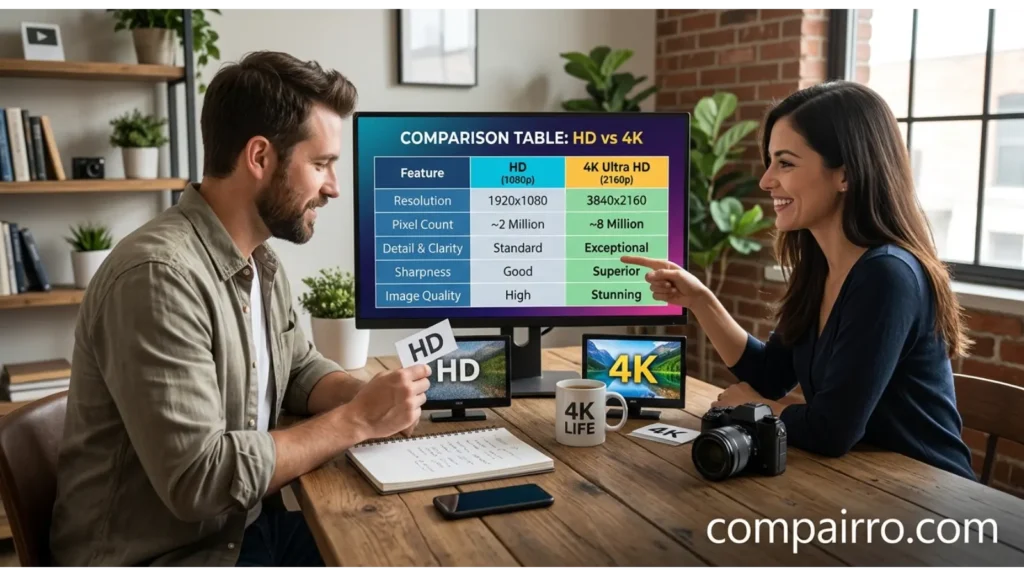
Here is a simple comparison to help you understand the main differences.
| Feature | HD (720p) | Full HD (1080p) | 4K UHD |
|---|---|---|---|
| Resolution | 1280 × 720 | 1920 × 1080 | 3840 × 2160 |
| Total pixels | About 0.92 million | About 2.07 million | About 8.29 million |
| Picture details | Basic | Clear | Very detailed |
| Screen suitability | Small screens | Small and medium screens | Medium and large screens |
| Internet needs | Lower | Moderate | Higher |
| Storage needs | Lower | Moderate | Higher |
| Typical cost | Lower | Moderate | Often higher |
| Gaming requirements | Lower | Moderate | Higher |
| Best use | Basic viewing | Everyday entertainment | High-quality entertainment |
Important: 4K UHD has four times as many pixels as Full HD and nine times as many pixels as 720p HD.
This is why 4K can show more visual details.
HD or 4K in Professional Life
Both resolutions are useful in professional environments, but the right choice depends on the type of work.
HD is useful for:
- Basic office work.
- Online meetings.
- Everyday presentations.
- Simple video editing.
- General computer tasks.
4K is useful for:
- Professional video editing.
- High-resolution photography.
- Detailed graphic design.
- Video production.
- Reviewing high-resolution footage.
For example, a video editor working with 4K footage may prefer a 4K monitor because it can display more details.
However, a person who mainly writes documents or manages emails may not need such a high-resolution display.
HD or 4K for Students and Beginners
Students and beginners sometimes struggle to understand whether they should pay extra for a 4K device.
The good news is that choosing the right resolution is simple when you understand your daily needs.
Here are some helpful tips:
- Check your screen size: A small screen may not show a major difference between HD and 4K.
- Consider your budget: Do not spend extra money unless you need the higher resolution.
- Check your internet: A stable connection is important for smooth 4K streaming.
- Understand your activities: Reading, studying, and browsing usually do not require 4K.
- Check content support: Your device and video source should support 4K to enjoy native 4K quality.
For most beginners, Full HD offers a useful balance between picture quality and price.
Signs or Characteristics Related to HD and 4K
Here are the main characteristics that make HD and 4K different.
HD characteristics:
- Lower pixel count than 4K.
- Often requires less bandwidth for streaming.
- Usually takes less storage for comparable video settings.
- Works well for everyday viewing.
- Often available on affordable devices.
4K characteristics:
- Higher pixel count.
- More visible details on suitable screens.
- Supports sharper images.
- Often requires more bandwidth.
- Can require more storage space.
- Works well for large displays and high-resolution content.
Remember that resolution is only one part of picture quality. Screen technology, brightness, contrast, color accuracy, and video quality also matter.
Simple Trick to Remember HD or 4K
Here is an easy way to remember the difference:
HD = Good everyday picture quality.
Full HD = Sharper everyday picture quality.
4K = Much higher resolution and more details.
Think of it this way:
Imagine looking at two photographs.
One photograph has fewer pixels, while the other has many more pixels. When displayed at a suitable size, the photograph with more pixels can show finer details.
The same basic idea applies to HD and 4K.
However, remember that more pixels do not automatically mean a better overall display. The screen and original content also play important roles.
FAQs:
1. Is 4K better than HD?
Yes. 4K has more pixels than HD and Full HD, allowing it to display more picture details.
2. Is HD good enough for everyday use?
Yes. HD and especially Full HD are suitable for everyday browsing, studying, watching videos, and basic entertainment.
3. Is 4K worth the extra money?
It can be worth it if you have a large screen, watch 4K content, or need more screen detail. Otherwise, Full HD may be enough.
4. Can I watch HD videos on a 4K TV?
Yes. A 4K television can play lower-resolution videos and may upscale them to fit the screen.
5. Does 4K use more internet data than HD?
Generally, yes. Streaming 4K videos usually uses more internet data because it requires more information to display the higher resolution.
6. Is 4K better for gaming?
4K can provide sharper gaming visuals, but it requires more graphics power. Full HD may be better if you want smoother performance on less powerful hardware.
7. Is Full HD the same as 4K?
No. Full HD has 1920 × 1080 pixels, while 4K UHD has 3840 × 2160 pixels.
Conclusion
So, is HD or 4K better? The answer depends on your needs, budget, screen size, and viewing habits.
4K is generally the better option for picture detail because it offers four times as many pixels as Full HD. It is especially useful for large televisions, movies, gaming, and professional video work.
On the other hand, HD and Full HD remain excellent choices for everyday activities, smaller screens, and affordable entertainment.
Before buying a new device, consider its screen size, display quality, internet requirements, and the type of content you watch.
Final memory rule: HD is good for everyday viewing, Full HD offers a sharper experience, and 4K provides more picture details.

Sara Taylor is a passionate English content writer who specializes in word meanings, spelling comparisons, and modern slang explanations. She creates easy-to-understand articles that help readers avoid common English mistakes and improve their writing skills. Her content focuses on simple learning, real-life examples, and clear explanations for everyday readers.