Is Usted Formal or Informal is a common question for anyone learning Spanish or trying to communicate respectfully. Spanish uses different forms of address depending on the relationship, situation, and level of respect. The word usted is especially important because it helps speakers show politeness when talking to others. But does usted always sound formal, or can it also be used in everyday conversations?
This is why many Spanish learners ask, is usted formal or informal? Understanding this small word can help you communicate politely and avoid awkward situations.
You may see usted in Spanish lessons, school textbooks, workplace conversations, emails, social media posts, and everyday discussions. It is especially common when speaking to older people, teachers, customers, or someone you do not know well.
However, there is one interesting detail: Spanish speakers in some countries also use usted with family members, friends, and people they know very well. So, its use is not always limited to formal situations.
Learning when to use usted is important because it helps you understand Spanish culture and show respect through language. It also makes your conversations sound more natural.
In this guide, you’ll learn the meaning, examples, usage, differences, common mistakes, and simple explanations in easy English.
Is Usted Formal or Informal? – Quick Answer
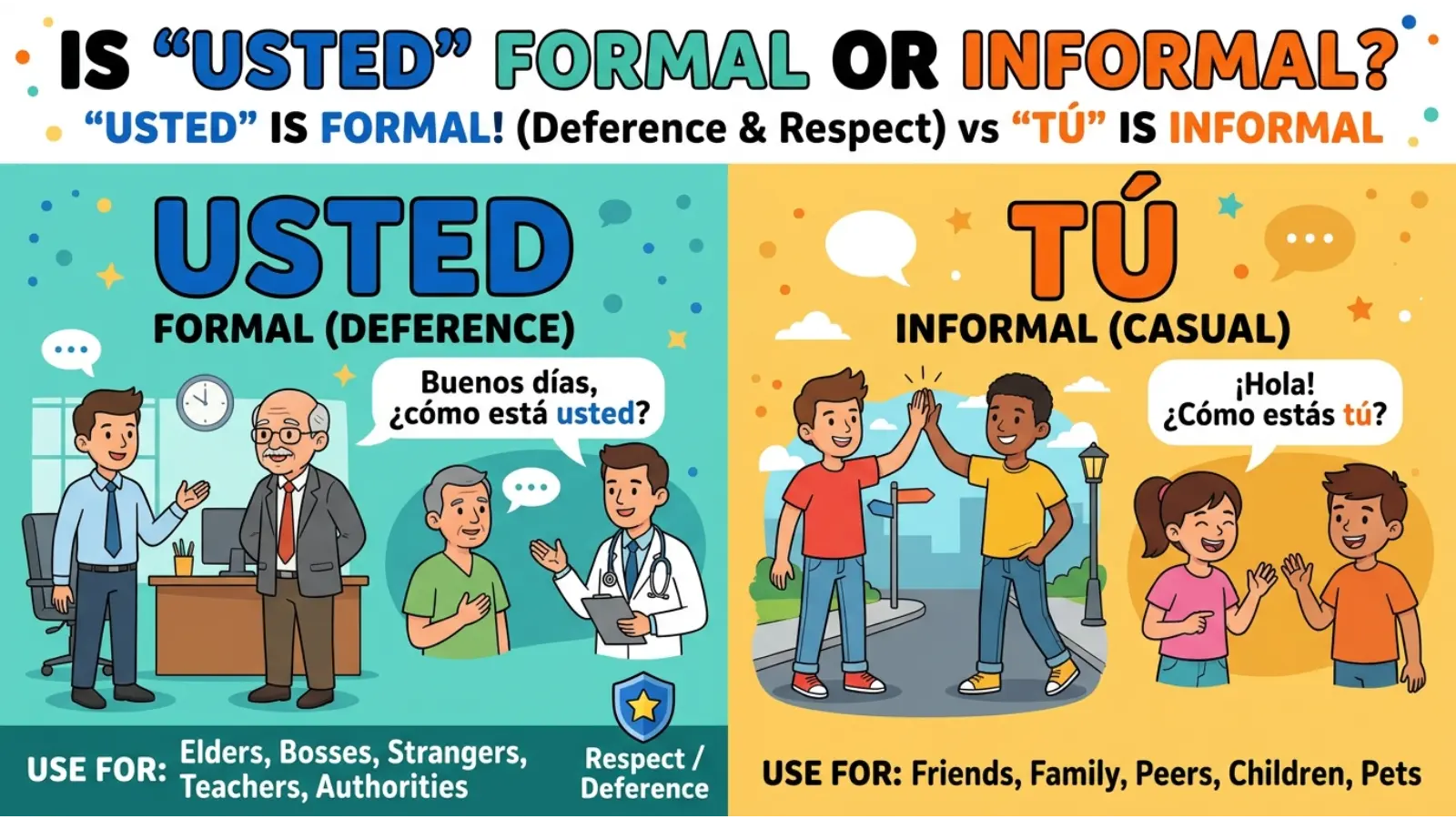
Usted is formal in Spanish. It means “you” and is generally used when speaking politely or respectfully to someone.
It is commonly used with:
- Older people.
- Teachers and professors.
- Managers and customers.
- Strangers and people you have just met.
Examples:
- ¿Cómo está usted? = How are you?
- ¿Dónde vive usted? = Where do you live?
- ¿Usted habla inglés? = Do you speak English?
Simple rule: Remember that usted is generally formal, while tú is generally informal.
However, some Spanish-speaking regions use usted in friendly and familiar conversations too.
The Origin of Usted
The word usted comes from the older Spanish expression vuestra merced, which means “your mercy” or “your grace.”
Over time, people shortened and changed this expression through everyday speech. Eventually, it developed into the modern word usted.
Historically, the expression was used to show respect when speaking to another person.
Today, usted remains an important part of Spanish communication. It is taught in schools and used in homes, businesses, public places, and formal conversations.
Although Spanish has changed over time, usted has kept its respectful meaning in many Spanish-speaking communities.
British English vs American English Usage
The word usted belongs to Spanish, not English. Therefore, British and American English do not have separate versions of this word.
Both English varieties use the same translation: you.
However, English does not usually show the same formal and informal difference that Spanish shows through usted and tú.
| Feature | British English | American English | Notes |
|---|---|---|---|
| Meaning | You | You | Same translation |
| Formal version | You | You | No separate word |
| Informal version | You | You | No separate word |
| Spanish equivalent | Usted | Usted | Generally formal |
| Alternative | Tú | Tú | Generally informal |
Important: Whether you speak British or American English, usted has the same Spanish meaning.
Which One Should You Use?
Choosing between usted and tú depends on the person, situation, and local culture.
Here is a simple guide.
Use usted when:
- You are meeting someone for the first time.
- You are speaking to an older person.
- You are talking to a teacher or professor.
- You are communicating with a customer.
- You are in a formal business meeting.
- You want to show politeness or respect.
Use tú when:
- You are talking to close friends.
- You are speaking with children.
- You are chatting with family members in communities where tú is normal.
- You are having a casual conversation.
- The other person invites you to use tú.
Is Usted More Polite Than Tú?
Generally, yes. Usted sounds more respectful or formal, while tú sounds more relaxed and friendly.
For example:
- Usted: ¿Cómo está usted? (How are you?)
- Tú: ¿Cómo estás? (How are you?)
Both sentences are correct. The main difference is the level of formality.

Common Mistakes With Usted
Spanish beginners sometimes confuse usted with other words or use the wrong verb form. Here are five common mistakes to avoid.
Mistake 1: Thinking Usted Is Informal
❌ Incorrect: Usted is always an informal word.
✔ Correct: Usted is generally formal and shows respect.
Mistake 2: Using the Wrong Verb Form
❌ Incorrect: Usted eres muy amable.
✔ Correct: Usted es muy amable.
Explanation: Usted uses third-person singular verb forms, even though it means “you.”
Mistake 3: Confusing Usted With Tú
❌ Incorrect: Tú está bien.
✔ Correct: Tú estás bien.
Explanation: Tú and usted use different verb forms.
Mistake 4: Thinking Usted Is Only for Older People
❌ Incorrect: You can only use usted with elderly people.
✔ Correct: You can also use it with teachers, customers, strangers, and professionals.
Mistake 5: Thinking Usted Is Rude or Cold
❌ Incorrect: Using usted means you do not like someone.
✔ Correct: It usually shows respect and politeness. Its meaning depends on the relationship and culture.
Usted in Everyday Examples
The easiest way to understand usted is to see how people use it in real-life situations.
1. At Work
In professional situations, usted can help you sound respectful.
Examples:
- ¿Usted trabaja aquí? = Do you work here?
- ¿Puede usted ayudarme? = Can you help me?
- ¿Usted tiene una reunión hoy? = Do you have a meeting today?
2. At School
Students may use usted when speaking to teachers, depending on local customs.
Examples:
- ¿Usted es mi profesor? = Are you my teacher?
- ¿Puede usted explicar esto? = Can you explain this?
- ¿Usted tiene mi tarea? = Do you have my homework?
3. On Social Media
Spanish speakers may use usted in comments and online conversations, especially when they want to sound respectful.
Examples:
- ¿Usted habla español? = Do you speak Spanish?
- ¿De dónde es usted? = Where are you from?
- ¿Usted conoce este lugar? = Do you know this place?
4. In Daily Life
You can also hear usted in shops, restaurants, hospitals, and public places.
Examples:
- ¿Qué desea usted? = What would you like?
- ¿Necesita usted ayuda? = Do you need help?
- ¿Cómo se llama usted? = What is your name?
5. In Text Messages
People sometimes use usted in messages when speaking politely.
Example:
Person A: Buenos días, ¿cómo está usted?
Person B: Estoy bien, gracias. ¿Y usted?
English:
Person A: Good morning, how are you?
Person B: I am fine, thank you. And you?
Usted – Google Trends & Usage Data
Many people search for is usted formal or informal because they want to understand Spanish grammar and speak naturally.
The question is especially useful for beginners who are learning how to address people politely.
Why Do People Search This Keyword?
Some common reasons include:
- They are learning Spanish for school.
- They want to communicate with Spanish-speaking people.
- They are preparing for Spanish exams.
- They want to understand the difference between tú and usted.
- They are travelling to Spanish-speaking countries.
- They want to avoid sounding disrespectful.
Countries Where People Learn and Use Usted
Spanish is spoken in many countries around the world.
- United States: Many students learn Spanish as a second language.
- United Kingdom: Spanish is a popular foreign language.
- India: Students and language learners explore Spanish grammar.
- Pakistan: Spanish learners search for basic words and sentence structures.
- Canada: Spanish is studied in schools and language programs.
- Australia: Many people learn Spanish for travel, study, and communication.
Is Usted Becoming More Popular?
There is no verified live search data here to confirm whether searches for this exact keyword are increasing or decreasing.
However, usted remains an important part of Spanish grammar. Its use also varies by country and region.
For example, some communities use it mainly in formal situations, while others use it in everyday conversations.

Comparison Table: Usted vs Tú vs Vos
Understanding the difference between these three Spanish pronouns makes learning Spanish much easier.
| Feature | Usted | Tú | Vos |
|---|---|---|---|
| Meaning | You | You | You |
| General use | Formal | Informal | Informal |
| Tone | Respectful | Friendly | Friendly |
| Verb form | Third-person singular | Second-person singular | Special second-person form |
| Common regions | Many Spanish-speaking countries | Spain and many Latin American countries | Argentina and parts of Latin America |
| Example | Usted habla | Tú hablas | Vos hablás |
Remember: All three words mean “you,” but their usage depends on regional language habits and social relationships.
Usted in Professional Life
In professional environments, using usted can help create a polite and respectful impression.
For example, imagine speaking to a customer in a Spanish-speaking country.
You could say:
- ¿En qué puedo ayudarle? = How can I help you?
- ¿Usted necesita más información? = Do you need more information?
- ¿Puede usted esperar un momento? = Can you wait a moment?
These expressions are useful in:
- Business meetings.
- Customer service.
- Job interviews.
- Formal emails.
- Workplace discussions.
- Professional phone calls.
However, some modern workplaces prefer tú because it creates a friendly and relaxed environment.
Therefore, pay attention to how other people communicate.

Usted for Students or Beginners
Spanish beginners often struggle with usted because it uses a different verb form from tú.
For example:
- Tú eres = You are.
- Usted es = You are.
- Tú tienes = You have.
- Usted tiene = You have.
- Tú hablas = You speak.
- Usted habla = You speak.
Although the English translation stays the same, the Spanish verb changes.
Easy Learning Tips
- Learn usted and tú together.
- Practice simple questions every day.
- Remember that usted generally uses third-person singular verbs.
- Listen to native Spanish speakers.
- Learn the local customs of the country you are visiting.
A little daily practice can make these differences easier to understand.
Signs or Characteristics Related to Usted
Here are the main characteristics that help you recognize and understand usted.
- Formal tone: It generally shows respect.
- Polite communication: It is common when addressing strangers.
- Third-person verb forms: It uses verbs like es, tiene, and habla.
- Singular meaning: It normally addresses one person.
- Written and spoken use: It appears in conversations, emails, letters, and messages.
- Regional differences: Some countries use it more often than others.
- Respectful relationships: It can be useful when talking to teachers, customers, and older people.
Does Usted Always Mean Respect?
Usually, usted communicates politeness or respect. However, it does not always mean that someone is being distant or unfriendly.
In some Latin American communities, family members and close friends use usted naturally.
The relationship and local culture matter just as much as the word itself.
Simple Trick to Remember Usted
Here is an easy trick:
- Usted = Generally formal
- Tú = Generally informal
- Vos = Informal in many regions
Think of it this way:
Imagine meeting your Spanish teacher for the first time.
You can say:
¿Cómo está usted?
Now imagine talking to your close friend.
You can say:
¿Cómo estás?
Both sentences mean “How are you?” However, the first sounds more formal, while the second sounds more casual.
Memory rule: Use usted to show respect and tú to speak casually, unless local customs suggest otherwise.
FAQs:
1. Is usted formal or informal in Spanish?
Usted is generally formal. Spanish speakers use it to show respect when speaking to strangers, older people, teachers, and professionals.
2. Does usted mean you?
Yes. Usted means “you” in English. It is normally used when addressing one person politely.
3. Is usted more polite than tú?
Generally, yes. Usted sounds more formal and respectful, while tú is usually used in casual conversations.
4. Can I use usted with friends?
Yes. In some Spanish-speaking countries and communities, people use usted with friends and family members.
5. Is usted used in Mexico?
Yes. Usted is commonly used in Mexico, especially in formal situations and respectful conversations.
6. Does usted use third-person verbs?
Yes. Usted uses third-person singular verb forms, such as es, tiene, and habla.
7. What is the difference between usted and ustedes?
Usted refers to one person, while ustedes refers to more than one person. In most Latin American countries, ustedes is used for both formal and informal groups.
Conclusion
So, is usted formal or informal? The simple answer is that usted is generally a formal Spanish pronoun used to show respect and politeness.
It is commonly used with older people, teachers, strangers, customers, and professionals. On the other hand, tú is generally used with friends, family, and people you know well.
However, remember that Spanish-speaking countries have different customs. In some places, usted is also common in friendly conversations.
The easiest memory rule is:
- Usted = Generally formal
- Tú = Generally informal
Once you understand this difference, speaking Spanish politely becomes much easier.

Sara Taylor is a passionate English content writer who specializes in word meanings, spelling comparisons, and modern slang explanations. She creates easy-to-understand articles that help readers avoid common English mistakes and improve their writing skills. Her content focuses on simple learning, real-life examples, and clear explanations for everyday readers.