sic meaning in text can be confusing because this short expression has different meanings depending on where you see it. You might notice SIC in a text message, social media comment, online discussion, or written article.
Sometimes, people use it as a casual expression, while in formal writing, it has a specific purpose. One of its most recognized uses is [sic], which shows that a spelling mistake, unusual word, or grammatical error appeared in the original source and was not introduced by the person quoting it.
In casual conversations, SIC may also be a typo for “sick” or a shortened form used within a particular online community. Understanding the surrounding sentence helps you identify the intended meaning.
Quick Answer:
In writing, [sic] means that the preceding word or error appears exactly as it did in the original source. In casual texting, SIC may be a typo for “sick” or context-specific slang.
What Does SIC Mean in Text?
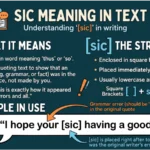
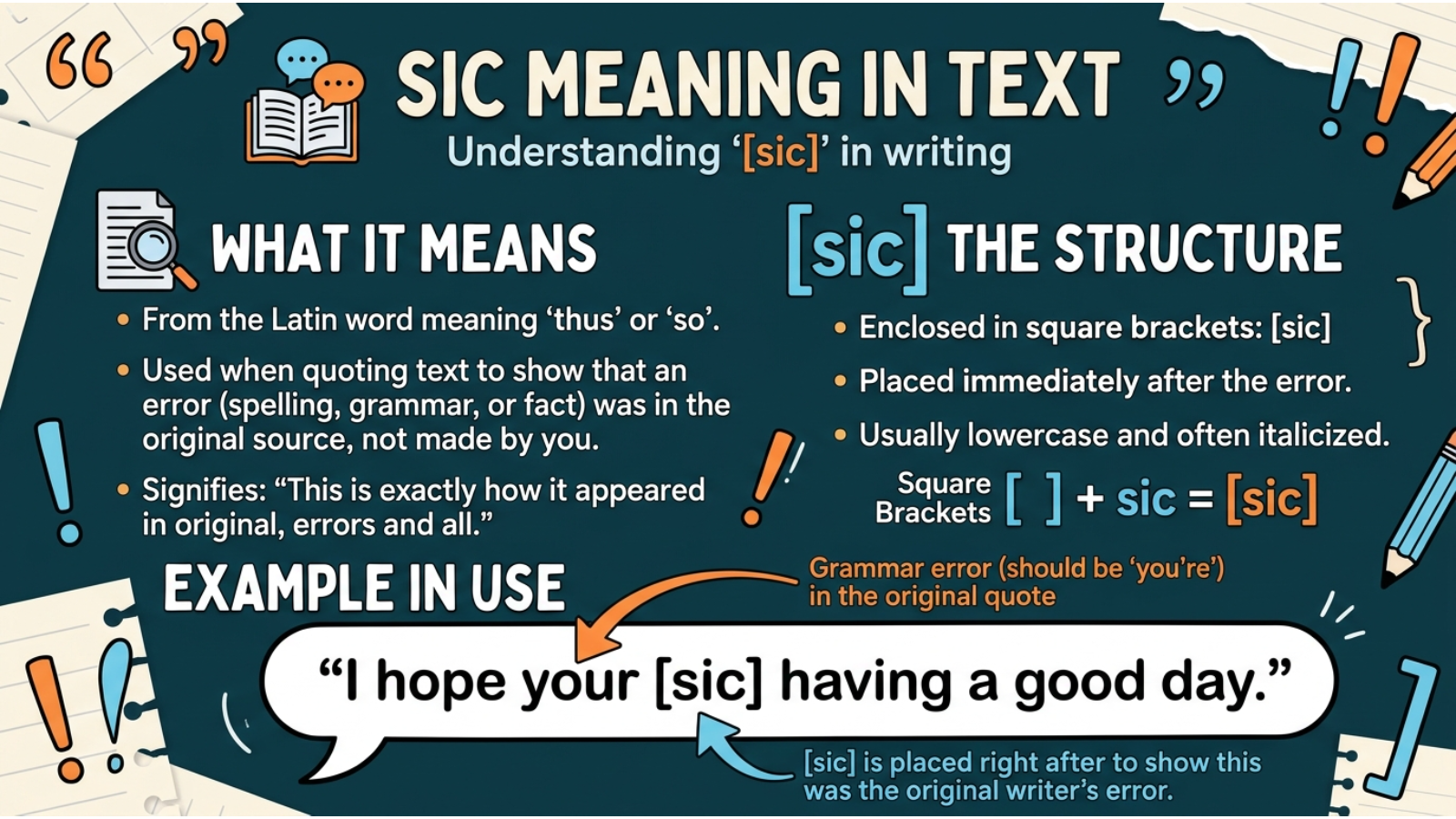
The meaning of SIC depends on the context in which someone uses it. Its most established meaning comes from the Latin word sic, meaning “thus” or “so.”
In writing, people place [sic] after an unusual spelling, grammatical mistake, or incorrect statement in a quotation. It tells readers that the original source contained that wording.
For example:
Original statement: “I definately like this movie.”
Quoted version: “I definately [sic] like this movie.”
Here, [sic] tells readers that “definately” was written that way in the original message. The person quoting it has not introduced the spelling mistake.
In casual texting, however, someone may write “sic” when they actually mean “sick.” The surrounding conversation helps determine the intended meaning.

SIC Full Form and Definition
Unlike abbreviations such as LOL and BRB, SIC does not have one universal texting full form.
Here are its main interpretations:
- Sic (Latin): Means “thus” or “so.”
- [Sic] in writing: Indicates that quoted wording appears exactly as it did in the original source.
- Sic as a possible typo: Someone may accidentally type SIC instead of “sick.”
- SIC as an abbreviation: It can represent different terms in professional, technical, or organizational settings.
Therefore, if you are searching for the SIC full form, remember that its meaning depends on the situation.
SIC Meaning in Different Contexts
1. SIC in Formal Writing
In articles, books, research papers, and other written documents, [sic] is used to preserve the accuracy of a quotation.
For example:
“The report stated that the results was [sic] incorrect.”
The marker indicates that the grammatical wording appeared in the original source.
2. SIC in Text Messages
In everyday messaging, SIC may be a typing mistake or personal shorthand.
For example:
Friend: “That movie was sic!”
The sender might have intended to write “sick,” which is sometimes used as slang for something impressive or exciting.
However, it is not safe to assume this meaning every time.
3. SIC on Social Media
On platforms such as Instagram, TikTok, Snapchat, and X, you may encounter SIC in captions, comments, or shared quotations.
Its meaning depends on the post. It may be an editorial marker, a typo, or an abbreviation used by a particular community.
4. SIC in Professional Communication
In professional writing, [sic] is useful when quoting an original source without changing its wording.
However, it should not be added unnecessarily. Use it only when preserving an unusual or incorrect part of the original quotation is important to the reader.
Is SIC Rude, Offensive, or Neutral?
SIC is generally neutral, but its tone depends on how it is used.
When [sic] appears in an article or quotation, it is an editorial marker rather than an insult.
However, using [sic] to point out someone’s spelling or grammar mistake can sometimes sound critical or embarrassing, especially in a public discussion.
In casual texting, if SIC is intended to mean “sick,” it may be a positive expression.
Consider these situations:
- Neutral: Using [sic] in a research paper.
- Informative: Showing that a quotation contains an original spelling mistake.
- Casual: Writing “sic” instead of “sick.”
- Potentially critical: Highlighting someone’s mistake in a public comment.

Where Is SIC Commonly Used?
You may see SIC in several types of communication:
- Text messages and private chats
- Instagram and Facebook comments
- TikTok captions
- Online discussions and forums
- News articles and quotations
- Academic writing
- Books and research papers
- Professional reports
Its editorial use is well established in writing, while its casual texting use is less standardized.
Real-Life Conversation Examples
Here are some examples showing different ways SIC or [sic] may appear.
Friendly Example
Friend: “That was sic!”
You: “You mean sick? 😂”
This example shows a possible informal spelling or typing variation.
Casual Example
Person A: “I love this new game.”
Person B: “It’s sic!”
The sender may be using SIC as a casual spelling of “sick,” meaning impressive or exciting.
Formal Example
Writer: “The original message said, ‘I recieved [sic] your email.'”
Here, [sic] indicates that the original spelling was preserved.
Argumentative Example
Person A: “You said the meeting was yesterday.”
Person B: “Your exact words were ‘the meeting are today [sic].'”
In this example, [sic] identifies the original grammatical wording. Depending on the conversation, it could sound like the person is pointing out a mistake.
Emotional and Psychological Meaning of SIC
SIC does not have one specific emotional or psychological meaning.
Its interpretation depends on the purpose of the message.
- In formal writing, it communicates accuracy.
- In casual messages, it may be intended as a playful expression.
- In online discussions, it may highlight an unusual statement.
- In arguments, it can sometimes make a correction sound critical.
Remember that a short word cannot reliably reveal someone’s feelings. Read the complete message before interpreting its tone.
Origin and Background of SIC
The word sic comes from Latin and traditionally means “thus” or “so.”
It became established in written English as an editorial marker used when reproducing another person’s exact words, including mistakes or unusual wording.
Today, [sic] is commonly seen in journalism, academic writing, books, and online quotations.
Its casual appearance in digital conversations is different. People sometimes shorten words, change spellings, or make typing mistakes while messaging. This is why SIC may have different interpretations in informal communication.
SIC vs. Similar Texting Terms
Understanding similar expressions can help prevent confusion.
| Term | Meaning | Common Use |
|---|---|---|
| SIC | Latin word meaning thus or so | Quoted writing |
| [sic] | Original wording reproduced exactly | Articles and quotations |
| Sick | Impressive or excellent (slang) | Casual conversations |
| FR | For real | Agreement or emphasis |
| TBH | To be honest | Sharing an opinion |
| LOL | Laughing out loud | Showing amusement |
| SMH | Shaking my head | Disbelief or disappointment |
Notice that SIC and sick are not automatically interchangeable. Their meanings depend on spelling and context.
When Should You Use SIC?
You can use [sic] when quoting an original statement that contains an unusual spelling, grammatical error, or wording that might otherwise appear to be your mistake.
For example:
“The customer wrote, ‘I recieved [sic] the package yesterday.'”
This makes it clear that the original spelling has been preserved.
In casual conversations, avoid using SIC if the other person might misunderstand it. Writing “sick,” “awesome,” or “excellent” is usually clearer.

When Should You Avoid Using SIC?
Avoid using [sic] unnecessarily, especially when the original wording does not need special attention.
You should also avoid using it simply to embarrass someone for a spelling or grammar mistake.
In everyday communication, consider your audience before using unfamiliar abbreviations.
Polite Alternatives to SIC
If you are using SIC to communicate that something is impressive, consider these alternatives:
- Awesome
- Amazing
- Excellent
- Cool
- Fantastic
- Impressive
- Great
If you are quoting someone and want to explain an original error, you can write:
- “Spelling as in the original.”
- “Original wording preserved.”
- “Quoted exactly as written.”
These expressions can make your message easier to understand.
Why Do People Use SIC?
People use SIC for different reasons depending on the situation.
In formal writing, it helps maintain the accuracy of quotations. Writers can reproduce the original words without making readers think they introduced an error.
In casual communication, people may use shortened spellings to save time or express themselves informally.
Common reasons include:
- Keeping original quotations accurate.
- Showing that an error belongs to the original source.
- Using informal internet language.
- Communicating quickly.
- Following the language style of an online community.
Is SIC Safe for Social Media?
Yes. SIC is generally safe to use on social media.
However, if you use [sic] to highlight another person’s spelling mistake, consider how your message may sound to others.
For a friendly conversation, it is usually better to correct someone politely rather than publicly draw attention to a minor error.
If you mean “sick” as slang, writing the complete word is clearer and less likely to cause confusion.
Common Misunderstandings About SIC
Some people assume SIC always means “sick,” but this is not correct.
Other common misunderstandings include:
- Thinking SIC always has a texting full form.
- Confusing the Latin word with modern internet slang.
- Assuming [sic] is an insult.
- Believing that SIC and sick have exactly the same meaning.
- Ignoring the sentence in which the word appears.
The best way to understand SIC is to check whether it appears in a quotation, formal document, or casual message.
Variations and Types of SIC
SIC may appear in several forms:
- sic: The lowercase Latin word.
- SIC: The uppercase form, sometimes used as an abbreviation.
- [sic]: The common editorial form used in quotations.
- sic!: May appear as an informal spelling or stylistic expression.
- sick: A separate English word that can mean ill or, in slang, impressive.
The brackets in [sic] are especially important because they commonly identify its editorial use.
How to Respond When Someone Uses SIC
Your response should depend on the context.
If someone writes “sic” in a casual message:
You can ask, “Do you mean sick?”
If someone uses [sic] in an article:
Understand that the original wording has been preserved.
If someone uses SIC in a confusing comment:
You can simply reply, “What do you mean by SIC?”
Asking for clarification is better than making an incorrect assumption.
Regional and Cultural Usage
The editorial use of [sic] is recognized in English-language writing across many countries.
However, casual texting habits can differ between regions, age groups, and online communities.
A person in one community may understand an abbreviation that another person has never encountered.
This is especially common in international conversations where people use different varieties of English.
FAQs About SIC Meaning in Text
1. What does SIC mean in text?
SIC has different interpretations. In writing, [sic] indicates that quoted wording appears exactly as it did in the original source. In casual messages, it may be a typo for “sick.”
2. What is the full form of SIC?
SIC does not have one universal full form. The Latin word means “thus” or “so,” while SIC can represent other abbreviations in different fields.
3. Does SIC mean sick in texting?
Not necessarily. Someone may type SIC when intending to write “sick,” but the two words have different standard spellings and meanings.
4. Is SIC rude or offensive?
No, SIC is not inherently rude. However, using [sic] to highlight another person’s mistake can sometimes sound critical.
5. What does [sic] mean in a sentence?
It shows that the unusual spelling, grammatical mistake, or wording appeared in the original quotation and was not added by the person quoting it.
6. Is SIC the same as sick?
No. SIC is a Latin word and an editorial marker in writing. Sick is an English word that can mean ill or impressive in informal slang.
Conclusion
The sic meaning in text depends on the situation. Its most established use is the Latin expression meaning “thus” or “so,” while [sic] is an editorial marker that shows when unusual or incorrect wording has been copied directly from an original source.
In casual texting, SIC may sometimes be a typo for “sick” or an informal expression, but this is not a universal meaning. Therefore, always consider the complete message before deciding what someone means.
If you see SIC in an article, social media comment, or private chat, understanding the context will help you avoid confusion and communicate more clearly.

Sara Taylor is a passionate English content writer who specializes in word meanings, spelling comparisons, and modern slang explanations. She creates easy-to-understand articles that help readers avoid common English mistakes and improve their writing skills. Her content focuses on simple learning, real-life examples, and clear explanations for everyday readers.