Have you ever written a sentence and stopped to wonder whether you should use complimented or complemented? You’re not alone. These two words sound almost exactly the same, which makes them easy to confuse.
Many people search for complimented or complemented because they want to use the correct word in school assignments, work emails, social media posts, or everyday conversations. Even native English speakers sometimes mix them up.
The confusion happens because both words have positive meanings, but they are used in different situations. One relates to praise, while the other relates to something that completes or improves something else.
Understanding the difference is important because using the wrong word can change the meaning of your sentence. Whether you’re a student, writer, professional, or English learner, knowing when to use each word can improve your communication.
In this guide, you’ll learn the meaning, examples, usage, differences, common mistakes, and simple explanations in easy English.
Complimented or Complemented – Quick Answer
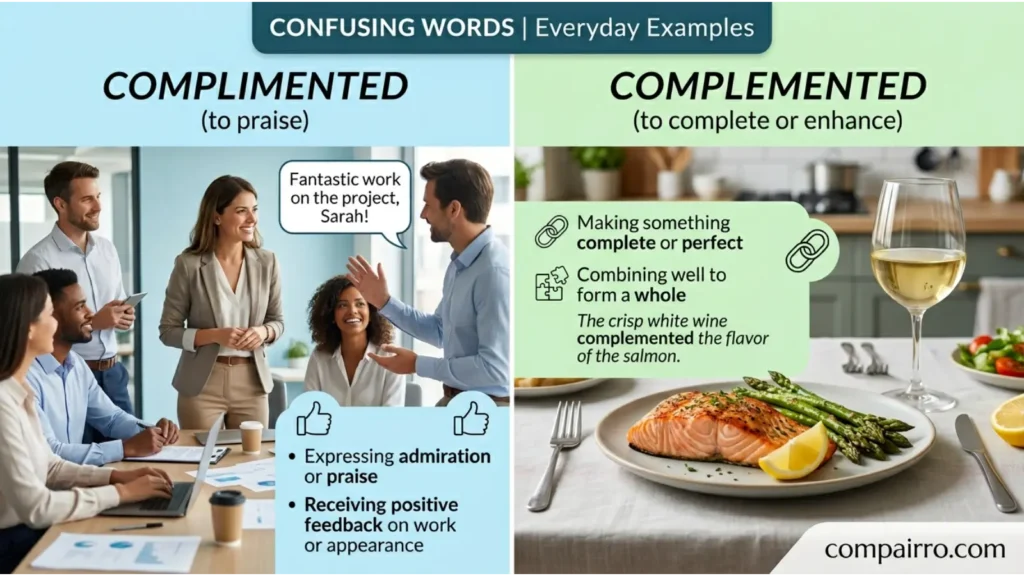
👉 Complimented = praised or said something nice about someone.
👉 Complemented = completed, matched, or improved something.
Examples
1 She complimented my new haircut.
2 The red tie complemented his black suit.
3 The fresh vegetables complemented the meal perfectly.
Simple Rule
👉 Compliment = Praise
👉 Complement = Complete
Remember: If you’re talking about giving praise, use complimented. If something matches or improves something else, use complemented.
The Origin of Complimented or Complemented
Although these words sound alike, they come from different origins.
- Compliment comes from a word meaning praise, respect, or polite expression.
- Complement comes from a Latin word meaning “to complete” or “fill up.”
Over time, both words became common in English. Today, they are frequently used in books, workplaces, schools, and online communication.
Because they are pronounced similarly, many people still confuse them when writing.
British English vs American English Usage
There is no major difference between British English and American English when using complimented and complemented.
| Feature | British English | American English | Notes |
|---|---|---|---|
| Complimented | Same | Same | Means praised |
| Complemented | Same | Same | Means completed or matched |
| Spelling | Same | Same | No spelling differences |
| Usage | Same | Same | Used worldwide |
Which One Should You Use?
Use complimented when talking about praise or admiration.
Use complemented when talking about things that go well together.
When Giving Praise or Admiration:
- Praising someone’s appearance
- Appreciating someone’s work
- Giving positive feedback
- Expressing admiration
Use Complemented When:
- Discussing fashion combinations
- Talking about matching colors
- Describing food pairings
- Explaining how things work well together
Formal and Informal Usage
- Both words can be used in formal writing.
- Both are common in everyday conversation.
- They are appropriate for school and workplace communication.
Common Mistakes With Complimented or Complemented
Mistake 1
❌ The teacher complemented my presentation.
✔ If the teacher praised your presentation, use complimented.
✅ The teacher complimented my presentation.
Mistake 2
❌ The blue curtains complimented the room.
✔ Curtains cannot praise a room. They match the room.
✅ The blue curtains complemented the room.
Mistake 3
❌ Her shoes complimented her dress.
✔ Shoes do not give praise.
✅ Her shoes complemented her dress.
Mistake 4
❌ He complemented me on my hard work.
✔ He gave praise, not completion.
✅ He complimented me on my hard work.
Complimented or Complemented in Everyday Examples
Work
✅ My manager complimented me on completing the project early.
✅ Her communication skills complemented the team’s strengths.
School
✅ The teacher complimented Sarah’s essay.
✅ The pictures complemented the science report.
Social Media
✅ Hundreds of followers complimented her artwork.
✅ The music complemented the video perfectly.
Daily Life
✅ My friend complimented my cooking.
✅ The sauce complemented the meal.
Text Messages
✅ “Thanks for complimenting my new profile picture!”
✅ “Those colors really complement each other.”
Complimented or Complemented – Google Trends & Usage Data
Many people search for complimented or complemented because these words sound alike but have different meanings.
Why People Search This Keyword
- Similar pronunciation
- Common writing mistakes
- School assignments
- Professional communication
- Grammar improvement
Popular Countries
This keyword is frequently searched in:
- United States
- United Kingdom
- India
- Pakistan
- Canada
- Australia
Search Trends
Searches often increase during:
- School terms
- Grammar lessons
- Writing projects
- Job application seasons
The confusion between praise and completion makes this one of the most searched English word comparisons.
Comparison Table: Complimented or Complemented
| Feature | Complimented | Complemented |
|---|---|---|
| Meaning | Praised someone | Matched or completed something |
| Related Idea | Admiration | Improvement |
| Used With People | Often | Sometimes |
| Used With Objects | Rarely | Frequently |
| Example | She complimented me. | The colors complemented each other. |
| Memory Tip | Compliment = Praise | Complement = Complete |
Complimented or Complemented in Professional Life
These words appear regularly in professional settings.
Complimented
- Performance reviews
- Employee recognition
- Customer feedback
- Team appreciation
Example:
✅ The director complimented the team for their hard work.
Complemented
- Design discussions
- Marketing campaigns
- Business strategies
- Product development
Example:
✅ The new software complemented the company’s existing tools.
Using the correct word helps create professional and accurate communication.
Complimented or Complemented for Students or Beginners

Many students struggle because the words sound almost identical.
Common Learning Confusion
- Similar pronunciation
- Similar spelling
- Positive meanings
- Lack of practice
Easy Learning Tips
- Focus on the meaning first.
- Read example sentences daily.
- Practice writing both words.
- Use memory tricks.
The more examples you see, the easier it becomes to choose the correct word.
Signs or Characteristics Related to Complimented or Complemented
Characteristics of Complimented
- Involves praise
- Usually directed at a person
- Shows appreciation
- Creates positive feelings
- Often used in conversations
Characteristics of Complemented
- Involves matching or improving
- Often used for objects or ideas
- Shows balance
- Creates harmony
- Common in design and fashion
Shared Characteristics
- Sound similar
- Frequently confused
- Used in formal and informal English
- Common in writing and speaking
Simple Trick to Remember Complimented or Complemented
👉 Compliment = Praise
👉 Complement = Complete
Think of it this way:
If your friend says:
“Your new jacket looks great!”
👉 They complimented you.
If your jacket matches your shoes perfectly:
👉 The shoes complemented the jacket.
A simple memory tip:
“I give a compliment. Things complement each other.”
FAQS:
1. What is the difference between complimented and complemented?
Complimented means praised someone. Complemented means matched or improved something.
2. Which word means giving praise?
The correct word is complimented.
3. Which word means something goes well together?
The correct word is complemented.
4. Are complimented and complemented homophones?
Yes. They sound very similar but have different meanings.
5. Can complemented be used for people?
Yes. A person’s skills can complement another person’s skills.
6. Is complimented used in professional writing?
Yes. It is often used for recognition and positive feedback.
7. How can I remember the difference easily?
Remember: Compliment = Praise and Complement = Complete.
Conclusion
The difference between complimented or complemented is simple once you know the meanings. Complimented is used when someone gives praise or admiration. Complemented is used when something matches, improves, or completes something else.
These words may sound alike, but they serve different purposes in English. Using the correct one can make your writing clearer and more professional.
A final memory rule:
👉 Compliment = Praise
👉 Complement = Complete
Keep this rule in mind, and you’ll rarely confuse these words again.

Sara Taylor is a passionate English content writer who specializes in word meanings, spelling comparisons, and modern slang explanations. She creates easy-to-understand articles that help readers avoid common English mistakes and improve their writing skills. Her content focuses on simple learning, real-life examples, and clear explanations for everyday readers.