Have you ever stopped while writing a sentence and wondered whether to use effect or affect? You’re not alone. Many people confuse these two words because they sound similar and are closely related in meaning.
This confusion happens in school assignments, workplace emails, social media posts, text messages, and everyday conversations. Even native English speakers sometimes mix them up.
The good news is that understanding the difference between effect or affect is easier than it seems. Once you learn a simple rule, you can use both words correctly and confidently.
People often search for this topic because they want to improve their writing, avoid grammar mistakes, and communicate more clearly. Whether you are a student, professional, or English learner, knowing when to use each word can make your writing look more polished.
In this guide, you’ll learn the meaning, examples, usage, differences, common mistakes, and simple explanations in easy English.
Effect or Affect – Quick Answer
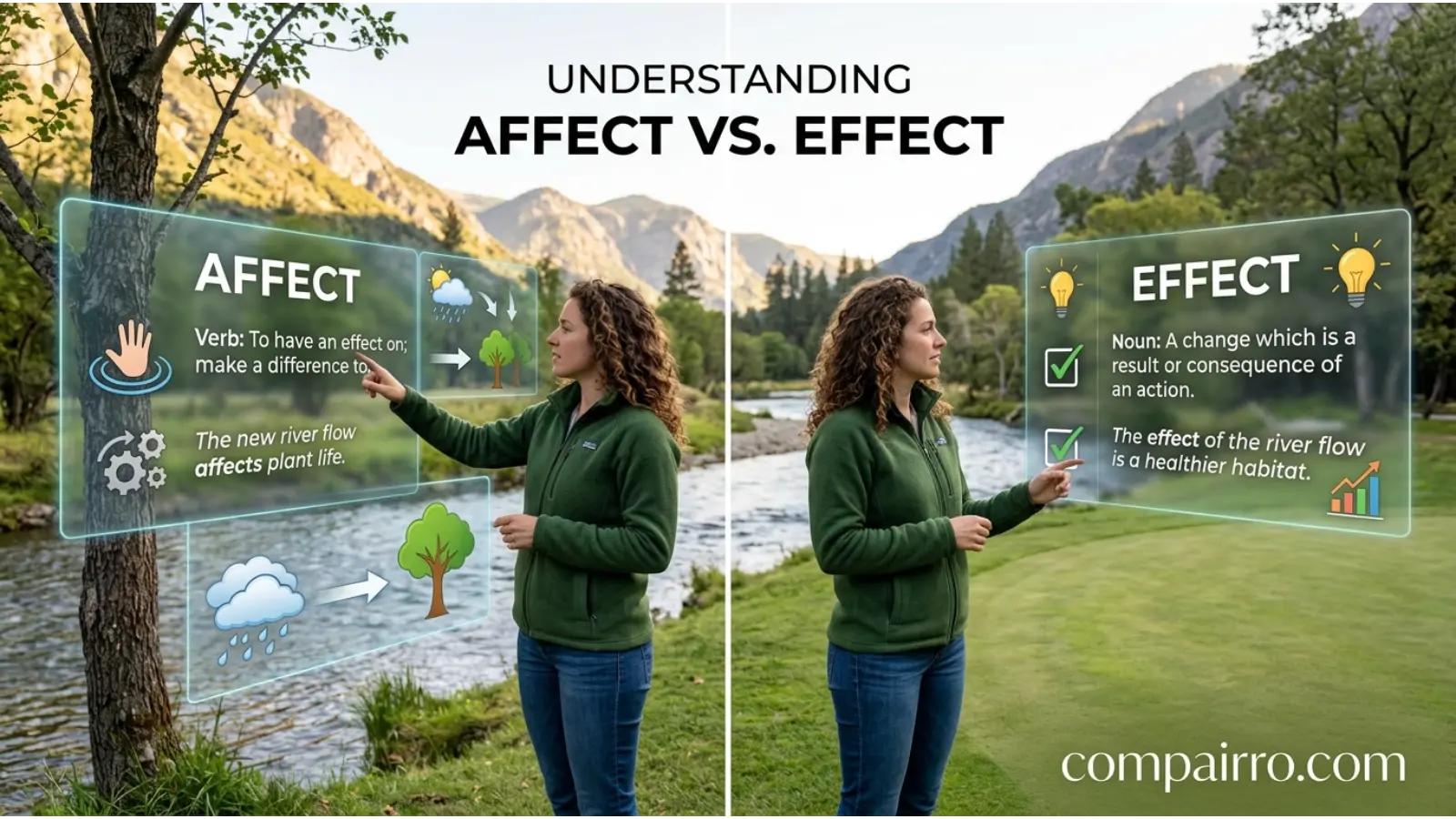
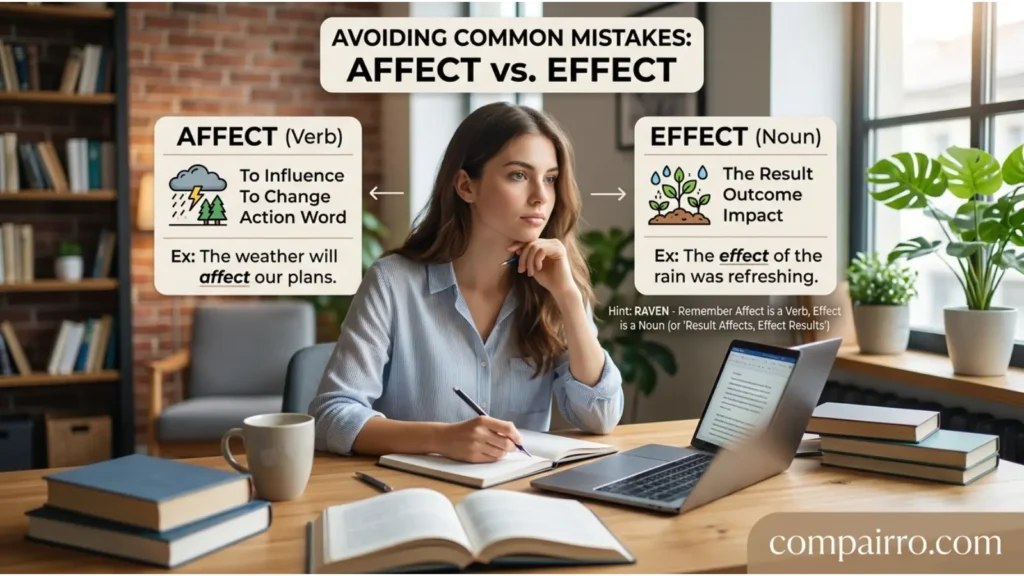
👉 Affect = to influence or change something (usually a verb)
👉 Effect = the result or outcome of a change (usually a noun)
Examples
1 The weather can affect your mood.
2 Lack of sleep can affect your health.
3 The new policy had a positive effect on employees.
4 Exercise has a good effect on the body.
Simple Rule
👉 Affect = Action
👉 Effect = End Result
Remember:
Affect causes something.
Effect is what happens because of it.
The Origin of Effect or Affect
Both words come from Latin roots.
- Affect comes from the Latin word afficere, meaning “to influence” or “to act upon.”
- Effect comes from the Latin word effectus, meaning “result” or “outcome.”
These words have been used in English for hundreds of years. Because they are related in meaning and sound similar, they often create confusion for writers and learners.
Today, they are commonly used in education, business, science, news articles, and online content.
British English vs American English Usage
There is no significant difference between British English and American English when using effect and affect.
| Feature | British English | American English | Notes |
|---|---|---|---|
| Affect meaning | Same | Same | Means to influence |
| Effect meaning | Same | Same | Means result or outcome |
| Spelling | Affect / Effect | Affect / Effect | No spelling differences |
| Usage rules | Same | Same | Grammar rules are identical |
Which One Should You Use?
Use affect when talking about influencing or changing something.
Use effect when talking about the result of that influence.
When to Use “Affect” Correctly:
- Writing about influence or impact
- Discussing emotions
- Talking about changes in behavior
- Explaining causes
Use Effect When:
- Talking about results
- Describing outcomes
- Writing reports
- Explaining consequences
Formal vs Informal Use
Both words are suitable for:
- Academic writing
- Business communication
- Professional reports
- Social media posts
- Everyday conversations
Common Mistakes With Effect or Affect
Mistake 1
❌ The rain had a bad affect on the game.
✔ The rain had a bad effect on the game.
Explanation: Here we need a result, so use effect.
Mistake 2
❌ Stress can effect your health.
✔ Stress can affect your health.
Explanation: Stress influences health, so use affect.
Mistake 3
❌ The new law will have a positive affect.
✔ The new law will have a positive effect.
Explanation: The sentence talks about a result.
Mistake 4
❌ Social media effects young people every day.
✔ Social media affects young people every day.
Explanation: Social media influences people, so affect is correct.
Effect or Affect in Everyday Examples
Work
- The manager’s feedback can affect employee performance.
- The training program had a positive effect on productivity.
School
- Missing classes can affect grades.
- Good study habits have a positive effect on learning.
Social Media
- Online comments can affect confidence.
- Viral content can have a huge effect on public opinion.
Daily Life
- Healthy eating can affect your energy level.
- Exercise has a positive effect on health.
Text Messages
- Your words may affect someone’s feelings.
- The encouraging message had a good effect on her mood.
Effect or Affect – Google Trends & Usage Data

The keyword effect or affect remains one of the most searched grammar topics online.
Why People Search It
- Similar pronunciation
- Common writing mistakes
- School assignments
- Workplace communication
- English learning
Popular Countries
People frequently search for this topic in:
- United States
- United Kingdom
- India
- Pakistan
- Canada
- Australia
Search Trends
Interest in this topic stays strong throughout the year because students, professionals, and English learners regularly encounter these words.
Social Media Popularity
Grammar tips about effect and affect are popular on:
- X
- Educational websites
- Language-learning apps
Comparison Table: Effect or Affect
| Feature | Affect | Effect |
|---|---|---|
| Part of Speech | Usually Verb | Usually Noun |
| Meaning | To influence | A result or outcome |
| Question Answered | What caused change? | What was the result? |
| Example | Noise affects sleep. | Noise has an effect on sleep. |
| Memory Tip | Action | End Result |
| Common Usage | Influence | Result |
Effect or Affect in Professional Life
Using these words correctly is important in professional communication.
Examples:
- Reports often discuss factors that affect performance.
- Business leaders analyze the effects of company decisions.
- Researchers study how different variables affect results.
- Managers evaluate the effects of workplace policies.
Correct usage helps make writing clearer and more professional.
Effect or Affect for Students or Beginners
Many students struggle because both words sound alike.
Common Confusion
- Similar pronunciation
- Related meanings
- Both appear in formal writing
Easy Learning Tips
- Learn one simple rule first.
- Practice with short sentences.
- Read examples every day.
- Check whether the word means “influence” or “result.”
The more examples you see, the easier it becomes.
Signs or Characteristics Related to Effect or Affect
Characteristics of Affect
- Usually acts as a verb
- Shows influence or change
- Often appears before a noun
- Describes an action
Characteristics of Effect
- Usually acts as a noun
- Refers to a result
- Describes an outcome
- Often follows words like “an,” “the,” or “a”
Common Patterns
- Affect → Cause
- Effect → Result
- Affect → Influence
- Effect → Outcome
Simple Trick to Remember Effect or Affect
Easy Memory Trick
👉 Affect = Action
👉 Effect = End Result
Think of it this way:
- The teacher’s advice affects the student.
- Better study habits are the effect of that advice.
Another example:
- Rain affects the roads.
- Wet roads are the effect of the rain.
If something is causing change, choose affect.
If something is the result of change, choose effect.
FAQS:
1. What is the difference between effect and affect?
Affect usually means to influence, while effect usually means the result of that influence.
2. Is affect a verb?
Yes. In most cases, affect is used as a verb.
3. Is effect a noun?
Yes. In most cases, effect is used as a noun.
4. Which word is used more often?
Both are common, but affect is often used when discussing influence and effect when discussing results.
5. Can effect ever be a verb?
Yes, but this use is less common and usually appears in formal writing.
6. Why do people confuse effect and affect?
They sound similar and have related meanings.
7. What is the easiest way to remember them?
Remember: Affect = Action, Effect = End Result.
Conclusion
Understanding effect or affect does not have to be difficult. The main difference is simple: affect usually means to influence something, while effect usually means the result of that influence.
These words are common in school, work, social media, and everyday conversations, so learning them can improve your writing and communication.
The easiest memory rule is:
👉 Affect = Action
👉 Effect = End Result
Once you remember this simple trick, choosing between effect and affect becomes much easier.

Sara Taylor is a passionate English content writer who specializes in word meanings, spelling comparisons, and modern slang explanations. She creates easy-to-understand articles that help readers avoid common English mistakes and improve their writing skills. Her content focuses on simple learning, real-life examples, and clear explanations for everyday readers.