Have you ever been writing a sentence and suddenly stopped because you were not sure whether to write realises or realizes? Many students, writers, and even professionals get confused here. It looks like both are correct, but which one should you use?
This confusion happens often in school assignments, emails, social media posts, and even in workplace writing. You might see “realizes” in American books and “realises” in British articles. Because of this difference, people often think one of them is wrong—but that is not true.
In everyday life, we see this word in many places. For example:
- Reading English books
- Watching movies with subtitles
- Writing essays at school
- Chatting online or on social media
- Sending professional emails
Understanding the correct usage is important because it helps you write clearly and confidently. It also makes your English look more natural, depending on whether you are using British or American style.
Many learners mix both forms in one paragraph, which can make writing look inconsistent. That’s why knowing the difference is useful for exams, content writing, blogging, and communication.
In this guide, you’ll learn the meaning, examples, usage, differences, common mistakes, and simple explanations in easy English.
REALISES OR REALIZES – QUICK ANSWER
👉 Realises (British English) = to understand or become aware of something
👉 Realizes (American English) = same meaning, different spelling
Both words mean: to suddenly understand something clearly.
Examples:
- She realises she made a mistake. ✅ (UK)
- She realizes she made a mistake. ✅ (US)
- I didn’t realize the truth earlier. ✅
Simple rule:
👉 Use “realises” for British English and “realizes” for American English.
THE ORIGIN OF REALISES OR REALIZES
The word comes from the root verb “realise/realize”, which means “to make real” or “to understand clearly.”
- It comes from old French “réaliser”
- It later entered English in the 1600s
- The spelling changed over time in different regions
British English kept the spelling “realise” (with “s”)
American English changed it to “realize” (with “z”)
This change happened because American English became simpler in spelling during the 18th–19th centuries.
Today, both forms are widely accepted depending on the region.
BRITISH ENGLISH VS AMERICAN ENGLISH USAGE
The difference is only in spelling, not in meaning.
| Feature | British English | American English | Notes |
|---|---|---|---|
| Spelling | realises | realizes | Same meaning |
| Verb form | realise | realize | Both correct |
| Usage | UK, Australia, etc. | US, Canada | Regional choice |
| Meaning | Understand something | Understand something | No difference |
WHICH ONE SHOULD YOU USE?
Choosing between realises or realizes depends on your audience.
- Use realises if you are writing for:
- UK readers
- Australia
- New Zealand
- Formal British exams
- Use realizes if you are writing for:
- USA readers
- Canadian American-style content
- Global websites using US English
- In casual chatting:
- Both are fine, but consistency matters most
- In school or exams:
- Follow the style your teacher uses
✔ Best rule: Don’t mix both in the same document.
COMMON MISTAKES WITH REALISES OR REALIZES
Mistake 1
❌ I realizes the problem.
✔ Wrong verb form. “I” takes “realize/realise,” not “realizes.”
Mistake 2
❌ She realisesed the truth.
✔ Wrong spelling. The correct form is “realised” or “realized.”
Mistake 3
❌ Mixing both forms in one paragraph
✔ Choose only one style (British or American).
Mistake 4
❌ Using wrong tense
❌ He realize yesterday the mistake.
✔ He realized (US) / realised (UK) yesterday the mistake.
REALISES OR REALIZES IN EVERYDAY EXAMPLES
Work:
- She realizes the deadline is tomorrow.
- He realises the report is incomplete.
School:
- The student realizes the answer is wrong.
- She realises she forgot her homework.
Social Media:
- He realizes his post got many likes.
- She realises the trend is changing.
Daily Life:
- I realize I left my keys at home.
- He realises the bus has already left.
Text Messages:
- “I just realized I missed your call.”
- “She realises she was late.”
REALISES OR REALIZES – GOOGLE TRENDS & USAGE DATA
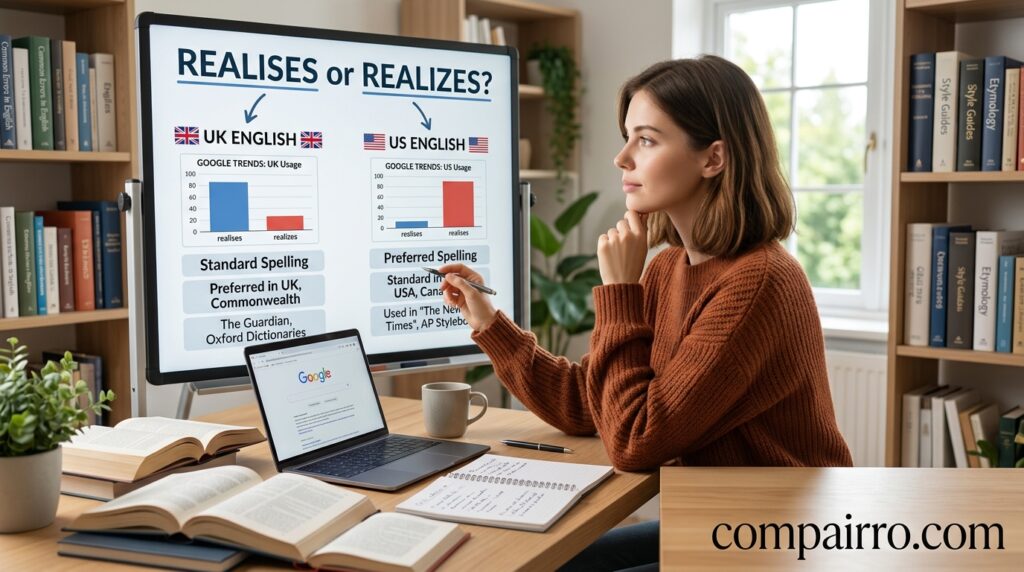
People search this keyword because English learners often get confused between British and American spelling.
Popular countries searching this topic:
- India
- Pakistan
- United States
- United Kingdom
- Canada
- Australia
Search trends show that:
- Students frequently search before exams
- Bloggers search for SEO writing consistency
- ESL learners want correct usage
- Social media users want correct spelling
The confusion mostly comes from mixed English exposure on the internet.
COMPARISON TABLE: REALISES OR REALIZES
| Feature | Realises | Realizes |
|---|---|---|
| Meaning | Understands something | Understands something |
| Region | British English | American English |
| Spelling | S form | Z form |
| Usage | Formal UK writing | Formal US writing |
| Difficulty | Easy | Easy |
REALISES OR REALIZES IN PROFESSIONAL LIFE
In professional writing, consistency is very important.
- Business emails must follow one style
- Reports should not mix UK and US spelling
- Websites should choose one standard
- Marketing content must match target audience
Example:
- UK company: “We realise the importance of your feedback.”
- US company: “We realize the importance of your feedback.”
✔ Tip: Always check your audience before writing.
REALISES OR REALIZES FOR STUDENTS OR BEGINNERS

Many beginners get confused because:
- They learn both UK and US English
- Online content mixes spelling styles
- Teachers may not explain the difference clearly
Easy tips:
- Pick one style and stick to it
- Practice writing short sentences daily
- Read books from one English type
SIGNS OR CHARACTERISTICS RELATED TO REALISES OR REALIZES
- Shows understanding
- Used in emotional moments
- Appears in storytelling
- Common in reflective thinking
- Used when someone learns a lesson
- Often appears after mistakes
- Found in both formal and informal writing
SIMPLE TRICK TO REMEMBER REALISES OR REALIZES
👉 Think of it like this:
- British = S = Simple UK style
- American = Z = Zippy US style
Think of it this way:
If you see “S,” think UK. If you see “Z,” think USA.
Example:
- UK school book → realises
- US movie subtitle → realizes
FAQS:
1. Is realises or realizes correct?
Both are correct. It depends on British or American English.
2. What is the meaning of realises/realizes?
It means to suddenly understand something.
3. Which is British English?
“Realises” is British English.
5. Can I mix both in one essay?
No, you should not mix them.
6. Is meaning different?
No, both have the same meaning.
7. Which one should I learn first?
Learn the one your school or job follows.
CONCLUSION
The difference between realises or realizes is very simple. Both words mean the same thing: to understand something clearly. The only difference is spelling based on region—British English uses “realises” and American English uses “realizes.”
The most important rule is consistency. Choose one style and stick with it in your writing.
Final memory trick:
👉 S = UK (realises), Z = US (realizes)
Once you remember this, you will never get confused again.