Have you ever been writing an email, school assignment, blog post, or social media caption and wondered whether to use flavor or flavour? Many English learners and even native speakers get confused because both spellings look correct.
You may see flavor in American websites, product labels, and advertisements. On the other hand, flavour often appears in British books, news articles, and educational materials. This difference can make people wonder if one spelling is wrong or if both are acceptable.
The confusion is common because English is used worldwide. Students, writers, business owners, marketers, and content creators often need to know which version fits their audience best. Understanding the difference can help you write more professionally and avoid spelling mistakes.
The good news is that both words have the same meaning. The difference is mainly based on the type of English being used.
In this guide, you’ll learn the meaning, examples, usage, differences, common mistakes, and simple explanations in easy English.
Flavor or Flavour – Quick Answer
👉 Flavor is the American English spelling.
👉 Flavour is the British English spelling.
Both words mean:
The taste of food or drink, or a special quality that makes something unique.
Examples
1 This ice cream has a chocolate flavor.
2 This ice cream has a chocolate flavour.
3 The restaurant adds local flavor/flavour to its dishes.
Simple Rule
👉 US = Flavor
👉 UK = Flavour
Remember: The meaning stays the same. Only the spelling changes.
The Origin of Flavor or Flavour
The word comes from the Old French word flaor, which referred to smell and taste. Over time, it became part of the English language.
Originally, the spelling flavour was commonly used in British English. Later, American English adopted the shorter spelling flavor.
This spelling difference follows a pattern seen in many English words, such as:
- Colour → Color
- Favour → Favor
- Honour → Honor
Today, both versions are widely accepted depending on the country and audience.
British English vs American English Usage
The main difference is spelling.
| Feature | British English | American English | Notes |
|---|---|---|---|
| Standard spelling | Flavour | Flavor | Same meaning |
| Used in schools | Yes | Yes | Depends on country |
| Used in media | Common | Common | Regional preference |
| Used in business | Common in UK | Common in US | Audience matters |
| Pronunciation | Same | Same | No major difference |
Which One Should You Use?
Choose the spelling based on your audience.
Use Flavor when:
- Writing for American readers
- Creating content for US businesses
- Using American English style guides
- Writing for US websites
Use Flavour when:
- Writing for UK readers
- Creating content for British companies
- Following British English standards
- Writing for UK schools or universities
For International Audiences
- Stay consistent.
- Do not switch between both spellings in the same document.
Common Mistakes With Flavor or Flavour
Mistake 1
❌ This product has great flavour and flavor.
✔ Use only one spelling style throughout your writing.
Mistake 2
❌ Flavor is correct and flavour is wrong.
✔ Both spellings are correct in different regions.
Mistake 3
❌ British people pronounce flavour differently.
✔ The pronunciation is generally the same.
Mistake 4
❌ Switching between flavor and flavour in one article.
✔ Choose one version and stay consistent.
Flavor or Flavour in Everyday Examples

Work
✅ Our new drink comes in a tropical flavor.
✅ Our new drink comes in a tropical flavour.
School
✅ Students discussed the flavor of different foods.
✅ Students discussed the flavour of different foods.
Social Media
✅ What’s your favorite ice cream flavor?
✅ What’s your favorite ice cream flavour?
Daily Life
✅ The soup has a rich chicken flavor.
✅ The soup has a rich chicken flavour.
Text Messages
✅ Which flavor should I buy?
✅ Which flavour should I buy?
Flavor or Flavour – Google Trends & Usage Data
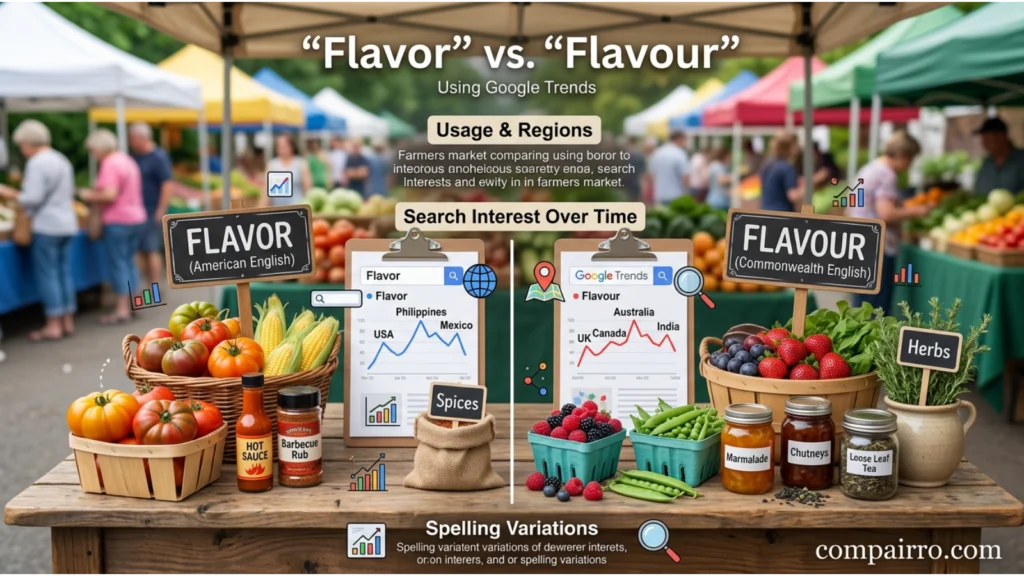
Many people search for flavor or flavour because they are unsure which spelling is correct.
Popular Search Reasons
- School assignments
- English learning
- Content writing
- SEO writing
- Business communication
- International marketing
Countries Where Searches Are Common
- United States
- United Kingdom
- India
- Pakistan
- Canada
- Australia
Search Trends
- Flavor receives more searches in the US.
- Flavour is more common in the UK and some Commonwealth countries.
- Students and writers often search the term to avoid spelling mistakes.
The keyword remains popular because English spelling differences continue to confuse learners worldwide.
Comparison Table: Flavor or Flavour
| Feature | Flavor | Flavour |
|---|---|---|
| English type | American English | British English |
| Meaning | Taste or characteristic | Taste or characteristic |
| Correct spelling | Yes | Yes |
| Used in USA | Very common | Less common |
| Used in UK | Less common | Very common |
| Pronunciation | Same | Same |
| Formal writing | Accepted in US | Accepted in UK |
Flavor or Flavour in Professional Life
Businesses often choose one spelling based on their target audience.
Examples
- US food brands usually use flavor.
- UK food brands usually use flavour.
- International companies may choose one version for consistency.
- Marketing teams often adapt spelling for different regions.
Professional writing looks more trustworthy when the spelling matches the audience’s language style.
Flavor or Flavour for Students or Beginners
Many beginners struggle because both spellings appear online.
Common Confusion
- Thinking one spelling is incorrect
- Mixing British and American English
- Switching spellings in essays
Easy Learning Tips
- Learn who your audience is.
- Use spell-check tools.
- Follow your school’s language style.
- Stay consistent throughout your writing.
With practice, choosing the correct version becomes easy.
Signs or Characteristics Related to Flavor or Flavour
Key Characteristics
- Refers to taste in food and drinks
- Can describe a special quality or style
- Has identical meanings in both spellings
- Used in everyday communication
- Common in food marketing
Common Uses
- Food packaging
- Restaurant menus
- School writing
- Advertising
- Social media content
- Product descriptions
Simple Trick to Remember Flavor or Flavour
👉 Flavor = America
👉 Flavour = Britain
Think of it this way:
- American English often removes the extra “u”.
- British English usually keeps the “u”.
Examples:
- Color → Colour
- Favor → Favour
- Honor → Honour
- Flavor → Flavour
If you remember this pattern, you’ll rarely make a mistake.
FAQs:
1. Is flavor or flavour correct?
Both are correct. The choice depends on whether you use American or British English.
2. What is the difference between flavor and flavour?
There is no difference in meaning. Only the spelling changes.
3. Which spelling is used in the USA?
Americans usually write flavor.
4. Which spelling is used in the UK?
British English uses flavour.
5. Do flavor and flavour sound different?
No. They are generally pronounced the same way.
6. Can I use both spellings in one article?
It is better to choose one spelling style and stay consistent.
7. Is flavour used in Canada and Australia?
Yes. British-style spelling, including flavour, is common in both countries.
Conclusion
The difference between flavor or flavour is simple. Both words mean the same thing and are used to describe taste or a special quality. The only real difference is spelling.
Use flavor for American English and flavour for British English. The most important rule is to stay consistent with the spelling style you choose.
A simple memory trick is:
👉 US = Flavor
👉 UK = Flavour
Once you remember that, choosing the correct spelling becomes easy.

Sara Taylor is a passionate English content writer who specializes in word meanings, spelling comparisons, and modern slang explanations. She creates easy-to-understand articles that help readers avoid common English mistakes and improve their writing skills. Her content focuses on simple learning, real-life examples, and clear explanations for everyday readers.