Have you ever studied atoms in science class and wondered if electrons are positive or negative? You may have seen pictures of atoms with tiny particles moving around a central part called the nucleus. These particles have different electric charges, and understanding them makes many science topics easier to learn.
The question “are electrons positive or negative” is common among students and beginners. It can be confusing because atoms contain electrons, protons, and neutrons, and each particle has a different role. Some students also mix up the charge of an electron with the charge of a proton.
You may come across this question in school textbooks, science exams, online lessons, educational videos, or internet searches. Knowing the correct answer can help you understand electricity, chemical reactions, static electricity, and how atoms behave.
The good news is that the answer is simple. Once you learn the charge of each particle, you can remember it easily without memorizing long scientific explanations.
Electrons are important because their movement helps explain many everyday events. For example, electric current in metal wires is mainly caused by the movement of electrons. The transfer of electrons can also make objects become electrically charged.
In this guide, you’ll learn the meaning, examples, usage, differences, common mistakes, and simple explanations in easy English.
Are Electrons Positive or Negative? – Quick Answer
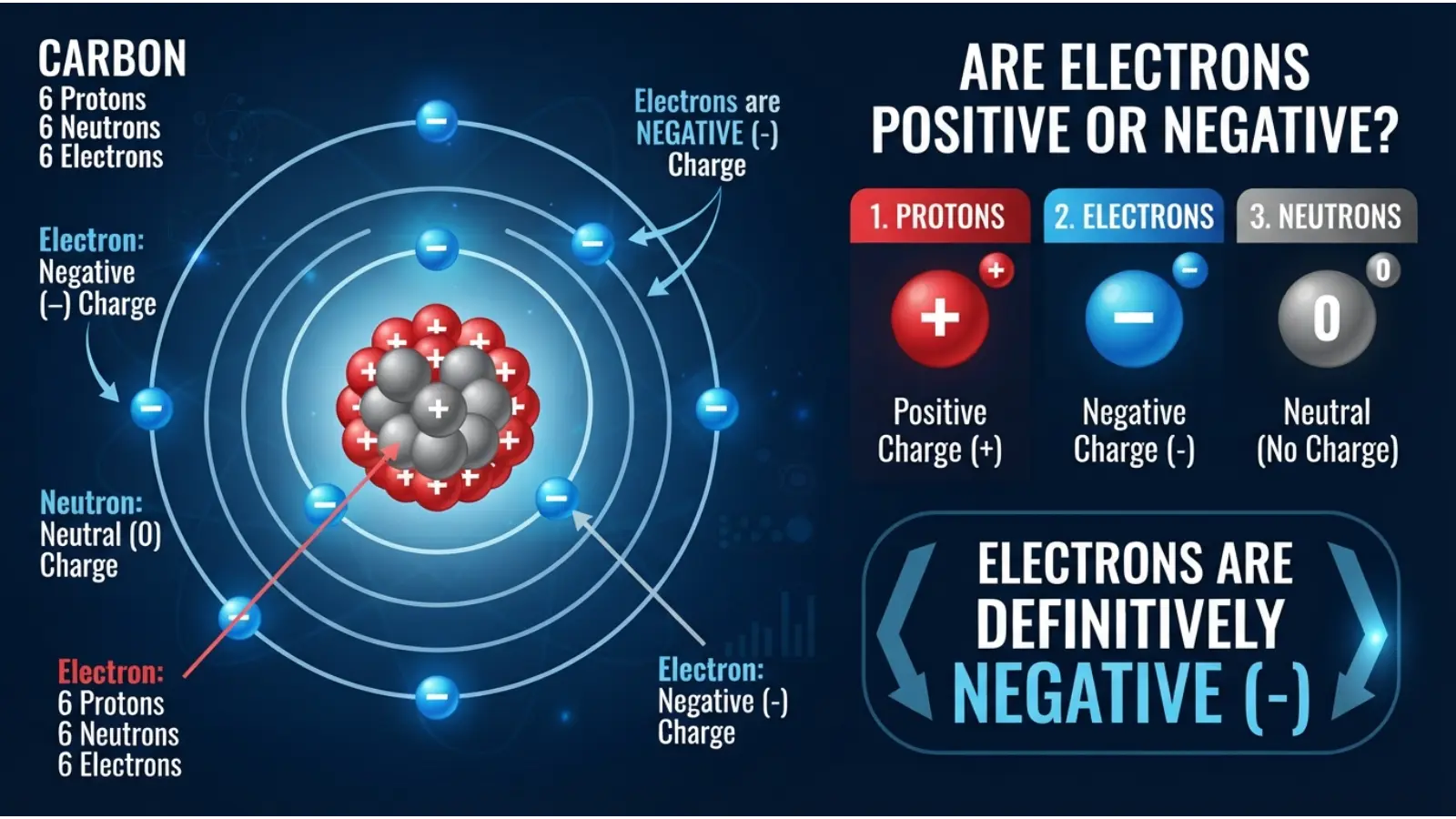
Electrons are negatively charged subatomic particles. Their electric charge is written with a minus sign (−). They are found in the space around an atom’s nucleus.
An electron has a charge of approximately \(-1.602 \times 10^{-19}\) coulombs. This is the same size of charge as a proton’s, but the sign is opposite.
In simple words:
- Electron = Negative (−)
- Proton = Positive (+)
- Neutron = Neutral (0)
Examples:
- An electron has a negative electric charge.
- A proton has a positive electric charge.
- A neutron has no net electric charge.
Simple rule: Remember that electrons are negative and protons are positive. Neutrons are neutral.
The Origin of Electrons
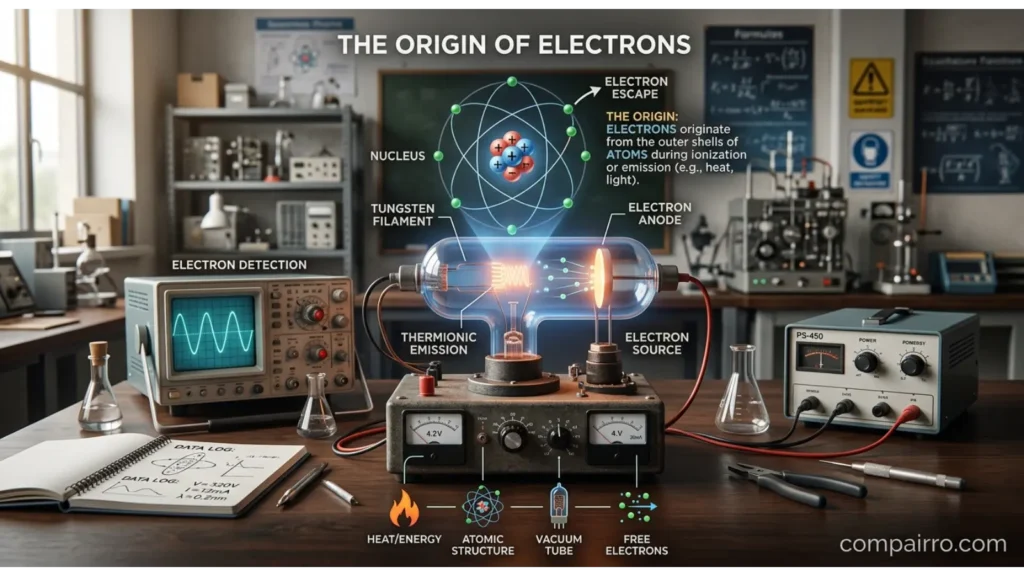
The electron is a basic particle of matter. Scientists discovered it through experiments that helped explain how atoms work.
In 1897, British physicist J. J. Thomson discovered the electron while studying rays in a discharge tube. His experiments showed that atoms contain tiny particles with a negative electric charge.
Before this discovery, many scientists believed atoms were the smallest parts of matter. The discovery of electrons showed that atoms contain even smaller parts.
Later, scientists developed better models of the atom. They learned that protons and neutrons are found in the nucleus, while electrons occupy regions around it.
Today, electrons are an important part of physics, chemistry, electronics, and many modern technologies. They help scientists explain electricity, chemical bonding, and the behavior of materials.
British English vs American English Usage
The term electron has the same meaning in British and American English. There is no difference in its spelling or electric charge.
| Feature | British English | American English | Notes |
|---|---|---|---|
| Spelling | Electron | Electron | Same spelling |
| Pronunciation | Electron | Electron | Minor accent differences may occur |
| Electric charge | Negative | Negative | Same scientific fact |
| Plural | Electrons | Electrons | Same plural form |
| Scientific use | Electron charge | Electron charge | Same meaning |
The word is also used in the same way in Pakistan, India, Canada, Australia, and other English-speaking regions.
Which One Should You Use?
If you are answering the question “are electrons positive or negative,” the correct answer is negative.
Use the following facts when studying or explaining the topic:
- For school exams: Write that electrons carry a negative electric charge.
- For science homework: Explain that electrons have a charge equal in size but opposite in sign to protons.
- For physics lessons: Use the symbol \(e^-\) to represent an electron.
- For chemistry: Remember that electrons play an important role in chemical bonds and reactions.
- For everyday explanations: Say that electrons are negatively charged particles found around an atom’s nucleus.
In formal science writing, avoid saying that electrons are positive or that they have no charge. Both statements are incorrect.

Common Mistakes About Electron Charges
Students sometimes make simple mistakes when learning about the parts of an atom. Here are four common examples and their correct explanations.
Mistake 1: Thinking electrons are positive
❌ Incorrect: Electrons have a positive charge.
✔ Correct: Electrons have a negative charge. Protons have a positive charge.
Mistake 2: Thinking electrons have no charge
❌ Incorrect: Electrons are neutral like neutrons.
✔ Correct: Electrons carry a negative charge. Neutrons have no net electric charge.
Mistake 3: Mixing up electrons and protons
❌ Incorrect: Protons are negative, and electrons are positive.
✔ Correct: Electrons are negative, while protons are positive.
Mistake 4: Thinking every atom is always neutral
❌ Incorrect: Every atom has no overall electric charge.
✔ Correct: A neutral atom has equal numbers of protons and electrons. However, an atom can gain or lose electrons and become an electrically charged ion.
Electrons in Everyday Examples
Electrons may be too small to see with your eyes, but their behavior helps explain many things around you.
1. At School
A science teacher may ask, “Are electrons positive or negative?” The correct answer is negative.
For example, if a test asks which subatomic particle has a negative charge, select electron.
2. At Work
Electrons are important in electrical engineering, electronics, and computer technology. People working in these fields study how electric charges move through materials and circuits.
For example, engineers use their knowledge of electron movement when designing electronic devices.
3. On Social Media
Educational videos and science posts often show diagrams of atoms. These diagrams usually label electrons with minus signs and protons with plus signs.
Understanding these symbols makes science content easier to follow.
4. In Daily Life
When you rub a balloon against your hair, electrons may transfer from one material to another. The balloon can gain extra electrons and become negatively charged.
This is one example of static electricity. The charged balloon may then attract small pieces of paper.
5. In Text Messages or Conversations
If a friend asks you a science question, you can give a short answer:
Friend: Are electrons positive or negative?
You: Electrons are negative. Protons are positive, and neutrons are neutral.
This is a simple and scientifically correct explanation.
Are Electrons Positive or Negative? – Google Trends and Usage Data
People search for “are electrons positive or negative” because they want a quick, clear answer to a basic science question.
Common reasons include:
- Preparing for school science tests.
- Completing physics or chemistry homework.
- Learning about atoms for the first time.
- Understanding electric charge and static electricity.
- Reviewing the difference between electrons, protons, and neutrons.
Students in the United States, United Kingdom, India, Pakistan, Canada, and Australia may search for this question while studying science.
However, the exact search popularity in each country can change over time. Without checking current Google Trends data, it would not be accurate to claim that one country has the highest search volume.
Search interest may also increase around school examinations or when students study atoms, electricity, and chemical reactions. These are reasonable explanations for search activity, not verified trends for a particular period.
The topic is especially useful for beginners because a short explanation can answer the main question while helping students understand related science concepts.
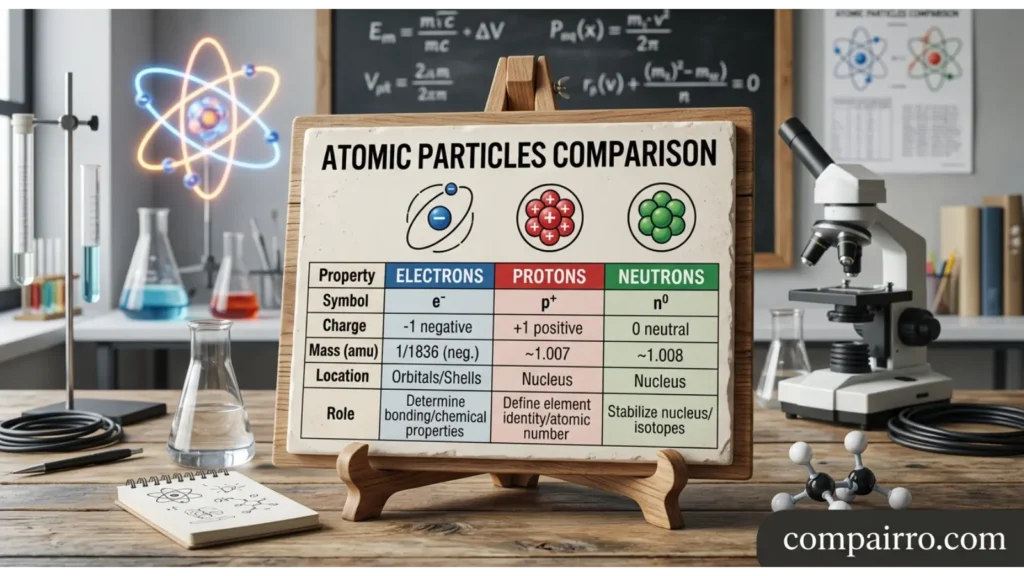
Comparison Table: Electrons, Protons, and Neutrons
Electrons, protons, and neutrons are three important subatomic particles. Their charges and locations help explain how atoms work.
| Feature | Electron | Proton | Neutron |
|---|---|---|---|
| Electric charge | Negative (−1) | Positive (+1) | Neutral (0) |
| Symbol | \(e^-\) | \(p^+\) | \(n^0\) |
| Location | Around the nucleus | Inside the nucleus | Inside the nucleus |
| Relative mass | About 1/1836 of a proton’s mass | About 1 atomic mass unit | About 1 atomic mass unit |
| Main importance | Electricity and chemical bonding | Determines the element | Helps make up the nucleus |
| Example | Electron in a copper atom | Proton in a hydrogen atom | Neutron in a carbon atom |
The charge values −1, +1, and 0 are relative charges. The electron and proton have equal charge magnitudes but opposite signs.
Electrons in Professional Life
Understanding electrons is useful in several careers and industries.
Electrical engineering: Engineers study the movement of electric charges to design circuits, power systems, and electrical equipment.
Electronics: Electronic devices, including phones, computers, and televisions, rely on the behavior of electrons in materials and components.
Chemistry: Scientists study electrons to understand how atoms form chemical bonds and react with other substances.
Physics: Physicists investigate electrons to learn about matter, electricity, magnetism, and the behavior of tiny particles.
Medical technology: Many medical tools rely on electronic systems. Some imaging methods also use physical processes involving electrons.
You do not need advanced knowledge to begin learning about these fields. Understanding that electrons have a negative charge is a useful first step.
Are Electrons Positive or Negative for Students and Beginners?
Beginners often confuse the three main subatomic particles because their names and functions must be learned together.
The easiest way to study them is to learn one fact at a time.
- Learn the charge: Electrons are negative, protons are positive, and neutrons are neutral.
- Learn their locations: Protons and neutrons are in the nucleus. Electrons occupy regions around the nucleus.
- Understand neutral atoms: Equal numbers of protons and electrons give an atom zero overall electric charge.
- Study ions: When atoms gain or lose electrons, they can become negatively or positively charged.
- Practice with questions: Test yourself by identifying the charge of each particle.
For example, a neutral atom with six protons normally has six electrons. If it gains one electron, it has one more negative charge than positive charge and becomes a negatively charged ion.
These simple steps make the topic easier to understand and remember.
Signs or Characteristics Related to Electrons
Here are the main features of electrons that every beginner should know.
- Negative charge: Every electron has the same negative electric charge.
- Very small mass: An electron is much lighter than a proton or neutron.
- Subatomic particle: An electron is smaller than an atom and is one of its basic components.
- Location around the nucleus: Electrons occupy regions around the atom’s central nucleus.
- Role in electricity: The movement of electrons explains electric current in many conductors.
- Role in chemistry: Electrons, especially those in an atom’s outer region, help determine how atoms bond and react.
- Role in ion formation: Atoms can gain or lose electrons to become ions.
- Quantum behavior: Electrons do not move around the nucleus in simple, fixed circular paths. Their behavior is described by quantum physics.
Remember that electrons are not the only particles involved in electric charge. Protons also carry charge, but it is positive.
Simple Trick to Remember Electron Charges
A memory trick can help you recall the charges of electrons, protons, and neutrons during an exam.
- Electron = Minus (−)
- Proton = Plus (+)
- Neutron = Neutral (0)
Think of it this way: the word neutral begins with “neu,” which can remind you that a neutron has no net electric charge.
You can also remember the phrase:
“Electrons are negative; protons are positive.”
Imagine three labels on a science chart: a minus sign for an electron, a plus sign for a proton, and a zero for a neutron.
Review these symbols a few times, and you will find it easier to answer questions about atomic structure.
FAQs
1. Are electrons positive or negative?
Electrons are negatively charged particles. Their charge is written with a minus sign (−).
2. Why do electrons have a negative charge?
Negative charge is a basic property of electrons. Scientists use this property to describe how electrons interact with other charged particles.
3. Are protons positive or negative?
Protons have a positive electric charge. Their charge has the same magnitude as an electron’s charge but the opposite sign.
4. Do neutrons have a positive or negative charge?
Neutrons have no net electric charge. That is why they are called neutral particles.
5. Where are electrons found in an atom?
Electrons occupy regions around the nucleus. The nucleus contains protons and, in most atoms, neutrons.
6. Can an electron become positive?
An electron does not become a positively charged electron under ordinary conditions. It remains negative, while atoms can become positive by losing electrons.
7. Why are electrons important in electricity?
The movement of electrons through materials such as metal wires helps produce electric current. Their behavior is also important in electronic devices.
Conclusion
So, are electrons positive or negative? Electrons are negative. They carry a negative electric charge and occupy regions around an atom’s nucleus.
Protons have a positive charge, while neutrons have no net charge. These three particles help explain the structure of atoms and many basic ideas in physics and chemistry.
Understanding electron charges can help you study electricity, chemical bonding, static electricity, and atomic structure. It is also a useful starting point for learning more advanced science topics.
The easiest memory rule is simple: electron = negative, proton = positive, neutron = neutral. Remember these three facts, and you will be ready to answer this question confidently in class or in a science exam.

Sara Taylor is a passionate English content writer who specializes in word meanings, spelling comparisons, and modern slang explanations. She creates easy-to-understand articles that help readers avoid common English mistakes and improve their writing skills. Her content focuses on simple learning, real-life examples, and clear explanations for everyday readers.