Imagine visiting a local market where one person sells fresh vegetables for money, while another exchanges rice for wheat without using cash. Both people are involved in trade, but they may be described using different words. This is why understanding the meaning of someone who sells or barters can help you improve your English vocabulary.
You may come across this phrase in school assignments, English grammar exercises, business conversations, workplace discussions, or online searches. Sometimes, a question asks for a person who sells goods. In other cases, it asks for someone who exchanges goods or services without money. Although these activities are related, their meanings are not exactly the same.
The correct word also depends on the situation. For example, a person who sells products is usually called a seller or vendor. A person who trades goods or services without money is called a barterer. Meanwhile, a trader may buy and sell goods or exchange them as part of a business.
Learning these words can make your writing clearer and help you choose the right answer in vocabulary quizzes, crossword puzzles, and everyday conversations. It can also help you understand the difference between selling, trading, and bartering.
In this guide, you’ll learn the meaning, examples, usage, differences, common mistakes, and simple explanations in easy English.
Someone Who Sells or Barters – Quick Answer
Someone who sells or barters is generally called a trader. However, the most accurate word depends on the activity.
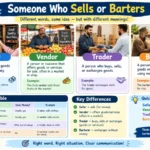
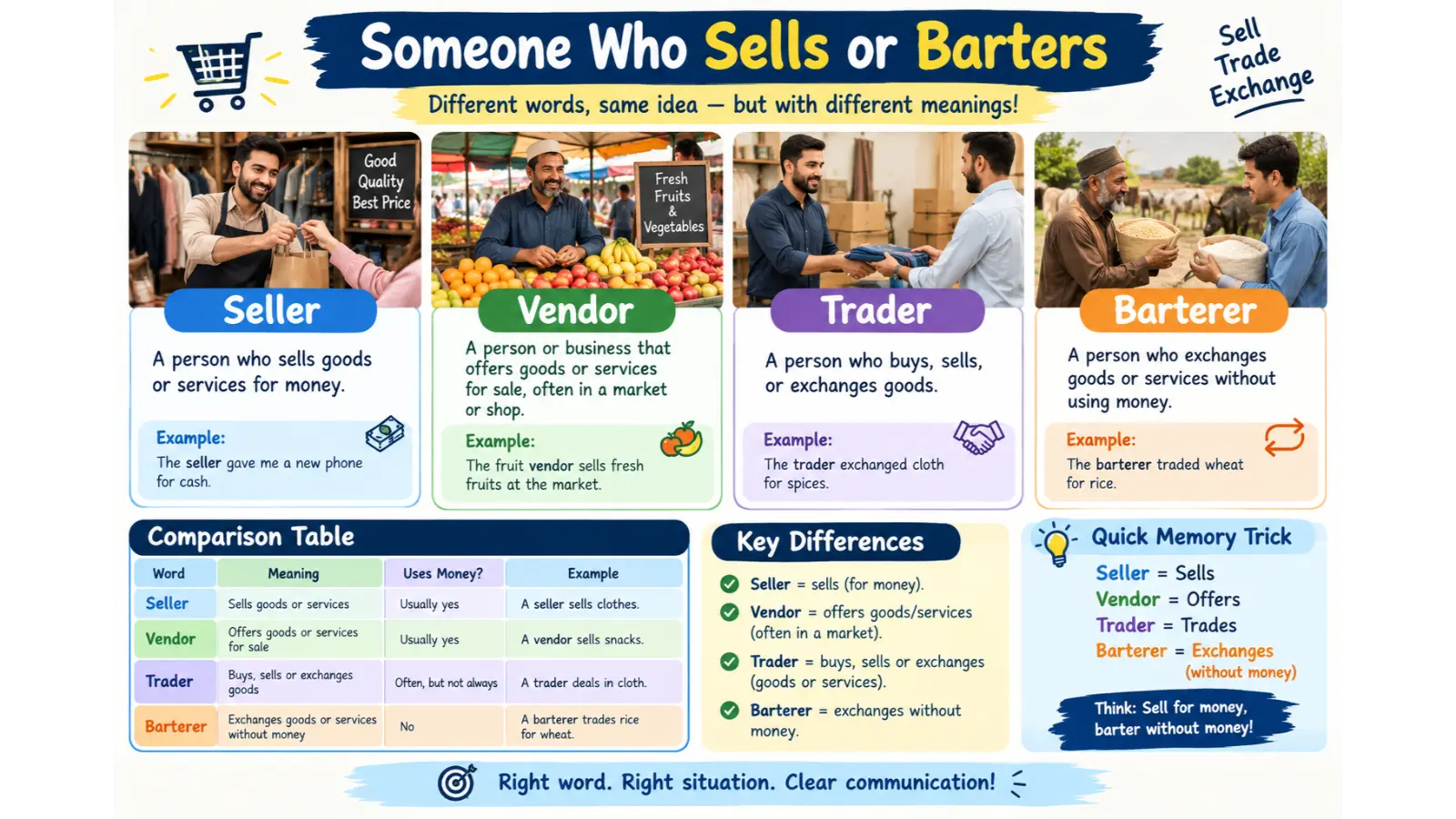
- Seller: A person who sells goods or services.
- Vendor: A person or business that offers goods or services for sale.
- Trader: A person who buys, sells, or exchanges goods.
- Barterer: A person who exchanges goods or services without using money.
Examples
- The seller sold me a new school bag.
- The street vendor sells fresh fruit.
- The trader exchanged cloth for spices.
- The barterer traded wheat for rice without paying cash.
Simple rule: Selling usually involves money, while bartering involves exchanging goods or services. A trader can be involved in either activity.
The Origin of Someone Who Sells or Barters
The words used for people who sell or exchange goods have a long history.
The word seller comes from the verb sell, which has roots in Old English. It describes someone who offers something in return for payment.
The word trade developed from older European words connected with a path, course, or way of doing business. Over time, it became linked to buying, selling, and exchanging goods.
The word barter came into English through French and is used for exchanging goods or services without money.
In the past, people often exchanged food, animals, tools, and clothing directly. Today, bartering still happens in local communities and online groups, although money is much more common in modern business.
British English vs American English Usage
British English and American English use the words seller, vendor, trader, and barterer in similar ways. However, some words are more common in certain settings.
| Feature | British English | American English | Notes |
|---|---|---|---|
| Person who sells | Seller | Seller | Common in both |
| Market seller | Market trader or vendor | Market vendor | Depends on context |
| Person who exchanges goods | Trader or barterer | Trader or barterer | Barterer is more specific |
| Person selling on the street | Street trader or vendor | Street vendor | Local usage varies |
| Business supplier | Supplier | Supplier | Often supplies other businesses |
There is no major difference in the basic meaning of these words. The best choice depends on what the person does and the type of business involved.
Which One Should You Use?
Choosing the correct word is easy when you understand the situation.
- Use seller when you mean someone who sells a product or service.
- Use vendor when referring to a person or business that sells goods, often in a market, shop, or event.
- Use trader when the person buys and sells goods or takes part in trade.
- Use barterer when the person exchanges goods or services without money.
- Use merchant when describing someone involved in buying and selling goods as a business.
- Use dealer when the person sells or trades a particular type of product, such as cars.
For formal writing, choose the most precise term. For example, vendor may be suitable for a market stall owner, while barterer is better when the main activity is exchanging goods without money.
In casual conversation, seller is often the easiest word to understand.
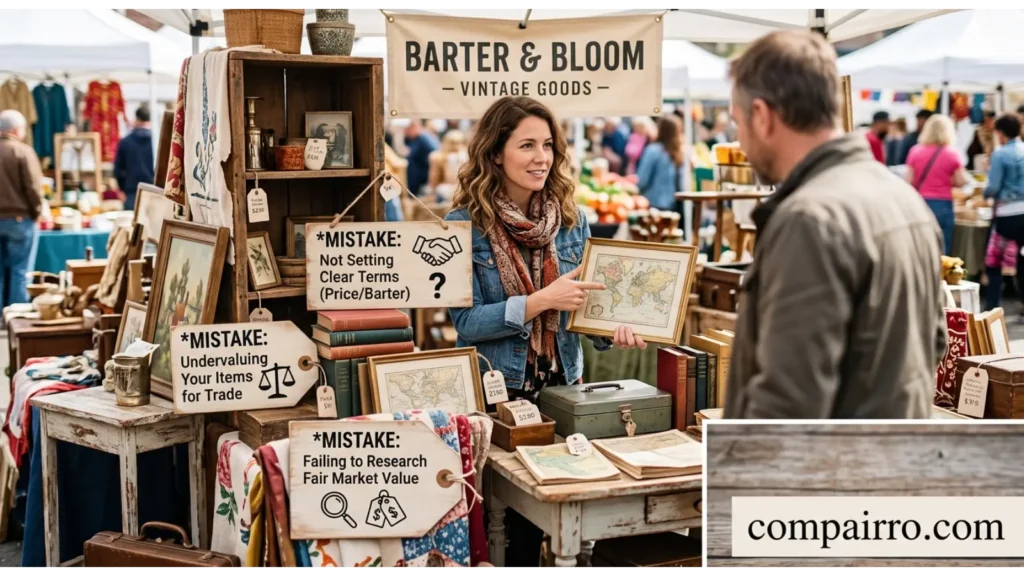
Common Mistakes With Someone Who Sells or Barters
People sometimes use these words as if they all mean exactly the same thing. However, there are important differences.
Mistake 1: Calling every seller a barterer
❌ The shopkeeper is a barterer because he sells shoes for money.
✔ A shopkeeper who sells shoes for money is a seller or retailer. A barterer exchanges goods or services without money.
Mistake 2: Thinking a trader only exchanges goods without money
❌ A trader never uses money.
✔ A trader may buy and sell goods using money. The word does not automatically mean bartering.
Mistake 3: Confusing a vendor with a customer
❌ The person buying apples is the vendor.
✔ The person selling apples is the vendor. The person buying them is the customer or buyer.
Mistake 4: Using merchant for every small exchange
❌ My friend exchanged one pen for another, so he is a merchant.
✔ Your friend took part in a simple exchange. A merchant usually buys and sells goods as a business.
Mistake 5: Assuming bartering is always a business
❌ Bartering only happens between business owners.
✔ Bartering can happen between friends, neighbors, farmers, and businesses. It simply means exchanging goods or services without money.

Someone Who Sells or Barters in Everyday Examples
These examples show how the words work in real situations.
1. Work
A person who sells products in a shop may be called a salesperson or seller.
Example: The salesperson helped the customer choose a laptop.
A business that supplies products to other companies may be called a vendor or supplier.
2. School
Students may learn these terms in English, economics, or social studies lessons.
Example: The teacher asked us to write the meaning of a trader and a barterer.
Remember that a trader may buy and sell goods, while a barterer exchanges items without money.
3. Social Media
Online marketplaces allow people to sell items or exchange them with others.
Example: A user posted an advertisement to sell an old bicycle.
Example: Another user offered to exchange a bicycle for a used phone.
The first person is a seller. The second person is involved in bartering if the exchange happens without money.
4. Daily Life
A fruit seller offers apples and bananas for money.
A neighbor may exchange fresh vegetables for eggs.
Both situations involve the exchange of goods, but only the second is an example of bartering when no money is used.
5. Text Messages
People may use simple words when discussing buying or exchanging items.
Example:
- Person A: “Are you selling your old books?”
- Person B: “Yes, but I can also trade them for other books.”
In this conversation, Person B is a seller if the books are sold and a trader if the books are exchanged.
Someone Who Sells or Barters – Google Trends and Usage Data
People search for this phrase for different reasons. Some want to find the correct English word, while others need help with schoolwork, vocabulary questions, or crossword clues.
Searches may also come from people who want to understand traditional trade and the difference between selling and exchanging goods.
Here are some common reasons people may look up these terms:
- United States: Learning business vocabulary and understanding online marketplaces.
- United Kingdom: Finding words for market sellers, vendors, and traders.
- India: Studying English vocabulary and traditional forms of trade.
- Pakistan: Solving English exercises, learning synonyms, and improving everyday English.
- Canada: Understanding terms used in retail and local trading.
- Australia: Learning about market vendors and small businesses.
These are possible reasons for searching, not verified country rankings. Without checking live Google Trends data, it would be inaccurate to claim which country searches the phrase most often or whether its popularity is rising.
For more precise keyword research, compare terms such as someone who sells goods, person who barters, seller synonym, and trader meaning in Google Trends or a keyword research tool.

Comparison Table: Someone Who Sells or Barters
The following table explains the main words and when to use them.
| Word | Meaning | Uses Money? | Example |
|---|---|---|---|
| Seller | Someone who sells goods or services | Usually yes | A seller sells shoes |
| Vendor | Someone who offers goods or services for sale | Usually yes | A vendor sells fruit |
| Trader | Someone who buys, sells, or exchanges goods | Often, but not always | A trader sells cloth |
| Barterer | Someone who exchanges goods or services without money | No money in the barter exchange | A farmer exchanges wheat for rice |
| Merchant | Someone who buys and sells goods as a business | Usually yes | A merchant sells household goods |
| Dealer | Someone who sells or trades certain products | Usually yes | A car dealer sells vehicles |
| Retailer | A business or person selling directly to customers | Usually yes | A retailer sells clothes |
Important: If a vocabulary question specifically asks for someone who sells or barters, trader may be the intended answer. However, check the wording because seller, vendor, or barterer may be more accurate in a specific situation.
Someone Who Sells or Barters in Professional Life
Selling and bartering are both ways of exchanging value, but they work differently in business.
A seller offers a product or service for payment. For example, a company may sell computers to schools. A vendor may provide office supplies to a company.
Bartering works differently. Two parties agree to exchange goods or services instead of paying the full amount in money. For example, a graphic designer may design a poster for a local shop in exchange for photography services.
Businesses may use barter arrangements when both sides agree on the value of what they exchange. However, they should keep clear records and check any tax or legal rules that apply to the transaction.
For professional communication, use the word that clearly describes the activity:
- Salesperson: Someone who sells products or services.
- Supplier: Someone who provides goods to another person or business.
- Trader: Someone involved in buying and selling goods.
- Barterer: Someone who exchanges goods or services without money.
Using the right term helps prevent confusion in business documents and conversations.
Someone Who Sells or Barters for Students or Beginners
Students sometimes struggle with these words because they all relate to goods, money, or exchange.
The easiest way to learn them is to connect each word with a simple action.
- Seller: Gives a product in return for payment.
- Buyer: Pays for a product.
- Trader: Buys, sells, or exchanges goods.
- Barterer: Exchanges goods or services without money.
- Vendor: Offers goods or services for sale.
Easy learning tips
- Write one sentence for each word.
- Use examples from a shop or market.
- Remember that selling and bartering are different ways to exchange value.
- Practice explaining the words to a friend.
- Read the full question before choosing a vocabulary answer.
For example, if a question asks, “What do we call a person who sells goods?” the answer may be seller or vendor. If it asks about exchanging goods without money, the answer is barterer.
Signs or Characteristics Related to Someone Who Sells or Barters
You can identify the correct term by looking at the person’s actions.
Common characteristics include:
- Selling: The person offers a product or service for money.
- Bartering: The person exchanges goods or services without money.
- Trading: The person buys, sells, or exchanges goods.
- Retailing: The person sells goods directly to customers.
- Supplying: The person provides goods or services to another person or business.
- Negotiating: The people involved agree on the price or value of an exchange.
A person can have more than one role. For example, a farmer may sell vegetables at a market and exchange some produce with a neighbor.
Therefore, do not identify someone only by their job title. Look at what they are doing in that situation.
Simple Trick to Remember Someone Who Sells or Barters
Here is an easy memory trick:
- Seller = Sells
- Trader = Trades
- Barterer = Exchanges without money
- Buyer = Buys
- Vendor = Offers goods or services for sale
Think of it this way:
A shopkeeper sells a bag for money. That person is a seller.
A farmer exchanges a bag of wheat for a bag of rice without money. That person is a barterer.
Someone who buys and sells different products may be called a trader.
Remember: If the question includes both selling and bartering, trader may be the expected general term. If it specifically mentions an exchange without money, barterer is more precise.
FAQs
1. What do you call someone who sells or barters?
A trader is a general term for someone involved in buying, selling, or exchanging goods. The exact word depends on the activity.
2. What is a person who sells goods called?
A person who sells goods is called a seller or vendor. A person who sells directly to customers may also be called a retailer.
3. What do you call someone who barters?
A person who barters is called a barterer. They exchange goods or services without using money for the exchange.
4. Is a trader the same as a seller?
Not exactly. A seller sells goods or services, while a trader may buy, sell, or exchange goods.
5. What is the difference between selling and bartering?
Selling usually means exchanging a product or service for money. Bartering means exchanging goods or services directly without money.
6. Can a person be both a seller and a barterer?
Yes. A person may sell products for money in one situation and exchange goods or services without money in another.
7. What is the best synonym for someone who sells or barters?
Trader may be a suitable general answer. However, use seller for someone who sells and barterer for someone who exchanges goods without money.
Conclusion
Someone who sells or barters may be described as a trader, but the best word depends on the situation. A seller offers goods or services for payment, a vendor sells products, and a barterer exchanges goods or services without money.
Understanding these differences helps you choose the correct word in English lessons, business writing, vocabulary quizzes, and everyday conversations.
The easiest memory rule is simple: Seller = sells, trader = trades, and barterer = exchanges without money. Once you remember this rule, you can identify the right word with confidence.

Sara Taylor is a passionate English content writer who specializes in word meanings, spelling comparisons, and modern slang explanations. She creates easy-to-understand articles that help readers avoid common English mistakes and improve their writing skills. Her content focuses on simple learning, real-life examples, and clear explanations for everyday readers.