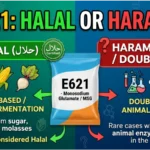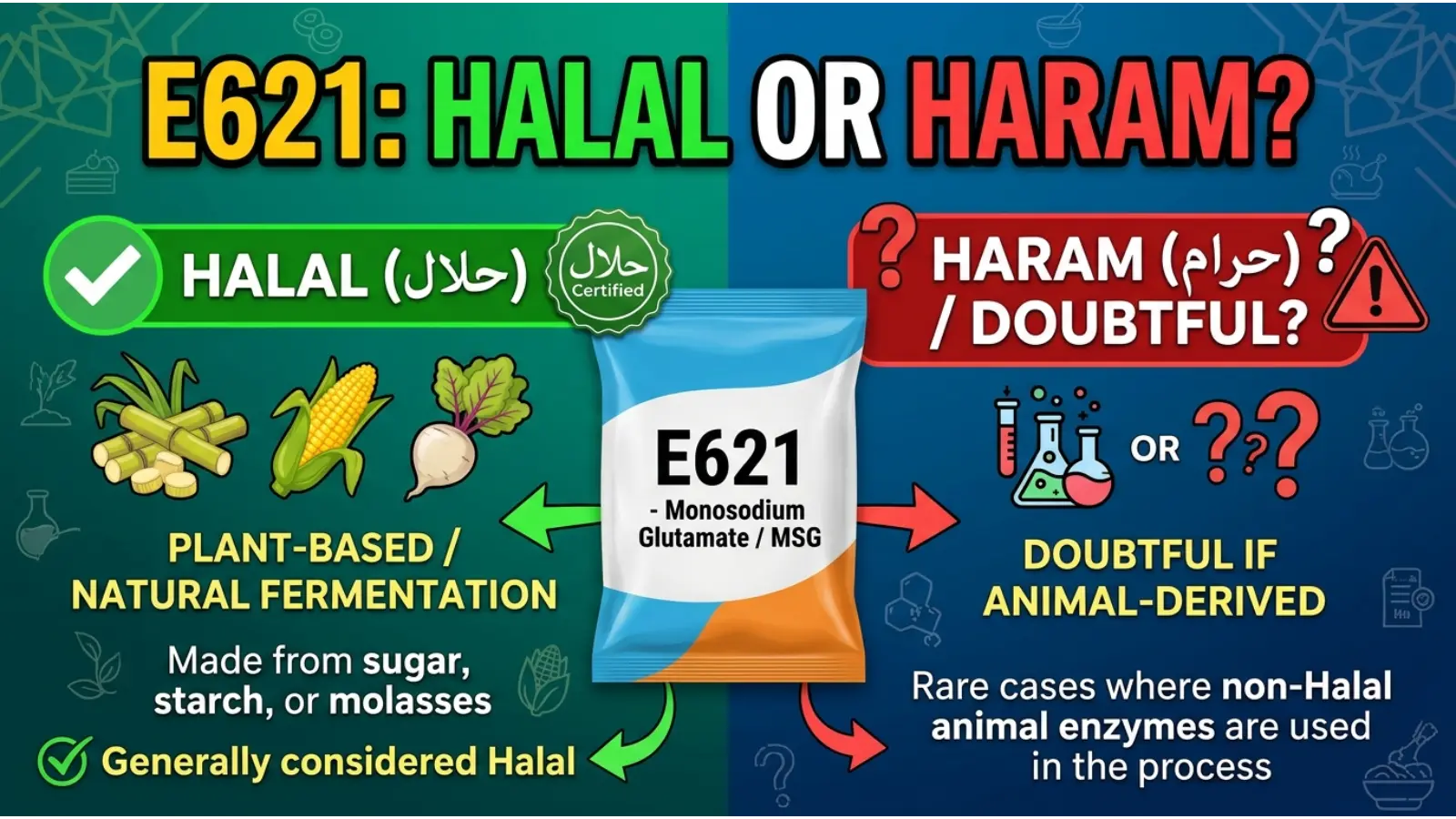
E621 Halal or Haram is a trending question among Muslims who want to make informed food choices. E621, also known as monosodium glutamate (MSG), is a flavor enhancer commonly found in instant noodles, chips, seasonings, sauces, and processed foods. However, many people wonder if this ingredient is halal or haram under Islamic dietary rules.
The question “E621 halal or haram” usually comes from confusion about food additives. Some additives come from plants, while others may come from animals or be made through different industrial processes. Because the ingredient code does not always tell you its full source, it is important to understand what it means.
E621 is commonly used as a flavor enhancer in packaged foods. It is also known as monosodium glutamate, or MSG. It gives food a savory taste and is often found in snacks, seasonings, instant noodles, and processed meals.
However, the name alone does not always answer every question about a product’s halal status. The source, manufacturing process, and any reliable halal certification may also matter.
In this guide, you will learn what E621 means, how its halal status is assessed, how to check food labels, and what common mistakes to avoid. The goal is to help you make informed choices without unnecessary worry.
E621 Halal or Haram – Quick Answer
E621 is generally considered halal when it is produced from permissible sources using an acceptable manufacturing process. Its status may need further checking if the source or production method is unclear.
E621 stands for monosodium glutamate (MSG), a flavor enhancer used to improve the savory taste of food.
Simple examples include:
- Halal-certified seasoning: E621 in a product with reliable halal certification is generally acceptable.
- Plant-based production: E621 produced through fermentation of suitable plant-based materials is generally considered halal.
- Unknown source: If you cannot confirm the source or certification, check with the manufacturer or a trusted halal certification body.
Simple rule: Do not judge a food additive by its code alone. Check its source and the finished product’s halal status.
The Origin of E621
E621 is the European food additive number for monosodium glutamate. It is widely known as MSG.
MSG contains glutamate, a substance linked to the savory taste called umami. Glutamate also occurs naturally in foods such as tomatoes, mushrooms, and cheese.
Today, commercial MSG is commonly made through fermentation using suitable raw materials, such as starch or sugar sources. The exact process can vary between manufacturers.
As processed foods became more common, E621 appeared on ingredient lists around the world. This led many consumers to ask questions about its safety, source, and halal status.
British English vs American English Usage
E621 is a food additive code, not an English word. Therefore, its meaning does not change between British and American English.
| Feature | British English | American English | Notes |
|---|---|---|---|
| Additive code | E621 | MSG | E621 is commonly used in European labeling. |
| Full name | Monosodium glutamate | Monosodium glutamate | The chemical name is the same. |
| Common term | MSG | MSG | Both terms refer to the same flavor enhancer. |
| Halal status | Depends on source and process | Depends on source and process | Check the product and certification. |
In the United States, food labels commonly use the name MSG. In many other markets, including those using European-style additive numbering, E621 may appear instead.
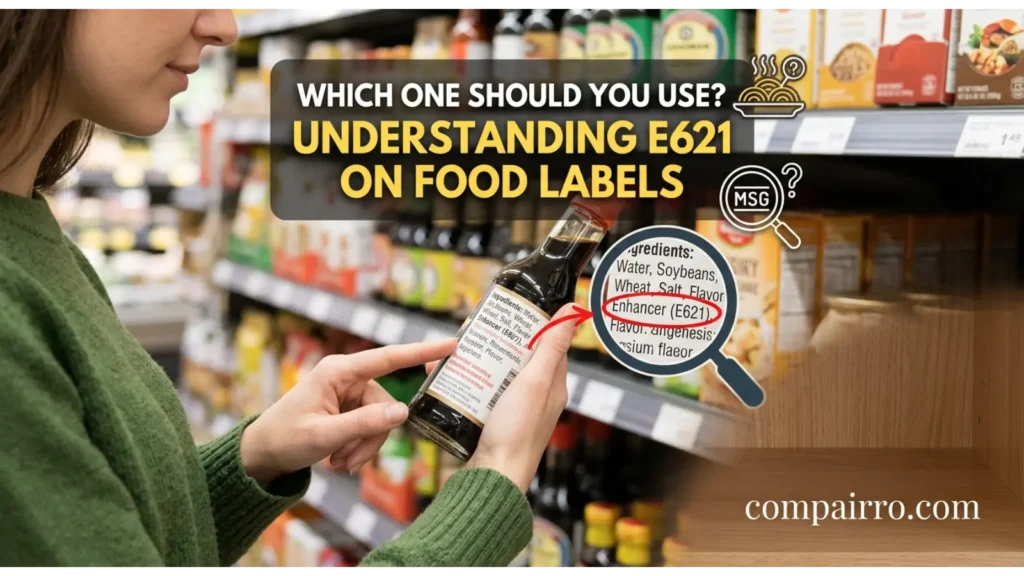
Which One Should You Use? Understanding E621 on Food Labels
You do not choose between two different ingredients when you see E621 and MSG. They refer to the same flavor enhancer.
Instead, choose food products according to your dietary needs and the information available on their labels.
- For everyday shopping: Look for a reliable halal certification when you want extra assurance.
- For imported products: Check the ingredient list and the country or organization responsible for halal certification.
- For unclear ingredients: Contact the manufacturer and ask how the additive is produced.
- For religious certainty: Ask a trusted Islamic scholar or halal certification authority about a specific product.
A food additive’s presence does not automatically make the entire product halal or haram. Other ingredients and the manufacturing process may also affect the final decision.
Common Mistakes About E621
Here are four common mistakes people make when checking E621.
Mistake 1: Assuming E621 is always haram
❌ “Every food containing E621 is haram.”
✔ This is too broad. E621 is generally considered halal when its source and production meet halal requirements.
Mistake 2: Assuming every product with E621 is halal
❌ “E621 is halal, so I can eat any product containing it.”
✔ The complete product matters. Other ingredients, processing aids, and manufacturing conditions may need to be considered.
Mistake 3: Confusing MSG with pork
❌ “MSG always comes from pork.”
✔ Commercial MSG is commonly produced through fermentation. Its source should be verified rather than assumed to be pork or another animal.
Mistake 4: Trusting every halal logo
❌ “Any logo that says halal proves the product is certified.”
✔ Check whether the certification is genuine and issued by a recognized or trusted organization.

E621 in Everyday Examples
E621 can appear in many foods. The following examples show where you might find it and what to check.
At Work
People may eat packaged lunches, instant soups, or ready-made meals during a busy workday.
Example: A worker buys instant noodles containing E621. They can check the package for halal certification or ask the manufacturer if the product’s status is unclear.
At School
Students may see E621 listed on chips, crackers, or flavored snacks.
Example: A student checks the snack’s ingredients and looks for reliable halal certification instead of assuming that every additive is forbidden.
On Social Media
Posts about food additives sometimes claim that certain E-numbers always come from prohibited sources.
Example: Before sharing a post about E621, check reliable food-labeling information and the manufacturer’s details.
In Daily Life
E621 may be present in seasoning powders, savory snacks, instant noodles, and some processed foods.
Example: A family checking a new imported seasoning can review its halal certificate or contact the company.
On Food Labels
E621 may appear under different names, including:
- E621
- Monosodium glutamate
- MSG
These names identify the same flavor enhancer. They do not, by themselves, confirm the halal status of every product.
E621 – Google Trends and Usage Data
People search for “E621 halal or haram” because they want a clear answer before buying or eating packaged food.
However, exact search popularity and country rankings require current data from a source such as Google Trends. Without checking live data, it would be misleading to claim that a particular country has the highest search volume.
Interest in halal food labeling may arise in several countries:
- United States: Consumers may look for MSG information and halal certification.
- United Kingdom: Muslims may check additive codes on imported and packaged foods.
- India: Consumers may look for halal information on snacks and processed foods.
- Pakistan: Shoppers may want to know whether imported noodles, chips, and seasonings are halal.
- Canada: Food labels and certification can help consumers assess packaged products.
- Australia: Consumers may check halal certification and ingredient information.
Searches about E621 may increase when a claim circulates online or when consumers encounter an unfamiliar ingredient.
Still, search interest does not prove that an ingredient is halal or haram. Religious guidance and reliable product information are more useful for making that decision.
Comparison Table: E621 Halal or Haram?
| Situation | General assessment | What to do |
|---|---|---|
| E621 made through suitable plant-based fermentation | Generally halal | Check the product’s other ingredients. |
| E621 in a reliably halal-certified product | Generally acceptable | Verify the certificate if necessary. |
| E621 with an unknown production source | Needs further checking | Contact the manufacturer. |
| Product containing other clearly prohibited ingredients | May be impermissible | Assess the entire product. |
| Online claim that all E621 is haram | Not enough evidence by itself | Check reliable sources. |
| Product with unclear or questionable certification | Requires caution | Consult a trusted halal authority. |
These are general guidelines, not a ruling on every product. A specific case may require more information about ingredients and manufacturing.

E621 in Professional Life
E621 is mainly relevant to food production, quality control, food labeling, and halal certification.
Food manufacturers use MSG to improve the savory flavor of certain products. Food scientists and quality-control teams must ensure that ingredients meet the applicable food safety and labeling rules.
Halal certification teams may also review raw materials, manufacturing processes, and possible sources of contamination.
For food businesses, clear ingredient records are important because consumers need accurate information to make informed choices.
If you work in food production or marketing, avoid making a blanket claim that all E621 products are halal. The claim should match the evidence available for the specific product.
E621 for Students or Beginners
Beginners may find E-numbers confusing because the codes do not explain the ingredient’s source in plain English.
Here are three simple learning tips:
- Learn the name: E621 means monosodium glutamate, also called MSG.
- Understand its purpose: It is used to enhance savory flavor.
- Check the full product: The code alone does not confirm whether the food is halal.
It also helps to separate three different questions:
- What is it? A flavor enhancer.
- What is it made from? Commonly produced through fermentation, though production details can vary.
- Is the product halal? That depends on the source, process, and other relevant ingredients.
Knowing these differences makes food labels easier to understand.
Signs or Characteristics Related to E621
When you want to identify E621 on a food label, look for these characteristics:
- Additive code: E621.
- Full name: Monosodium glutamate.
- Short name: MSG.
- Main purpose: Enhances savory flavor.
- Common food types: Seasonings, savory snacks, instant noodles, soups, and processed foods.
- Production method: Commercial MSG is commonly produced through fermentation.
- Halal status: Depends on the relevant source and production requirements.
- Labeling: The code or name may appear in the ingredient list.
Remember that the presence of E621 does not automatically tell you whether the entire product is halal.
Simple Trick to Remember E621 Halal or Haram
Think of it this way:
E621 = MSG = Flavor enhancer
Halal status = Source + Manufacturing process + Other ingredients
This easy memory rule helps you avoid two common errors: assuming that every E621 product is forbidden or assuming that every product containing it is automatically halal.
For example, if you see E621 on a packet of chips, you know what the additive is. You still need to check the product’s overall halal status if you want religious assurance.
FAQs:
1. Is E621 halal or haram in Islam?
E621 is generally considered halal when its source and production process meet halal requirements. Check the specific product if important details are unclear.
2. Is E621 the same as MSG?
Yes. E621 is the additive code for monosodium glutamate, commonly called MSG.
3. Does E621 contain pork?
Not necessarily. Commercial MSG is commonly produced through fermentation. Do not assume it comes from pork without reliable evidence.
4. Is E621 halal in Pakistan?
Its status depends on the product and its production. Check for reliable halal certification or contact the manufacturer, especially for imported foods.
5. Is E621 safe to eat?
MSG is an approved food ingredient in many countries when used under applicable food regulations. People who believe they react to MSG can discuss their symptoms with a healthcare professional.
6. Is E621 halal in chips and instant noodles?
It can be. The answer depends on the complete product, its ingredients, and its production process. Check the label and halal certification.
7. How can I check whether E621 is halal?
Look for a reliable halal certificate, review the ingredient list, and contact the manufacturer if the source is unclear. You can also ask a trusted Islamic scholar or certification body.
Conclusion
So, is E621 halal or haram? E621 is generally considered halal when it comes from permissible sources and is produced through an acceptable process. However, the additive code alone cannot confirm the halal status of every food product.
E621 is another name for monosodium glutamate, or MSG, a flavor enhancer commonly made through fermentation. It may appear in snacks, instant noodles, soups, and seasonings.
When checking a food label, look at the complete ingredient list and any reliable halal certification. If you are unsure about a particular product, contact its manufacturer or ask a trusted halal authority.
The easiest rule to remember is this: Know what E621 is, check the product’s source and certification, and avoid making decisions based on unverified online claims.

Sara Taylor is a passionate English content writer who specializes in word meanings, spelling comparisons, and modern slang explanations. She creates easy-to-understand articles that help readers avoid common English mistakes and improve their writing skills. Her content focuses on simple learning, real-life examples, and clear explanations for everyday readers.