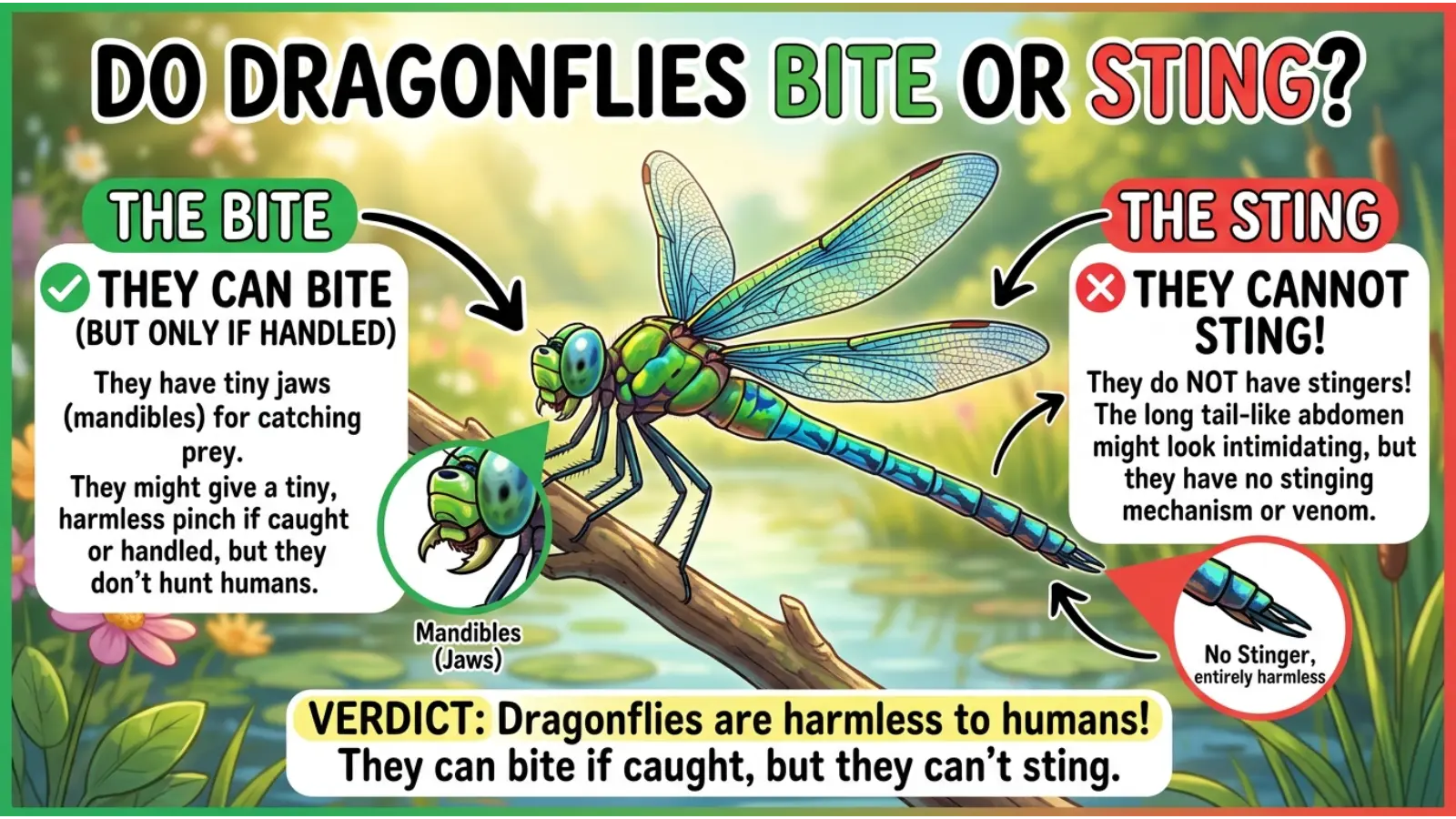
Imagine sitting near a lake, walking through a garden, or enjoying a sunny afternoon when a colorful dragonfly suddenly flies close to you. Its large eyes, long body, and fast-moving wings may look a little scary. You might wonder, do dragonflies bite or sting humans? Can they hurt you if they land on your hand or clothes?
Many people have these questions because dragonflies look similar to small flying insects that can sting or bite. Some people also believe that dragonflies are dangerous because of their sharp-looking bodies and fast movements. However, the truth is much less frightening.
Dragonflies are common insects found near ponds, lakes, rivers, gardens, and other places with water. They are actually helpful to the environment because they eat mosquitoes and other small flying insects. Still, it is useful to understand how they behave and whether touching one is safe.
People search for this topic to learn about dragonflies, understand their behavior, and find out what happens if one lands on their skin. You may also come across this question at school, in nature videos, on social media, or during everyday conversations.
The important thing to remember is that dragonflies are not naturally aggressive toward people. However, they can sometimes bite if they are caught or handled.
In this guide, you’ll learn the meaning, examples, usage, differences, common mistakes, and simple explanations in easy English.
Do Dragonflies Bite or Sting? – Quick Answer
Dragonflies can bite, but they do not sting humans.
A dragonfly has strong jaws that help it catch and eat small insects. However, it does not have a stinger like a bee or wasp.
Most dragonflies are harmless to people and prefer to fly away rather than attack.
Here are three important facts:
- Bite: Yes, a dragonfly can bite if you catch or handle it.
- Sting: No, dragonflies do not have stingers.
- Danger: They are generally not dangerous to humans.
Examples:
- A dragonfly flying around your garden is usually harmless.
- A dragonfly landing on your arm is not a reason to panic.
- A dragonfly held tightly in your hand may bite to defend itself.
Simple rule:
👉 Dragonflies can bite, but they cannot sting.
Think of them as helpful flying insects rather than dangerous creatures.
The Origin of Dragonflies
Dragonflies are among the oldest groups of flying insects on Earth. Their ancestors lived hundreds of millions of years ago, long before modern humans appeared.
They belong to the insect order called Odonata. This group also includes damselflies, which look similar but usually have slimmer bodies and different wing positions.
The name “dragonfly” is believed to come from old stories and names connected with dragons. Over time, the name became common because of the insect’s unusual appearance.
Dragonflies are known for:
- Their large, noticeable eyes.
- Their long and narrow bodies.
- Their two pairs of strong wings.
- Their ability to fly in different directions.
- Their skill at catching small insects.
Today, dragonflies are popular subjects in nature photography, wildlife videos, science lessons, and social media posts.
British English vs American English Usage
There is no important difference between British and American English when using the word dragonfly.
Both countries use the same spelling and meaning. The word describes the same flying insect.
| Feature | British English | American English | Notes |
|---|---|---|---|
| Spelling | Dragonfly | Dragonfly | Same spelling |
| Pronunciation | Dragonfly | Dragonfly | Slight accent differences |
| Meaning | Flying insect | Flying insect | Same meaning |
| Bite | Can bite | Can bite | Same behavior |
| Sting | Cannot sting | Cannot sting | Same fact |
Whether you live in the UK or the US, the answer to “Do dragonflies bite or sting?” remains the same.
Which One Should You Understand: Bite or Sting?
It is important to understand the difference between biting and stinging because these words describe two different ways insects can defend themselves.
1. What Does Biting Mean?
Biting happens when an animal or insect uses its mouthparts or jaws to grip or break something.
Dragonflies have strong jaws that help them eat other insects. They may use these jaws to bite if someone catches or handles them.
2. What Does Stinging Mean?
Stinging happens when an insect uses a special body part called a stinger to inject venom.
Bees and wasps are common examples of stinging insects. Dragonflies do not have this type of body part.
When Should You Be Careful?
Although dragonflies are usually harmless, you should:
- Avoid catching them with your hands.
- Never squeeze or trap them.
- Let them fly away naturally.
- Watch them from a comfortable distance.
- Avoid touching their wings because they are delicate.
The best approach is to enjoy watching dragonflies without trying to hold them.
Common Mistakes About Dragonflies
People often misunderstand dragonflies because they look unusual. Here are four common mistakes and the correct explanations.
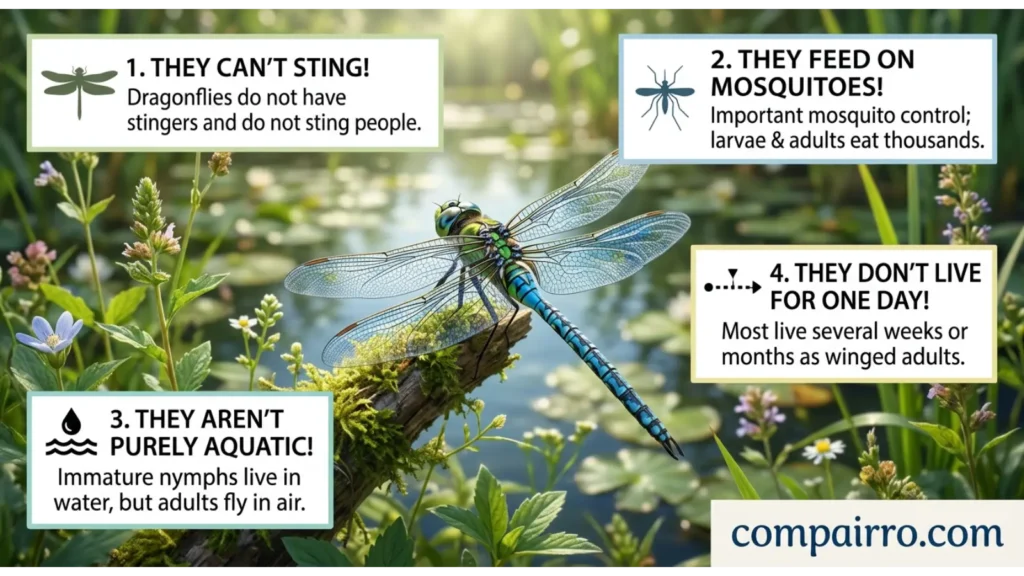
Mistake 1: Thinking Dragonflies Can Sting
❌ Incorrect: Dragonflies sting people like bees.
✔ Correct: Dragonflies do not have stingers. They can only bite using their jaws.
Mistake 2: Believing Every Dragonfly Is Dangerous
❌ Incorrect: Every dragonfly can attack humans.
✔ Correct: Dragonflies usually avoid people. They are not aggressive and do not normally attack humans.
Mistake 3: Thinking a Dragonfly Will Bite When It Lands on You
❌ Incorrect: A dragonfly landing on your arm means it is going to bite.
✔ Correct: A dragonfly may simply be resting. It does not automatically bite when it lands on someone.
Mistake 4: Believing Dragonflies Are Poisonous
❌ Incorrect: Dragonflies are poisonous and can harm people through touch.
✔ Correct: Dragonflies are not poisonous to humans. Simply seeing or having one land on you is generally harmless.
Mistake 5: Thinking Dragonflies Attack People for Food
❌ Incorrect: Dragonflies chase humans because they want to eat them.
✔ Correct: Dragonflies hunt small insects, not people. Their fast movements are usually part of their normal hunting behavior.
Do Dragonflies Bite or Sting in Everyday Situations?
Understanding dragonfly behavior becomes easier when you look at common situations.
1. In Your Garden
You may see dragonflies flying around flowers, plants, or trees.
They are usually looking for small insects to eat. They do not normally bother people working or relaxing in gardens.
2. Near Lakes and Ponds
Dragonflies are commonly found near water because they lay their eggs in or near water.
Their young stage, called a nymph, lives underwater and feeds on small water animals.
Example: If you are sitting near a pond and a dragonfly flies past you, there is usually nothing to worry about.
3. When One Lands on Your Skin
Sometimes, a dragonfly may land on your hand, shoulder, or clothing.
This does not mean it wants to bite you. It may simply be resting or using the nearby surface as a temporary landing place.
Stay calm and allow it to fly away.
4. When Someone Tries to Catch One
This is when a bite is more likely.
If a dragonfly feels trapped or threatened, it may use its jaws to defend itself. However, its bite is generally minor and does not usually cause serious injury.
5. In Videos and Social Media
You may see videos of dragonflies landing on people’s hands or flying around their heads.
These videos can make people curious about whether dragonflies are friendly, dangerous, or likely to bite.
Remember that a dragonfly flying close to your face does not mean it is trying to attack you.
Do Dragonflies Bite or Sting? – Google Trends and Usage Data
The question “do dragonflies bite or sting” is a nature-related search query. People commonly search for it when they see a dragonfly or want to understand whether the insect is dangerous.
There are several reasons behind this curiosity:
- Safety concerns: People want to know whether dragonflies can hurt them.
- School learning: Students search for simple facts about insects.
- Nature curiosity: Wildlife lovers want to understand dragonfly behavior.
- Social media: Interesting insect videos encourage people to ask questions.
- Gardening: People want to know whether dragonflies are helpful or harmful.
Search Interest Around the World
People in different countries may search for this question, including:
- United States: People often look for information about dragonflies around gardens, lakes, and outdoor spaces.
- United Kingdom: Nature lovers and students may search for dragonfly facts.
- India: People may search for information about dragonflies during outdoor activities and school learning.
- Pakistan: Students and curious readers may want to know whether dragonflies can bite or sting.
- Canada: People may look for information about insects found near lakes and wetlands.
- Australia: Wildlife enthusiasts may search for dragonfly behavior and safety.
Important: These are examples of possible search interests, not verified Google Trends rankings. Exact search volumes and country rankings require current Google Trends or keyword research data.
Why Are People Confused?
The main reason is appearance. Dragonflies have large eyes, strong jaws, and fast wings.
Some people assume that every insect with a sharp-looking body can sting. However, dragonflies are different from bees, wasps, and mosquitoes.
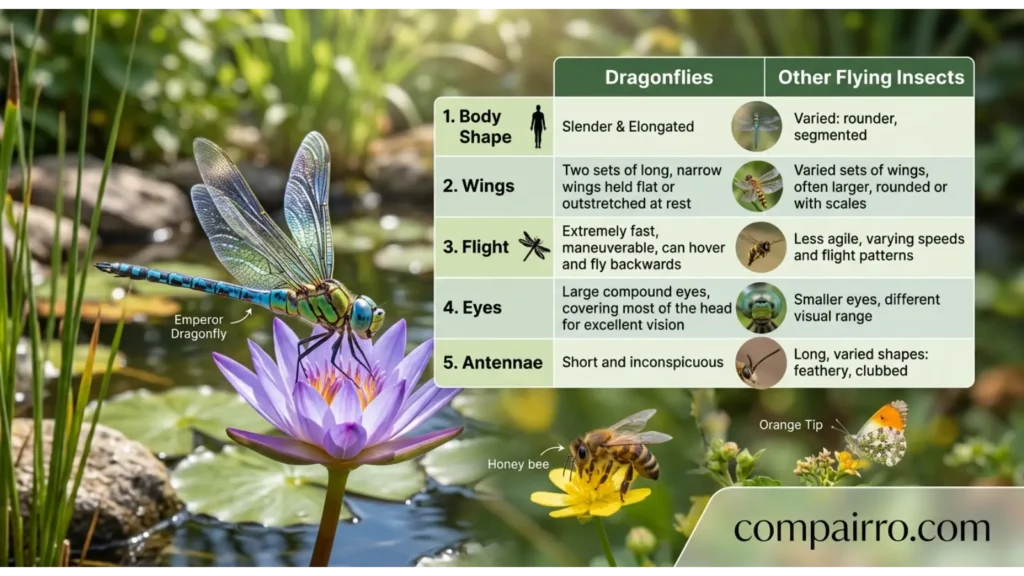
Comparison Table: Dragonflies vs Other Flying Insects
Not all flying insects have the same behavior. Some bite, some sting, and others are mostly harmless to people.
| Insect | Can Bite? | Can Sting? | Risk to Humans |
|---|---|---|---|
| Dragonfly | Yes, rarely | No | Usually low |
| Honeybee | No typical biting defense | Yes | Can sting |
| Wasp | Can bite in some situations | Yes | Can sting |
| Mosquito | Yes | No | Can spread diseases |
| Butterfly | No harmful bite | No | Harmless |
| Housefly | No typical human bite | No | Can carry germs |
Main difference: Dragonflies use their jaws to catch food, while bees and wasps have stingers for defense.
Dragonflies in Professional Life and the Environment
Dragonflies are not commonly used in workplaces, but they have an important role in nature and scientific research.
They help maintain balance in the environment by eating small insects.
Benefits of Dragonflies
- Mosquito control: Dragonflies eat mosquitoes and other small flying insects.
- Natural balance: They help control insect populations.
- Environmental health: Their presence can provide useful information about the condition of nearby water habitats.
- Scientific research: Researchers study dragonflies to understand insect behavior, biodiversity, and environmental changes.
Dragonflies are also useful in nature education because they help students learn about insect life cycles and ecosystems.
Dragonflies for Students and Beginners
If you are learning about insects for the first time, dragonflies are an interesting example.
However, beginners sometimes confuse dragonflies with other flying insects.
Here are some easy learning tips:
- Remember that dragonflies belong to the insect group called Odonata.
- Learn that adult dragonflies have two pairs of wings.
- Understand that they have strong jaws for catching prey.
- Remember that they do not have stingers.
- Learn about their life cycle, which includes an egg, an aquatic nymph, and an adult.
Why Do Students Get Confused?
Students may think that all insects can sting because bees and wasps are familiar examples.
However, insects have different body structures and defense methods.
A dragonfly is a useful example of an insect that can bite but cannot sting.
Signs or Characteristics Related to Dragonflies
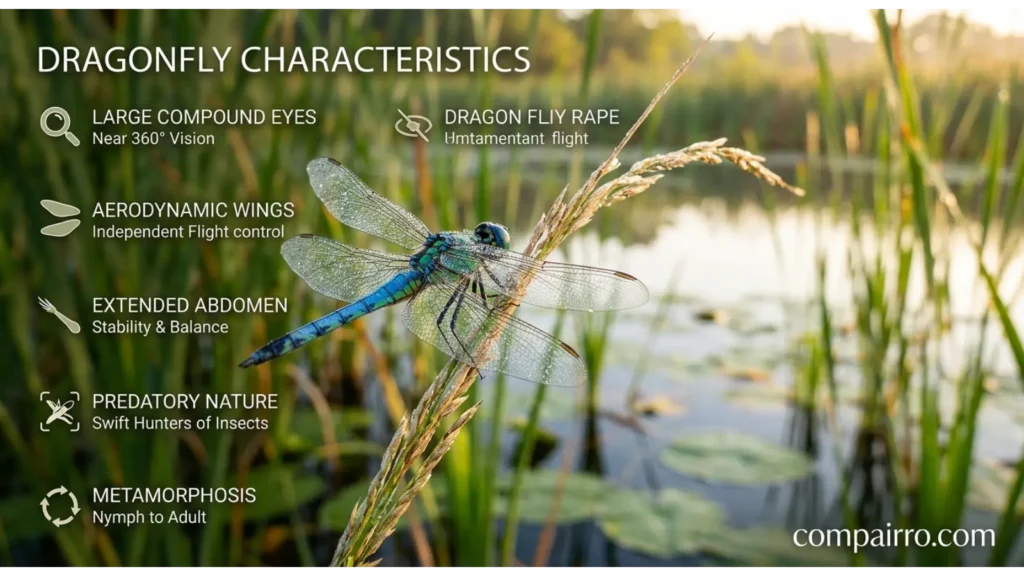
Dragonflies have several features that make them easy to recognize.
Azure Gaze: Dragonfly Macro HD Wallpaper | 2048×1290 | Wallpaper Abyss
Dragonfly and Transparent Wings on branch – animal behavior.
6
1. Large Eyes
Dragonflies have very large compound eyes. These help them see movement and find small insects while flying.
2. Long Body
Their bodies are usually long, thin, and divided into sections.
3. Four Wings
Dragonflies have two pairs of wings. They can move each pair in ways that help them fly with great control.
4. Strong Jaws
They have strong mouthparts that help them catch and eat insects.
5. Fast Flying Ability
Dragonflies are skilled flyers. They can move forward, turn quickly, and even hover in the air.
6. Water-Based Life Cycle
Most dragonflies spend their early life underwater as nymphs before becoming flying adults.
7. Helpful Feeding Habits
Adult dragonflies eat mosquitoes, flies, and other small insects. This makes them useful members of many ecosystems.
Can You Recognize an Aggressive Dragonfly?
Dragonflies do not normally show aggression toward humans. Flying close to someone, changing direction quickly, or landing nearby does not mean an attack is about to happen.
Their behavior is usually connected to hunting, resting, or finding a suitable place to land.
Simple Trick to Remember: Do Dragonflies Bite or Sting?
Here is an easy way to remember the difference:
- 👉 Dragonfly = Can bite
- 👉 Bee = Can sting
- 👉 Butterfly = Harmless to people
Think of it this way:
A dragonfly uses its mouth to catch and eat insects. It does not have a special stinger to inject venom.
For example:
- If a dragonfly flies near you, stay calm.
- If it lands on your hand, let it rest or fly away.
- If you try to catch it, remember that it may bite to protect itself.
Easy memory rule: Dragonflies have jaws, not stingers.
FAQs:
1. Do dragonflies bite humans?
Yes, dragonflies can bite humans, but this usually happens when someone catches, holds, or threatens them. They rarely bite people naturally.
2. Can dragonflies sting you?
No, dragonflies cannot sting humans because they do not have stingers like bees or wasps.
3. Are dragonflies dangerous to humans?
No, dragonflies are generally harmless to humans. They do not normally attack people and are helpful because they eat mosquitoes and other insects.
4. What happens if a dragonfly bites you?
A dragonfly bite may cause a small amount of pain or temporary discomfort. Serious problems are uncommon. Wash the area with soap and water if the skin is broken.
5. Why do dragonflies fly close to humans?
Dragonflies may fly close to people while hunting small insects. They may also be looking for a place to rest. This behavior does not mean they want to attack.
6. Are dragonflies poisonous?
No, dragonflies are not poisonous to humans. Touching one is generally harmless, although you should avoid handling wild insects.
7. Should you be afraid of dragonflies?
No, there is no need to be afraid of dragonflies. They are useful insects that help control mosquito populations. Enjoy watching them without trying to catch them.
Conclusion
So, do dragonflies bite or sting? The simple answer is that dragonflies can bite, but they cannot sting humans.
They have strong jaws that help them catch and eat small insects. However, they do not have stingers like bees or wasps.
Most dragonflies are harmless and do not attack people. They are also helpful to the environment because they eat mosquitoes and other small insects.
If you see a dragonfly in your garden, near a pond, or flying around your home, there is usually no reason to worry. Just avoid catching or squeezing it.
Final memory rule: Dragonflies can bite, but they cannot sting. They are helpful insects, not dangerous enemies.

Sara Taylor is a passionate English content writer who specializes in word meanings, spelling comparisons, and modern slang explanations. She creates easy-to-understand articles that help readers avoid common English mistakes and improve their writing skills. Her content focuses on simple learning, real-life examples, and clear explanations for everyday readers.