Imagine you are studying chemistry and come across the chemical formula HCl. Your teacher asks a simple question: Is HCl an acid or a base? You may know that acids and bases are two important types of chemical substances, but identifying them can sometimes be confusing.
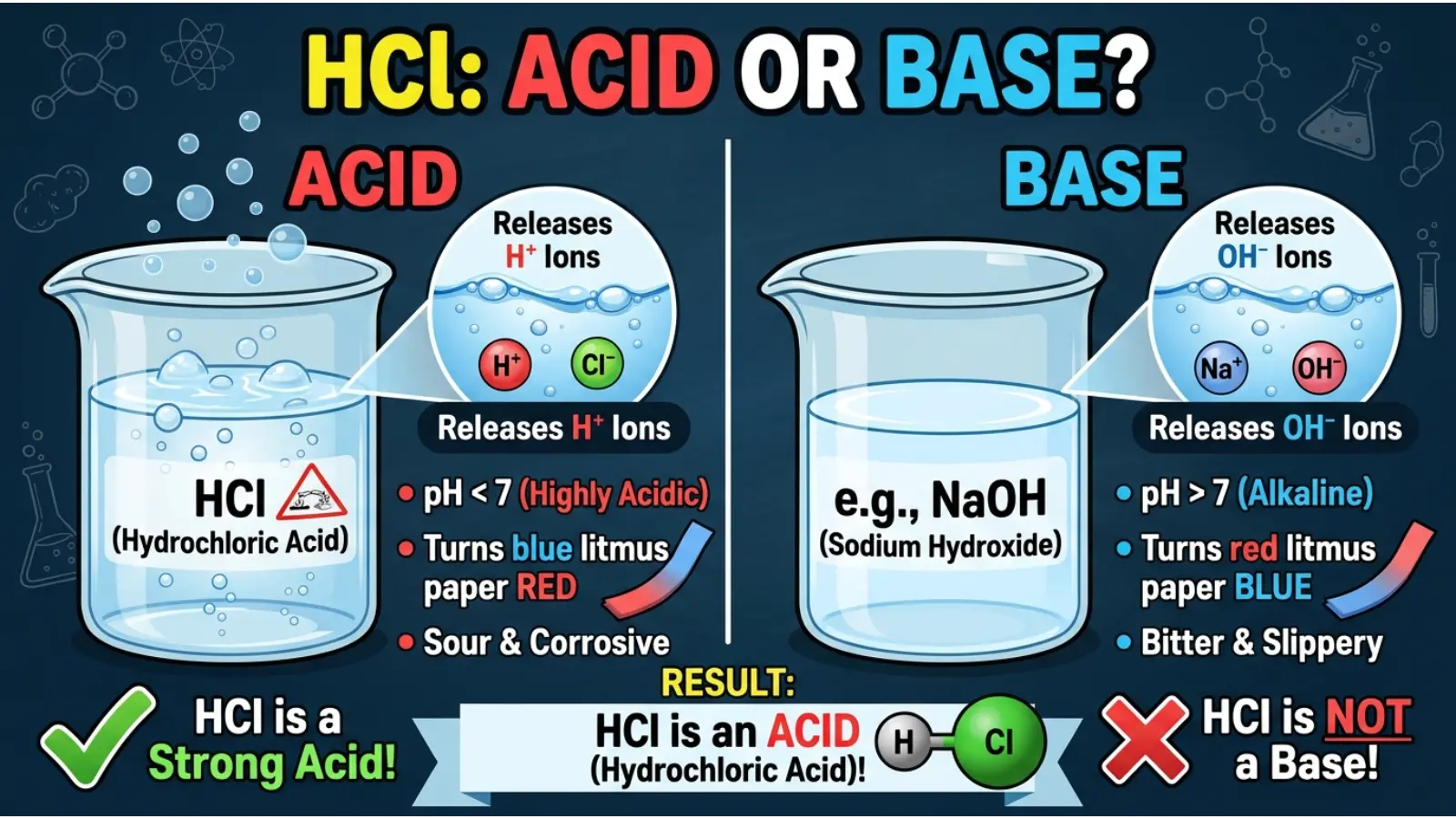
The answer is simple: HCl is an acid, not a base. Its full name is hydrochloric acid. It is known as a strong acid because it releases hydrogen ions (H⁺) when dissolved in water.
Many students search for HCl acid or base because they want to understand its chemical nature, properties, and behavior. This topic is also important for chemistry exams, school assignments, laboratory studies, and basic science knowledge.
You may see HCl mentioned in chemistry textbooks, laboratory experiments, industrial processes, and discussions about the human digestive system. However, understanding why HCl is an acid is just as important as remembering its name.
In this guide, we will explain its meaning, properties, uses, examples, and differences between acids and bases. We will also discuss common mistakes and simple ways to remember the answer.
In this guide, you’ll learn the meaning, examples, usage, differences, common mistakes, and simple explanations in easy English.
HCl Acid or Base – Quick Answer
HCl is a strong acid
Hydrochloric Acid = Hydrochloric Acid
HCl is a strong acid, not a base. When it dissolves in water, it separates into hydrogen ions (H⁺) and chloride ions (Cl⁻).
The chemical equation is:
\[ HCl + H_2O \rightarrow H_3O^+ + Cl^- \]
This reaction produces hydronium ions (H₃O⁺), which make the solution acidic.
Examples:
- HCl in water forms an acidic solution.
- HCl reacts with certain metals to produce hydrogen gas.
- HCl reacts with bases to form salt and water.
Simple rule:
Remember that HCl is an acid because it produces hydrogen ions in water.
The Origin of HCl
HCl stands for hydrochloric acid when it refers to its aqueous solution. The chemical formula contains two elements:
- H = Hydrogen
- Cl = Chlorine
Hydrogen chloride (HCl) is a gas when pure and at normal room conditions. When this gas dissolves in water, it forms hydrochloric acid.
The name hydrochloric acid became widely used in chemistry as scientists studied acids, chemical reactions, and their properties.
Today, HCl is an important chemical in laboratories, industries, and science education.
British English vs American English Usage
There is no major difference between British and American English when using the term hydrochloric acid.
Both countries use the same chemical formula, scientific name, and pronunciation in chemistry.
| Feature | British English | American English | Notes |
|---|---|---|---|
| Chemical formula | HCl | HCl | Same |
| Chemical name | Hydrochloric acid | Hydrochloric acid | Same |
| Classification | Strong acid | Strong acid | Same |
| Scientific use | Chemistry | Chemistry | Same |
| Spelling | Hydrochloric | Hydrochloric | Same |
Therefore, students in both countries can use HCl and hydrochloric acid in the same way.
Which One Should You Use?
If you are discussing HCl in chemistry, use the term that matches your sentence.
Here are some examples:
- For school assignments: Write hydrochloric acid when explaining the full name of HCl.
- For chemistry equations: Use HCl as its chemical formula.
- For laboratory studies: Use hydrochloric acid when referring to its water-based solution.
- For scientific discussions: Explain that HCl is a strong acid.
- For beginners: Remember that HCl is not a base.
HCl is an acid in water. However, pure hydrogen chloride gas should not be confused with its aqueous solution.
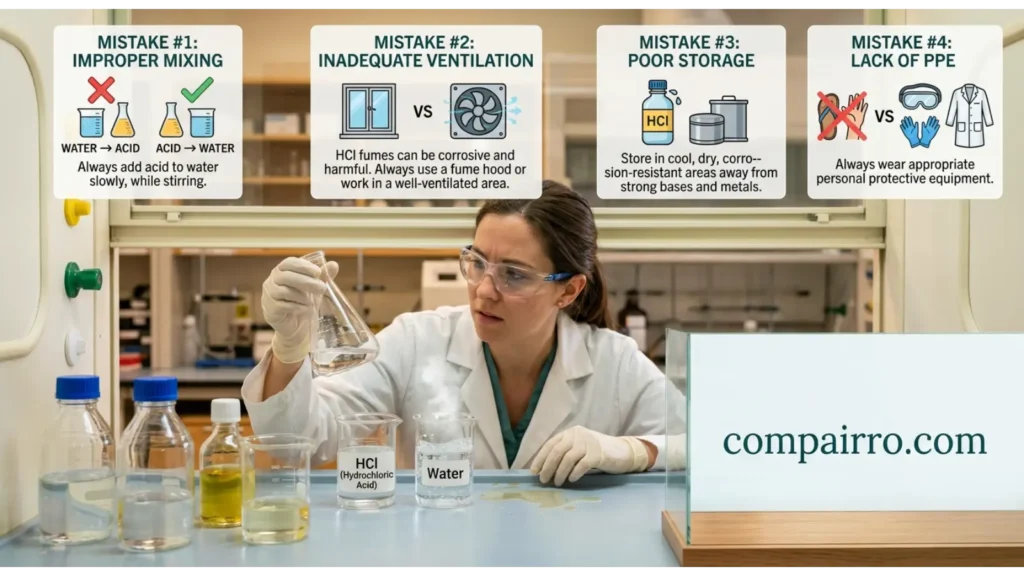
Common Mistakes With HCl
Students sometimes make mistakes when learning about acids and bases. Here are five common misunderstandings.
Mistake 1: Thinking HCl is a base
❌ HCl is a base because it contains hydrogen.
✔ HCl is an acid because it produces hydrogen ions in water.
Mistake 2: Confusing HCl with chlorine
❌ HCl and chlorine gas are the same substances.
✔ HCl contains hydrogen and chlorine, while chlorine gas has the formula Cl₂.
Mistake 3: Thinking every substance containing hydrogen is an acid
❌ All hydrogen-containing compounds are acids.
✔ Not every compound containing hydrogen behaves as an acid. Water and methane are examples of hydrogen-containing compounds with different chemical properties.
Mistake 4: Thinking strong acid means concentrated acid
❌ Strong acid and concentrated acid have exactly the same meaning.
✔ Strong refers to how much an acid ionizes in water. Concentrated refers to how much acid is present in a given amount of solution.
Mistake 5: Confusing hydrogen chloride gas with hydrochloric acid
❌ Hydrogen chloride gas and hydrochloric acid are completely identical forms.
✔ Hydrogen chloride is a gas, while hydrochloric acid is hydrogen chloride dissolved in water.
HCl in Everyday Examples
HCl is an important chemical that has several practical uses. Here are some simple examples.
1. School and Education
Students learn about HCl when studying acids, bases, chemical formulas, and chemical reactions.
Example:
- HCl is classified as a strong acid.
- Its formula contains hydrogen and chlorine.
2. Work and Industry
Hydrochloric acid is used in different industrial processes.
Examples include:
- Cleaning and processing metals.
- Producing certain chemicals.
- Adjusting the pH of industrial solutions.
3. Human Digestive System
Hydrochloric acid is naturally present in the stomach.
It helps create an acidic environment that supports digestion and helps the body process food.
4. Daily Life
You may not use pure hydrochloric acid at home, but it has a role in making some commercial cleaning and industrial products.
It is important to remember that concentrated hydrochloric acid is corrosive and should only be handled by trained people using proper safety equipment.
HCl – Google Trends and Usage Data
The keyword HCl acid or base is related to basic chemistry education. People commonly search for it when they want a quick answer or need help understanding chemical substances.
Here are some reasons behind these searches:
- Students: They want to prepare for chemistry tests and exams.
- Teachers: They explain acids and bases using HCl as an example.
- Beginners: They want to understand chemical formulas.
- Science learners: They want to learn about strong acids and chemical reactions.
- Internet users: They search for simple answers to science questions.
Popular Countries
People studying chemistry may search for this topic in different countries, including:
- United States: Students use chemistry resources for school and college studies.
- United Kingdom: Chemistry learners study hydrochloric acid in science courses.
- India: Students often study HCl in school chemistry and competitive exams.
- Pakistan: Students learn about HCl in chemistry textbooks and science examinations.
- Canada: Science students study acids, bases, and chemical reactions.
- Australia: HCl is included in chemistry learning materials.
Important: These are potential audiences for the topic, not verified Google Trends rankings. Actual search interest and country rankings require live Google Trends data.
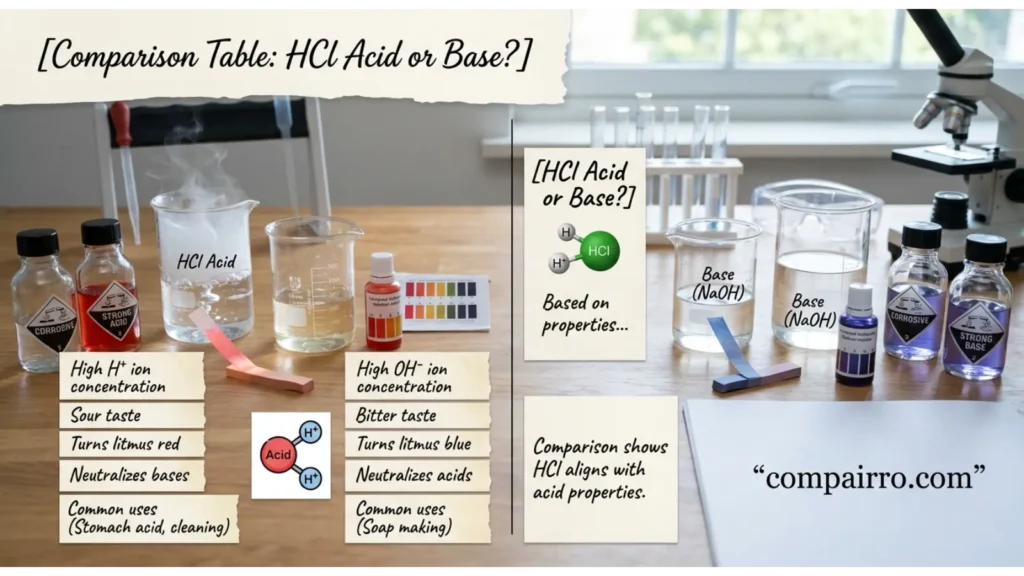
Comparison Table: HCl Acid or Base?
To understand HCl better, it helps to compare acids and bases.
| Feature | HCl (Acid) | Base |
|---|---|---|
| Nature | Acidic | Basic |
| pH value | Below 7 | Above 7 |
| Hydrogen ions | Increases H⁺ in water | Usually reduces H⁺ concentration |
| Litmus test | Blue litmus turns red | Red litmus turns blue |
| Example | HCl | NaOH |
| Chemical behavior | Reacts with bases | Reacts with acids |
| Taste | Acids are often sour | Some bases are bitter |
Note: Never taste laboratory chemicals to identify them.
HCl vs NaOH
HCl – Hydrochloric Acid
HCl is a strong acid that produces hydronium ions in water.
NaOH – Sodium Hydroxide
NaOH is a strong base that produces hydroxide ions (OH⁻) in water.
Both substances are important in chemistry, but they have different chemical properties.
HCl in Professional Life
Hydrochloric acid has many uses in professional and industrial settings.
Some important applications include:
- Chemical manufacturing: Used to produce different chemical products.
- Metal processing: Helps remove unwanted surface materials from metals in controlled industrial processes.
- Laboratories: Used in scientific research and chemical analysis.
- Water treatment: Used in certain processes to adjust pH levels.
- Food production: Used in controlled food-processing applications under approved safety standards.
HCl must be handled carefully because it can cause serious chemical burns and damage materials.
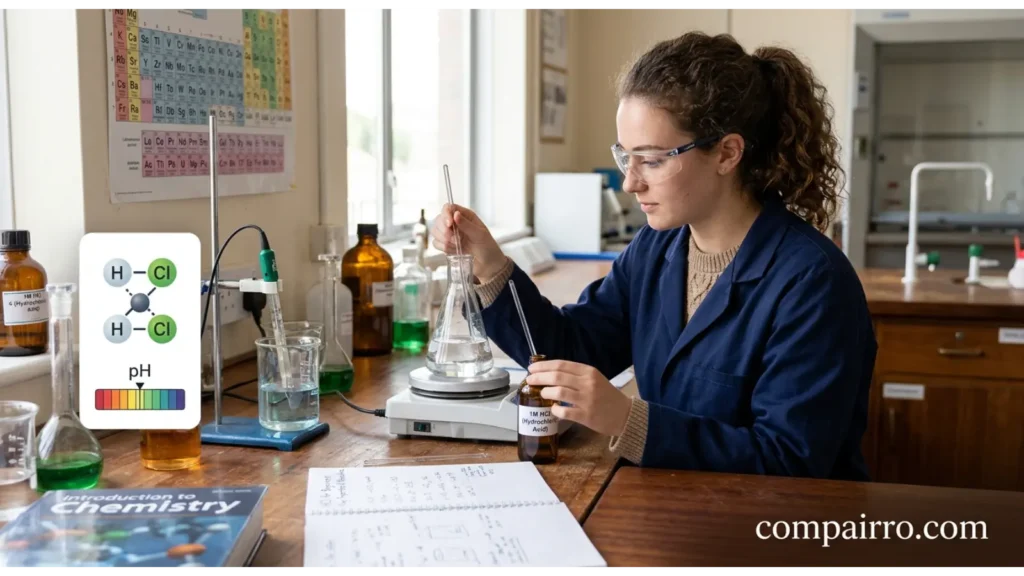
HCl for Students or Beginners
Hydrochloric Acid is an important topic for students because it helps explain the basic properties of acids.
However, beginners sometimes struggle to understand why HCl is called a strong acid.
Here are some easy learning tips:
- Remember the full name: Hydrochloric acid.
- Learn its chemical formula: HCl.
- Understand that it produces hydrogen ions in water.
- Remember that its pH is below 7 in an ordinary aqueous solution.
- Compare it with a common base such as sodium hydroxide (NaOH).
Important Chemistry Concept
According to the Arrhenius definition, an acid increases the concentration of hydrogen ions in water, while a base increases the concentration of hydroxide ions.
HCl follows the acid definition because it forms hydronium ions when dissolved in water.
Signs or Characteristics Related to HCl
HCl has several important chemical characteristics.
1. Strong Acid
HCl ionizes almost completely in dilute aqueous solutions.
2. Chemical Formula
Its chemical formula is HCl.
3. Colorless Solution
Hydrochloric acid is generally a colorless solution when pure.
4. Low pH
Its aqueous solution has a pH below 7.
5. Reaction With Bases
HCl reacts with bases to produce salt and water.
6. Reaction With Certain Metals
It can react with certain metals to produce hydrogen gas.
7. Presence in the Stomach
Hydrochloric acid is naturally found in the human stomach and supports digestion.
8. Corrosive Nature
Concentrated hydrochloric acid can damage skin, eyes, and other materials.
Simple Trick to Remember HCl Acid or Base
Here is an easy trick to remember the answer:
HCl = Acid
NaOH = Base
Think of it this way:
- HCl gives an acidic solution.
- NaOH gives a basic solution.
- Acidic pH = Below 7.
- Basic pH = Above 7.
For example:
- If your chemistry teacher asks whether HCl is an acid or base, answer strong acid.
- If your teacher asks whether NaOH is an acid or base, answer strong base.
This simple comparison makes the topic easier to remember.
FAQs:
1. Is HCl an acid or a base?
HCl is a strong acid. It is called hydrochloric acid when dissolved in water.
2. Why is HCl called a strong acid?
HCl is called a strong acid because it ionizes almost completely in water, producing hydronium ions.
3. What is the full form of HCl?
HCl represents hydrogen chloride. Its aqueous solution is called hydrochloric acid.
4. Is HCl a strong or weak acid?
HCl is a strong acid because it ionizes almost completely in dilute water.
5. What is the pH of HCl?
The pH depends on its concentration. An ordinary aqueous HCl solution has a pH below 7.
6. Is HCl present in the human body?
Yes. Hydrochloric acid is naturally present in the stomach, where it helps create an acidic environment for digestion.
7. What happens when HCl reacts with a base?
HCl reacts with a base in a neutralization reaction to form salt and water. For example, HCl reacts with NaOH to produce sodium chloride and water.
\[ HCl + NaOH \rightarrow NaCl + H_2O \]
Conclusion
So, is HCl acid or base? The answer is simple: HCl is a strong acid, not a base.
Its full name is hydrochloric acid, and it produces hydronium ions when dissolved in water. It is widely used in chemistry education, laboratories, industries, and several scientific processes.
Understanding HCl is important for students and beginners because it helps explain how acids work and how they differ from bases.
Final memory rule: HCl = Strong Acid, while NaOH = Strong Base.
Remember this simple rule, and you will easily identify HCl in your chemistry lessons and exams.

Sara Taylor is a passionate English content writer who specializes in word meanings, spelling comparisons, and modern slang explanations. She creates easy-to-understand articles that help readers avoid common English mistakes and improve their writing skills. Her content focuses on simple learning, real-life examples, and clear explanations for everyday readers.