Have you ever wondered whether black is a positive or negative color? You may have seen black used in clothing, logos, websites, science books, or social media posts. Sometimes, people connect black with sadness, darkness, and bad luck. Other times, they use it to show power, elegance, strength, and style. So, what does black really mean?
The answer depends on the situation. Black can represent both positive and negative ideas. It does not have one fixed meaning in every culture or setting. For example, a black suit may look professional and elegant, while a black symbol in an electrical diagram may represent a specific wire or connection. In color psychology, black can also suggest mystery, confidence, or seriousness.
People often search for this question because they want to understand color meanings, design choices, science lessons, or cultural beliefs. You may come across it at school, in the workplace, while texting, or when browsing social media. Understanding the context helps you avoid common mistakes and explain the meaning correctly.
In this guide, you’ll learn the meaning, examples, usage, differences, common mistakes, and simple explanations in easy English.
Is Black Positive or Negative? – Quick Answer
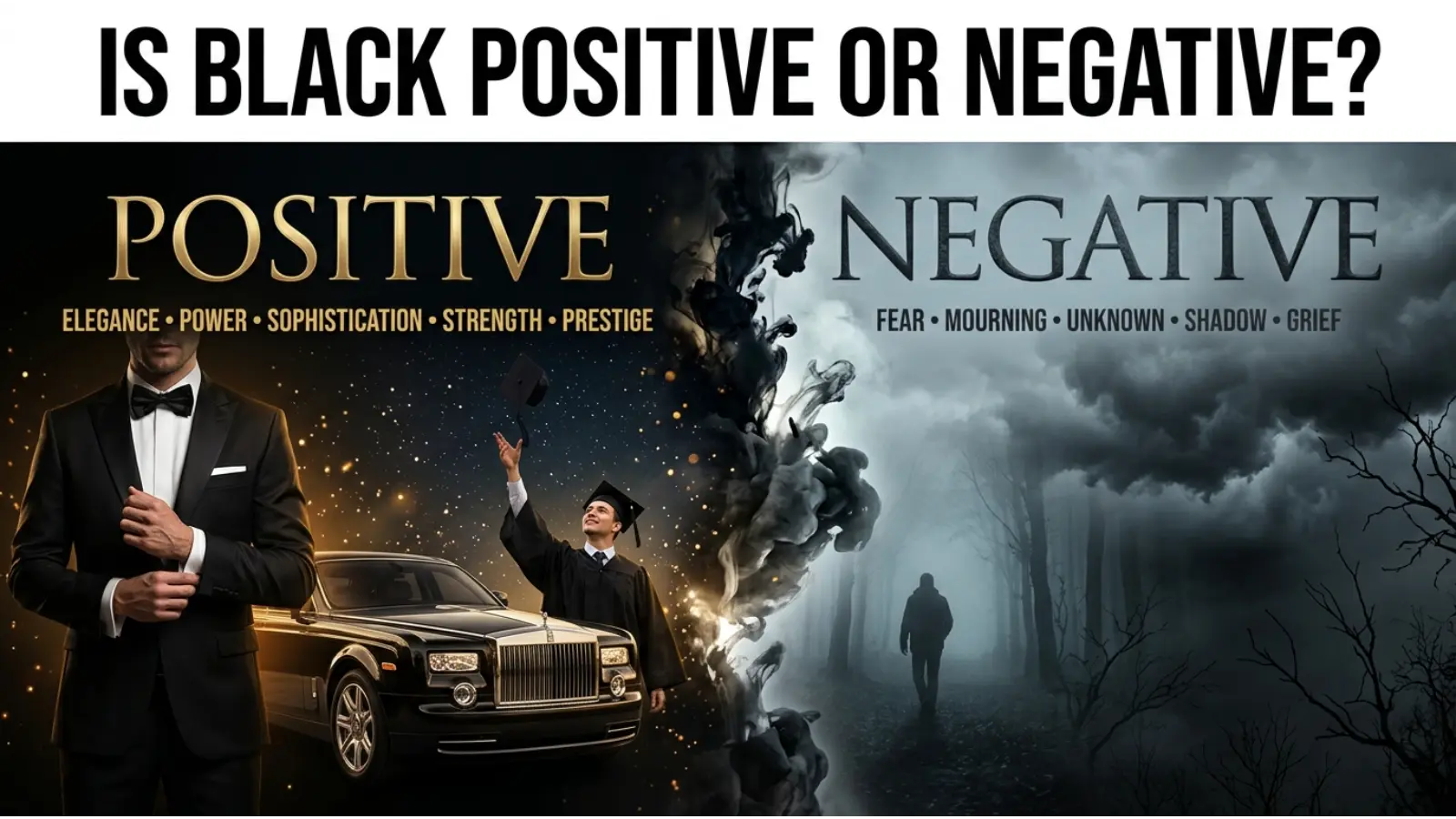
Black can be both positive and negative. Its meaning depends on how and where it is used. In fashion and branding, black often represents elegance, power, and confidence. In some situations, it can represent sadness, danger, or loss.
Here are three simple examples:
- Positive: A black suit can represent elegance and professionalism.
- Negative: Black clothing may be worn at funerals to express grief in some cultures.
- Neutral: Black ink is commonly used for writing and printing.
Simple rule: Black does not always mean something bad. Look at the context to understand its meaning.
The Origin of Black and Its Meaning
Black is one of the oldest colors recognized by humans. People have used black pigments in art, clothing, writing, and decoration for thousands of years.
Historically, black has had different meanings across cultures. In some places, it became linked with mourning and death. In others, it represented authority, wealth, strength, and formality.
Today, black is widely used in fashion, business, graphic design, photography, and digital media. Many brands use it to create a simple, bold, or premium look.
The meaning of black has changed over time, but one thing remains true: its meaning depends on the situation and the person interpreting it.
British English vs American English Usage
Black has the same basic meaning in British English and American English. There is no major spelling difference between the two varieties.
However, the emotional meaning of black can vary depending on culture, tradition, and personal experience.
| Feature | British English | American English | Notes |
|---|---|---|---|
| Spelling | Black | Black | Same spelling |
| Fashion | Elegance and formality | Elegance and formality | Common in both |
| Mourning | Used in some funeral traditions | Used in some funeral traditions | Customs may vary |
| Design | Bold and modern | Bold and modern | Depends on the design |
| Symbolism | Can suggest mystery or sadness | Can suggest mystery or sadness | Context matters |
Black is also used in English phrases such as “black tie,” “black market,” and “blackout.” Each phrase has its own meaning, so you should not judge it by the color alone.
Which One Should You Use? Understanding Black in Different Situations
If you are deciding whether black is a positive or negative color, first consider your purpose.
- For clothing: Choose black when you want a classic, formal, or simple look.
- For branding: Black can help create a bold, elegant, or serious appearance.
- For website design: Black backgrounds can create contrast, but you need readable text.
- For art: Black can express sadness, mystery, strength, or creativity.
- For schoolwork: Explain the meaning based on the subject, such as physics, culture, or color psychology.
- For social media: Black can be used to create stylish designs or express a particular mood.
Black is suitable for both formal and casual settings. However, the meaning can change with the other colors, symbols, words, and images around it.

Common Mistakes About Black Being Positive or Negative
People sometimes assume that black always has one meaning. Here are four common mistakes to avoid.
Mistake 1: Thinking black always means something bad
❌ “Black is always a negative color.”
✔ Black can represent elegance, strength, confidence, mystery, or sadness. Its meaning depends on context.
Mistake 2: Believing black always represents sadness
❌ “Anyone wearing black must be unhappy.”
✔ People wear black for many reasons, including fashion, comfort, work, and personal preference.
Mistake 3: Confusing cultural beliefs with facts
❌ “Black always brings bad luck.”
✔ Some people connect black with bad luck, but this is a cultural belief, not a proven universal fact.
Mistake 4: Assuming black has the same meaning in every field
❌ “Black means negative in science, design, and everyday life.”
✔ Black can have different meanings in different fields. In an electrical diagram, for example, a wire’s meaning depends on the relevant standard and circuit.

Black in Everyday Examples
Black appears in daily life in many different ways. The following examples show how its meaning can change.
1. At Work
Black is common in professional clothing because it can look formal and neat.
Example: “He wore a black suit to the job interview.”
Here, black suggests professionalism rather than negativity.
2. At School
Students may learn about black in art, science, or literature.
Example: “The artist used black to create contrast in the painting.”
In this case, black is a useful artistic tool.
3. On Social Media
Black is often used in profile pictures, posters, advertisements, and graphic designs.
Example: “The designer used a black background with white text.”
This combination can create a bold and clear appearance when the contrast is strong enough.
4. In Daily Life
Black is a common color for shoes, bags, furniture, and vehicles.
Example: “She bought a black handbag because it matched many outfits.”
Here, black is a practical and stylish choice.
5. In Text Messages
People may mention black when discussing clothing, moods, or design preferences.
Example:
- Person A: “Which color should I choose for my poster?”
- Person B: “Use black and gold. It will look elegant.”
The conversation uses black in a positive way.
Is Black Positive or Negative According to Google Trends and Search Behavior?
People search for “is black positive or negative” for different reasons. Some want to understand color psychology, while others may be asking about electricity, cultural symbolism, or design.
It is important to separate common search interests from actual search data. Without checking a specific Google Trends report, we cannot confirm which country searches this exact keyword the most or whether its popularity is increasing.
Here is how the topic may relate to different audiences:
- US: People may explore black in fashion, branding, art, and color symbolism.
- UK: Searches may relate to design, clothing, culture, and everyday expressions.
- India: Interest may include color meanings, traditions, education, and design.
- Pakistan: Students and general readers may search for simple explanations of color symbolism or science-related questions.
- Canada: Black may be discussed in fashion, art, business, and cultural contexts.
- Australia: Common areas of interest may include design, clothing, and color psychology.
These are possible reasons for searching, not verified country rankings.
Social media can also influence interest in color meanings. When black is used in a popular design, outfit, or online trend, people may become curious about what it represents.
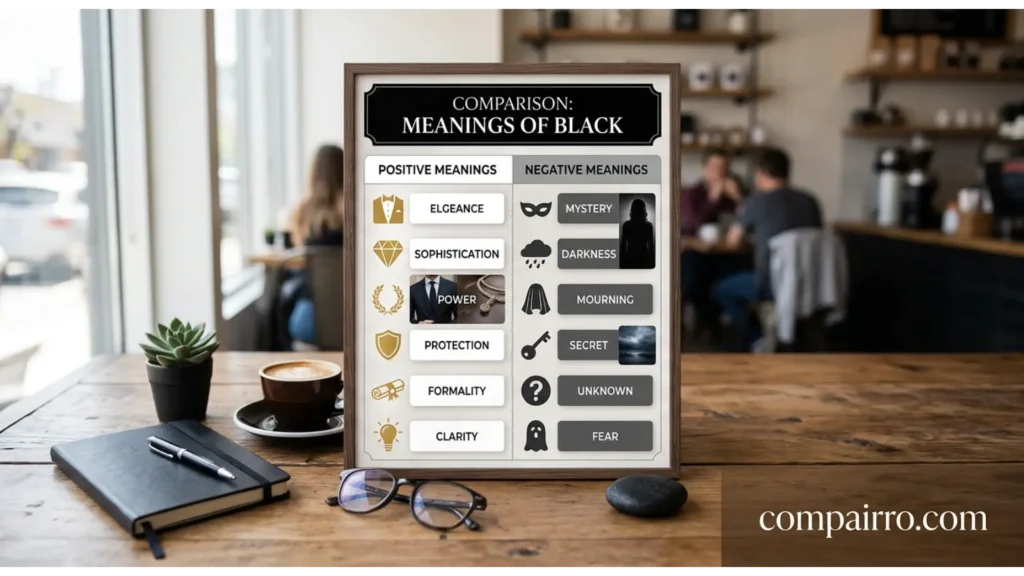
Comparison Table: Positive vs Negative Meanings of Black
Black can communicate different ideas depending on the setting. This table makes the differences easier to understand.
| Situation | Possible Positive Meaning | Possible Negative Meaning |
|---|---|---|
| Fashion | Elegance and confidence | May feel too formal for some events |
| Business | Authority and professionalism | May seem serious or unapproachable |
| Art | Creativity and contrast | Sadness or darkness |
| Culture | Strength or respect | Mourning in some traditions |
| Branding | Luxury and simplicity | A design may feel too heavy |
| Psychology | Confidence or mystery | May be associated with fear or sadness |
| Photography | Depth and contrast | Important details may be hard to see |
These meanings are not fixed rules. The same black design may feel powerful to one person and gloomy to another.
Black in Professional Life
Black plays an important role in many workplaces and industries.
Fashion and Business
Black suits, shoes, and accessories are popular because they can look formal and work with many other colors.
Marketing and Branding
Companies may use black to suggest quality, strength, simplicity, or luxury. However, the effect depends on the logo, font, layout, and target audience.
Website Design
Black backgrounds can make bright colors stand out. Still, designers should use readable text, enough contrast, and a layout that is comfortable to view.
Photography and Film
Black helps create shadows, depth, and contrast. Filmmakers may also use it to create mystery or a serious mood.
In professional settings, black is neither automatically positive nor negative. Its success depends on how it supports the message.
Black for Students and Beginners
Students may find this topic confusing because black can have different meanings in different subjects.
For example, an art teacher may discuss black as a color used for contrast, while a literature teacher may explain how darkness represents fear or mystery in a story.
Here are some easy learning tips:
- Check the subject: Ask whether the topic is about art, culture, science, or psychology.
- Look at the example: A black suit and a black warning symbol may communicate different things.
- Avoid absolute statements: Words such as “always” and “never” can lead to mistakes.
- Use simple examples: Connect the meaning to something familiar, such as clothes or a website.
- Consider culture: People may interpret colors differently because of their traditions and experiences.
Remember, understanding context is more useful than memorizing a single meaning.
Signs or Characteristics Related to Black
Black is linked with several common ideas in design, culture, and everyday life. These are possible associations, not rules that apply to everyone.
- Elegance: Black clothing is often used for formal events.
- Power: Black may create a strong and confident visual impression.
- Mystery: Black is often used in stories and images to create suspense.
- Sadness: Some people associate black with grief or loss.
- Simplicity: Black can make a design look clean and uncluttered.
- Contrast: Black can help lighter colors stand out.
- Seriousness: Businesses may use black to create a formal appearance.
- Versatility: Black works with many other colors in fashion and design.
These characteristics explain why black can be useful in many different settings.
Simple Trick to Remember Whether Black Is Positive or Negative
Here is an easy way to remember the meaning of black:
Black = Context, not just color.
Think of it this way:
- A black suit can suggest elegance.
- A black background can create contrast.
- Black clothing at a funeral may express grief.
- Black in a painting can create mystery.
The color is the same, but the meaning changes with the situation.
Whenever someone asks whether black is positive or negative, think about three things: where it appears, how it is used, and what it communicates.
FAQs:
1. Is black a positive or negative color?
Black can be both. It may represent elegance, strength, or confidence, but it can also suggest sadness, mystery, or mourning.
2. Does black mean negative energy?
Some spiritual or cultural beliefs connect black with negative energy. However, this is a belief, not a scientifically established fact.
3. Is black a good color for business?
Yes. Black is often used in business clothing, logos, and websites because it can look professional, bold, and elegant.
4. What does black mean in color psychology?
Black may be associated with power, control, mystery, elegance, or sadness. Its effect depends on the person and the setting.
5. Is black a positive color in different cultures?
Its meaning varies. Some cultures connect black with mourning, while others may use it to express strength, respect, or formality.
6. Is black positive or negative in science?
Black does not have one universal positive or negative meaning in science. Its meaning depends on the subject, diagram, measurement, or system being studied.
7. Can black be used with other colors?
Yes. Black works well with white, gold, red, blue, and many other colors. The combination can create different moods and styles.
Conclusion
So, is black positive or negative? Black can represent both positive and negative ideas, depending on the context. It may suggest elegance, power, confidence, and simplicity. In other situations, it may represent sadness, mourning, or mystery.
The most important thing is not to judge a color by one meaning alone. Consider where black appears and what message it is meant to communicate.
Easy memory rule: Black is not always positive or negative. Its meaning depends on how and where it is used.

Sara Taylor is a passionate English content writer who specializes in word meanings, spelling comparisons, and modern slang explanations. She creates easy-to-understand articles that help readers avoid common English mistakes and improve their writing skills. Her content focuses on simple learning, real-life examples, and clear explanations for everyday readers.