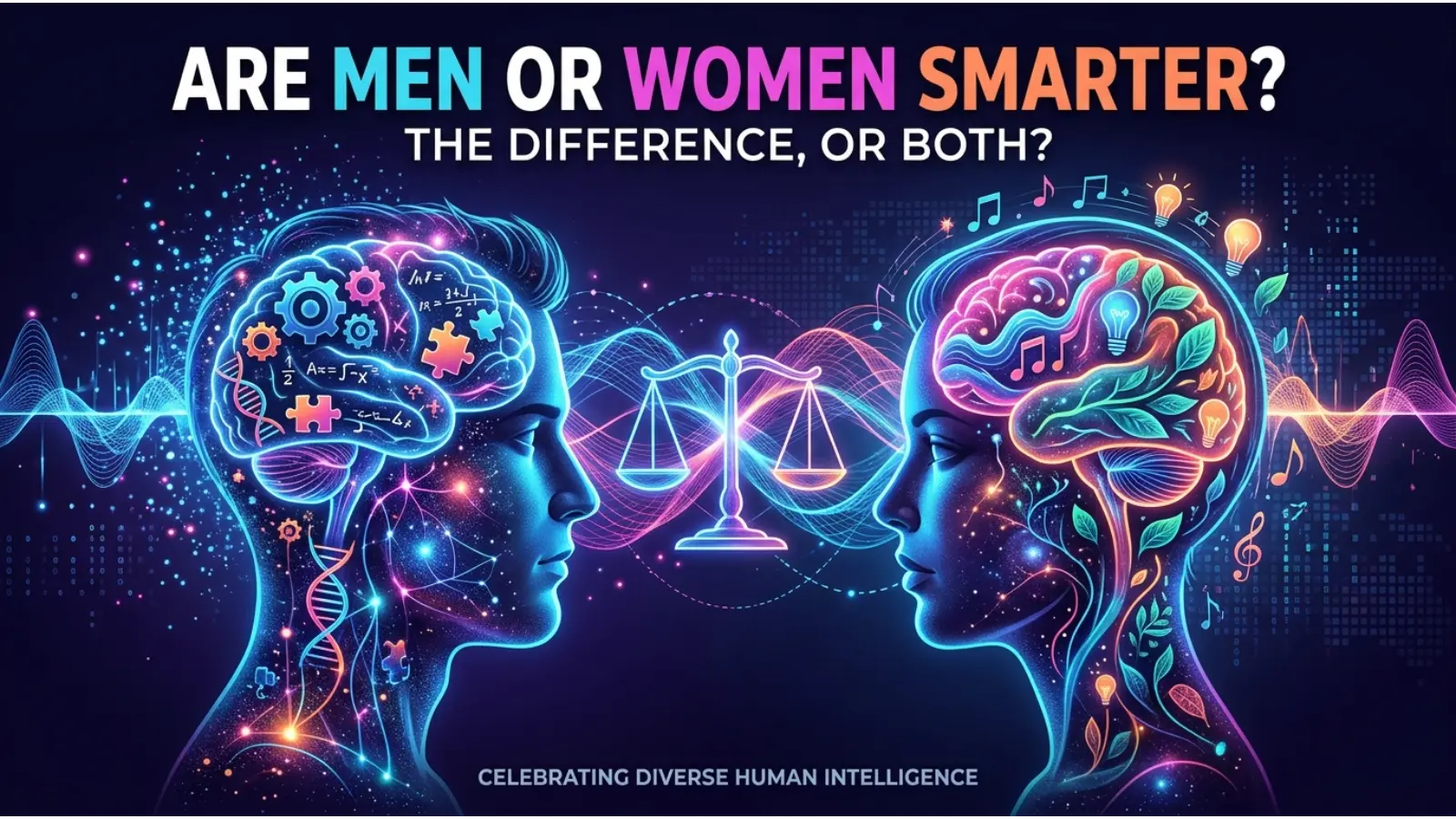
Have you ever been in a classroom where a girl gets the highest marks, while a boy solves a difficult math problem faster than everyone else? Situations like these often make people wonder: are men or women smarter? It is a common question that sparks curiosity, friendly debates, and discussions about intelligence.
People search for this topic for many reasons. Some want to understand the differences between male and female brains. Others want to know who performs better in school, math, science, memory tests, or problem-solving. You may also see this question on social media, in workplace discussions, online forums, and everyday conversations.
However, intelligence is not as simple as getting good grades or solving a puzzle quickly. It includes many skills, such as learning, reasoning, understanding language, solving problems, and making decisions. People also have different experiences, interests, and learning opportunities.
So, does one gender have a natural advantage over the other? Research suggests that men and women have broadly similar average general intelligence, although some studies find average differences in certain specific abilities. These differences do not tell us how intelligent an individual person is.
In this guide, you’ll learn the meaning, examples, usage, differences, common mistakes, and simple explanations in easy English.
Are Men or Women Smarter? – Quick Answer
Neither men nor women are proven to be universally smarter than the other. Research generally finds that average general intelligence is similar between the sexes. Some average differences may appear in specific skills, but individual abilities vary greatly.
Intelligence includes several abilities, including:
- Reasoning: Understanding information and solving problems.
- Memory: Remembering facts, instructions, and experiences.
- Language: Understanding words and expressing ideas.
- Spatial skills: Understanding shapes, distances, and how objects fit together.
- Learning: Gaining knowledge and using it in new situations.
Examples:
- A woman may be excellent at solving complex scientific problems.
- A man may have strong language skills and an excellent memory.
- Two people of the same gender may have very different strengths and abilities.
Simple rule: Intelligence depends on the individual, not just gender.

The Origin of the Debate About Male and Female Intelligence
The question of whether men or women are smarter has been discussed for centuries. In the past, some researchers tried to explain differences in education and achievement through biological differences between men and women.
However, early studies often had serious limits. Women and girls did not always have the same access to education, employment, or scientific opportunities as men and boys. As a result, differences in achievement could not fairly be explained by biology alone.
Over time, intelligence tests and brain research became more advanced. Researchers began studying many different skills rather than judging intelligence through one test or type of achievement.
Today, scientists understand that intelligence is influenced by many factors, including genetics, education, health, environment, and life experiences.
Social media has also made the debate more popular. Short videos and online posts sometimes claim that one gender is naturally smarter. However, such claims often leave out important details from scientific research.
British English vs American English Usage
The phrase “are men or women smarter” has the same meaning in British and American English. There is no spelling difference in this question.
| Feature | British English | American English | Notes |
|---|---|---|---|
| Common wording | Are men or women smarter? | Are men or women smarter? | Same wording |
| Spelling | Intelligence | Intelligence | Same spelling |
| Grammar | Men and women are intelligent. | Men and women are intelligent. | Same grammar |
| Informal usage | Who is smarter? | Who is smarter? | Common in conversation |
| Formal usage | Is intelligence different between the sexes? | Is intelligence different between the sexes? | Suitable for academic discussion |
In the UK, the US, Pakistan, India, Canada, and Australia, people can use the same basic question.
For school assignments or scientific writing, however, it is better to ask about specific abilities and research findings instead of assuming that one gender is smarter overall.
Which One Should You Believe?
When discussing whether men or women are smarter, it is important to focus on reliable evidence rather than personal opinions.
Here are some useful guidelines:
- For science: Look for studies that measure intelligence using clear and reliable methods.
- For education: Consider individual learning skills, study habits, and access to learning.
- For work: Judge people by their knowledge, performance, and problem-solving skills.
- For everyday conversations: Remember that one person’s ability cannot represent an entire gender.
- For social media: Check whether a claim comes from credible research or simply expresses an opinion.
In formal writing, use phrases such as “average differences in specific cognitive abilities” rather than saying that all men or all women think in the same way.
The main point is simple: both men and women can be highly intelligent, and neither group should be judged by stereotypes.
Common Mistakes About Male and Female Intelligence
People often misunderstand intelligence because they rely on a small number of examples or popular beliefs.
Mistake 1: Assuming men are always better at math
❌ Incorrect: Every man is naturally better at math than every woman.
✔ Correct: Mathematical ability varies from person to person. Some studies find average differences on certain tasks, but there is considerable overlap between males and females.
Mistake 2: Assuming women are always better at language
❌ Incorrect: Every woman has better language skills than every man.
✔ Correct: Some research finds average differences in certain verbal tasks, but individuals vary widely. Many men have excellent language skills, and many women excel in technical fields.
Mistake 3: Using school grades as the only measure
❌ Incorrect: The student with the highest marks is always the smartest person.
✔ Correct: Grades show performance in particular subjects. They do not measure every form of intelligence, creativity, practical knowledge, or problem-solving.
Mistake 4: Believing that brain size proves intelligence
❌ Incorrect: A larger brain automatically means a person is smarter.
✔ Correct: Brain size alone cannot tell us how intelligent someone is. Brain structure, connections, development, and many other factors matter.
Mistake 5: Believing that one study proves everything
❌ Incorrect: One research result proves that all men or all women are smarter.
✔ Correct: Scientific findings must be considered alongside other studies, the methods used, and the size of the observed differences.

Are Men or Women Smarter in Everyday Life? Examples
Intelligence can appear in many situations. A person’s strengths may become clear when they face a challenge, learn something new, or help others solve a problem.
At Work
A male engineer may be excellent at designing a system, while a female engineer may be equally skilled at developing a new solution.
Their success depends on their training, knowledge, creativity, and experience, not simply their gender.
At School
One student may solve math questions quickly, while another may write excellent essays or understand science concepts deeply.
Both students can be intelligent in different ways. Good teaching and regular practice can help both improve.
On Social Media
A video may show a man solving a puzzle faster than a woman, or the other way around.
However, one short video cannot establish which gender is smarter. The result may depend on practice, familiarity with the puzzle, attention, or luck.
In Daily Life
One person may be good at planning a journey, while another may be skilled at managing money or repairing household items.
These abilities involve different kinds of knowledge and problem-solving. A single skill cannot measure someone’s entire intelligence.
In Text Messages and Conversations
Friends may joke about who is smarter during a quiz or game.
For example:
“Your answer was faster than mine!”
“That doesn’t mean you’re smarter at everything. Let’s try another question!”
This keeps the conversation friendly without turning a game into a judgment about gender.
Are Men or Women Smarter? – Google Trends and Usage Data
The question attracts attention because people are curious about the brain, intelligence, relationships, school performance, and differences between men and women.
However, exact search popularity varies by time and location. Without checking current Google Trends data, it would be inaccurate to claim that a particular country searches for this phrase the most.
People may search for related questions in the following countries:
- United States: Interest in psychology, intelligence research, education, and gender differences.
- United Kingdom: Discussions about school achievement, brain science, and equal opportunities.
- India: Questions about academic performance, competitive exams, and intelligence.
- Pakistan: Curiosity about education, gender stereotypes, and scientific explanations.
- Canada: Interest in psychology, research, and equal access to education.
- Australia: Discussions about cognitive skills, learning, and gender differences.
These are possible reasons for interest, not verified rankings of search volume.
Search trends can change when a new study, news story, or viral video brings attention to the subject. People may also search for related phrases such as “male vs female intelligence,” “are women smarter than men,” and “who has a higher IQ?”
For accurate search-volume comparisons, use Google Trends and SEO keyword tools. Remember that search interest shows what people want to know, not whether a claim is scientifically correct.
Comparison Table: Male vs Female Intelligence
The following table summarizes common research questions without treating average differences as rules for every individual.
| Area | What research generally suggests | Important point |
|---|---|---|
| General intelligence | Average scores are broadly similar | Neither gender is universally smarter |
| Mathematics | Some studies find differences on certain tasks | Performance varies widely |
| Verbal skills | Some average differences appear on particular tests | Individual results overlap |
| Spatial skills | Some tasks show average differences | Practice and experience matter |
| Memory | Results depend on the type of memory being tested | There is no single memory ranking |
| Creativity | Depends on the task and how creativity is measured | Both genders can be highly creative |
| Problem-solving | Depends on the problem and the person’s experience | Skills can be learned and improved |
| Academic success | Varies by subject, setting, and opportunity | Grades do not measure every ability |
It is important to understand the difference between an average and an individual result. Even when a study finds a difference between two groups, it does not mean that every member of one group performs better than every member of the other.

Male and Female Intelligence in Professional Life
Intelligence matters in the workplace, but success usually depends on more than a test score.
Workers need to understand instructions, solve problems, communicate clearly, learn new skills, and make sound decisions. Different jobs may also require different strengths.
For example:
- A doctor needs medical knowledge, careful reasoning, and good communication.
- A software developer needs logical thinking, technical knowledge, and problem-solving skills.
- A teacher needs subject knowledge, planning, and the ability to explain ideas.
- A business owner needs decision-making, financial understanding, and adaptability.
Men and women can succeed in all these fields. There is no reliable basis for deciding that a job belongs to one gender because one group is supposedly smarter.
Employers should assess relevant skills, education, experience, and performance rather than rely on gender-based assumptions.
Are Men or Women Smarter for Students and Beginners?
Students often ask this question because they want to understand why some classmates learn faster or perform better on tests.
The answer is that learning speed differs from person to person. It can depend on prior knowledge, interest, sleep, teaching methods, practice, and the type of task.
If you are a student, these habits can help you develop your abilities:
- Practice regularly: Short, focused study sessions can help you remember information.
- Ask questions: If a topic is confusing, ask a teacher or classmate to explain it.
- Use different methods: Try diagrams, examples, reading, and practice questions.
- Learn from mistakes: Review incorrect answers to understand what went wrong.
- Get enough rest: Sleep supports attention, learning, and memory.
- Avoid unfair comparisons: Focus on your own progress instead of competing with stereotypes.
You do not need to prove that you are smarter than another gender. Building knowledge and improving your skills are much more useful goals.
Signs or Characteristics Related to Intelligence
There is no single sign that proves a person is highly intelligent. However, several habits can support learning and problem-solving.
Common examples include:
- Curiosity: Asking questions and wanting to understand how things work.
- Reasoning: Connecting information and finding logical answers.
- Adaptability: Learning from new situations and adjusting plans.
- Problem-solving: Looking for practical ways to handle challenges.
- Clear communication: Explaining ideas so that others can understand them.
- Learning from mistakes: Changing an approach when it does not work.
- Open-mindedness: Considering new information before reaching a conclusion.
- Persistence: Continuing to learn when a subject becomes difficult.
These characteristics are not exclusive to men or women. They can develop through education, experience, practice, and support.
Also, a person may be strong in one area and need more practice in another. That is normal and does not make them less valuable or capable.
Simple Trick to Remember: Are Men or Women Smarter?
Think of intelligence as a collection of skills rather than a competition between two genders.
Think of it this way:
- Intelligence = Different thinking and learning abilities.
- Gender = Not a complete measure of intelligence.
- Individual differences = Important when understanding real people.
- Practice and education = Ways to build knowledge and skills.
Imagine two students preparing for an exam. One understands math quickly, while the other writes strong answers in English. Both may have valuable abilities, and both can improve in the subjects they find difficult.
The easiest memory rule is this: Judge intelligence by a person’s abilities and evidence, not by gender alone.
FAQs:
1. Are men or women smarter on average?
Research generally finds similar average levels of general intelligence. Some specific abilities may show average differences, but these do not establish that one gender is universally smarter.
2. Do men have higher IQs than women?
There is no simple, universal rule that men have higher IQs than women. Results depend on the test, sample, and abilities being measured.
3. Are women better at learning than men?
Neither gender is always better at learning. Learning depends on the subject, prior knowledge, teaching, practice, and individual differences.
4. Are men naturally better at math?
No, not as a universal rule. Some studies find average differences on certain mathematical tasks, but ability varies greatly among individuals and can improve with practice.
5. Are women better at memory?
It depends on the kind of memory being tested. Some studies find average differences in specific memory tasks, but there is no single rule that women have better memory in every situation.
6. Does brain size determine intelligence?
No. Brain size alone cannot determine a person’s intelligence. Researchers consider many factors, including brain structure, development, and cognitive performance.
7. What matters more than gender when developing intelligence?
Education, practice, health, life experiences, learning opportunities, and individual strengths all matter. Supporting these factors helps people build knowledge and improve their abilities.
Conclusion
So, are men or women smarter? The best answer is that neither gender is universally smarter than the other. Scientific research generally finds similar average general intelligence, although some studies report differences in specific cognitive skills.
Intelligence is complex. It includes reasoning, memory, language, problem-solving, learning, and other abilities. People can have different strengths regardless of whether they are male or female.
Instead of judging someone by gender, look at their actual skills, knowledge, effort, and achievements. Schools, workplaces, and families can help everyone learn by offering fair opportunities and encouragement.
Final memory rule: Intelligence belongs to individuals, not stereotypes. Both men and women can be intelligent, creative, and successful.

Sara Taylor is a passionate English content writer who specializes in word meanings, spelling comparisons, and modern slang explanations. She creates easy-to-understand articles that help readers avoid common English mistakes and improve their writing skills. Her content focuses on simple learning, real-life examples, and clear explanations for everyday readers.