Choosing a new TV can be confusing, especially when you see two popular display technologies: OLED and QLED. Both offer excellent picture quality, bright colors, and modern features. However, they work in different ways, and each has its own strengths.
You may wonder whether OLED or QLED is better for watching movies, playing games, or enjoying your favorite TV shows. Some people prefer OLED because it produces deep black colors and gives a cinema-like experience. Others choose QLED because it offers higher brightness and works well in rooms with lots of sunlight.
The confusion often starts when shopping online or visiting an electronics store. TV brands use terms such as OLED, QLED, Neo QLED, and QD-OLED. Although these names sound similar, they do not all describe the same display technology.
Understanding these differences can help you make a smarter buying decision. It can also help you avoid spending extra money on features you may not need.
Whether you are a student researching display technology, a gamer looking for a better screen, or someone planning to buy a new television, knowing how OLED and QLED work is useful.
In this guide, you’ll learn the meaning, examples, usage, differences, common mistakes, and simple explanations in easy English.
Is OLED or QLED Better? – Quick Answer
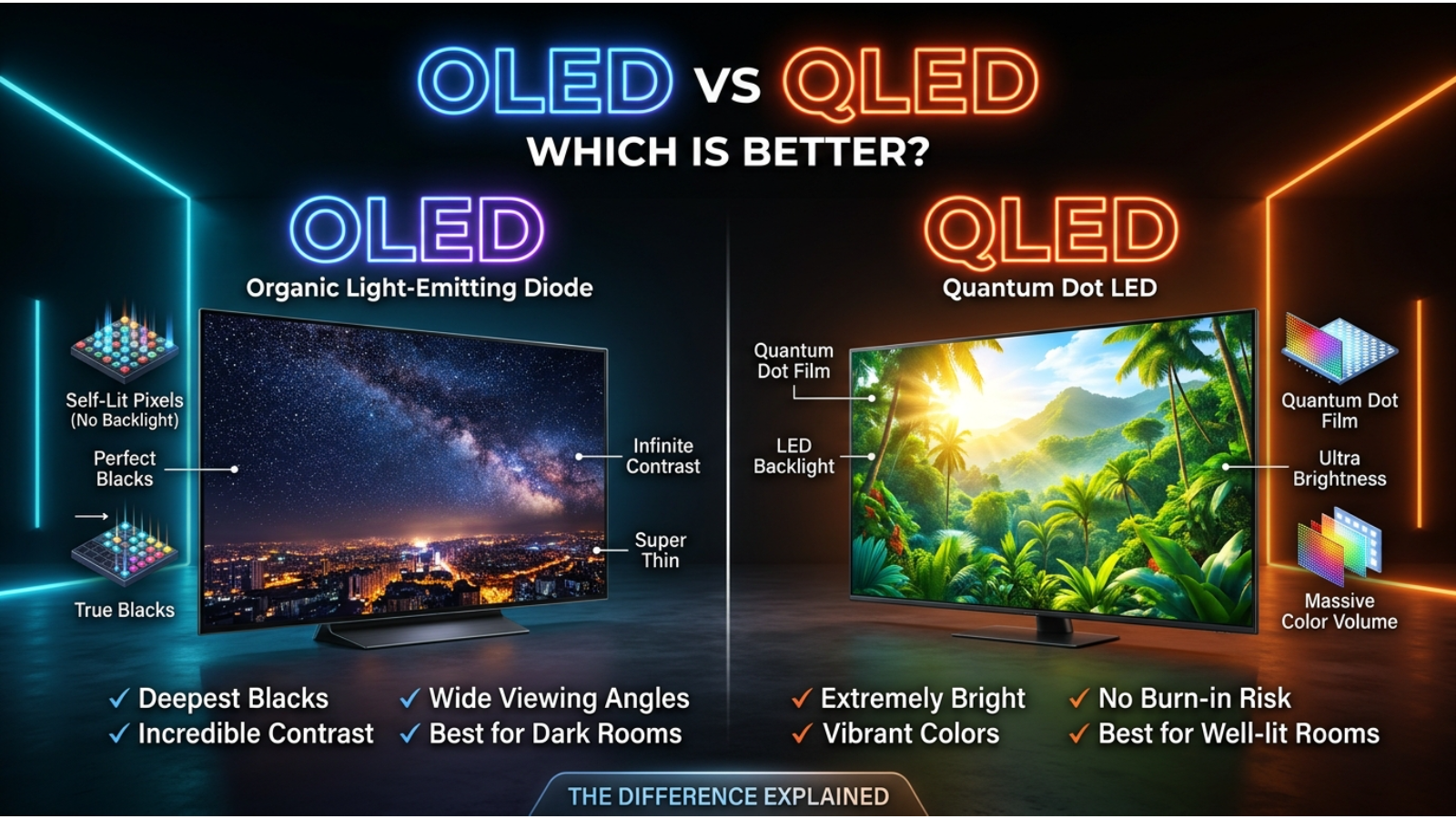
OLED is generally better for picture quality, deep blacks, contrast, and movie watching. QLED is often better for bright rooms, higher brightness, and avoiding the risk of permanent image retention associated with OLED.
Both technologies can provide an excellent viewing experience. The right choice depends on your room, budget, and daily usage.
Here is a simple explanation:
- OLED: Best for deep blacks, excellent contrast, and cinematic picture quality.
- QLED: Best for bright rooms, colorful pictures, and high brightness.
- QD-OLED: Combines OLED technology with quantum dots for rich colors and excellent contrast.
Examples:
- Watching movies in a dark room? OLED is an excellent choice.
- Watching television in a sunny living room? QLED may be better.
- Playing games with excellent contrast and fast response? OLED is worth considering.
Simple rule:
👉 OLED = Better blacks and contrast.
👉 QLED = More brightness and bright-room performance.
The Origin of OLED and QLED
Organic Light-Emitting Diode and QLED developed as different ways to improve television picture quality.
OLED stands for Organic Light-Emitting Diode. OLED technology uses organic materials that produce light when electricity passes through them. Each pixel can turn on or off independently.
OLED technology became popular in premium televisions because it can produce true black colors without a separate backlight.
QLED stands for Quantum Dot Light-Emitting Diode. It uses quantum dots to improve color and brightness. Most traditional QLED televisions use an LED backlight to produce light.
Samsung helped make QLED televisions widely known in the consumer TV market.
Today, both technologies are available from several major television brands. They continue to improve through better panels, processors, and display features.
British English vs American English Usage
There is no spelling or pronunciation difference between OLED and QLED in British and American English.
Both countries use the same technical terms because they are international display technology names.
| Feature | British English | American English | Notes |
|---|---|---|---|
| OLED | OLED | OLED | Same term |
| QLED | QLED | QLED | Same term |
| Television | Television | Television / TV | Same meaning |
| Picture quality | Picture quality | Picture quality | Same usage |
| Display technology | Display technology | Display technology | Same meaning |
People in the UK and US use these terms when discussing televisions, gaming screens, and display technology.
Which One Should You Use?
If you are deciding between OLED and QLED, consider how you normally use your television.
There is no single winner for everyone. Both technologies have useful features.
Choose OLED if:
- You enjoy watching movies and TV shows.
- You want deep black colors.
- You watch television in a dark or dim room.
- You want excellent contrast.
- You enjoy gaming with fast pixel response times.
- You want a premium cinematic experience.
Choose QLED if:
- Your room receives lots of sunlight.
- You watch television during the daytime.
- You prefer a very bright screen.
- You often watch channels with static logos.
- You want more choices across different price ranges.
- You want to avoid OLED’s specific burn-in risk.
What about formal and informal usage?
OLED and QLED are technical terms, not informal expressions. You can use them in product reviews, professional discussions, shopping guides, and everyday conversations.
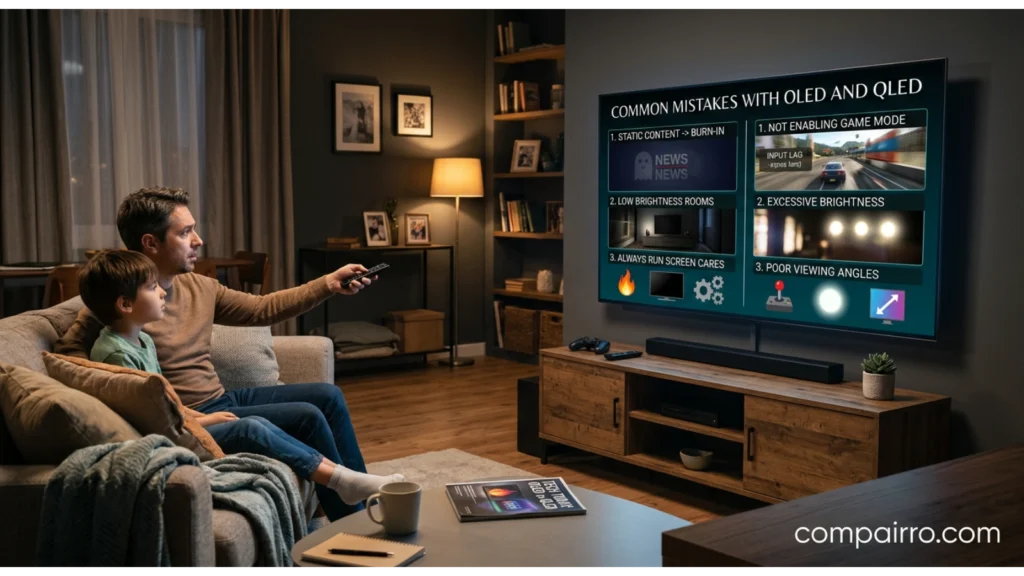
Common Mistakes With OLED and QLED
People often misunderstand these technologies because their names sound similar. Here are some common mistakes to avoid.
Mistake 1: Thinking OLED and QLED are the same technology
❌ OLED and QLED work in exactly the same way.
✔ They use different display systems. OLED pixels produce their own light, while traditional QLED televisions use an LED backlight with quantum dots.
Mistake 2: Thinking every QLED TV is brighter than every OLED TV
❌ QLED is always brighter than OLED.
✔ Many QLED TVs can reach higher brightness levels, but performance depends on the specific television model.
Mistake 3: Believing OLED is always better
❌ OLED is the best choice for every room.
✔ OLED is excellent for dark-room viewing, but QLED may be more suitable for bright rooms.
Mistake 4: Thinking QLED produces perfect black colors
❌ Every QLED television can produce the same black levels as OLED.
✔ Traditional QLED screens use a backlight, which can cause some light to appear in dark areas. However, advanced local dimming can improve black levels.
Mistake 5: Thinking OLED always suffers from burn-in
❌ Every OLED television develops burn-in quickly.
✔ OLED burn-in is possible, especially with long-term display of static images, but normal viewing habits and built-in protection features can reduce the risk.
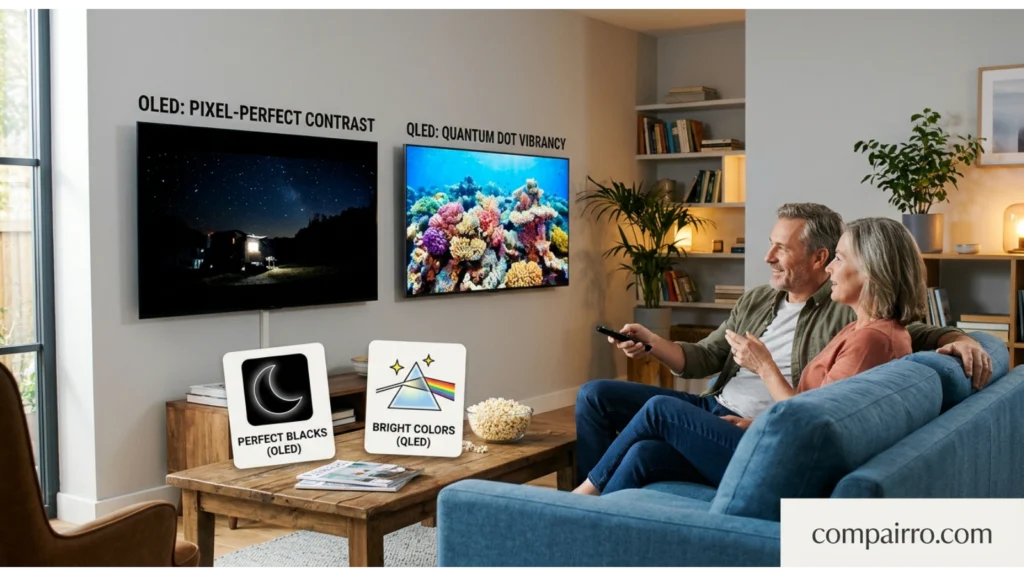
OLED and QLED in Everyday Examples
Let’s understand how both technologies perform in real-life situations.
1. Watching Movies
OLED is an excellent option for movie lovers. It produces deep blacks, making dark movie scenes look more natural.
QLED can also provide an enjoyable movie experience, especially in a bright room.
2. Playing Video Games
Both OLED and QLED can be excellent for gaming.
OLED offers fast pixel response times, strong contrast, and smooth motion. Some QLED models offer high refresh rates and excellent brightness.
3. Watching Television at Work
If you use a television as a large display for presentations or information, QLED can be a practical choice because of its brightness.
However, the right option depends on the screen size, resolution, and how long static content stays visible.
4. Using Social Media
If you connect your computer or streaming device to a television to watch YouTube videos, social media content, and online entertainment, both technologies work well.
5. Daily Family Entertainment
For family entertainment, think about the lighting in your room.
- Bright living room: QLED is worth considering.
- Dark entertainment room: OLED is worth considering.
- Mixed lighting: Compare specific models before buying.
OLED or QLED – Google Trends and Usage Data
The keyword is OLED or QLED better reflects growing interest in modern television technology.
People search for this comparison because they want to understand which screen offers better value and performance.
Here are some common reasons behind these searches:
- Choosing a new television.
- Comparing Samsung and LG televisions.
- Finding the best TV for gaming.
- Understanding picture quality.
- Comparing brightness and contrast.
- Learning about OLED burn-in.
- Finding an affordable television.
Popular countries where people may search for this topic include:
- United States: Buyers compare premium televisions and gaming displays.
- United Kingdom: People research television features before purchasing.
- India: Customers compare display quality and prices.
- Pakistan: Buyers look for suitable televisions within different budgets.
- Canada: People compare televisions for movies and home entertainment.
- Australia: Consumers research brightness and screen performance.
Search interest can change depending on new television releases, sales seasons, and product launches.
However, exact country rankings and search volumes should be checked through Google Trends or a keyword research tool. The list above is not a verified ranking.
Comparison Table: OLED vs QLED
The easiest way to understand both technologies is to compare their main features.
| Feature | OLED | QLED |
|---|---|---|
| Full Form | Organic Light-Emitting Diode | Quantum Dot Light-Emitting Diode |
| Black Levels | Excellent | Depends on backlight and dimming |
| Contrast | Excellent | Good to excellent |
| Brightness | Very good | Often higher |
| Colors | Rich and accurate | Bright and colorful |
| Viewing Angles | Generally wider | Varies by panel |
| Response Time | Very fast | Varies by model |
| Burn-in Risk | Possible | No typical OLED-style burn-in |
| Dark Room | Excellent | Good to excellent |
| Bright Room | Good | Often excellent |
| Gaming | Excellent | Excellent |
| Price | Often premium | Available across more price ranges |
Important: These are general differences. Premium QLED models can perform better than entry-level OLED models in some areas.
OLED or QLED in Professional Life
OLED and QLED are not only useful for home entertainment. They also have practical uses in professional environments.
For example, businesses use large screens for presentations, meetings, advertising, and digital displays.
OLED may be useful for:
- Premium visual presentations.
- High-quality video editing displays.
- Creative work where contrast matters.
- Professional entertainment setups.
QLED may be useful for:
- Bright meeting rooms.
- Business presentations.
- Digital information screens.
- General office entertainment.
However, professional users should also consider screen resolution, color accuracy, brightness, connectivity, and operating hours.
For long-running static displays, commercial display specifications are especially important.
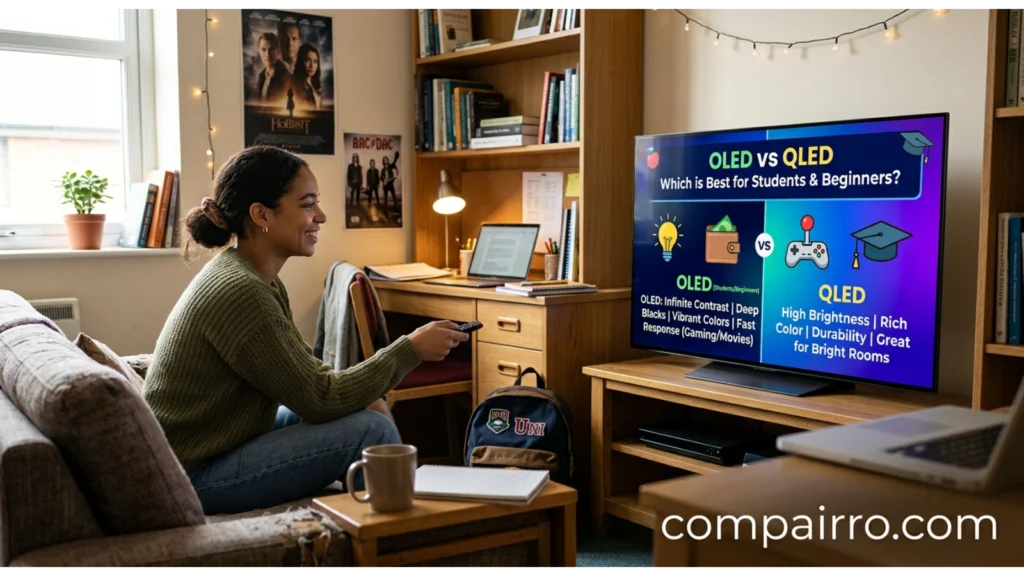
OLED or QLED for Students or Beginners
Students and beginners may find these technologies confusing at first.
The main reason is that both names contain the letters LED, but they work differently.
Here are some easy learning tips:
- Remember that OLED pixels produce their own light.
- Understand that traditional QLED screens use an LED backlight.
- Learn that quantum dots help improve color performance.
- Compare black levels and brightness separately.
- Check real-world reviews before choosing a television.
Beginner tip: Do not choose a television only because its technology sounds more advanced. Compare the actual model and its features.
For example, an excellent QLED television may be a better purchase than a basic OLED model if your room is very bright.
Signs or Characteristics Related to OLED and QLED
Both technologies have unique features that help buyers understand their performance.
OLED characteristics:
- Each pixel produces its own light.
- Pixels can turn off individually.
- Excellent black levels.
- Very high contrast.
- Fast pixel response times.
- Wide viewing angles on many models.
- Possible permanent image retention over time.
QLED characteristics:
- Uses quantum dot technology.
- Traditional models use an LED backlight.
- Often delivers high brightness.
- Produces rich and colorful images.
- Available in different screen sizes.
- Offers a wide range of prices.
- Advanced models may include local dimming.
One important difference: Some QLED televisions also use Mini-LED backlighting. This can improve brightness control and contrast.
Simple Trick to Remember OLED or QLED
If you always forget which technology is better for different situations, use this simple memory trick.
👉 OLED = Outstanding Blacks
👉 QLED = Quality Brightness
Think of it this way:
Imagine watching a movie at night with all the lights turned off. OLED can make dark scenes look more realistic because individual pixels can switch off.
Now imagine watching television in a sunny living room. A bright QLED television may make the picture easier to see.
Easy examples:
- Movie lover? Consider OLED.
- Bright living room? Consider QLED.
- Gaming enthusiast? Compare both technologies.
- Budget-conscious buyer? Compare individual models and prices.
Remember, the best television is the one that suits your needs.
FAQs:
1. Is OLED better than QLED?
OLED is generally better for black levels, contrast, and dark-room viewing. QLED is often better for high brightness and bright rooms.
2. Which TV lasts longer, OLED or QLED?
Both can last for many years. Their lifespan depends on usage, brightness, build quality, and operating conditions.
3. Is QLED better for bright rooms?
Yes, many QLED televisions offer high brightness, making them suitable for rooms with lots of natural light.
4. Does OLED have better picture quality?
OLED usually offers better black levels and contrast. However, premium QLED models can also deliver excellent picture quality.
5. Is OLED better for gaming?
OLED is excellent for gaming because of its fast response times and strong contrast. However, many QLED televisions also offer gaming features such as high refresh rates and HDMI 2.1.
6. Can OLED screens get burn-in?
Yes, OLED screens can develop permanent image retention after prolonged exposure to certain static images. However, modern OLED televisions include features designed to reduce this risk.
7. Which is better for watching movies, OLED or QLED?
OLED is usually the better choice for watching movies in a dark room because it produces deep blacks and excellent contrast.
Conclusion
So, is OLED or QLED better? The answer depends on your viewing habits, room lighting, and budget.
OLED is an excellent choice if you want deep blacks, outstanding contrast, and a cinematic viewing experience. On the other hand, QLED is a strong option if you need a brighter screen for daytime viewing and want more choices across different price ranges.
Both technologies offer excellent features, and neither is perfect for every situation.
Before buying a television, compare its brightness, resolution, refresh rate, connectivity, price, and customer reviews.
Final memory rule:
👉 Choose OLED for better blacks and contrast.
👉 Choose QLED for brightness and bright-room viewing.
Understanding these differences will help you make a confident decision and choose a television that gives you the best value for your money.

Sara Taylor is a passionate English content writer who specializes in word meanings, spelling comparisons, and modern slang explanations. She creates easy-to-understand articles that help readers avoid common English mistakes and improve their writing skills. Her content focuses on simple learning, real-life examples, and clear explanations for everyday readers.