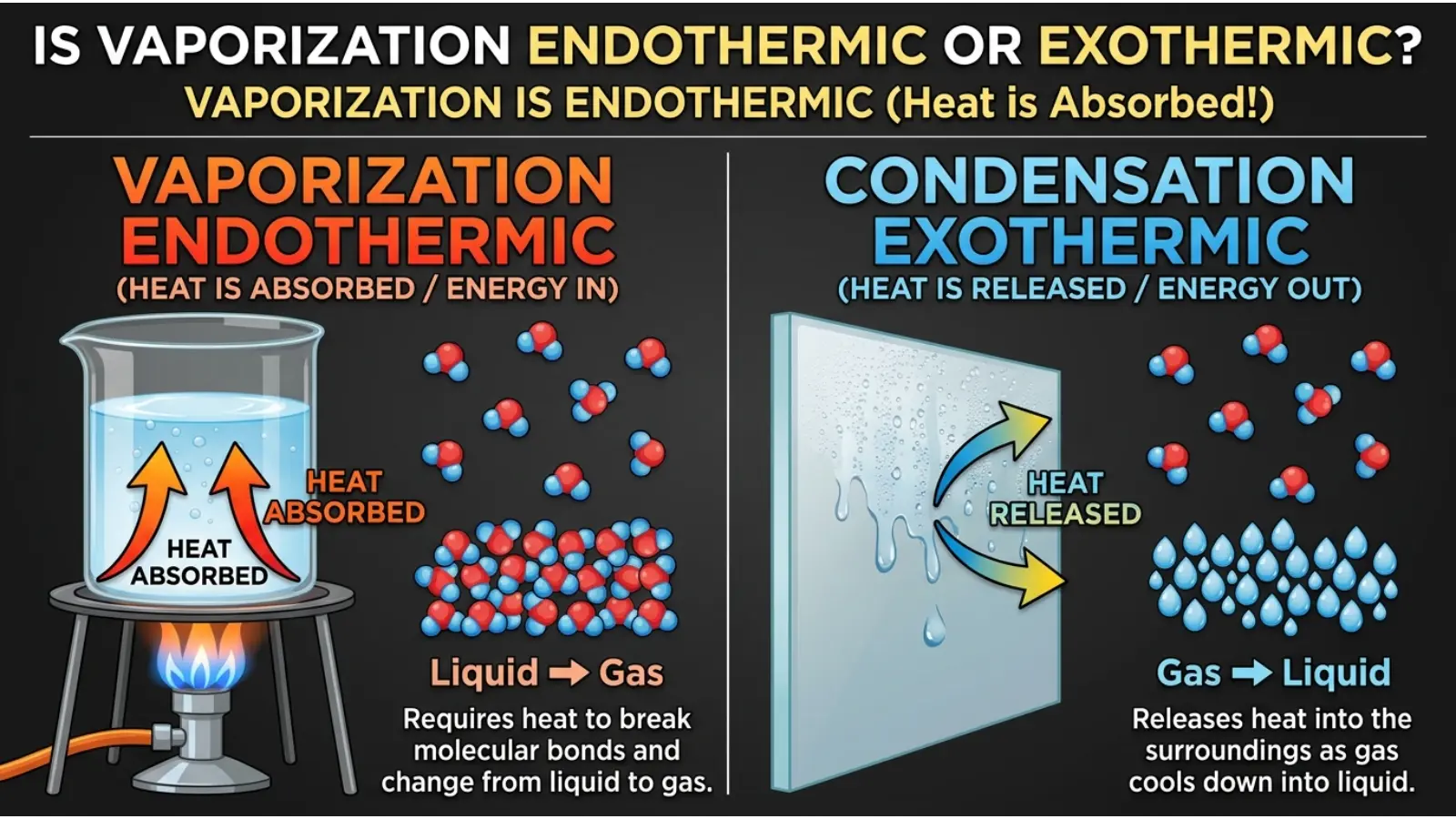
Is Vaporization Endothermic or Exothermic is a common science question among students learning about heat, energy, and changes of state. Vaporization happens when a liquid changes into a gas, such as water turning into steam. But does this process release heat or absorb energy from its surroundings?
However, many students get confused when learning about this process in science. They often ask, is vaporization endothermic or exothermic? Understanding the answer is important because it helps explain how heat moves during changes of state.
You may come across this question in school science lessons, chemistry textbooks, homework, classroom discussions, online searches, and science exams. It is also a common topic for students learning about energy, temperature, and the states of matter.
The main confusion is between endothermic and exothermic reactions. Both terms describe how energy moves, but they have opposite meanings. One process absorbs heat, while the other releases heat.
Vaporization is not a chemical reaction. Instead, it is a physical change in which a liquid turns into a gas. During this change, the liquid needs energy to overcome the forces that hold its particles close together.
For example, when water changes into water vapor, it absorbs heat from its surroundings. This is why vaporization is classified as an endothermic process.
In this guide, you’ll learn the meaning, examples, usage, differences, common mistakes, and simple explanations in easy English.
Is Vaporization Endothermic or Exothermic? – Quick Answer
Correct answer: Endothermic
Vaporization is an endothermic process because a liquid absorbs heat energy to change into a gas.
In simple words, vaporization needs heat to happen. The liquid takes in energy from its surroundings as its particles move farther apart and become a gas.
Examples:
- Boiling water: Water absorbs heat and changes into steam.
- Evaporation: Water on wet clothes absorbs energy and slowly turns into water vapor.
- Sweating: Sweat absorbs heat from your skin as it evaporates, helping your body cool down.
Simple rule:
- Endothermic = Absorbs heat.
- Exothermic = Releases heat.
- Vaporization = Absorbs heat.
Remember: When a liquid changes into a gas, it needs energy. Therefore, vaporization is endothermic.
The Origin of Vaporization
The word vaporization comes from the word “vapor,” which means a gas or gaseous form of a substance.
The concept has been studied for centuries as scientists explored how matter changes from one state to another.
Scientists learned that substances can exist in three common states:
- Solid
- Liquid
- Gas
Vaporization describes the change from a liquid state to a gas state.
For example, when scientists heat water, its particles gain energy and move more freely. Eventually, water can turn into water vapor.
Today, vaporization is an important topic in chemistry, physics, engineering, and everyday science education.
British English vs American English Usage
The word vaporization has the same scientific meaning in British and American English. However, there is a small spelling difference.
British English commonly uses vaporisation, while American English usually uses vaporization.
Both spellings describe the same process: a liquid changing into a gas.
| Feature | British English | American English | Notes |
|---|---|---|---|
| Common spelling | Vaporisation | Vaporization | Different spelling |
| Meaning | Liquid changes into gas | Liquid changes into gas | Same meaning |
| Scientific use | Chemistry and physics | Chemistry and physics | Same concept |
| Related word | Vapour | Vapor | Spelling difference |
| Process | Endothermic | Endothermic | Same energy change |
You can use either spelling depending on your audience or school requirements.
Which One Should You Use?
When answering the question “Is vaporization endothermic or exothermic?” the correct answer is always endothermic under ordinary conditions.
Here is when and how to use this scientific term:
- In school: Write that vaporization absorbs heat energy.
- In chemistry: Explain that energy is needed to overcome intermolecular forces.
- In physics: Describe the change from liquid to gas.
- In science exams: Choose endothermic when asked about vaporization.
- In everyday life: Use evaporation of water or drying clothes as examples.
Vaporization is a scientific term, so it is mainly used in formal education and scientific discussions.
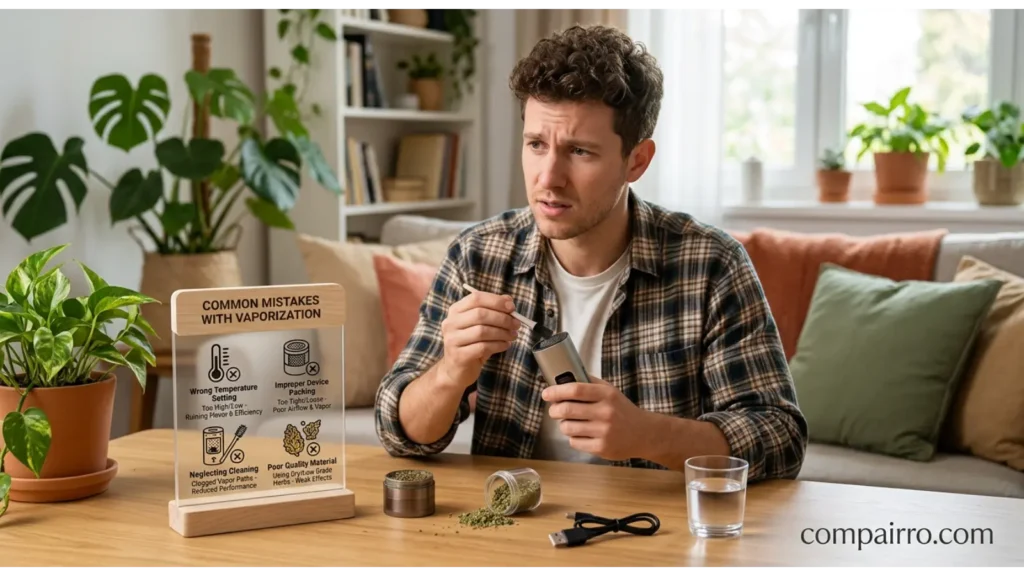
Common Mistakes With Vaporization
Students sometimes confuse vaporization with other changes of state. Here are four common mistakes and their correct explanations.
Mistake 1: Thinking vaporization is exothermic
❌ Incorrect: Vaporization releases heat into the surroundings.
✔ Correct: Vaporization absorbs heat energy, so it is endothermic.
Mistake 2: Confusing vaporization with condensation
❌ Incorrect: Vaporization and condensation both absorb heat.
✔ Correct: Vaporization absorbs heat, while condensation releases heat.
Mistake 3: Thinking vaporization only happens at boiling point
❌ Incorrect: A liquid can only turn into gas when it boils.
✔ Correct: Vaporization includes both evaporation and boiling. Evaporation can happen below the boiling point.
Mistake 4: Thinking vaporization creates a new substance
❌ Incorrect: Water becomes a completely different chemical substance when it evaporates.
✔ Correct: Water remains H₂O. Only its physical state changes from liquid to gas.
Vaporization in Everyday Examples
Vaporization happens around us more often than we realize. Here are some simple examples.
1. At Home
When you boil water for tea, the liquid absorbs heat from the stove and changes into steam.
2. At School
During a chemistry experiment, a teacher may heat water to demonstrate how a liquid changes into a gas.
3. In Daily Life
After washing clothes, you hang them outside. Water slowly evaporates from the fabric and enters the air.
4. During Exercise
When you exercise, your body produces sweat. As the sweat evaporates, it absorbs heat from your skin and helps cool your body.
5. In Nature
Water from rivers, lakes, and oceans evaporates due to energy from sunlight. This process helps drive the water cycle.
These examples show why vaporization is an important part of everyday life.
Vaporization – Google Trends and Usage Data
The keyword “is vaporization endothermic or exothermic” is an educational chemistry question.
People search for this topic because they want a quick and clear answer about heat transfer during changes of state.
Some common reasons include:
- Students preparing for chemistry exams.
- Beginners learning about endothermic processes.
- Teachers explaining changes of state.
- People completing science homework.
- Learners comparing vaporization with condensation.
Students in the US, UK, India, Pakistan, Canada, and Australia may search for this topic while studying chemistry.
However, exact search popularity and country rankings require current Google Trends data. Without checking live data, it would not be accurate to claim which country searches this keyword the most.
The topic remains useful for educational content because it answers a clear science question.
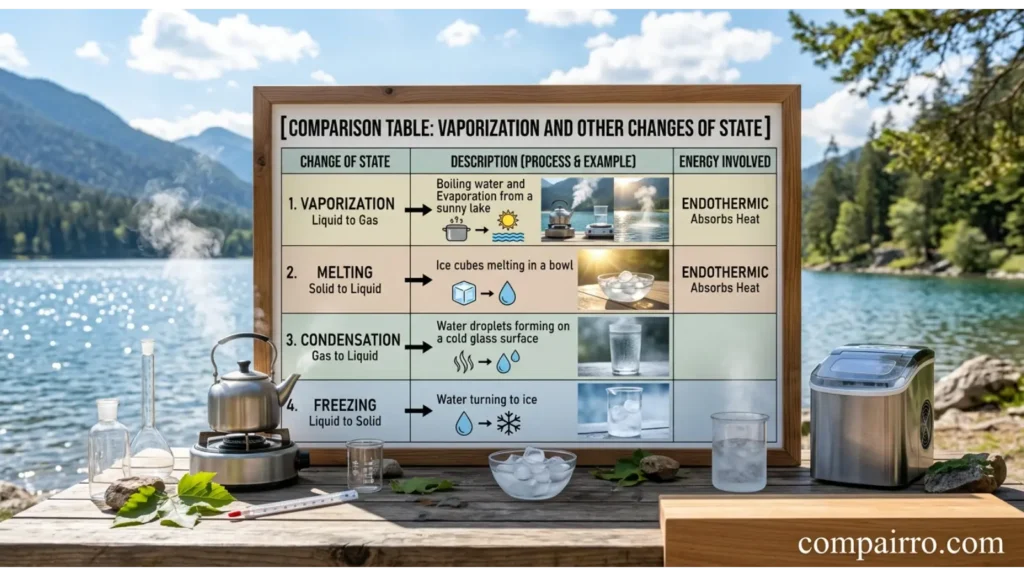
Comparison Table: Vaporization and Other Changes of State
To understand vaporization better, compare it with other common changes of state.
| Process | Change of State | Heat Energy | Type |
|---|---|---|---|
| Vaporization | Liquid to gas | Absorbed | Endothermic |
| Condensation | Gas to liquid | Released | Exothermic |
| Melting | Solid to liquid | Absorbed | Endothermic |
| Freezing | Liquid to solid | Released | Exothermic |
| Sublimation | Solid to gas | Absorbed | Endothermic |
| Deposition | Gas to solid | Released | Exothermic |
This table shows an important pattern: changes toward a higher-energy state generally absorb heat, while the reverse changes release heat.
Vaporization in Professional Life
Vaporization is not only important in school chemistry. It also has many practical uses in different industries.
Here are some examples:
1. Power Plants
Some power plants heat water to produce steam. The steam can then help turn turbines to generate electricity.
2. Food Industry
Vaporization is used in food processing to remove water from certain products.
3. Air Conditioning
Cooling systems use the evaporation of refrigerants to absorb heat from indoor air.
4. Medicine and Healthcare
Vaporization is used in some medical and laboratory processes where liquids need to change into gases.
5. Chemical Industry
Factories use vaporization in processes such as distillation and separation of liquid mixtures.
These applications show how understanding heat absorption can help people design useful machines and industrial processes.
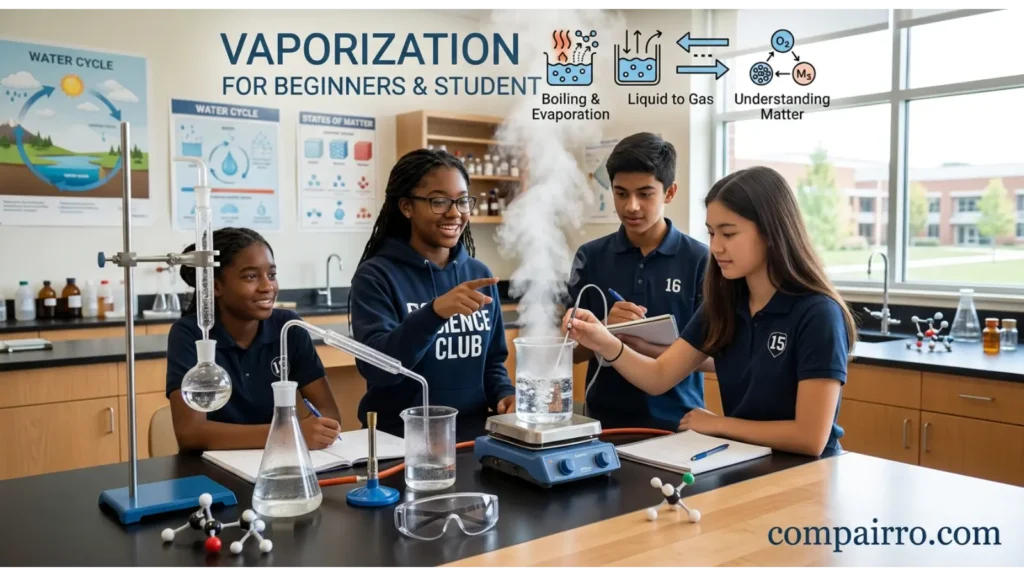
Vaporization for Students or Beginners
Vaporization may seem difficult at first, especially when students learn terms like endothermic, exothermic, evaporation, and boiling.
However, the concept becomes easier when you understand what happens to liquid particles.
Why do beginners struggle?
- They confuse heat absorption with heat release.
- They think evaporation and boiling are completely different processes.
- They forget that vaporization is a physical change.
- They confuse vaporization with condensation.
Easy learning tips:
- Remember that vaporization means liquid to gas.
- Connect vaporization with boiling water.
- Remember that heat must be absorbed.
- Compare it with condensation to understand the opposite process.
- Practice simple examples from everyday life.
A useful exam sentence is:
“Vaporization is an endothermic process because a liquid absorbs heat energy to change into a gaseous state.”
Signs or Characteristics Related to Vaporization
Vaporization has several important characteristics that help identify it.
1. Heat Absorption
The liquid absorbs energy from its surroundings during vaporization.
2. Change of State
The substance changes from a liquid into a gas.
3. Physical Change
No new chemical substance is formed. For example, liquid water and water vapor are both H₂O.
4. Particle Movement
Particles gain enough energy to move farther apart and enter the gaseous state.
5. Cooling Effect
Evaporation can cool nearby surfaces because energy is taken from them.
6. Two Main Forms
Vaporization happens through two main processes:
- Evaporation: A liquid changes into gas from its surface and can happen below its boiling point.
- Boiling: A liquid changes into gas throughout the liquid when it reaches its boiling point at a given pressure.
7. Energy Requirement
Vaporization requires energy to overcome the attractive forces between liquid particles.
Simple Trick to Remember Vaporization
Here is an easy trick to remember whether vaporization is endothermic or exothermic.
- Vaporization = Liquid to Gas = Heat Absorbed.
- Condensation = Gas to Liquid = Heat Released.
Think of it this way:
Imagine placing a wet shirt outside on a sunny day.
The water in the shirt absorbs energy from its surroundings and slowly changes into water vapor. As a result, the shirt becomes dry.
This is vaporization through evaporation.
Easy memory phrase:
“Going up needs energy, coming down releases energy.”
- Liquid to gas = Endothermic.
- Gas to liquid = Exothermic.
This simple trick can help you remember the answer during science exams.
FAQs:
1. Is vaporization endothermic or exothermic?
Vaporization is endothermic because a liquid absorbs heat energy when changing into a gas.
2. Why is vaporization an endothermic process?
It is endothermic because liquid particles need energy to overcome the attractive forces between them.
3. Is evaporation endothermic or exothermic?
Evaporation is endothermic because the liquid absorbs energy as it changes into gas.
4. Is boiling endothermic or exothermic?
Boiling is endothermic because the liquid needs heat energy to change into a gas.
5. Is condensation endothermic or exothermic?
Condensation is exothermic because a gas releases heat energy when changing into a liquid.
6. Does vaporization absorb or release heat?
Vaporization absorbs heat from its surroundings. That is why it is classified as an endothermic process.
7. Is vaporization a physical or chemical change?
Vaporization is a physical change because the substance changes its state but keeps the same chemical composition.
Conclusion
So, is vaporization endothermic or exothermic? The correct answer is endothermic.
Vaporization happens when a liquid changes into a gas by absorbing heat energy. It includes two main processes: evaporation and boiling.
You can see vaporization in everyday life when water boils, wet clothes dry, and sweat evaporates from your skin.
The most important point to remember is that vaporization absorbs heat, while condensation releases heat.
Final memory rule: Liquid to Gas = Endothermic, and Gas to Liquid = Exothermic.

Sara Taylor is a passionate English content writer who specializes in word meanings, spelling comparisons, and modern slang explanations. She creates easy-to-understand articles that help readers avoid common English mistakes and improve their writing skills. Her content focuses on simple learning, real-life examples, and clear explanations for everyday readers.