Have you ever seen the phrase “rather or not” and wondered if it is correct? Many people search for this phrase because it looks similar to another common expression: “whether or not.”
This confusion often happens in school assignments, workplace emails, social media posts, text messages, and everyday conversations. Since the words rather and whether can sometimes sound similar, people may accidentally use the wrong phrase.
Understanding the difference is important because using the correct expression helps your writing sound clear and professional. It can also prevent misunderstandings when you communicate with others.
Many English learners and even native speakers make mistakes with these phrases. That is why it is useful to know when each word should be used and which expression is considered correct in standard English.
In this guide, you’ll learn the meaning, examples, usage, differences, common mistakes, and simple explanations in easy English.
Rather or Not – Quick Answer
👉 “Rather or not” is usually incorrect in standard English.
In most situations, people actually mean “whether or not.”
Simple Definition
- Whether or not = if something happens or does not happen.
- Rather = preferably or more willingly.
Examples
✅ I don’t know whether or not he will come.
✅ Please tell me whether or not you agree.
✅ We need to decide whether or not to leave early.
Easy Memory Rule
👉 Whether = choice or possibility
👉 Rather = preference
If you are talking about a choice between possibilities, use whether or not.
The Origin of Rather or Not
The phrase “rather or not” does not have a recognized meaning in standard English grammar.
The confusion comes from mixing up two different words:
- Rather comes from Old English and means “more willingly” or “preferably.”
- Whether comes from Old English and is used when discussing alternatives, possibilities, or choices.
As online communication grew through texting and social media, spelling mistakes became more common. Because of this, many people accidentally type rather or not when they mean whether or not.
Today, grammar tools and dictionaries generally consider whether or not the correct expression.
British English vs American English Usage
There is no major difference between British English and American English for this expression.
Both varieties use whether or not as the correct phrase.
| Feature | British English | American English | Notes |
|---|---|---|---|
| Correct phrase | Whether or not | Whether or not | Same usage |
| Rather or not | Usually incorrect | Usually incorrect | Considered a mistake |
| Formal writing | Whether or not | Whether or not | Preferred everywhere |
| Everyday speech | Whether or not | Whether or not | Commonly used |
Which One Should You Use?
You should use whether or not when discussing a possibility, condition, or choice.
Best Situations
- Academic writing
- School assignments
- Workplace communication
- Emails
- Reports
- Everyday conversations
Formal Use
✅ Please confirm whether or not you will attend.
Informal Use
✅ Let me know whether or not you’re coming.
Avoid
❌ Please confirm rather or not you will attend.
Common Mistakes With Rather or Not
Mistake 1
❌ I don’t know rather or not she likes coffee.
✔ Use whether or not because you are discussing a possibility.
Mistake 2
❌ Tell me rather or not you agree.
✔ Correct: Tell me whether or not you agree.
Mistake 3
❌ We must decide rather or not to continue.
✔ Correct: We must decide whether or not to continue.
Mistake 4
❌ Rather or not it rains, we will go.
✔ Correct: Whether or not it rains, we will go.
Rather or Not in Everyday Examples
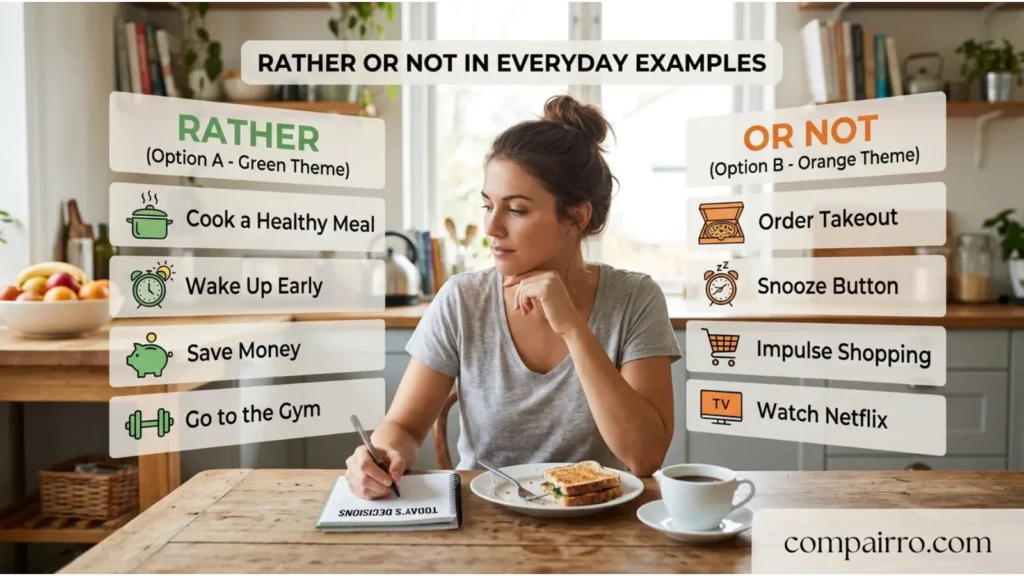
Work
✅ The manager wants to know whether or not the project is ready.
School
✅ Students must decide whether or not to join the competition.
Social Media
✅ Many users discuss whether or not the news is true.
Daily Life
✅ We are deciding whether or not to travel this weekend.
Text Messages
✅ Let me know whether or not you’re free tonight.
Rather or Not – Google Trends & Usage Data
Many people search for rather or not because they are unsure if it is correct English.
Why People Search It
- Similar sound to “whether or not”
- Typing mistakes
- Grammar confusion
- English learning challenges
Popular Countries
Searches commonly come from:
- United States
- United Kingdom
- India
- Pakistan
- Canada
- Australia
Search Trends
Grammar-related searches continue to grow because people want clearer writing for school, work, and online communication.
Social Media Popularity
On social media, typing mistakes happen frequently. As a result, users often search online to check if a phrase is correct.
Comparison Table: Rather or Not
| Feature | Rather | Whether or Not |
|---|---|---|
| Meaning | Preference | Possibility or choice |
| Grammar role | Adverb | Conjunction phrase |
| Correct phrase | Rather do something | Whether or not |
| Formal writing | Yes | Yes |
| Used for decisions | No | Yes |
| Common confusion | Often mixed up | Correct expression |
Rather or Not in Professional Life

In professional settings, using the correct phrase is important.
Business emails, reports, and presentations should use whether or not when discussing decisions or possibilities.
Examples
✅ The company will decide whether or not to expand.
✅ Please inform us whether or not the meeting will continue.
Using the correct expression helps communication stay clear and professional.
Rather or Not for Students or Beginners
Students often struggle with this phrase because the words sound somewhat similar.
Common Confusion
- Mixing up whether and rather
- Typing quickly
- Learning English grammar rules
Easy Learning Tips
- Remember that whether introduces choices.
- Remember that rather shows preference.
- Read example sentences regularly.
- Practice using both words separately.
Signs or Characteristics Related to Rather or Not
Characteristics of “Whether or Not”
- Shows possibility
- Discusses choices
- Common in questions
- Used in formal writing
- Used in everyday speech
Characteristics of “Rather”
- Shows preference
- Means “instead”
- Can mean “quite” in some contexts
- Often used with comparisons
Common Pattern
If the sentence involves deciding, checking, or choosing, whether or not is usually correct.
Simple Trick to Remember Rather or Not
Easy Memory Trick
👉 Whether = Choice
👉 Rather = Preference
Think of it this way:
- “Would you like tea or coffee?” → A choice → whether
- “I’d rather have tea.” → A preference → rather
Another easy example:
✅ We must decide whether or not to go.
✅ I would rather stay home.
The first sentence is about a choice. The second is about a preference.
FAQS:
1. Is “rather or not” correct English?
Usually no. In most cases, the correct phrase is whether or not.
2. What does “whether or not” mean?
It means regardless of which possibility is true.
3. Why do people confuse rather and whether?
They may sound similar to some learners and are often mistyped.
4. Can I use “rather or not” in formal writing?
No. Formal writing should normally use whether or not.
5. What does “rather” mean by itself?
It means preferably, instead, or more willingly.
6. Is “whether or not” used in business emails?
Yes. It is very common in professional communication.
7. How can I remember the difference?
Think: whether = choice, rather = preference.
Conclusion
The phrase rather or not is usually considered incorrect in standard English. In most situations, the correct expression is whether or not, which is used when talking about choices, possibilities, or decisions.
Understanding the difference can improve your writing at school, work, and in everyday conversations. Remember that rather expresses a preference, while whether or not expresses a choice between possibilities.
A simple memory rule is:
👉 Whether = choice
👉 Rather = preference
Keep this rule in mind, and you will avoid one of the most common English grammar mistakes.

Sara Taylor is a passionate English content writer who specializes in word meanings, spelling comparisons, and modern slang explanations. She creates easy-to-understand articles that help readers avoid common English mistakes and improve their writing skills. Her content focuses on simple learning, real-life examples, and clear explanations for everyday readers.