Have you ever seen the words peel and peal and wondered if they mean the same thing? Many people get confused because these words sound exactly alike. They are examples of homophones, which are words that have the same pronunciation but different meanings and spellings.
You may come across peel or peal in school assignments, books, workplace writing, online articles, social media posts, or everyday conversations. Since they sound identical, many writers accidentally use the wrong one.
For example, someone may write, “I heard a peel of bells,” when the correct word is actually peal. On the other hand, writing “peal the orange” would also be incorrect because peel is the right word for removing skin from fruit.
Understanding the difference between these words helps improve your writing, speaking, and grammar skills. It also prevents common spelling mistakes that can make sentences confusing.
In this guide, you’ll learn the meaning, examples, usage, differences, common mistakes, and simple explanations in easy English.
Peel or Peal – Quick Answer
👉 Peel means to remove the outer skin or covering from something.
👉 Peal means a loud ringing sound, especially from bells, or a loud burst of laughter or thunder.
Examples
Peel
- Please peel the potato before cooking.
- She peeled the orange carefully.
Peal
- A peal of church bells echoed through the town.
- We heard a peal of laughter from the next room.
Simple Rule
👉 Peel = Skin
👉 Peal = Sound
Remember: If you are removing a covering, use peel. If you are talking about a ringing or loud sound, use peal.
The Origin of Peel or Peal
The word peel comes from old words related to removing or stripping away an outer layer. It has been used in English for hundreds of years.
The word peal comes from older French and Latin roots connected to ringing bells and loud sounds. It became common in churches and towns where bell ringing was an important part of daily life.
Today, peel is much more common in everyday conversations because people often talk about fruits, vegetables, and removing coverings. Peal is less common but still appears in books, news articles, and descriptive writing.
British English vs American English Usage
There is no spelling difference between British English and American English for these words.
| Feature | British English | American English | Notes |
|---|---|---|---|
| Peel | Peel | Peel | Same meaning and spelling |
| Peal | Peal | Peal | Same meaning and spelling |
| Pronunciation | Same | Same | Both are pronounced alike |
| Usage | Same | Same | Used worldwide |
Which One Should You Use?
Choose the word based on the meaning you want.
Use Peel When:
- Removing fruit skin
- Removing vegetable skin
- Taking off labels or coverings
- Talking about layers coming off
Use Peal When:
- Describing ringing bells
- Talking about loud laughter
- Describing thunder sounds
- Writing stories or formal descriptions
Formal and Informal Use
- Peel is common in both formal and informal writing.
- Peal is often seen in literature, news writing, and descriptive language.
Common Mistakes With Peel or Peal
Mistake 1
❌ I heard a peel of bells this morning.
✔ Use peal because bells create a ringing sound.
Mistake 2
❌ Please peal the banana.
✔ Use peel because you remove the banana’s skin.
Mistake 3
❌ A loud peel of laughter came from the crowd.
✔ Use peal because laughter is a sound.
Mistake 4
❌ She pealed the potato before cooking.
✔ Use peeled because she removed the skin.
Peel or Peal in Everyday Examples
Work
- The designer asked us to peel off the old sticker.
- A peal of laughter filled the meeting room after the joke.
School
- Students learned how to peel fruit safely.
- The story described a peal of bells from a nearby church.
Social Media
- Watch me peel this mango in seconds!
- A peal of laughter could be heard in the viral video.
Daily Life
- Peel the carrots before making soup.
- We heard a peal of thunder during the storm.
Text Messages
- “Can you peel the oranges for the party?”
- “Did you hear that peal of thunder last night?”
Peel or Peal – Google Trends & Usage Data
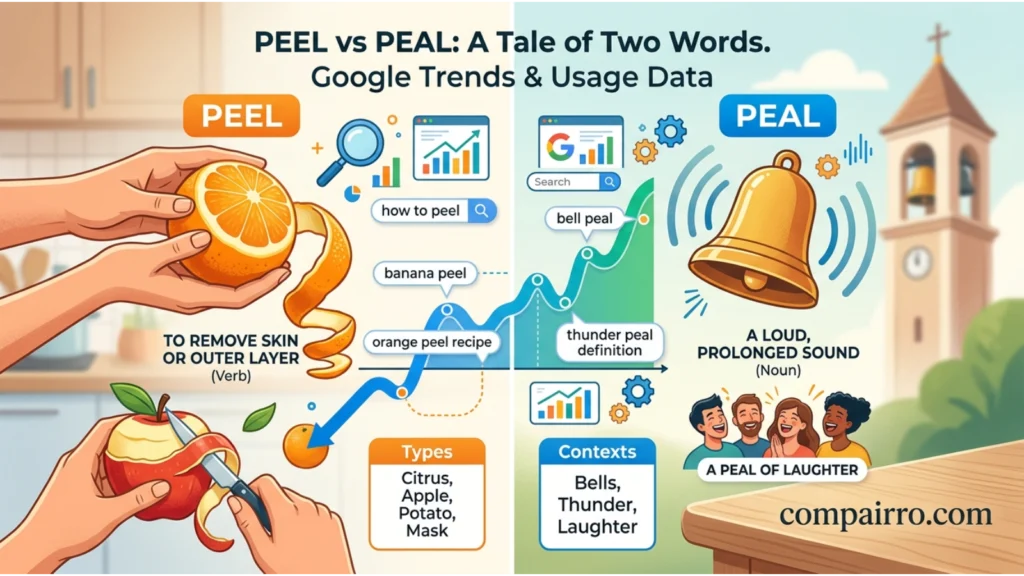
Many people search for peel or peal because they sound exactly the same but have different meanings.
Common reasons for searches include:
- Grammar homework
- Spelling checks
- Writing improvement
- English language learning
- Professional writing
Countries where this topic is often searched include:
- United States
- United Kingdom
- India
- Pakistan
- Canada
- Australia
Search interest increases during school terms because students frequently study homophones and commonly confused words.
Online grammar websites and educational blogs also discuss these words because they are easy to mix up.
Comparison Table: Peel or Peal
| Feature | Peel | Peal |
|---|---|---|
| Meaning | Remove outer skin | Loud ringing sound |
| Part of Speech | Noun / Verb | Noun / Verb |
| Related To | Fruits, vegetables, coverings | Bells, laughter, thunder |
| Common Usage | Very common | Less common |
| Example | Peel the apple | A peal of bells |
| Easy Memory Tip | Skin | Sound |
Peel or Peal in Professional Life

Understanding the difference between these words can improve professional communication.
Food Industry
- Workers peel fruits and vegetables before processing.
Education
- Teachers explain the difference between peel and peal in grammar lessons.
Writing and Publishing
- Editors check for homophone mistakes to ensure accuracy.
Journalism
- Reporters may describe a peal of thunder or a peal of church bells in articles.
Using the correct word helps create clear and professional writing.
Peel or Peal for Students or Beginners
Many beginners struggle with these words because they sound exactly the same.
Common Confusion
- Same pronunciation
- Different spelling
- Different meanings
Easy Learning Tips
- Connect peel with fruit skin.
- Connect peal with bell sounds.
- Practice using both words in sentences.
- Read examples regularly.
The more you see them in context, the easier they become to remember.
Signs or Characteristics Related to Peel or Peal
Characteristics of Peel
- Related to removing outer layers
- Common in cooking
- Often used as a verb
- Can also refer to discarded skin
Characteristics of Peal
- Related to sounds
- Usually describes ringing bells
- Often appears in literature
- Can describe laughter or thunder
Shared Characteristics
- Same pronunciation
- Different meanings
- Different spellings
- Commonly confused homophones
Simple Trick to Remember Peel or Peal
👉 Peel = Skin
👉 Peal = Sound
Think of it this way:
- You peel an orange because it has skin.
- You hear a peal of bells because bells make sounds.
Another easy trick:
👉 Peel has two “e” letters like the layers you remove.
👉 Peal has “a” like audio, which relates to sound.
This simple memory trick can help you choose the correct word every time.
FAQs:
1. What is the difference between peel and peal?
Peel means removing an outer layer, while peal refers to a loud ringing or burst of sound.
2. Are peel and peal pronounced the same?
Yes. They are homophones and sound exactly alike.
3. Which word is used for fruits?
Use peel when talking about fruit skin.
4. What does a peal of bells mean?
It means the ringing sound made by bells.
5. Is peal commonly used today?
Yes, but it is less common than peel and mostly appears in descriptive writing.
6. Can peel be a noun?
Yes. The skin removed from a fruit or vegetable can be called a peel.
7. Why do people confuse peel and peal?
People confuse them because they have the same pronunciation but different meanings and spellings.
Conclusion
The difference between peel or peal is simple once you know what each word means. Peel refers to removing an outer layer, such as the skin of a fruit or vegetable. Peal refers to a loud ringing sound, such as bells, thunder, or laughter.
These words sound the same, which is why many learners mix them up. However, remembering their meanings can help you avoid common grammar mistakes and write more clearly.
A final memory rule:
👉 Peel = Skin
👉 Peal = Sound
Keep this simple trick in mind, and you’ll easily know which word to use in any situation.

Sara Taylor is a passionate English content writer who specializes in word meanings, spelling comparisons, and modern slang explanations. She creates easy-to-understand articles that help readers avoid common English mistakes and improve their writing skills. Her content focuses on simple learning, real-life examples, and clear explanations for everyday readers.