A sore, red, or irritated area of skin can be worrying, especially when you do not know what caused it. Many people search for friction burn or herpes because the two can sometimes look similar at first. However, they are different conditions with different causes.
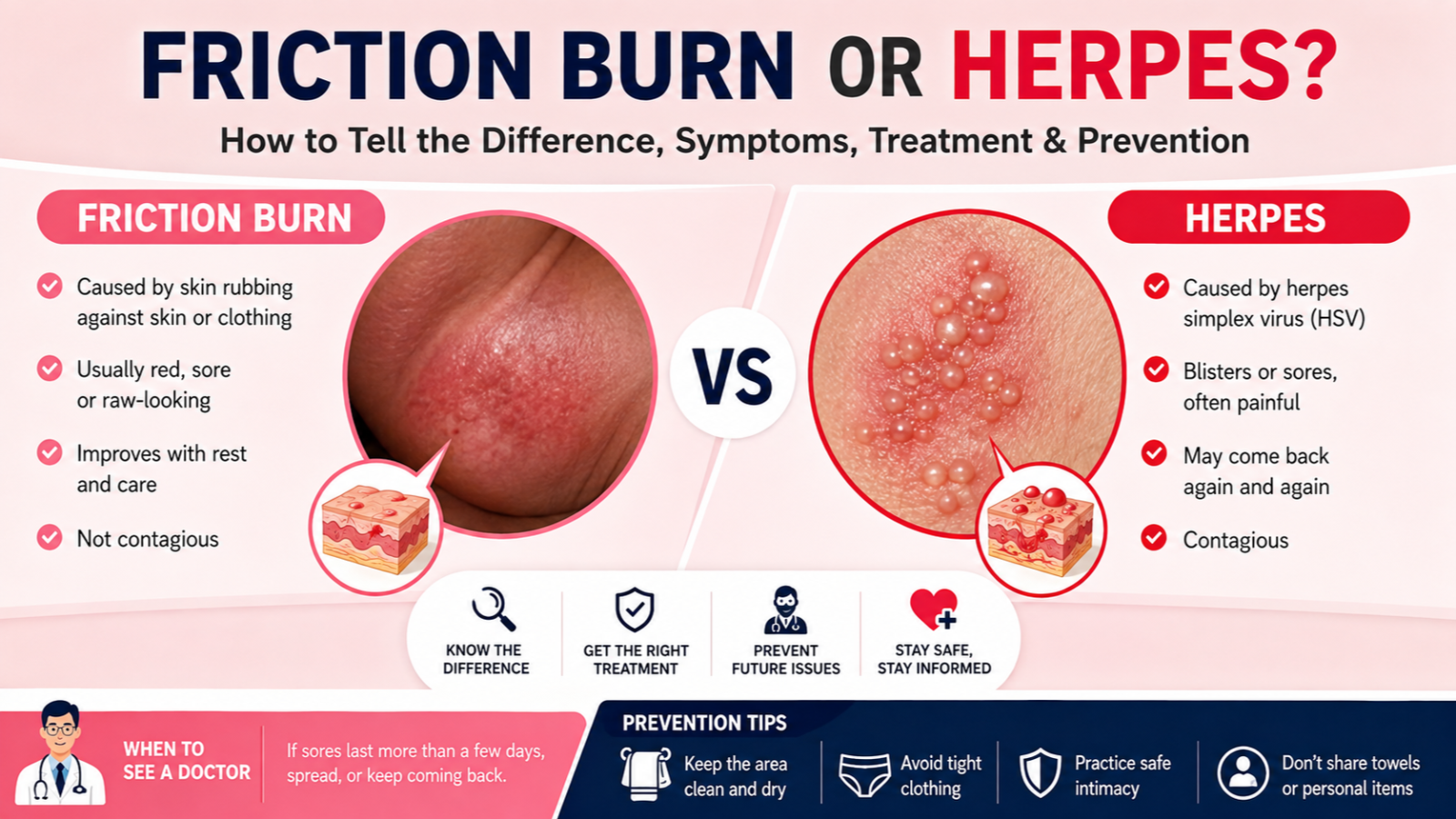
A friction burn usually happens when skin rubs against skin, clothing, sports equipment, or another surface. It can cause redness, tenderness, burning, or irritation. Herpes, on the other hand, is caused by the herpes simplex virus (HSV). It can cause groups of small blisters or sores and may come back over time.
The confusion is understandable because skin problems can have overlapping signs. A person may also search online after noticing a new sore and feel nervous about what it means. Pictures and online descriptions can help with general information, but they cannot reliably diagnose a skin problem.
This topic can come up in health classes, medical searches, conversations, or social media discussions. It is important to remember that having a sore does not automatically mean someone has herpes. There are many other possible causes, including irritation, eczema, allergies, and other infections.
Understanding the basic differences can help you decide when simple skin care may be enough and when it is better to speak with a doctor or other trusted healthcare professional.
In this guide, you’ll learn the meaning, examples, usage, differences, common mistakes, and simple explanations in easy English.
FRICTION BURN OR HERPES – QUICK ANSWER
👉 Friction burn = skin irritation caused by repeated rubbing or friction.
👉 Herpes = a viral infection caused by herpes simplex virus (HSV), which can cause sores or blisters.
A friction burn often appears after an obvious source of rubbing. For example, irritated skin may develop after exercise, tight clothing, or repeated contact with a rough surface.
Herpes may begin with sensations such as tingling, itching, or burning, followed by small blisters or sores. However, symptoms vary, and some people have mild or no noticeable symptoms.
Simple examples
- Friction burn: Skin becomes sore after repeated rubbing from clothing or physical activity.
- Herpes: A person develops recurring sores that a healthcare professional identifies as being caused by HSV.
- Neither is certain from appearance alone: A new sore can have many causes, so diagnosis may require a medical examination or testing.
Simple rule
👉 Friction = rubbing.
👉 Herpes = virus.
If you are unsure, do not try to diagnose yourself from a picture. A healthcare professional can give a more reliable answer.
THE ORIGIN OF FRICTION BURN OR HERPES
The term friction burn describes irritation or injury caused by rubbing. The word “friction” refers to resistance created when two surfaces move against each other. The term is commonly used for skin irritation caused by repeated rubbing.
Herpes comes from an old Greek word associated with creeping or spreading. In modern medicine, herpes refers to infections caused by herpes simplex viruses and related viruses.
HSV-1 and HSV-2 are the two main types of herpes simplex virus. HSV-1 commonly causes oral herpes, while HSV-2 is commonly associated with genital herpes. However, either type can infect different body areas.
The word “herpes” is widely used online and in everyday health searches. Because people often worry when they notice a sore, searches comparing herpes with other skin problems are common.
BRITISH ENGLISH VS AMERICAN ENGLISH USAGE
There is no important spelling difference between friction burn and herpes in British and American English.
| Feature | British English | American English | Notes |
|---|---|---|---|
| Friction burn | Friction burn | Friction burn | Same term |
| Herpes | Herpes | Herpes | Same spelling |
| Skin irritation | Skin irritation | Skin irritation | Same meaning |
| Blister | Blister | Blister | Same spelling |
| Healthcare professional | Healthcare professional | Healthcare professional | Both forms are understood |
Medical terms are generally understood worldwide. Differences are more likely to appear in general healthcare wording rather than in these two terms.
WHICH ONE SHOULD YOU USE?
Use the term that correctly describes the condition being discussed.
- Use friction burn when skin irritation is linked to rubbing or repeated contact.
- Use herpes when discussing an HSV infection.
- Do not call a sore herpes simply because it looks unusual.
- Do not assume every red or painful area is a friction burn.
- For school or health writing, explain the cause rather than guessing the diagnosis.
- In a medical situation, describe your symptoms honestly and let a healthcare professional make the diagnosis.
When should you get medical advice?
Consider speaking with a healthcare professional if:
- You have a new sore and do not know its cause.
- The area is getting worse rather than better.
- You have repeated or unexplained sores.
- You have significant pain, fever, or feel unwell.
- The problem does not improve with basic care.
- You are worried that an infection may be involved.
COMMON MISTAKES WITH FRICTION BURN OR HERPES
Mistake 1: Assuming every sore is herpes
❌ “I have a sore, so I must have herpes.”
✔ A sore can have many causes. Appearance alone cannot confirm herpes.
Mistake 2: Assuming friction always causes a simple rash
❌ “If the skin was rubbing, it cannot be an infection.”
✔ Friction can irritate skin, but other conditions can occur at the same time. Persistent or unusual symptoms deserve medical advice.
Mistake 3: Diagnosing from online pictures
❌ “My skin looks similar to a picture online, so I know what it is.”
✔ Online pictures are useful for general education but cannot replace an examination or appropriate testing.
Mistake 4: Ignoring symptoms because they seem small
❌ “It is only a small sore, so it cannot matter.”
✔ A small skin problem can have different causes. If it persists, returns, or worries you, ask a healthcare professional.
Mistake 5: Using the terms as if they mean the same thing
❌ “Friction burn and herpes are two names for the same condition.”
✔ They are different. Friction burn is related to physical rubbing, while herpes is caused by HSV.
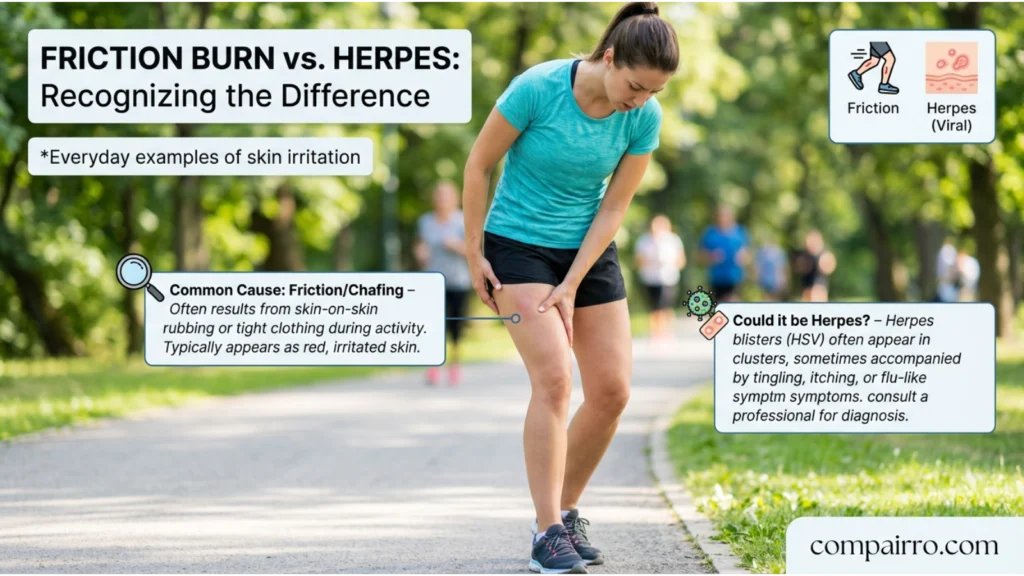
FRICTION BURN OR HERPES IN EVERYDAY EXAMPLES
Work
Someone who spends a long time moving in clothing or equipment that repeatedly rubs the skin may develop irritation. In this situation, friction may be a possible cause.
If the skin problem continues or has unusual symptoms, it should not automatically be blamed on friction.
School
Students may hear terms such as “rash,” “burn,” or “herpes” online and assume they describe the same thing. They do not.
For health education, remember that a medical diagnosis requires more than simply looking at a symptom.
Social Media
Social media posts often show pictures of skin conditions and ask users to identify them. This can create unnecessary fear.
A safer approach is to use reliable health information and speak with a qualified healthcare professional when symptoms are concerning.
Daily Life
Friction can happen during normal activities. Clothing, movement, or repeated rubbing can irritate skin.
Herpes is different because it is a viral infection. It is not caused simply by rubbing the skin.
Text Messages
If someone says, “Is this a friction burn or herpes?” avoid giving them a definite diagnosis based only on a description.
A helpful response is: “They can look similar, so a healthcare professional can help identify the cause.”
FRICTION BURN OR HERPES – GOOGLE TRENDS & USAGE DATA
People search friction burn or herpes because they want to understand a new or unusual skin symptom. The search often reflects uncertainty rather than a confirmed diagnosis.
Search interest can change over time. Google Trends uses relative search interest, not a direct count of people with a condition. Therefore, it should not be used to estimate how common herpes or friction burns are.
Interest in these health terms can appear across English-speaking and English-searching audiences in countries such as:
- United States
- United Kingdom
- India
- Pakistan
- Canada
- Australia
Search behavior can also increase when people see health discussions on social media or search for explanations of symptoms.
However, there is an important point: search popularity does not tell you what condition a person has. Someone may search “friction burn or herpes” simply because they are worried and want general information.
For health topics, medical sources and professional advice are more useful than trying to diagnose a condition through search trends.
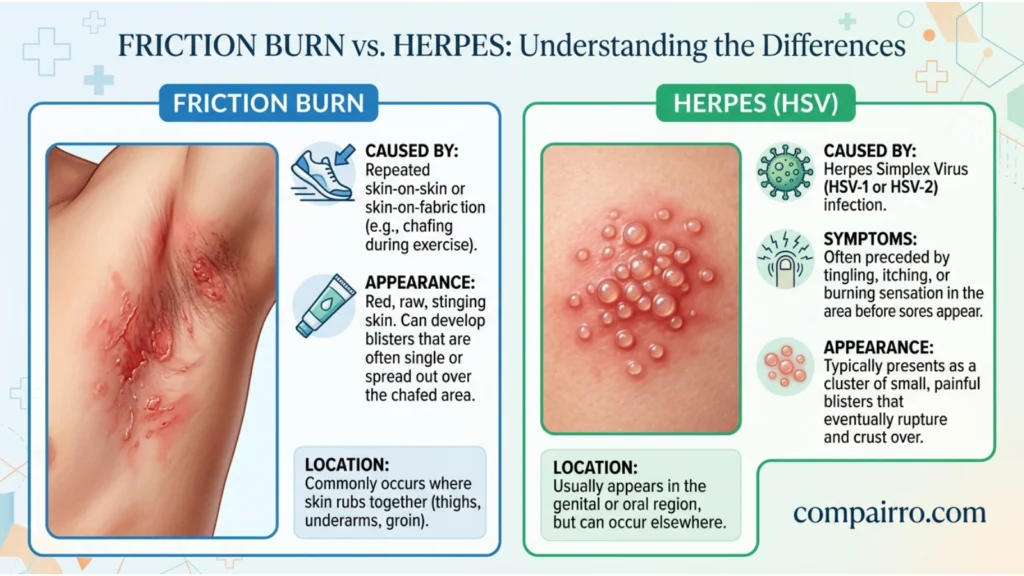
COMPARISON TABLE: FRICTION BURN OR HERPES
| Feature | Friction Burn | Herpes |
|---|---|---|
| Main cause | Rubbing or friction | Herpes simplex virus |
| Type | Skin irritation or injury | Viral infection |
| Common feeling | Burning, soreness, tenderness | Tingling, burning, itching, soreness |
| Appearance | Red or irritated skin; may become raw | May cause small blisters or sores |
| Cause of recurrence | Repeated friction or irritation | HSV can reactivate |
| Diagnosis | Often based on history and examination | May require examination and/or testing |
| Contagious? | No, friction itself is not contagious | HSV can spread through contact |
| Treatment | Reducing irritation and allowing skin to heal | Medical treatment may be used when appropriate |
| When to seek help | Persistent, severe, or unusual symptoms | New, recurring, painful, or concerning sores |
The table gives general differences, but symptoms can overlap. A healthcare professional is the best person to identify an uncertain skin problem.
FRICTION BURN OR HERPES IN PROFESSIONAL LIFE
In healthcare, professionals avoid making a diagnosis from one symptom alone.
A doctor may ask when the problem started, whether it has happened before, what the area feels like, and whether there were possible sources of irritation or exposure. Depending on the situation, they may recommend an examination or testing.
In a workplace setting, the terms should also be used carefully. It is not appropriate to label another person as having herpes based on the appearance of their skin.
Privacy matters, especially with health conditions. If you have concerns about your own symptoms, discuss them privately with a qualified healthcare professional.
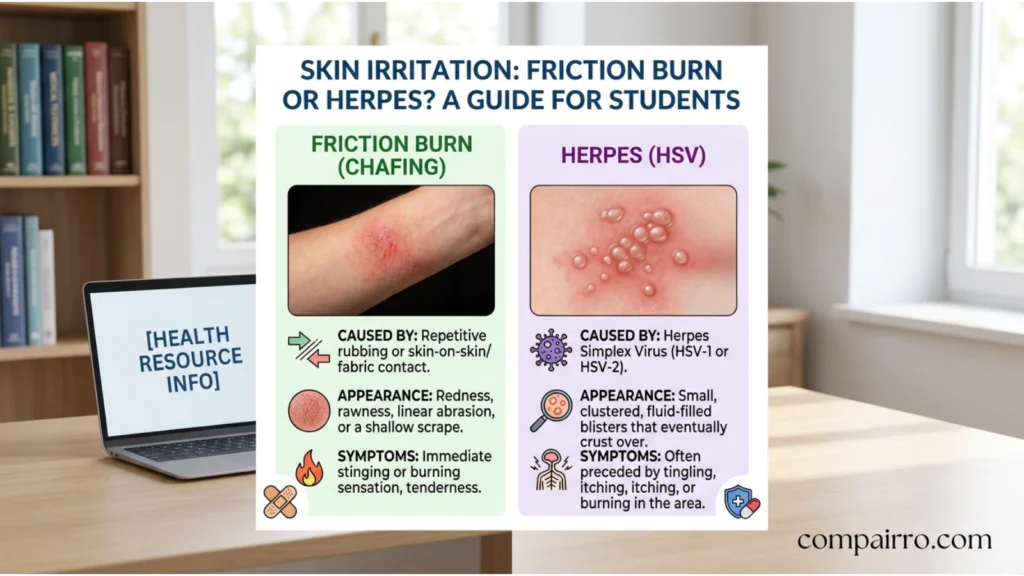
FRICTION BURN OR HERPES FOR STUDENTS OR BEGINNERS
Beginners often struggle with this topic because many skin conditions can look alike.
A simple way to learn is to focus first on the cause:
- Friction burn: Think about rubbing or repeated contact.
- Herpes: Think about HSV, a virus.
- Symptoms: Remember that symptoms can overlap.
- Diagnosis: Do not depend on appearance alone.
- Testing: A healthcare professional can recommend testing when needed.
Easy learning tips
- Learn the cause before memorizing symptoms.
- Do not use online pictures as a diagnosis.
- Remember that “sore” is a symptom, not a diagnosis.
- Ask a healthcare professional when symptoms are unclear.
- Use trusted medical sources for health information.
SIGNS OR CHARACTERISTICS RELATED TO FRICTION BURN OR HERPES
Possible characteristics of friction irritation
- Red or irritated skin
- Burning or stinging feeling
- Tenderness
- Symptoms in an area exposed to repeated rubbing
- Improvement after the source of irritation is removed
Possible characteristics of herpes
- Tingling, itching, or burning before sores appear
- Small blisters or sores
- Pain or tenderness
- Sores that can heal and later return
- Some people may have very mild symptoms or no noticeable symptoms
Important warning
These signs are not enough to diagnose herpes. Other skin conditions can cause similar symptoms.
If you have an unexplained sore, especially one that is painful, recurring, or not healing, it is better to get professional medical advice.
SIMPLE TRICK TO REMEMBER FRICTION BURN OR HERPES
👉 Friction burn = rubbing problem
👉 Herpes = virus problem
Think of it this way:
If your first thought is “Something has been rubbing my skin,” friction may be relevant.
If you are asking whether a sore could be caused by HSV, that is a herpes question that may require professional evaluation or testing.
The easiest memory phrase is:
“Friction rubs. Herpes is viral.”
Remember, this trick helps you understand the difference. It does not diagnose a particular sore.
FAQs:
1. How can I tell if it is a friction burn or herpes?
You cannot always tell from appearance alone. Friction usually has a clear connection to rubbing, while herpes is caused by HSV and may cause blisters or sores.
2. Can friction cause herpes?
No. Friction does not create the herpes virus. However, irritation can make an existing skin problem feel worse.
3. Does a friction burn look like herpes?
Sometimes skin irritation and other conditions can have similar symptoms. That is why appearance alone is not a reliable way to diagnose herpes.
4. Does herpes always cause visible sores?
No. Some people with HSV have mild symptoms or no noticeable symptoms.
5. Can a doctor tell the difference between friction and herpes?
A healthcare professional can assess the symptoms and skin. Testing may be recommended when herpes needs to be confirmed.
6. Should I worry about every painful skin area?
No. Many everyday causes can lead to skin irritation. However, persistent, recurring, or unusual symptoms should be checked by a healthcare professional.
7. Is it safe to diagnose herpes from an online photo?
No. Online photos cannot reliably confirm a diagnosis. Professional medical assessment and testing are more reliable when needed.
CONCLUSION
Understanding friction burn or herpes starts with knowing that they are not the same condition. A friction burn is linked to rubbing and skin irritation, while herpes is caused by the herpes simplex virus.
Some symptoms can overlap, so it is not always possible to identify the cause by appearance alone. A new or unexplained sore should not automatically be labeled as herpes.
The most important memory rule is simple:
👉 Friction burn = rubbing.
👉 Herpes = HSV virus.
If symptoms are persistent, painful, recurring, or worrying you, speak with a healthcare professional instead of relying on an online diagnosis.

Sara Taylor is a passionate English content writer who specializes in word meanings, spelling comparisons, and modern slang explanations. She creates easy-to-understand articles that help readers avoid common English mistakes and improve their writing skills. Her content focuses on simple learning, real-life examples, and clear explanations for everyday readers.