If you are learning Spanish, French, or another language with grammatical gender, you may wonder, “Is pais masculine or feminine?” This question often comes up when learners see the word país and need to choose the correct article or adjective.
The word país means “country” in Spanish. Because Spanish nouns have grammatical gender, you cannot always guess the gender from the English meaning. A country is not a male or female person, but the Spanish word for country still has a grammatical gender.
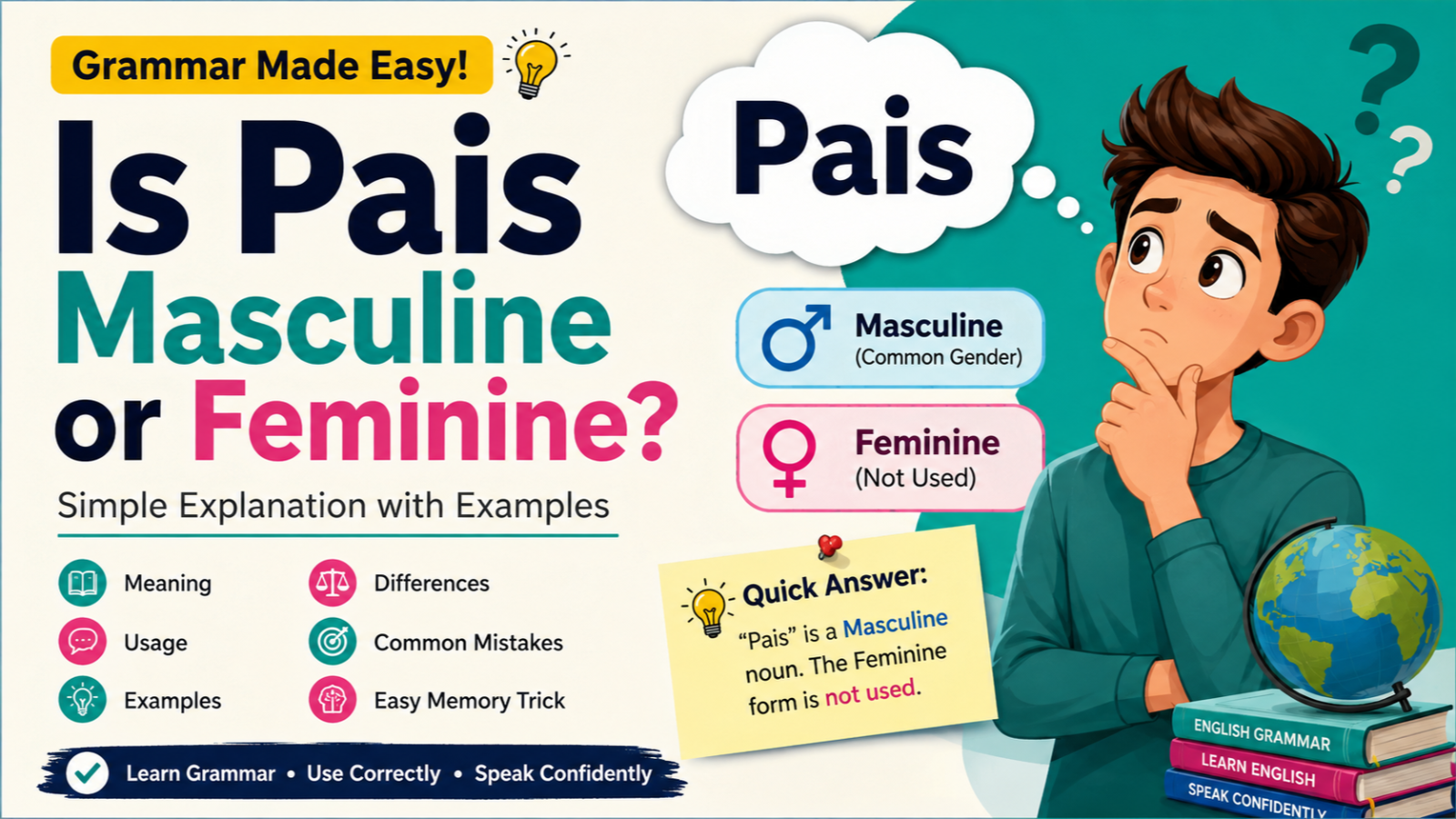
So, is pais masculine or feminine? The answer is simple: país is masculine in Spanish. You normally use el país for “the country” and un país for “a country.”
You may see this word in school lessons, Spanish books, travel websites, news articles, social media posts, and everyday conversations. It is also common when talking about where someone lives, where they come from, or which country they want to visit.
One important point is the accent mark. The correct Spanish spelling is país, with an accent over the í. Writing pais without the accent is common when people cannot type Spanish characters, but país is the standard spelling.
Understanding the gender of this word helps you build correct Spanish sentences and avoid common mistakes. In this guide, you’ll learn the meaning, examples, usage, differences, common mistakes, and simple explanations in easy English.
IS PAIS MASCULINE OR FEMININE – QUICK ANSWER
👉 País = masculine noun in Spanish.
The correct definite article is:
- el país = the country
- un país = a country
Examples
- El país es hermoso. = The country is beautiful.
- Quiero visitar un país nuevo. = I want to visit a new country.
- Este país es muy grande. = This country is very large.
Simple rule
👉 País is masculine, so use “el” or “un” before it when an article is needed.
Remember that grammatical gender does not mean that a country is literally male. It is simply a feature of Spanish grammar.
THE ORIGIN OF PAÍS
The Spanish word país comes from Old French païs, which is related to the idea of a land, region, or country.
It is ultimately connected with Latin pāgēnsis, a word linked to a district or countryside. Over time, related forms developed in Romance languages.
In modern Spanish, país means country, nation, or land depending on the context.
The accent is also important. Spanish writes país with an accent because the vowels a and í are pronounced as separate syllables: pa-ís.
BRITISH ENGLISH VS AMERICAN ENGLISH USAGE
The question “Is pais masculine or feminine?” is about Spanish grammar, not an English spelling difference.
In British and American English, the word country has no grammatical gender. English normally does not classify nouns as masculine or feminine in the way Spanish does.
| Feature | British English | American English | Notes |
|---|---|---|---|
| English word | country | country | Same |
| Spanish word | país | país | Same |
| Spanish gender | Masculine | Masculine | No regional difference |
| Definite article | el país | el país | Spanish uses el |
| Accent | país | país | Accent stays the same |
Therefore, whether you are learning Spanish in the UK, US, Canada, Australia, India, or Pakistan, país remains masculine.
WHICH ONE SHOULD YOU USE?
If you are writing or speaking Spanish, use país as a masculine noun.
Here are the main forms to remember:
- el país — the country
- un país — a country
- este país — this country
- ese país — that country
- otro país — another country
- mi país — my country
- nuestro país — our country
Formal and academic use
País is completely normal in formal writing, schoolwork, news, reports, and academic Spanish.
For example:
El país necesita nuevas leyes.
The country needs new laws.
Casual use
You can also use país in everyday conversations.
¿De qué país eres?
What country are you from?
The gender does not change between formal and informal Spanish.
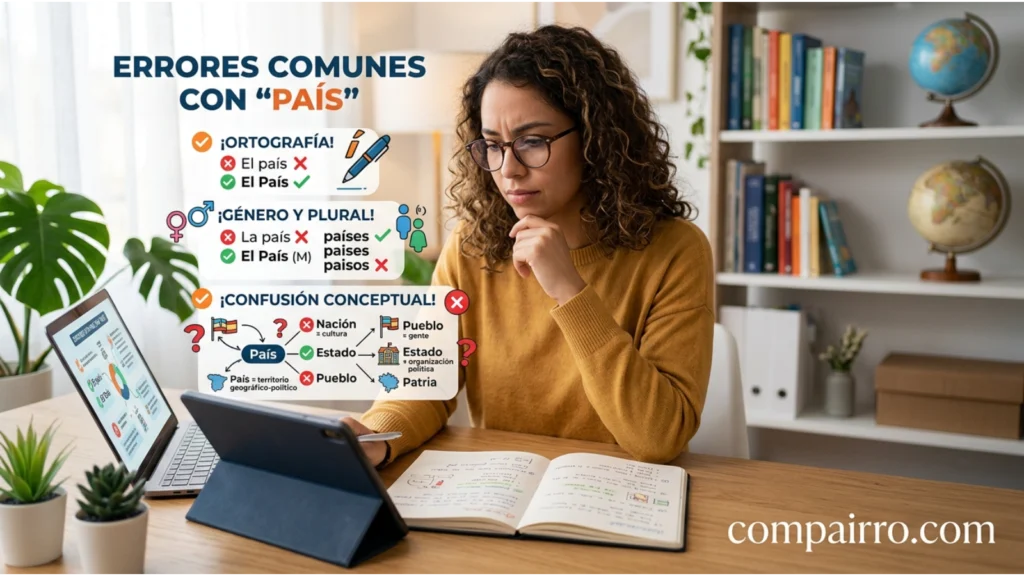
COMMON MISTAKES WITH PAÍS
Mistake 1: Using “la país”
❌ La país es grande.
✔ El país es grande.
País is masculine, so the correct article is el, not la.
Mistake 2: Using “una país”
❌ Quiero visitar una país.
✔ Quiero visitar un país.
The masculine indefinite article un is needed.
Mistake 3: Forgetting the accent
❌ pais
✔ país
The standard Spanish spelling includes an accent over í.
The accent also helps show the correct pronunciation: pa-ís.
Mistake 4: Thinking the meaning decides the gender
❌ “Country is not a person, so it cannot be masculine.”
✔ Spanish grammatical gender is different from biological gender.
A noun can be grammatically masculine even when it refers to an object, place, or idea.
Mistake 5: Changing the gender because of the country’s name
❌ Assuming país becomes feminine because the country has a feminine-sounding name.
✔ The noun país stays masculine.
For example:
España es un país hermoso.
Here, España is the name of the country, while país is the masculine noun.

PAÍS IN EVERYDAY EXAMPLES
Work
Spanish speakers may use país when discussing international business or work.
La empresa trabaja en varios países.
The company works in several countries.
Notice that países is the plural form.
School
Students often see the word in geography and language lessons.
México es un país de América del Norte.
Mexico is a country in North America.
Social Media
People may use país when talking about travel, culture, or where they live.
Mi país tiene muchas culturas diferentes.
My country has many different cultures.
Daily Life
Amo mi país.
I love my country.
¿Cuál es tu país favorito para viajar?
Which country is your favorite for traveling?
Text Messages
In casual Spanish messages, you might see:
¿De qué país eres?
This means:
What country are you from?
The noun is still masculine even in a short text message.

PAÍS – GOOGLE TRENDS & USAGE DATA
People often search “is pais masculine or feminine” because Spanish learners know that nouns can have grammatical gender but may not know which article to use.
The search is especially useful for learners who encounter phrases such as el país, un país, or este país and want to understand why masculine forms appear.
Search interest can come from many English-speaking and Spanish-learning communities, including the US, UK, India, Pakistan, Canada, and Australia.
Spanish is widely studied in the United States and Canada, while learners in the UK and Australia also encounter it through school, travel, and online learning.
In India and Pakistan, Spanish is also learned by students, travelers, language learners, and people interested in international communication.
There is no special internet trend that changes the grammatical gender of país. Online searches mainly reflect a common beginner question: Why is “country” masculine in Spanish?
The key point is that grammatical gender is part of the Spanish language system. It is not based on whether the thing itself is male or female.
COMPARISON TABLE: PAÍS
| Spanish Form | Gender | English Meaning | Example |
|---|---|---|---|
| el país | Masculine | the country | El país es grande. |
| un país | Masculine | a country | Es un país pequeño. |
| este país | Masculine | this country | Este país es interesante. |
| ese país | Masculine | that country | Ese país está lejos. |
| mi país | Masculine | my country | Mi país es hermoso. |
| los países | Masculine plural | the countries | Los países cooperan. |
| muchos países | Masculine plural | many countries | Muchos países participaron. |
This table shows that país keeps its masculine grammatical gender across these common forms.
PAÍS IN PROFESSIONAL LIFE
The word país is very common in professional Spanish.
You may see it in international business, government documents, news reports, company websites, and travel information.
For example:
La empresa opera en cinco países.
The company operates in five countries.
Another example is:
El país tiene una economía en crecimiento.
The country has a growing economy.
Because país is a standard noun, there is no special professional form. The main thing is to use the correct article and adjective agreement.
PAÍS FOR STUDENTS OR BEGINNERS
Beginners often struggle with país because English does not normally assign masculine or feminine gender to nouns.
The best way to learn it is to memorize the word together with its article.
Instead of learning only:
país = country
learn:
el país = the country
This makes it easier to remember the correct gender.
Easy learning tips
- Learn el país, not just país.
- Remember that un país means “a country.”
- Practice short sentences.
- Pay attention to adjective agreement.
- Always include the accent when writing standard Spanish.
For example:
El país es pequeño.
Both el and pequeño match the masculine noun país.
SIGNS OR CHARACTERISTICS RELATED TO PAÍS
Because país is a grammar topic, its most useful characteristics are language patterns rather than physical signs.
Common characteristics
- País is a noun.
- It means country or nation.
- It is masculine in Spanish.
- Its singular definite article is el.
- Its singular indefinite article is un.
- It has an accent: país.
- Its plural form is países.
- The plural noun remains masculine.
Common patterns
You will often see:
- el país
- un país
- este país
- ese país
- otro país
- mi país
- muchos países
- varios países
These patterns can help you recognize the word quickly when reading Spanish.
SIMPLE TRICK TO REMEMBER PAÍS
Here is an easy memory trick:
👉 País = masculine
👉 El país = the country
👉 Un país = a country
Think of the phrase “EL country.”
Whenever you need to say “the country” in Spanish, remember:
EL + PAÍS = EL PAÍS
Think of it this way:
If you see:
el país
you already know the noun is masculine.
If you see:
la país
something is wrong because la is feminine, while país is masculine.
Another useful trick is to learn the word as a complete phrase rather than as an isolated vocabulary word.
Country → el país
That small habit can make Spanish grammar much easier.
FAQs:
1. Is país masculine or feminine in Spanish?
País is masculine. The correct phrase is el país, meaning “the country.”
2. Is it “el país” or “la país”?
It is el país. The noun país is masculine.
3. What does país mean?
País means country or nation in Spanish.
4. Why is país masculine?
Spanish assigns grammatical gender to nouns. The gender does not have to match the biological sex of the thing being described.
5. What is the plural of país?
The plural is países, meaning countries. It remains grammatically masculine.
6. Does país need an accent?
Yes. The standard Spanish spelling is país, with an accent on í.
7. Is país masculine in all Spanish-speaking countries?
Yes. País is masculine throughout standard Spanish, regardless of the Spanish-speaking country or region.
CONCLUSION
So, is pais masculine or feminine? The answer is clear: país is a masculine noun in Spanish.
The most important phrase to remember is el país, which means “the country.” You can also use un país for “a country.”
Remember that grammatical gender does not mean a country is male. It simply describes how the noun behaves in Spanish grammar.
Also, do not forget the accent. The standard spelling is país, not pais.
👉 Easy memory rule: País = masculine → el país.
Once you remember that one phrase, using país correctly becomes much easier.

Sara Taylor is a passionate English content writer who specializes in word meanings, spelling comparisons, and modern slang explanations. She creates easy-to-understand articles that help readers avoid common English mistakes and improve their writing skills. Her content focuses on simple learning, real-life examples, and clear explanations for everyday readers.