Have you ever written a sentence like “Whose coming to the party?” and wondered if it should be “Who’s coming to the party?” These two words sound exactly the same, so it is easy to mix them up. However, whose and who’s have different meanings and different jobs in a sentence.
People often search for whose or who’s because both words appear in everyday English. You may see them in school assignments, emails, workplace messages, text messages, social media posts, and normal conversations. Even fluent English speakers sometimes pause when choosing between them.
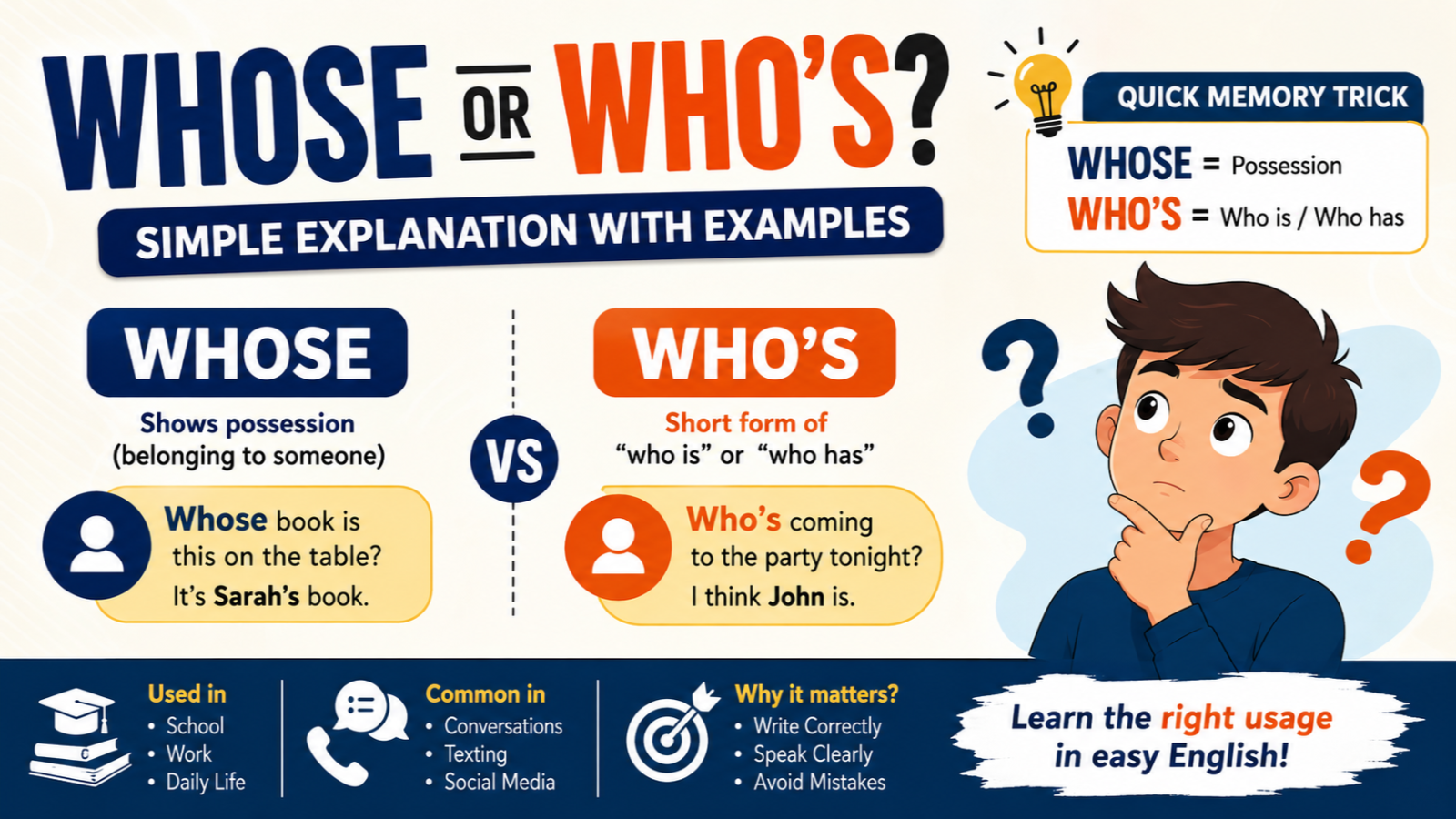
The main problem is simple: whose is connected to possession, while who’s is a short form of either “who is” or “who has.” The apostrophe in Who is does not show possession. This is one of the most common points of confusion.
For example, “Whose phone is this?” asks about the owner of the phone. On the other hand, “Who is using this phone?” means “Who is using this phone?”
Once you learn this small difference, choosing the correct word becomes much easier. You can also use a simple replacement trick to check your sentence in seconds.
In this guide, you’ll learn the meaning, examples, usage, differences, common mistakes, and simple explanations in easy English.
Whose or Who’s – Quick Answer
👉 Whose = asks about possession or ownership.
👉 Who is = short for who is or who has.
Examples of Whose
- Whose jacket is this?
- Whose car is parked outside?
- Do you know whose book this is?
In these sentences, whose asks who owns something.
Examples of Who’s
- Who is coming with us? = Who is coming with us?
- Who is at the door? = Who is at the door?
- Who is finished the project? = Who has finished the project?
Simple rule
👉 Whose = ownership
👉 Who is = who is / who has
A quick test is to replace Who is with who is or who has. If the sentence still makes sense, who’s is correct.
The Origin of Whose or Who’s
Whose comes from the older English word whose, which developed as the possessive form of “who.” It has been used for centuries to ask about ownership or connection.
For example, “Whose house is this?” has the same basic idea as asking, “This house belongs to whom?”
Who’s is different. It is a contraction, which means two words are shortened into one. The apostrophe shows that letters have been left out.
Who is can represent:
- Who is
- Who has
For example:
Who is there? → Who is there?
Who has arrived? → Who is arrived?
Both forms became common in everyday English because contractions are natural in speech and informal writing.
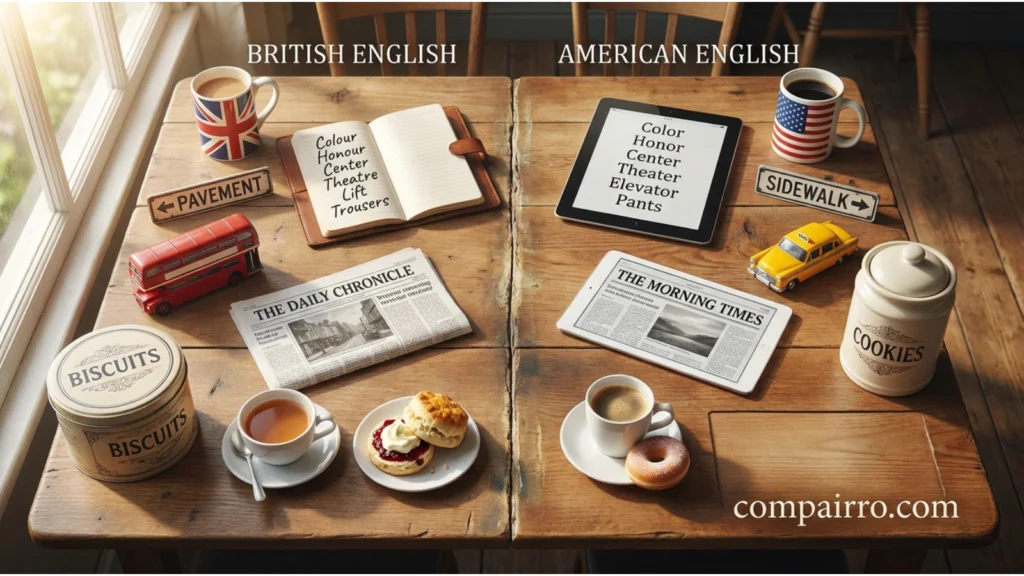
British English vs American English Usage
There is no major difference between British and American English when it comes to the basic meanings of whose and who’s.
Both varieties use whose for possession and who’s as a contraction of “who is” or “who has.”
| Feature | British English | American English | Notes |
|---|---|---|---|
| Whose | Used for possession | Used for possession | Same meaning |
| Who’s | Who is / who has | Who is / who has | Same meaning |
| Apostrophe | Used in who’s | Used in who’s | Shows contraction |
| Whose car? | Correct | Correct | Asks about ownership |
| Who’s driving? | Correct | Correct | Means “Who is driving?” |
So, whether you are writing for readers in the UK, US, Canada, Australia, India, or Pakistan, the same basic rule applies.
Which One Should You Use?
Choosing between whose or who’s depends on what you want to say.
whose when you are talking about ownership, possession, or a relationship.
- Whose phone is ringing?
- Whose idea was this?
- I know the person whose bag was lost.
Use who’s when you can replace it with who is or who has.
- Who’s your teacher? → Who is your teacher?
- Who’s waiting outside? → Who is waiting outside?
- Who’s already finished? → Who has already finished?
Use these tips:
- School writing: Use the correct form based on meaning.
- Workplace writing: Check contractions when writing formal messages.
- Texting: Who’s is common because it is a normal contraction.
- Academic writing: Both forms can be correct when used properly.
- Social media: Either word can appear, depending on the sentence.
Remember that who’s does not mean “belonging to who.” The apostrophe does not make it possessive.

Common Mistakes With Whose or Who’s
Mistake 1: Using who’s for ownership
❌ Who’s phone is this?
✔ Whose phone is this?
The sentence asks about the owner of the phone. Therefore, whose is correct.
Mistake 2: Using whose when you mean “who is”
❌ Whose coming to dinner?
✔ Who’s coming to dinner?
You can replace who’s with “who is”: “Who is coming to dinner?”
Mistake 3: Thinking the apostrophe shows possession
❌ Who’s book is on the desk?
✔ Whose book is on the desk?
An apostrophe does not always mean possession. In who’s, it shows that the word is a contraction.
Mistake 4: Forgetting that who’s can mean “who has”
❌ Whose already completed the work?
✔ Who’s already completed the work?
Here, who’s means “who has.”
Mistake 5: Choosing based only on pronunciation
❌ “They sound the same, so either one is fine.”
✔ Check the meaning before choosing.
Whose and who’s are homophones. They sound alike but have different meanings and spellings.

Whose or Who’s in Everyday Examples
At Work
Whose laptop is on the meeting table?
This asks about ownership.
Who’s joining the meeting today?
This means “Who is joining the meeting today?”
At School
Whose notebook is this?
You are asking who owns the notebook.
Who’s absent today?
This means “Who is absent today?”
On Social Media
Who is going to the concert tonight?
Here, who’s means “who is.”
Whose post did you share?
Here, whose asks about the person who owns or created the post.
In Daily Life
Whose keys are these?
You want to know who owns the keys.
Who is at the door?
You want to know who is at the door.
In Text Messages
Who is coming over?
= Who is coming over?
Whose charger did I take?
= Which person’s charger did I take?
These examples show why context matters more than pronunciation.
Whose or Who’s – Google Trends & Usage Data
People search for whose or who’s because these words are pronounced almost the same but perform different grammatical roles.
The confusion is especially common among English learners. It also appears in searches about grammar, proofreading, schoolwork, and everyday writing.
Search interest for grammar questions can vary over time and by location. English-speaking countries such as the US, UK, Canada, and Australia naturally have many searches involving English grammar. English learners in India and Pakistan also commonly study confusing word pairs like these.
The topic is useful online because people often write quickly on social media, in comments, and in text messages. Autocorrect can also make mistakes easier to miss.
Instead of relying on a pronunciation-based guess, learners can use the replacement test:
Who’s → Who is / Who has
Whose → Belonging to whom / belonging to which person
This simple method works in most everyday sentences.
Comparison Table: Whose or Who’s
| Word | Meaning | Grammar Role | Example |
|---|---|---|---|
| Whose | Belonging to whom | Possessive word | Whose bag is this? |
| Who’s | Who is | Contraction | Who’s calling me? |
| Who’s | Who has | Contraction | Who’s finished the task? |
| Whose | Shows ownership or connection | Possessive | Whose idea was it? |
The key difference
Whose asks about the person something belongs to.
Who’s tells us that “who is” or “who has” has been shortened.
Whose or Who’s in Professional Life
Knowing the difference between whose or who’s is useful at work because small grammar mistakes can affect the clarity of emails and documents.
For example:
Whose report is this?
This asks about the person responsible for the report.
Who’s responsible for this report?
This means “Who is responsible for this report?”
Both sentences can be correct, but they ask the question in different ways.
When writing professional emails, reports, applications, or business messages, always check whether who’s can be expanded to “who is” or “who has.”
Whose or Who’s for Students or Beginners
Beginners often struggle with these words because they sound the same. The apostrophe can also make who’s look like a possessive word.
The best way to learn is to focus on meaning instead of spelling alone.
Easy learning tips
- Learn whose = ownership.
- Learn who’s = who is / who has.
- Read the complete sentence before choosing.
- Use the replacement test.
- Practice with short sentences.
- Do not choose based only on pronunciation.
For example:
_____ pencil is this?
Ask yourself: Is the sentence asking about ownership?
Yes. So the answer is:
Whose pencil is this?
Now try:
_____ coming to class?
Can you say “Who is coming to class?”
Yes. Therefore:
Who’s coming to class?
Signs or Characteristics Related to Whose or Who’s
Characteristics of Whose
- Shows possession.
- Asks who owns something.
- Can appear before a noun.
- Can show a relationship or connection.
- Does not use an apostrophe.
Examples:
- Whose house?
- Whose teacher?
- Whose responsibility?
Characteristics of Who’s
- Contains an apostrophe.
- Is a contraction.
- Means “who is” or “who has.”
- Commonly appears in questions and conversations.
- Does not show possession.
Examples:
- Who is there?
- Who’s ready?
- Who is finished?
Simple Trick to Remember Whose or Who’s
Here is the easiest memory trick:
👉 Whose = Whose property?
👉 Who is = Who is / Who has
Think of it this way:
If you are asking “Who owns it?”, use whose.
If you can say “Who is” or “Who has,” use Who is.
Quick examples
Whose shoes are these?
→ Who owns these shoes?
Who is wearing those shoes?
→ Who is wearing those shoes?
Another easy test
Take this sentence:
Who is coming?
Replace who’s:
Who is coming? ✅
So Who is correct.
Now:
Whose bag is this?
Try “Who is bag is this?” ❌
That does not work. So whose is correct.
FAQs:
1. What is the difference between whose and who’s?
Whose shows possession, while Who is is short for “who is” or “who has.”
2. Is who’s possessive?
No. Who is a contraction. Whose is the possessive form.
3. Is “whose phone is this?” correct?
Yes. Whose phone is this? asks who owns the phone.
4. Is “who’s phone is this?” correct?
No. The correct sentence is “Whose phone is this?”
5. Can who’s mean who has?
Yes. For example, “Who’s finished?” can mean “Who has finished?”
6. Do whose and who’s sound the same?
Yes. They are pronounced alike in standard English, even though their meanings and spellings are different.
7. How can I remember whose vs who’s?
Remember: whose = ownership, while who’s = who is/who has.
Conclusion
Understanding whose or who’s is much easier once you focus on what the sentence means.
Use whose when you are asking about ownership or showing that something belongs to someone. For example, “Whose jacket is this?”
Use Who is when you mean “who is” or “who has.” For example, “Who is coming?” means “Who is coming?”
The easiest memory rule is:
👉 Whose = ownership
👉 Who’s = who is / who has
When you are unsure, expand who’s into “who is” or “who has.” If the sentence makes sense, who’s is correct. If you are asking who owns something, choose whose.
Once you practice this simple trick, choosing between whose or Who is becomes quick and easy.

Sara Taylor is a passionate English content writer who specializes in word meanings, spelling comparisons, and modern slang explanations. She creates easy-to-understand articles that help readers avoid common English mistakes and improve their writing skills. Her content focuses on simple learning, real-life examples, and clear explanations for everyday readers.