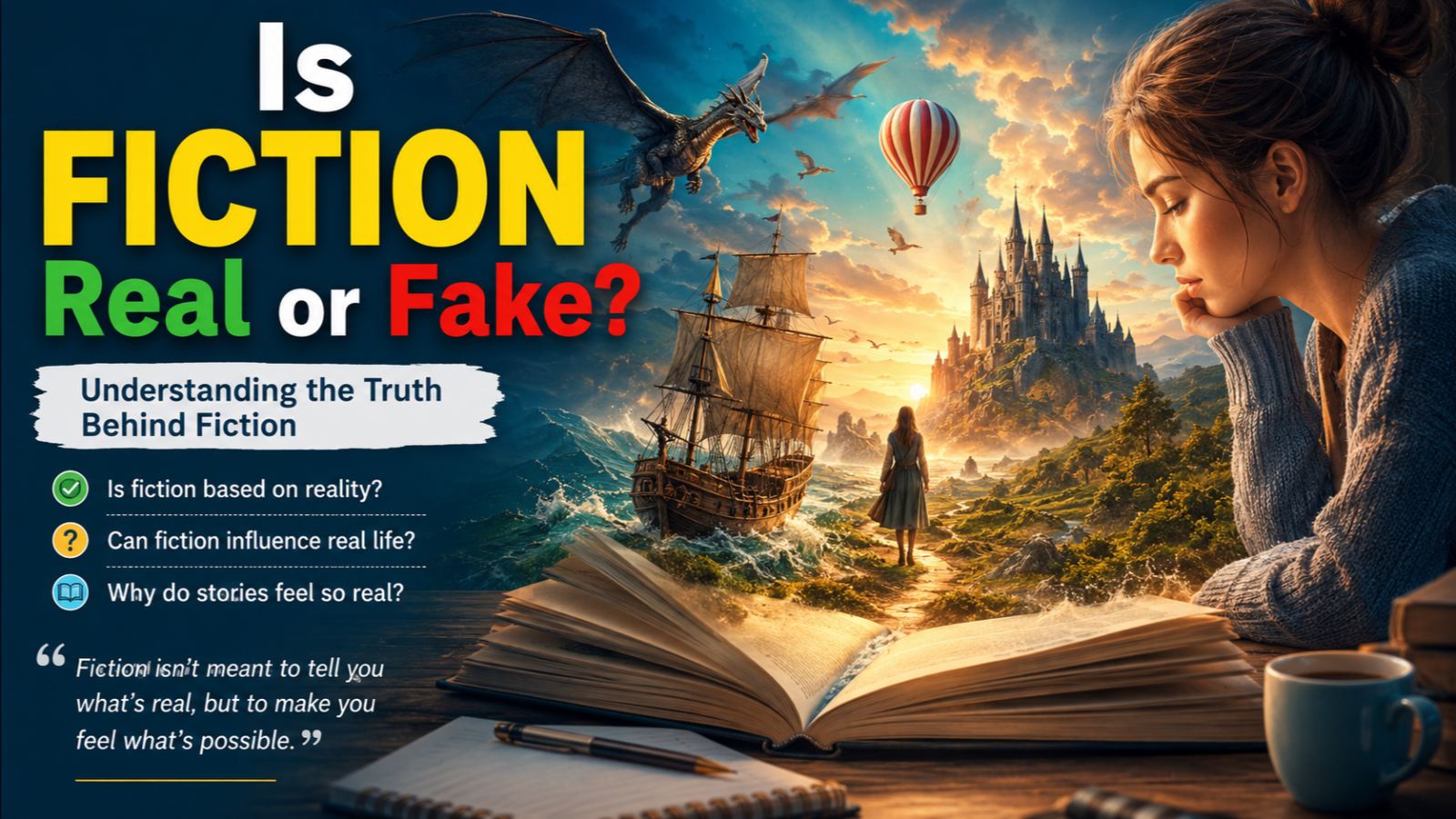
Have you ever watched a movie or read a story and wondered, “Is fiction real or fake?” You are not alone. Many students and new readers ask this question because fiction can feel very realistic. A story may have real places, human emotions, family problems, friendships, or even events that sound like they could happen in real life.
The simple answer is that fiction is made-up or imagined content. However, this does not mean every part of a fictional story is completely impossible. Writers can use real places, real historical events, and real-life ideas while creating an imaginary story.
For example, a novel may take place in London, which is a real city, but the characters and events in the story may be created by the author. In the same way, a movie can show a real country but tell a fictional story.
People often search “is fiction real or fake” because the word “fiction” can be confusing. You may see it in books, movies, school lessons, social media, online articles, and conversations. It is also common in English classes when teachers ask students to identify fiction and nonfiction.
Understanding this difference helps you know whether information is presented as an imagined story or as factual information. It also makes reading books and watching movies easier because you can understand what the writer wants you to believe within the story.
In this guide, you’ll learn the meaning, examples, usage, differences, common mistakes, and simple explanations in easy English.
Is Fiction Real or Fake – Quick Answer
👉 Fiction = an imagined or made-up story, not a factual account of real events.
Fiction is created by writers for entertainment, education, or storytelling. Characters, plots, conversations, and events are usually invented.
However, fiction can contain real facts, places, ideas, or historical settings.
Examples
- Harry Potter is fiction because its characters and magical world are imaginary.
- A story about a made-up family living in New York is fiction, even though New York is real.
- A historical novel can use real historical events while adding fictional characters and scenes.
Simple rule
👉 Fiction means “made-up story.”
Think of it this way:
Fiction = imagination
Nonfiction = facts
A fictional story can feel real, but that does not make the story itself factual.
The Origin of Fiction
The word fiction comes from the Latin word fictio, which is connected with the idea of forming, shaping, or creating something.
Over time, the word became associated with stories created from imagination rather than direct statements of fact.
People have told fictional stories for thousands of years. Long before modern novels and movies, people shared myths, legends, folktales, and imagined stories through spoken traditions.
As writing became more common, fiction developed into different forms. These include novels, short stories, plays, comics, and modern screen stories.
Today, fiction is everywhere. You can find it in books, television shows, movies, video games, online stories, and other forms of entertainment.
British English vs American English Usage
There is no major difference between British and American English when using the word fiction.
The spelling and basic meaning are the same in both forms of English.
| Feature | British English | American English | Notes |
|---|---|---|---|
| Spelling | Fiction | Fiction | Same |
| Meaning | Imagined story | Imagined story | Same |
| Pronunciation | Similar | Similar | Minor accent differences may occur |
| Fiction book | Common | Common | Same meaning |
| Nonfiction | Common | Common | Same basic meaning |
So, whether you are writing for readers in the UK, US, Canada, Australia, India, or Pakistan, fiction has the same basic meaning.
Which One Should You Use?
If you are talking about a story created from imagination, use fiction.
For example:
- “I enjoy reading fiction.”
- “This novel is a work of fiction.”
- “The movie is based on a fictional character.”
Use nonfiction when you are talking about writing that presents facts or information about real subjects.
Fiction is suitable for:
- Novels
- Short stories
- Fantasy books
- Mystery stories
- Science-fiction stories
- Imaginary characters
- Many movies and TV shows
- Made-up adventures
Nonfiction is suitable for:
- Biographies
- History books
- News reports
- Textbooks
- Documentaries that present factual information
- Instructional books
- Scientific writing
Remember that some works can mix fact and imagination. For example, historical fiction may use real history as a base but create fictional characters or conversations.
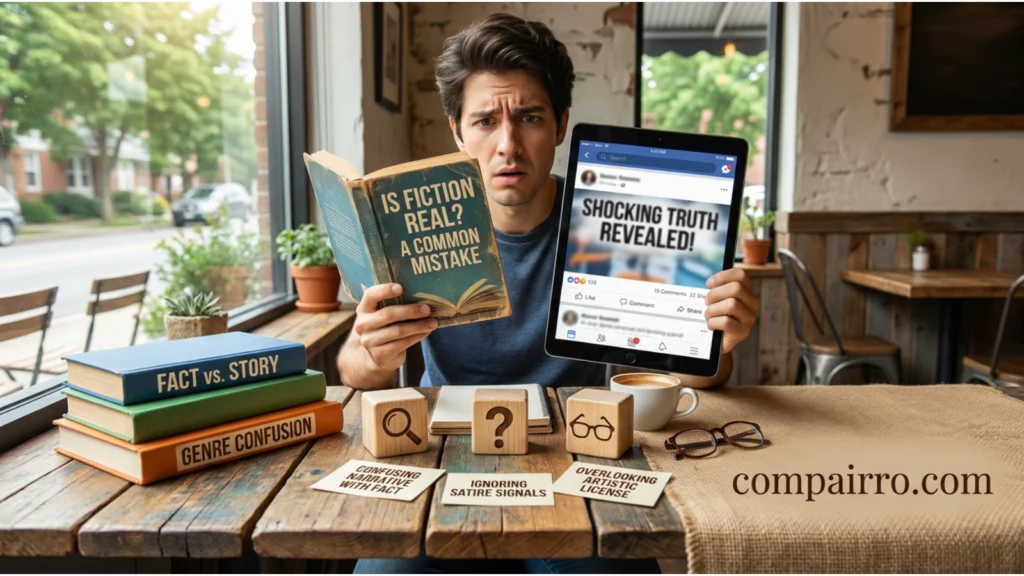
Common Mistakes With Is Fiction Real or Fake
Mistake 1: Thinking fiction means everything is impossible
❌ “If a story is fiction, every place and idea in it must be fake.”
✔ Fiction does not mean every detail is imaginary. A fictional story can use real cities, countries, jobs, cultures, or historical settings.
For example, a fictional character can live in a real city such as London.
Mistake 2: Thinking fiction means lying
❌ “Fiction is just another word for lying.”
✔ Fiction is not normally called lying. It is intentional storytelling created through imagination.
A novelist is not trying to trick readers into believing that an imaginary story is a factual report.
Mistake 3: Assuming realistic fiction is true
❌ “This novel feels completely real, so it must be a true story.”
✔ A story can be realistic without being factual.
Realistic fiction often uses normal people, familiar places, and believable situations.
Mistake 4: Confusing historical fiction with history
❌ “A historical fiction novel is exactly the same as a history book.”
✔ Historical fiction can use real historical events but may include invented characters, dialogue, or scenes.
A history book mainly focuses on factual information, while historical fiction focuses on storytelling.
Mistake 5: Thinking nonfiction cannot contain storytelling
❌ “Nonfiction books cannot tell stories.”
✔ Nonfiction can use storytelling techniques while still presenting factual information.
For example, a biography may tell the life story of a real person.
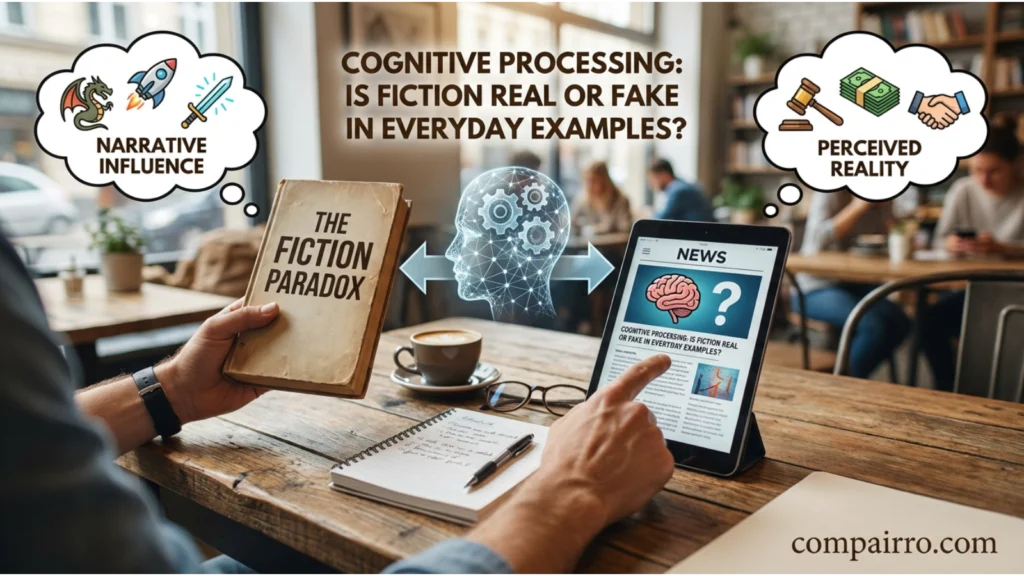
Is Fiction Real or Fake in Everyday Examples?
Fiction appears in many parts of everyday life. Here are some simple examples.
Work
Imagine a company creates a training story about an imaginary employee named Sara.
The company may use Sara to explain how workplace communication works. Sara is fictional, even though the situation may be realistic.
Example:
“ The training video uses a fictional employee to explain the problem.”
School
Students often read both fiction and nonfiction in school.
A fantasy novel is fiction because its story is imagined. A science textbook is nonfiction because it mainly provides factual information.
Example:
“Our English teacher asked us to choose a fiction book for reading practice.”
Social Media
Social media users sometimes share fictional stories, jokes, or made-up characters for entertainment.
A post may look realistic, but readers should not automatically assume it is a true story.
Example:
“That story sounds real, but the creator said it was fictional.”
Daily Life
People may create imaginary stories while playing games, writing, drawing, or telling stories to children.
Example:
“My little brother wrote a fictional story about a talking dog.”
Text Messages
The word fiction is less common in casual texting, but people may still use it when discussing books, movies, or stories.
Example:
“Is that movie based on a true story or is it fiction?”

Is Fiction Real or Fake – Google Trends & Usage Data
People search “is fiction real or fake” because they want a quick way to understand the difference between fictional and factual content.
Search interest can change over time because people encounter the word fiction in books, movies, school assignments, online discussions, and entertainment.
The exact popularity of this search phrase can also change by country and by time. Therefore, search-volume numbers should be checked directly in a current keyword research or Google Trends tool rather than treated as permanent figures.
The question is especially useful for beginners because the word fiction is often connected with different types of stories.
People in countries such as the US, UK, India, Pakistan, Canada, and Australia commonly encounter fiction through schools, books, movies, streaming platforms, and online content.
Why beginners search this keyword
Common reasons include:
- They want to know whether fiction means fake.
- They are learning fiction and nonfiction in school.
- They want to understand a book category.
- They are asking whether a movie is based on real events.
- They are confused by realistic fictional stories.
- They want to understand terms used by authors and readers.
A useful search-related question is:
“Is fiction fake?”
The answer is that fiction is generally imagined or invented, but it does not mean that every detail is false or impossible.
Comparison Table: Is Fiction Real or Fake?
| Feature | Fiction | Nonfiction |
|---|---|---|
| Main purpose | Storytelling | Giving factual information |
| Characters | Often invented | Usually real people or subjects |
| Events | Usually imagined | Based on facts |
| Settings | Can be real or imaginary | Usually real |
| Examples | Novels, fantasy, short stories | Biographies, textbooks, history |
| Can it use real facts? | Yes | Yes |
| Is it presented as factual? | Usually no | Yes |
| Main focus | Imagination and story | Facts and information |
The biggest difference is how the work presents its information.
Fiction creates a story, while nonfiction mainly aims to communicate facts about real subjects.
Is Fiction Real or Fake in Professional Life?
Fiction can also be useful in professional settings.
Writers, advertisers, filmmakers, game designers, and educators often create fictional examples to explain ideas or entertain audiences.
For example, a company may create an imaginary customer profile to show how a product works.
A training program may also use a fictional workplace situation so employees can practice solving a problem.
Fiction is therefore not limited to novels. It can be a useful tool for communication and learning.
Professional examples
- A fictional customer in a marketing presentation
- An imaginary business case in training
- A fictional character in an advertisement
- A made-up situation in a communication exercise
- Fictional examples in educational content
The important thing is to make it clear when something is fictional so readers or viewers do not mistake it for factual information.
Is Fiction Real or Fake for Students or Beginners?
Students often struggle with fiction because some fictional stories look extremely realistic.
A writer may describe ordinary school life, real cities, real jobs, and normal family situations. This can make readers wonder whether the story actually happened.
The key is to look at how the work is presented.
Easy learning tips
- Learn the difference between fiction and nonfiction.
- Look for labels such as “novel” or “fiction.”
- Check whether the characters are invented.
- Do not assume a realistic story is automatically true.
- Remember that historical fiction may contain both fact and imagination.
- Check reliable sources if you need to confirm whether an event really happened.
Simple example
Suppose you read a story about a student named Ali who goes to a school in Lahore.
Lahore can be a real place, but Ali and the events in the story may be completely fictional.
Therefore, a real setting does not automatically make a story nonfiction.
Signs or Characteristics Related to Fiction
Here are common characteristics that can help you recognize fiction:
- Imaginary characters: The people or creatures may be created by the writer.
- Invented events: The main events are often part of the story rather than recorded facts.
- Story structure: Fiction usually has characters, a setting, a plot, and a conflict.
- Creative settings: The story may take place in a real or imaginary location.
- Dialogue: Characters often have conversations created by the writer.
- Imagination: Fiction allows writers to explore ideas that may not happen in real life.
- Different genres: Fiction includes fantasy, mystery, romance, science fiction, adventure, and many other genres.
- Realistic fiction: Some fictional stories can look very similar to everyday life.
- Historical fiction: A story may combine real history with invented characters or events.
- Emotional storytelling: Fiction often uses stories to help readers feel connected to characters and situations.
These features can help you understand why fiction may feel real without being factual.
Simple Trick to Remember Is Fiction Real or Fake
Here is the easiest memory trick:
👉 Fiction = Fabricated story
👉 Nonfiction = Factual information
The word fiction can remind you of something formed or imagined.
Think of it this way:
Fiction → Imagine
Nonfiction → Facts
For example:
📖 A wizard living in a magical world → Fiction
📚 A textbook explaining how plants grow → Nonfiction
🏙️ A made-up family living in a real city → Fiction
👨🏫 A factual biography of a real person → Nonfiction
So, whenever you ask “Is fiction real or fake?”, remember:
👉 Fiction is an imagined story, but it can include real places, facts, ideas, and experiences.
FAQs:
1. Is fiction real or fake?
Fiction is generally an imagined or made-up story. It is not presented as a factual account, although it can include real places or facts.
2. Does fiction mean false?
Not exactly. Fiction means the story is created or imagined rather than presented as a factual account.
3. Can fiction be based on a true story?
Yes. A fictional work can be inspired by real events while adding imagined characters, dialogue, or scenes.
4. Is a fictional character real?
Usually, no. A fictional character is created by an author, filmmaker, or other storyteller.
5. Can fiction have real people in it?
Yes. Some fictional works may include real historical figures or other real people, but the surrounding story can still contain invented parts.
6. What is the difference between fiction and nonfiction?
Fiction mainly tells imagined stories, while nonfiction mainly presents information about real people, events, subjects, or ideas.
7. Is historical fiction real?
Historical fiction is a mix of history and imagination. It may use real events and settings while adding fictional characters, dialogue, or storylines.
Conclusion
So, is fiction real or fake? The simplest answer is that fiction is imagined or invented storytelling, not a factual account of events.
However, fiction is not always completely disconnected from reality. A fictional story can use real cities, historical events, cultures, emotions, and everyday situations. That is why some fictional stories can feel very real.
The main difference between fiction and nonfiction is the purpose and presentation of the work. Fiction creates an imagined story, while nonfiction mainly communicates facts.

Sara Taylor is a passionate English content writer who specializes in word meanings, spelling comparisons, and modern slang explanations. She creates easy-to-understand articles that help readers avoid common English mistakes and improve their writing skills. Her content focuses on simple learning, real-life examples, and clear explanations for everyday readers.