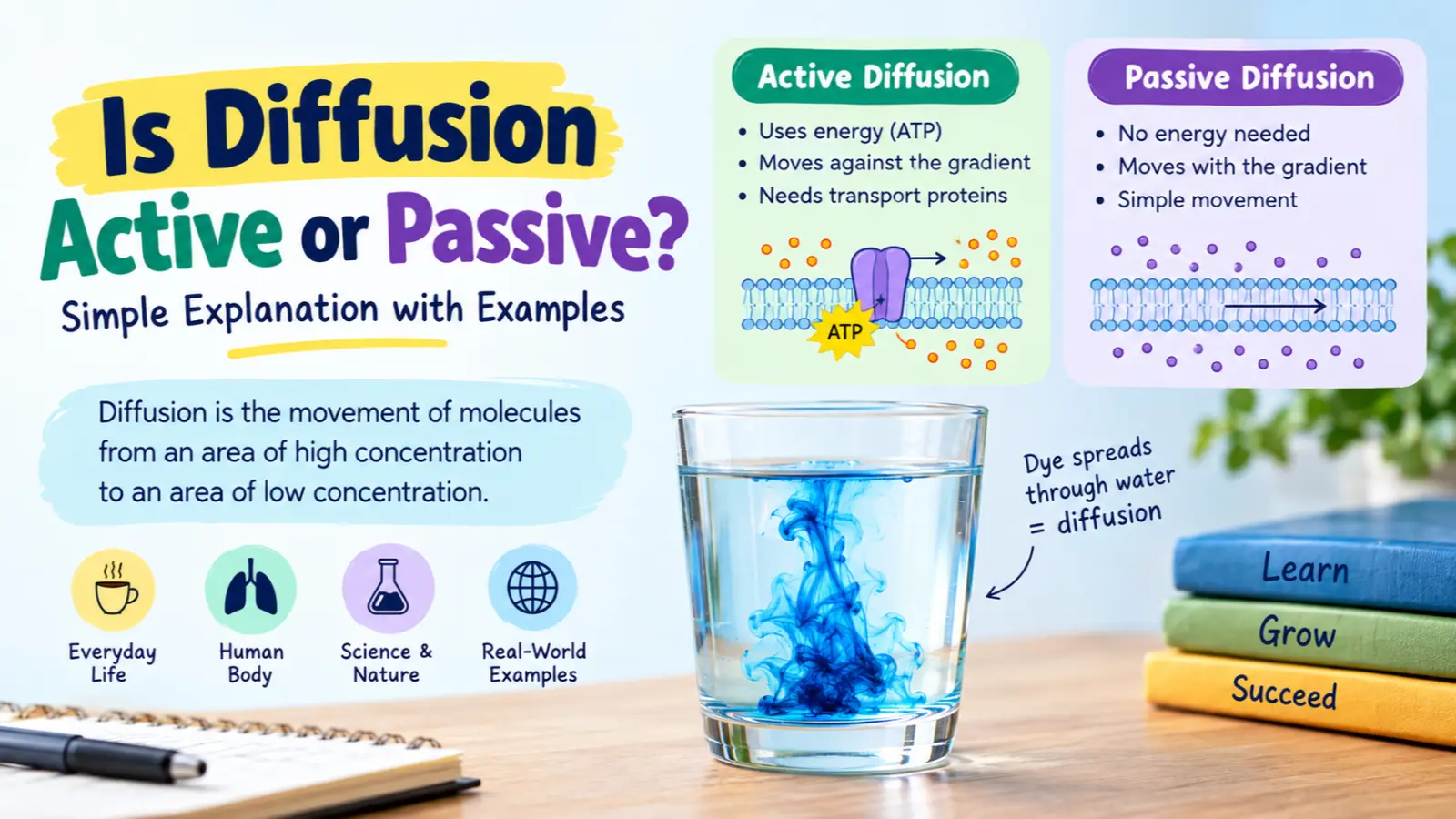
Is Diffusion Active or Passive is a common biology question for students learning about cell transport. Diffusion is the movement of particles from an area of higher concentration to an area of lower concentration. It happens naturally without the cell using energy. That is why diffusion is classified as a passive transport process.
Many students search for “is diffusion active or passive” because diffusion is often discussed with active transport and passive transport in biology. The terms can sound confusing at first. You may wonder if cells need energy for diffusion or whether substances move by themselves.
Diffusion is especially important in school and college biology. You may see it when learning about cell membranes, gases, water, oxygen, carbon dioxide, and how substances move into and out of cells.
The main idea is simple: diffusion happens when particles move from an area where they are more concentrated to an area where they are less concentrated. It does not require the cell to use energy from ATP.
Understanding this difference can make topics such as osmosis, facilitated diffusion, and active transport much easier. It can also help you answer common biology test questions correctly.
In this guide, you’ll learn the meaning, examples, usage, differences, common mistakes, and simple explanations in easy English.
Is Diffusion Active or Passive – Quick Answer
👉 Diffusion is a passive transport process.
Diffusion is called passive because particles move from an area of higher concentration to lower concentration without using cellular energy (ATP).
Examples:
- Oxygen can diffuse from the air sacs of the lungs into the blood.
- Carbon dioxide can diffuse from the blood into the lungs.
- A smell can spread through a room as gas particles move from an area of higher concentration to lower concentration.
Simple rule:
👉 Diffusion = high concentration → low concentration + no ATP
Think of it as particles spreading out naturally until they become more evenly distributed.
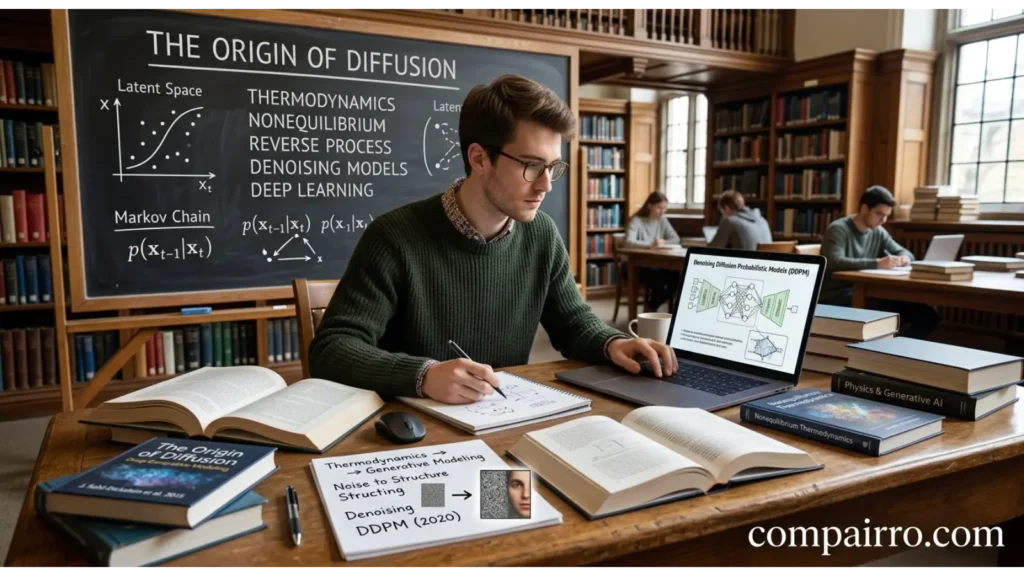
The Origin of Diffusion
The word diffusion comes from the Latin word diffundere, meaning “to spread out” or “pour out.”
The scientific idea of diffusion developed as scientists studied how particles move and spread. It became an important concept in physics, chemistry, and biology.
In biology, diffusion is used to explain how substances move across cell membranes and within living systems.
The concept is also connected to the natural movement of particles caused by their constant random motion.
You do not need to memorize the history to understand the process. The most important point is that particles naturally move and spread from higher concentration toward lower concentration.
British English vs American English Usage
There is no major British English vs American English difference in the word diffusion.
The spelling and scientific meaning are the same in both forms of English.
| Feature | British English | American English | Notes |
|---|---|---|---|
| Spelling | Diffusion | Diffusion | Same |
| Meaning | Movement from high to low concentration | Movement from high to low concentration | Same |
| Biology use | Common | Common | Same |
| Scientific use | Common | Common | Same |
| Pronunciation | Similar | Similar | Minor accent differences may occur |
So, whether you are studying in the UK, US, Pakistan, India, Canada, or Australia, diffusion has the same basic scientific meaning.
Which One Should You Use?
If you are answering the question “Is diffusion active or passive?”, the correct answer is passive.
Use the term passive transport when explaining diffusion across a cell membrane without cellular energy.
Remember these points:
- Diffusion is passive transport.
- It does not directly require ATP.
- Particles move from higher concentration to lower concentration.
- It can happen in gases, liquids, and biological systems.
- Simple diffusion can occur directly through a cell membrane.
- Some substances need membrane proteins and use facilitated diffusion, which is also passive.
In school or exam answers, a simple sentence is usually enough:
“Diffusion is a passive transport process because substances move down their concentration gradient without using cellular energy.”
Common Mistakes With Diffusion
Mistake 1: Saying diffusion requires ATP
❌ Incorrect: “Diffusion needs ATP energy from the cell.”
✔ Correct: Diffusion does not require ATP. It is a passive transport process.
Mistake 2: Saying particles move from low to high concentration
❌ Incorrect: “Diffusion moves particles from low concentration to high concentration.”
✔ Correct: Diffusion normally moves particles from higher concentration to lower concentration.
Mistake 3: Confusing diffusion with active transport
❌ Incorrect: “Diffusion and active transport both require cellular energy.”
✔ Correct: Diffusion is passive, while active transport requires energy to move substances against their concentration gradient.
Mistake 4: Thinking all movement across a membrane is diffusion
❌ Incorrect: “Every substance crossing a cell membrane is using diffusion.”
✔ Correct: Cells use several transport methods. These include simple diffusion, facilitated diffusion, osmosis, and active transport.
Mistake 5: Confusing diffusion with osmosis
❌ Incorrect: “Diffusion and osmosis are exactly the same.”
✔ Correct: Diffusion refers to the movement of particles from higher to lower concentration. Osmosis specifically involves the movement of water across a selectively permeable membrane.
Diffusion in Everyday Examples
Work
Diffusion is not usually a workplace process, but the concept can help people understand gases and chemicals.
For example, if a strong scent is released in a large room, its particles can gradually spread through the surrounding air.
School
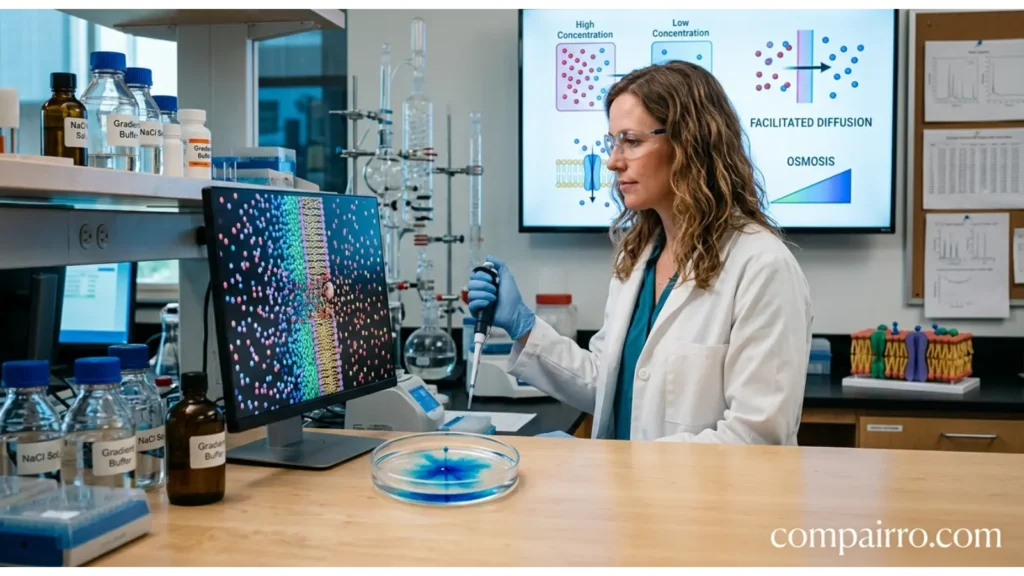
A common classroom experiment uses food coloring and water.
When food coloring is added to still water, the color gradually spreads. This happens because the particles move and spread through the water.
Social Media
Diffusion is a scientific term rather than a social media slang word. However, you may see it used in educational videos, science posts, and biology study content.
For example:
“Diffusion is passive transport.”
Daily Life
A perfume or food smell can spread through a room. The particles move through the air and become more widely distributed.
This is a simple real-life example of diffusion.
Text Messages
People normally do not use “diffusion” as a texting abbreviation.
If someone sends:
“Diffusion is passive.”
They are most likely discussing science or biology rather than using slang.
Is Diffusion Active or Passive – Google Trends & Usage Data
The search phrase “is diffusion active or passive” is mainly an educational query. Students often search questions like this when preparing for biology lessons, homework, quizzes, or exams.
Search interest can change over time, especially around school and examination periods. Google Trends measures relative search interest, not the exact number of searches, so it should not be treated as a precise popularity count.
The topic is relevant across many English-speaking and English-learning countries, including:
- US: Common in school and college biology.
- UK: Used in biology and science education.
- India: Common among students studying biology and science.
- Pakistan: Frequently relevant to school, college, and medical-entry science studies.
- Canada: Used in biology and general science education.
- Australia: Common in school and university science courses.
A major reason for this search is simple confusion between passive transport and active transport. Students may also search related questions such as:
- Is diffusion passive transport?
- Does diffusion require energy?
- Is facilitated diffusion active or passive?
- What is the difference between diffusion and active transport?
- Does diffusion use ATP?
- Is osmosis a type of diffusion?
These related questions show why understanding the basic concentration-gradient rule is useful.
Comparison Table: Is Diffusion Active or Passive?
| Feature | Diffusion | Active Transport |
|---|---|---|
| Transport type | Passive | Active |
| Energy required | No ATP required | Requires cellular energy |
| Direction | High to low concentration | Often low to high concentration |
| Concentration gradient | Down the gradient | Against the gradient |
| Cell energy | Not directly required | Required |
| Example | Oxygen moving into cells | Sodium-potassium pump |
| Main idea | Natural spreading | Energy-powered movement |
Simple Comparison
Diffusion:
High concentration → Low concentration
No ATP
Active transport:
Low concentration → High concentration
Energy required
The direction of movement is one of the easiest ways to tell them apart.
Diffusion in Professional Life
Diffusion is especially useful in professional fields connected to science and health.
Doctors, nurses, laboratory workers, biologists, pharmacists, and medical students may study diffusion as part of human biology and cell biology.
For example, understanding diffusion helps explain how oxygen and carbon dioxide move during gas exchange in the lungs.
Scientists also use diffusion concepts when studying cells, membranes, chemicals, and biological systems.
You do not need to work in a laboratory to understand the basic idea. Once you learn the concentration-gradient rule, many biology topics become easier.
Diffusion for Students or Beginners
Beginners often struggle with diffusion because several transport processes sound similar.
The easiest way to learn it is to focus on three questions:
- Where is the concentration higher?
- Where is the concentration lower?
- Does the process require cellular energy?
For simple diffusion, the answer is:
- Starts at higher concentration.
- Moves toward lower concentration.
- Does not require ATP.
Easy learning tips
- Draw two areas with different concentrations.
- Use arrows to show movement from high to low.
- Remember that diffusion is passive.
- Compare it with active transport.
- Learn examples such as oxygen and carbon dioxide.
- Do not confuse diffusion with osmosis.
A small diagram can often make this topic much easier than memorizing a long definition.
Signs or Characteristics Related to Diffusion
Here are the main characteristics of diffusion:
- Passive process: Diffusion does not directly use ATP.
- High to low: Particles move down their concentration gradient.
- Natural movement: Particles are constantly moving because of their random motion.
- No cellular pumping: Simple diffusion does not require a cell to pump particles.
- Can reach equilibrium: Movement continues until concentrations become more evenly distributed.
- Important in cells: Diffusion helps move substances across biological membranes.
- Works with gases and liquids: Diffusion can occur in different types of matter.
- Can involve membrane proteins: Facilitated diffusion uses proteins but remains passive.
- Affected by concentration difference: A larger concentration difference can increase the tendency for net diffusion.
- Important for gas exchange: Oxygen and carbon dioxide movement are common biological examples.
Simple Trick to Remember Is Diffusion Active or Passive
Here is an easy memory trick:
👉 Diffusion = Down
Both words start with D.
Diffusion moves Down the concentration gradient.
And because it moves naturally down the gradient:
👉 Diffusion = Passive
Think of it this way:
Imagine a crowded room with a door leading to an empty room. People naturally spread toward the less crowded area when they can.
In the same way, particles tend to move from an area where they are more concentrated toward an area where they are less concentrated.
Remember:
High → Low = Diffusion = Passive
Low → High = Active transport = Energy needed
This simple pattern can help you answer many basic biology questions.
FAQs:
1. Is diffusion active or passive?
Diffusion is passive transport because it does not require the cell to use ATP to move particles down their concentration gradient.
2. Does diffusion require energy?
Simple diffusion does not require cellular energy from ATP. Particles move naturally down their concentration gradient.
3. Does diffusion move from high to low concentration?
Yes. Net diffusion normally moves particles from an area of higher concentration to an area of lower concentration.
4. Is facilitated diffusion active or passive?
Facilitated diffusion is passive. It uses membrane proteins but does not require ATP.
5. Is osmosis active or passive?
Osmosis is a passive process involving the movement of water across a selectively permeable membrane.
6. What is the difference between diffusion and active transport?
Diffusion is passive and moves substances down their concentration gradient. Active transport uses cellular energy to move substances against their concentration gradient.
7. Does diffusion always need a cell membrane?
No. Diffusion can happen without a cell membrane. For example, gas particles can diffuse through the air.
Conclusion
So, is diffusion active or passive? The answer is clear: diffusion is passive transport.
Particles move from an area of higher concentration toward an area of lower concentration. The process does not require the cell to spend ATP to make the movement happen.
Diffusion is important in biology because it helps explain the movement of substances such as oxygen and carbon dioxide. It also helps students understand other transport processes, including facilitated diffusion, osmosis, and active transport.
The easiest memory rule is:
👉 Diffusion = High to Low = Passive = No ATP
Once you remember this pattern, the question “Is diffusion active or passive?” becomes much easier to answer.

Sara Taylor is a passionate English content writer who specializes in word meanings, spelling comparisons, and modern slang explanations. She creates easy-to-understand articles that help readers avoid common English mistakes and improve their writing skills. Her content focuses on simple learning, real-life examples, and clear explanations for everyday readers.