Have you ever looked at a chemistry question and wondered, “Is CO2 polar or nonpolar?” It may seem like a simple question, but the answer depends on more than just the atoms in the molecule. You also need to look at the molecule’s shape and how its bonds are arranged.
Carbon dioxide, written as CO₂, is a common gas that you meet in school chemistry, science books, and everyday life. It is found in the air, produced when people and animals breathe out, and released when fuels burn. Because CO₂ has oxygen atoms bonded to carbon, many beginners think it must be a polar molecule.
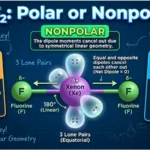
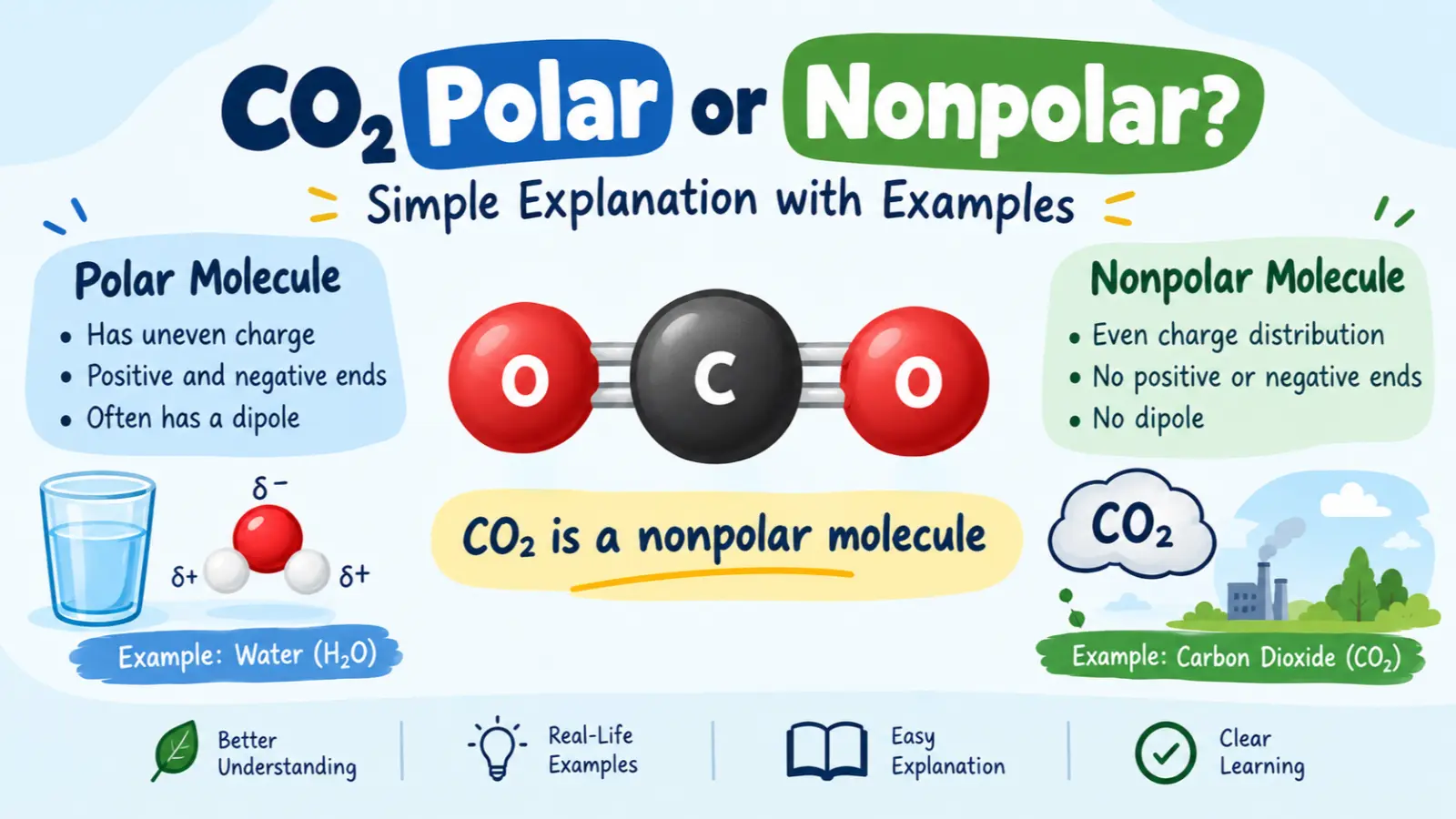
That idea is understandable. The bonds between carbon and oxygen are polar because oxygen attracts the shared electrons more strongly than carbon. However, the overall molecule behaves differently because of its shape. CO₂ has a linear shape, which means the two oxygen atoms are positioned on opposite sides of the carbon atom.
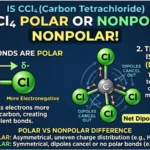
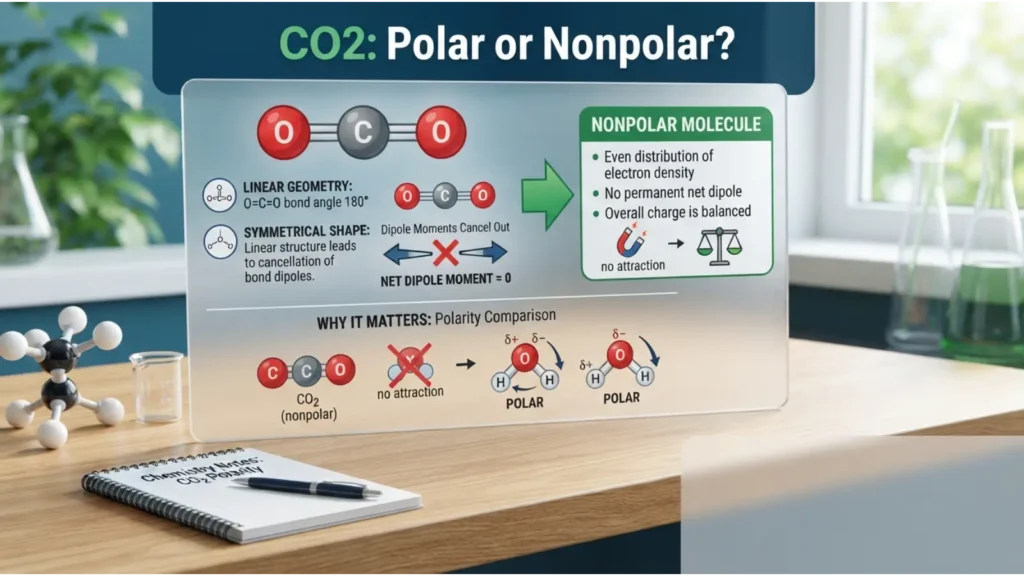
This arrangement causes the bond dipoles to cancel each other. As a result, the molecule has no overall dipole moment and is classified as nonpolar.
Understanding this difference is useful when studying molecular geometry, chemical bonding, electronegativity, intermolecular forces, and physical properties. It also helps explain why a molecule can contain polar bonds but still be nonpolar overall.
In this guide, you’ll learn the meaning, examples, usage, differences, common mistakes, and simple explanations in easy English.
CO2 Polar or Nonpolar – Quick Answer
👉 CO₂ is nonpolar.
Carbon dioxide has two polar C=O bonds, but its linear molecular shape makes the bond dipoles cancel each other.
Simple explanation
CO₂ looks like this:
O = C = O
The carbon atom is in the center, and the two oxygen atoms are directly opposite each other.
Each C=O bond is polar because oxygen is more electronegative than carbon. However, the two bond dipoles point in opposite directions with equal strength.
So:
Polar bonds + symmetrical linear shape = nonpolar molecule
Examples
- CO₂ → nonpolar
- H₂O → polar
- O₂ → nonpolar
Simple rule
👉 Look at both the bonds and the shape.
A molecule can have polar bonds without being a polar molecule.
The Origin of CO2 Polar or Nonpolar
The question “CO2 polar or nonpolar” comes from basic chemistry and molecular structure.
The formula CO₂ means carbon dioxide. The name comes from its composition: one carbon atom and two oxygen atoms.
The word polar refers to an uneven distribution of electrical charge in a molecule. A nonpolar molecule does not have a permanent overall separation of positive and negative charge.
Chemists use ideas such as electronegativity, bond polarity, molecular geometry, and dipole moments to decide whether a molecule is polar or nonpolar.
As students learn Lewis structures and VSEPR theory, they often encounter CO₂ as a useful example. It shows an important chemistry idea: bond polarity and molecular polarity are not always the same thing.
British English vs American English Usage
There is no British-versus-American spelling difference in CO₂, polar, nonpolar, carbon dioxide, or molecular polarity.
The chemistry terminology is used in essentially the same way in both forms of English.
| Feature | British English | American English | Notes |
|---|---|---|---|
| Carbon dioxide | Carbon dioxide | Carbon dioxide | Same |
| Polar | Polar | Polar | Same |
| Nonpolar | Nonpolar | Nonpolar | Same |
| CO₂ | CO₂ | CO₂ | Same chemical formula |
| Electronegativity | Electronegativity | Electronegativity | Same |
You may also see “non-polar” written with a hyphen in some educational materials. “Nonpolar” is also widely used.
Which One Should You Use?
When answering the question “CO2 polar or nonpolar?”, the correct answer is nonpolar.
Use the following approach when solving chemistry questions:
- First, identify the bonds.
- Next, check the electronegativity difference.
- Then, find the molecular shape.
- Finally, check whether the bond dipoles cancel.
For CO₂, the C=O bonds are polar, but the molecule is linear and symmetrical.
In school or exams
A clear answer is:
“CO₂ is a nonpolar molecule because it has a linear, symmetrical shape, so the two C=O bond dipoles cancel.”
In academic writing
You can explain that CO₂ has polar carbon-oxygen bonds but zero net molecular dipole moment.
Common Mistakes With CO2 Polar or Nonpolar
Mistake 1: Thinking polar bonds always make a polar molecule
❌ “CO₂ has polar C=O bonds, so CO₂ must be polar.”
✔ The bonds are polar, but their dipoles cancel because of the molecule’s linear shape.
Mistake 2: Ignoring molecular shape
❌ “CO₂ has oxygen atoms, so it is polar.”
✔ The atoms alone do not decide molecular polarity. The arrangement of the atoms also matters.
Mistake 3: Saying CO₂ has no polar bonds
❌ “CO₂ is nonpolar, so its C=O bonds are nonpolar.”
✔ Each C=O bond is polar because carbon and oxygen have different electronegativities.
Mistake 4: Confusing CO₂ with H₂O
❌ “CO₂ and H₂O both contain oxygen, so they should have the same polarity.”
✔ H₂O is bent, while CO₂ is linear. Their different shapes lead to different overall molecular polarity.
Mistake 5: Looking only at the Lewis structure
❌ “I counted the atoms, so I know the polarity.”
✔ You also need to consider molecular geometry and the direction of bond dipoles.
CO2 Polar or Nonpolar in Everyday Examples
Understanding CO₂ polarity is useful in many basic chemistry situations.
Work
Scientists and laboratory workers may discuss CO₂ when studying gases, chemical reactions, environmental science, or industrial processes.
For example:
“The CO₂ molecule is nonpolar because its two bond dipoles cancel.”
School
Students commonly see CO₂ in questions about:
- Lewis structures
- VSEPR theory
- Electronegativity
- Molecular geometry
- Bond polarity
- Dipole moments
- Intermolecular forces
Social Media
Science pages and educational videos often ask questions such as:
“Is CO₂ polar or nonpolar?”
These questions are popular because CO₂ provides a simple example of the difference between polar bonds and molecular polarity.
Daily Life
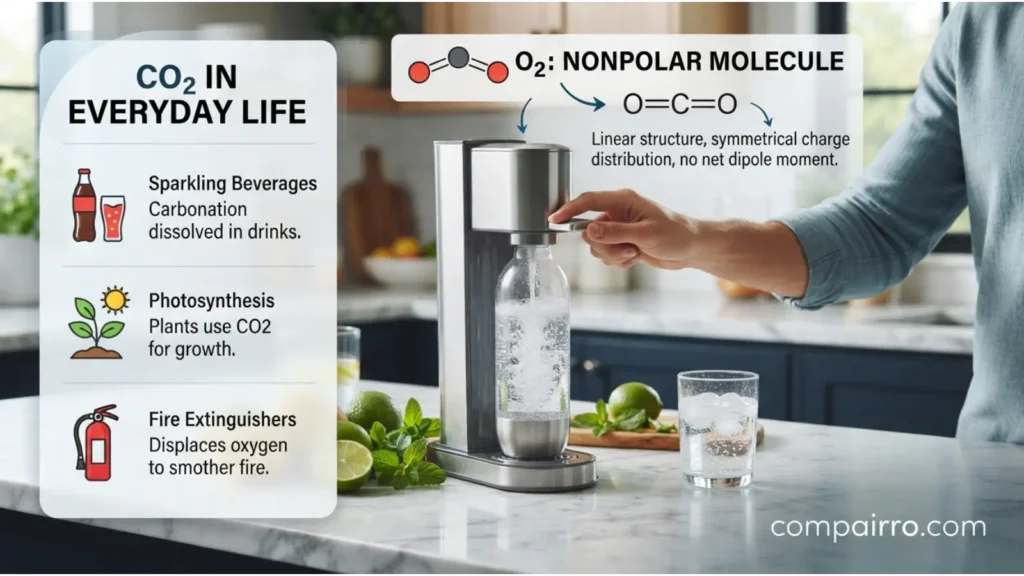
CO₂ is present in the air around us. Humans and animals release CO₂ during respiration, and plants use carbon dioxide during photosynthesis.
The polarity question, however, is mainly a chemistry concept rather than something you normally notice in daily life.
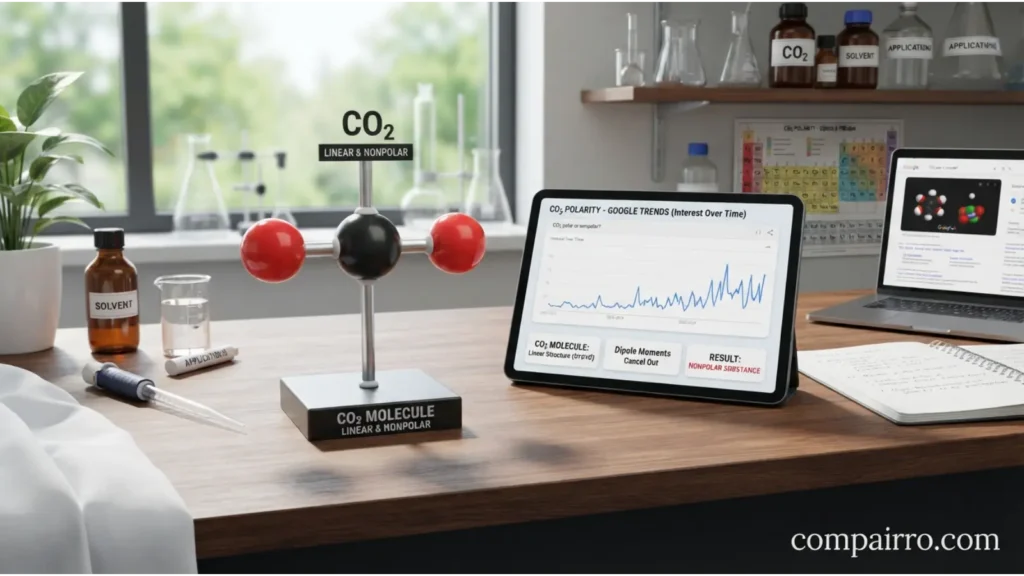
CO2 Polar or Nonpolar – Google Trends & Usage Data
People search “CO2 polar or nonpolar” mainly because they want a quick answer for chemistry homework, exams, assignments, or molecular polarity practice.
The query is especially useful for beginners because CO₂ can be confusing: its individual bonds are polar, while the complete molecule is nonpolar.
Searches for this topic can appear among students in countries where English-language chemistry resources are common, including:
- United States: Chemistry students often search molecular polarity explanations.
- United Kingdom: The topic appears in school and university chemistry learning.
- India: Students commonly study molecular geometry and polarity in chemistry courses.
- Pakistan: Students may search the question while preparing chemistry lessons, tests, and exams.
- Canada: Molecular polarity is part of general chemistry education.
- Australia: Students may encounter CO₂ polarity in chemistry and science courses.
Search interest can change around school and examination periods. However, the exact search volume for this specific phrase changes over time, so it should not be treated as a fixed number.
A major reason for the confusion is simple: students often learn bond polarity first and molecular polarity later.
Comparison Table: CO2 Polar or Nonpolar
| Molecule | Shape | Bond Polarity | Overall Polarity |
|---|---|---|---|
| CO₂ | Linear | Polar C=O bonds | Nonpolar |
| H₂O | Bent | Polar O–H bonds | Polar |
| O₂ | Linear | Nonpolar O–O bond | Nonpolar |
| NH₃ | Trigonal pyramidal | Polar N–H bonds | Polar |
| CH₄ | Tetrahedral | Nearly nonpolar C–H bonds | Nonpolar |
| SO₂ | Bent | Polar S–O bonds | Polar |
This comparison shows why molecular shape matters. CO₂ is symmetrical, so its two C=O dipoles cancel.
CO2 Polar or Nonpolar in Professional Life
CO₂ polarity can be useful in chemistry, environmental science, laboratory work, and education.
Professionals and students may use molecular polarity to understand:
- How molecules interact
- Solubility behavior
- Intermolecular forces
- Molecular structure
- Chemical reactions
- Physical properties of substances
CO₂ is also important in environmental science because it is a greenhouse gas. Its molecular polarity is a separate chemistry concept from its role in the atmosphere.
For basic chemistry, the key point remains:
CO₂ has polar bonds but is a nonpolar molecule.
CO2 Polar or Nonpolar for Students or Beginners
Beginners often struggle because they mix up bond polarity and molecular polarity.
Here is an easy method.
Step 1: Draw the structure
CO₂ can be represented as:
O=C=O
Step 2: Find the shape
CO₂ has a linear molecular geometry.
The bond angle is about 180°.
Step 3: Check electronegativity
Oxygen attracts electrons more strongly than carbon.
Therefore, each C=O bond is polar.
Step 4: Check the dipoles
The two bond dipoles point in opposite directions.
Because the molecule is symmetrical, they cancel.
Step 5: Give the final answer
CO₂ is nonpolar overall.
Easy learning tip
Do not stop after asking:
“Are the bonds polar?”
Also ask:
“Do the bond dipoles cancel?”
That second question often gives you the final answer.
Signs or Characteristics Related to CO2 Polar or Nonpolar
The main characteristics that help identify CO₂ as nonpolar are:
- One carbon atom is in the center.
- Two oxygen atoms are attached to carbon.
- The molecule has a linear shape.
- The C=O bonds are polar.
- The two C=O bonds are arranged symmetrically.
- Their dipoles point in opposite directions.
- The dipoles cancel each other.
- CO₂ has no net permanent dipole moment.
- Therefore, the complete molecule is nonpolar.
Important distinction
Bond polarity: C=O bonds are polar.
Molecular polarity: CO₂ is nonpolar.
This distinction is the most important part of the topic.
Simple Trick to Remember CO2 Polar or Nonpolar
Here is an easy memory trick:
CO₂ = straight line
Straight + symmetrical = dipoles cancel
Dipoles cancel = nonpolar
Think of it this way:
O ← C → O
The two sides pull in opposite directions with equal effect.
So the overall pull balances out.
A useful comparison is:
CO₂ → linear → nonpolar
H₂O → bent → polar
Remember: shape can change the final polarity.
FAQs:
1. Is CO₂ polar or nonpolar?
CO₂ is nonpolar overall because its two polar C=O bond dipoles cancel in its linear, symmetrical shape.
2. Are the bonds in CO₂ polar?
Yes. Each C=O bond is polar because oxygen has a higher electronegativity than carbon.
3. Why is CO₂ nonpolar if it has polar bonds?
Its two polar bonds point in opposite directions and cancel each other.
4. What is the shape of CO₂?
CO₂ has a linear molecular shape with a bond angle of about 180°.
5. Is H₂O polar like CO₂?
No. H₂O is polar because its bent shape prevents its O–H bond dipoles from fully canceling.
6. Does CO₂ have a dipole moment?
CO₂ has no net permanent dipole moment because its two equal and opposite bond dipoles cancel.
7. What is the easiest way to know if CO₂ is polar?
Remember: CO₂ is linear and symmetrical, so its bond dipoles cancel and the molecule is nonpolar.
Conclusion
So, is CO2 polar or nonpolar? The answer is nonpolar.
The important point is that CO₂ contains polar C=O bonds, but the molecule itself is nonpolar. Its linear and symmetrical shape places the two bond dipoles in opposite directions, causing them to cancel.
This is why you should never decide molecular polarity by looking only at the atoms or individual bonds. Always check the molecular shape and dipole directions.
The easiest rule to remember is:
👉 CO₂ = polar bonds + linear shape + cancellation = nonpolar molecule.
Once you understand this idea, questions about molecular polarity become much easier. CO₂ is one of the best examples for learning the difference between bond polarity and overall molecular polarity.

Sara Taylor is a passionate English content writer who specializes in word meanings, spelling comparisons, and modern slang explanations. She creates easy-to-understand articles that help readers avoid common English mistakes and improve their writing skills. Her content focuses on simple learning, real-life examples, and clear explanations for everyday readers.