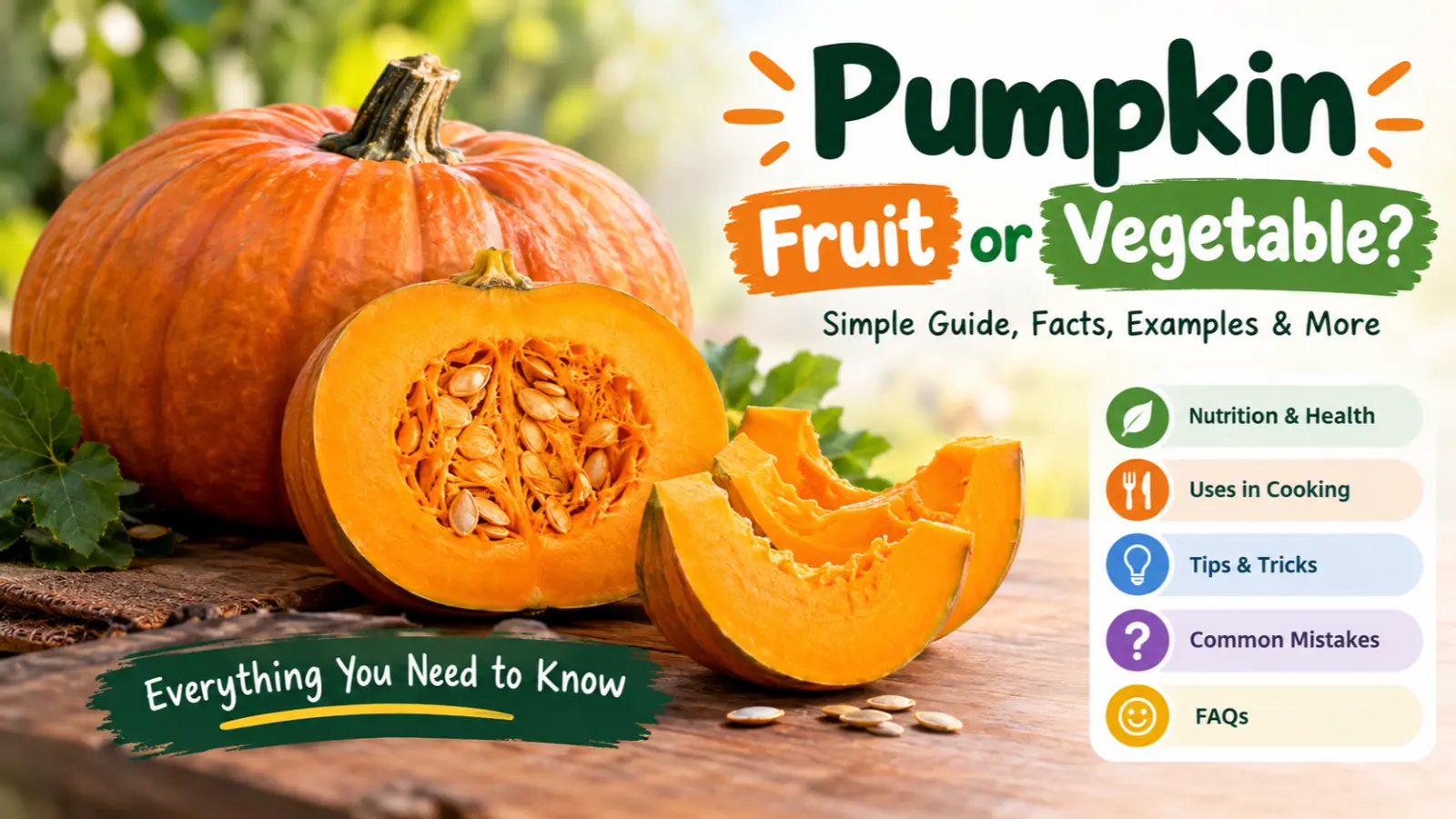
Have you ever looked at a pumpkin and wondered, “Is pumpkin a fruit or a vegetable?” It is an easy question to ask because pumpkins are often used in soups, curries, pies, and other foods that we usually think of as vegetables.
The confusion becomes even greater because pumpkins grow in gardens like many vegetables, but they also have seeds inside. So, where does pumpkin really belong?
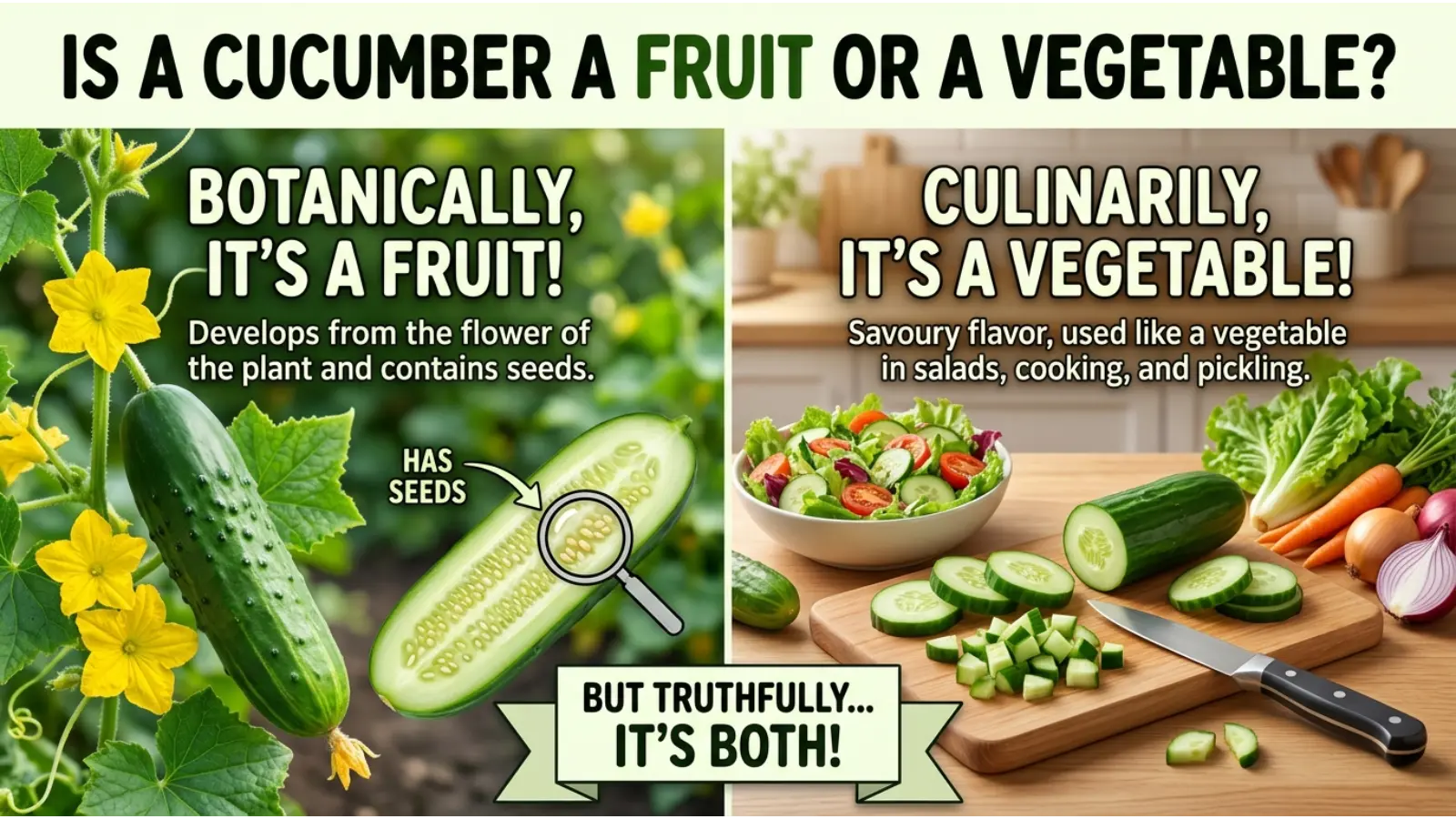
The answer depends on how you define it. Botanically, a pumpkin is a fruit because it develops from the flower of a pumpkin plant and contains seeds. However, in cooking, pumpkins are commonly treated as vegetables because they are often used in savory dishes.
You may come across this question at school, in cooking, during conversations, on social media, or while searching the internet. Understanding the difference between botanical and culinary meanings makes the answer much easier.
In this guide, you’ll learn the meaning, examples, usage, differences, common mistakes, and simple explanations in easy English.
Pumpkin Fruit or Vegetable – Quick Answer
👉 Pumpkin = a fruit botanically, but it is commonly used as a vegetable in cooking.
A fruit usually develops from the flower of a plant and contains seeds. Pumpkin fits this botanical definition.
In everyday cooking, however, pumpkins are often grouped with vegetables because they are used in soups, stews, curries, roasted dishes, and other savory meals.
Examples
- 🎃 Botany: Pumpkin is a fruit because it develops from a flower and contains seeds.
- 🍲 Cooking: Pumpkin is often treated like a vegetable in savory recipes.
- 🥧 Food: Pumpkin can also be used in sweet dishes such as pies and desserts.
Simple rule:
👉 Fruit = how the plant develops. Vegetable = how we commonly use it in food.
So, if someone asks, “Is pumpkin a fruit or vegetable?”, the simplest answer is:
Pumpkin is botanically a fruit, but it is commonly used as a vegetable in cooking.
The Origin of Pumpkin Fruit or Vegetable
The word pumpkin comes from an older word related to a type of large, round squash. Pumpkins belong to the Cucurbitaceae family, also called the gourd family.
This family includes several familiar plants, such as squash, cucumbers, melons, and gourds.
Pumpkins have been grown and eaten for a very long time. Different types of squash were cultivated in the Americas before European contact.
Over time, pumpkins became popular in many parts of the world. Today, they are used in many different types of food.
The pumpkin also became strongly linked with autumn and Halloween in countries such as the United States and Canada. This helped make the pumpkin a familiar symbol around the world.
British English vs American English Usage
There is no major British-American spelling difference in the word pumpkin. Both British and American English use pumpkin.
The main difference is not the word itself. It is how people may describe or use the food.
| Feature | British English | American English | Notes |
|---|---|---|---|
| Spelling | Pumpkin | Pumpkin | Same spelling |
| Botanical classification | Fruit | Fruit | Same scientific classification |
| Cooking use | Often treated as a vegetable | Often treated as a vegetable | Culinary use can vary |
| Pumpkin pie | Commonly understood | Very common | Especially associated with American cuisine |
| Pumpkin seeds | Common term | Common term | Same general meaning |
So, whether you are in the UK, US, India, Pakistan, Canada, or Australia, the basic botanical answer remains the same.
Which One Should You Use?
The answer depends on what you are talking about.
Use “fruit” when:
- You are discussing plant science or botany.
- You are answering a science question.
- You are explaining how pumpkins develop.
- You are talking about seeds and flowers.
- You are studying plant classification.
Use “vegetable” when:
- You are discussing everyday cooking.
- You are talking about savory pumpkin recipes.
- You are describing how pumpkin is commonly used in meals.
- You are grouping foods by cooking use.
Formal vs informal use
In a science class, saying pumpkin is a fruit is the more precise botanical answer.
In a kitchen or grocery conversation, calling pumpkin a vegetable is common because people often classify foods by taste and use rather than plant biology.
The important thing is to understand the context.

Common Mistakes With Pumpkin Fruit or Vegetable
Mistake 1: Saying pumpkin is only a vegetable
❌ “Pumpkin is definitely a vegetable in every situation.”
✔ Botanically, pumpkin is a fruit. It is commonly treated as a vegetable in cooking.
Mistake 2: Thinking all sweet foods are fruits
❌ “Pumpkin must be a vegetable because it can be used in savory dishes.”
✔ Culinary use does not decide botanical classification.
A fruit can be used in savory food, just as some fruits are used in sweet dishes.
Mistake 3: Thinking all fruits are sweet
❌ “A fruit must taste sweet.”
✔ Sweet taste is not a scientific requirement for being a fruit.
Botanically, the key idea is that the fruit develops from the flower of a plant and usually contains or surrounds seeds.
Mistake 4: Confusing pumpkin with a root vegetable
❌ “Pumpkin is a root because it grows near the ground.”
✔ Pumpkin develops above ground from the flowering part of the plant. It is not a root vegetable.
Mistake 5: Thinking cooking changes its botanical classification
❌ “Pumpkin becomes a vegetable when we cook it.”
✔ Cooking does not change its botanical classification. It remains a fruit botanically.
Pumpkin Fruit or Vegetable in Everyday Examples
The easiest way to understand the topic is to see how pumpkin is used in real life.
Work
Imagine someone brings pumpkin soup to a workplace lunch.
They might say:
“I made a vegetable soup with pumpkin.”
This is perfectly normal in everyday cooking language.
School
A science teacher may ask:
“Is pumpkin a fruit or vegetable?”
A strong answer would be:
“Pumpkin is botanically a fruit because it develops from a flower and contains seeds.”
Social Media
You may see posts around Halloween showing pumpkins as decorations.
People may also post recipes for pumpkin soup, roasted pumpkin, pumpkin bread, or pumpkin pie.
Daily Life
At a market, you might see pumpkins placed with other vegetables.
That does not necessarily mean they are botanically vegetables. Stores usually organize food based on practical shopping and cooking categories.
Text Messages
This topic is not normally used as slang in text messages. However, someone might text:
“Wait, is pumpkin actually a fruit?”
A simple reply could be:
“Yes! Botanically, pumpkin is a fruit, but we often cook it like a vegetable.”
Pumpkin Fruit or Vegetable – Google Trends & Usage Data
The search phrase “pumpkin fruit or vegetable” is mainly used by people who want a quick classification answer.
It is especially useful for beginners because the culinary use of pumpkin can make its botanical classification confusing.
Search interest can also increase during autumn and Halloween-related periods, particularly in countries where pumpkins are strongly connected with seasonal celebrations and food.
People in the US, UK, India, Pakistan, Canada, and Australia may all search this question, although search interest can change over time and by season.
Why do people search it?
Common reasons include:
- School science questions
- General curiosity
- Cooking and nutrition discussions
- Pumpkin recipes
- Halloween content
- Gardening questions
- Plant classification
- Internet debates about fruits and vegetables
Important note about Google Trends
Google Trends measures relative search interest, not the exact number of searches. Interest can change by date, location, season, and search term.
Therefore, a specific country-by-country ranking should be checked directly in Google Trends for the exact time period being studied rather than treated as a permanent fact.

Comparison Table: Pumpkin Fruit or Vegetable
| Feature | Pumpkin as a Fruit | Pumpkin as a Vegetable |
|---|---|---|
| Classification | Botanical | Culinary |
| Develops from a flower | Yes | Not the main focus |
| Contains seeds | Yes | Not the main focus |
| Used in savory dishes | Yes | Yes |
| Used in desserts | Yes | Sometimes |
| Used in soups | Yes | Yes |
| Science classification | Fruit | Not the botanical classification |
| Everyday cooking category | Less common | Common |
| Main idea | Plant structure | Food use |
This table shows why both words can appear when people talk about pumpkins.
The key difference is botany versus cooking.
Pumpkin Fruit or Vegetable in Professional Life
Pumpkin classification can be useful in several professional areas.
Agriculture
Farmers and agricultural workers may need to understand plant groups, growing patterns, flowers, fruits, and seeds.
Food Industry
Food companies may describe pumpkin based on how it is prepared and sold. Culinary language often focuses on recipes and food categories.
Education
Teachers may use pumpkins as an easy example when explaining the difference between botanical fruits and culinary vegetables.
Nutrition and Food Writing
Food writers may call pumpkin a vegetable in a recipe because that is familiar to readers. Scientific writing may instead call it a fruit.
The context matters more than the label alone.
Pumpkin Fruit or Vegetable for Students or Beginners
Students often struggle with this question because they learn that fruits are sweet and vegetables are used in savory meals.
That is a useful everyday idea, but it is not the complete scientific definition.
The easiest way to understand it is to focus on the plant.
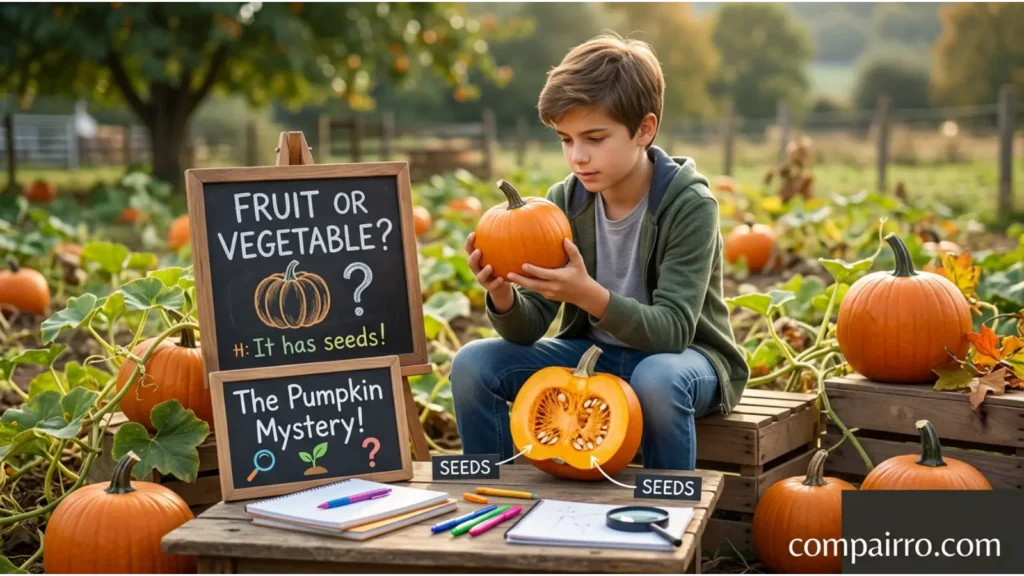
A botanical fruit forms from a plant’s flower and contains seeds or develops around the plant’s seed-bearing part. Pumpkin fits this description.
Easy learning tips
- Remember that botany and cooking use different categories.
- Look at how the food develops on the plant.
- Do not decide only by taste.
- Remember that some botanical fruits are commonly called vegetables.
- Use the word fruit when answering a science question about pumpkin classification.
Signs or Characteristics Related to Pumpkin Fruit or Vegetable
Characteristics that make pumpkin a botanical fruit
- 🎃 It develops from the flower of the pumpkin plant.
- 🌱 It contains seeds.
- 🌼 It forms as the plant’s flower develops into a mature fruit.
- 🌿 It belongs to the gourd family.
- 🔬 It fits the botanical idea of a fruit.
Characteristics that make people call it a vegetable
- 🍲 People commonly use it in savory meals.
- 🥣 You can add it to soups.
- 🍛 You can use it in curries and other cooked dishes.
- 🔥 You can roast it.
- 🛒 It is often sold alongside vegetables in grocery stores.
These two sets of characteristics explain why people sometimes disagree about the answer.
Simple Trick to Remember Pumpkin Fruit or Vegetable
Here is an easy memory trick:
👉 Flower + Seeds = Fruit
Pumpkin develops from a flower and contains seeds, so botanically it is a fruit.
Then remember:
👉 Kitchen Use = Often Vegetable
Think of it this way:
If you are in a science class → Pumpkin = Fruit.
If you are planning a savory meal → Pumpkin = Commonly treated as a vegetable.
Use this simple trick to remember the difference without getting confused.
FAQs:
1. Is pumpkin a fruit or vegetable?
Pumpkin is botanically a fruit because it develops from a flower and contains seeds. In cooking, it is commonly treated as a vegetable.
2. Why is pumpkin called a vegetable?
People often call pumpkin a vegetable because they commonly use it in savory dishes such as soups, curries, and roasted meals.
3. Is pumpkin a fruit scientifically?
Yes. Scientifically, pumpkin is a fruit because it develops from the flowering part of the plant and contains seeds.
4. Is pumpkin a fruit or vegetable in cooking?
In cooking, pumpkin is often treated as a vegetable. Culinary categories are based more on taste and food use than plant structure.
5. Are pumpkin seeds part of the fruit?
Yes. The seeds grow inside the pumpkin, which supports its botanical classification as a fruit.
6. Is pumpkin a vegetable in the UK and US?
The word and basic botanical classification are the same in both countries. Botanists classify pumpkin as a fruit, while cooks commonly use it as a vegetable.
7. What is the easiest way to remember whether pumpkin is a fruit?
Remember: if it develops from a flower and contains seeds, think fruit. Pumpkin fits this rule.
Conclusion
So, is pumpkin a fruit or vegetable? The answer becomes simple when you separate science from cooking.
Botanically, pumpkin is a fruit. It develops from the flower of the pumpkin plant and contains seeds.
However, in everyday cooking, pumpkin is commonly treated as a vegetable, especially when it is used in soups, curries, roasted dishes, and other savory meals.
There is no real contradiction. The two terms are being used in different ways.

Sara Taylor is a passionate English content writer who specializes in word meanings, spelling comparisons, and modern slang explanations. She creates easy-to-understand articles that help readers avoid common English mistakes and improve their writing skills. Her content focuses on simple learning, real-life examples, and clear explanations for everyday readers.