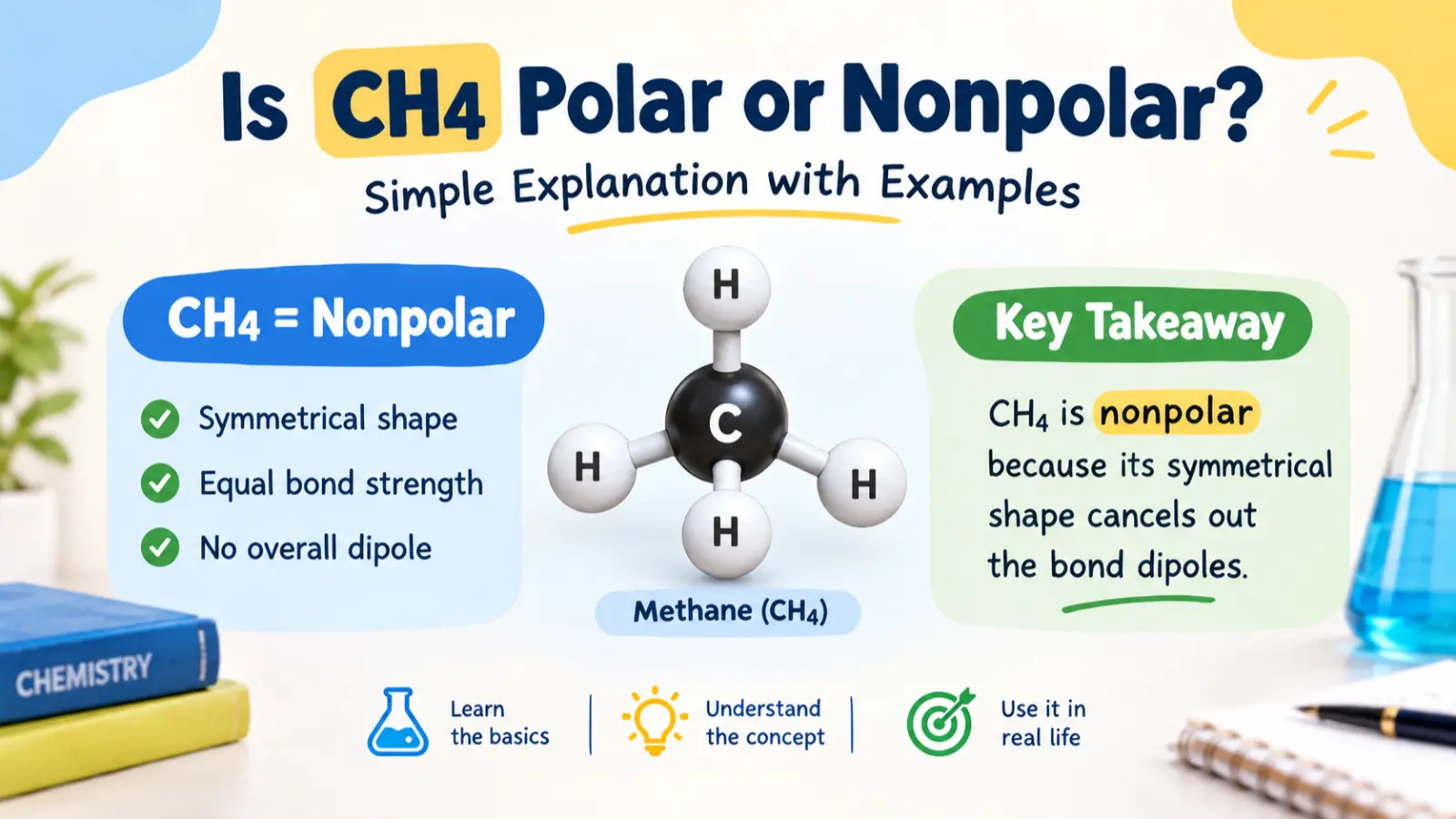
Have you ever looked at a chemistry question asking, “Is CH4 polar or nonpolar?” and wondered how to tell the answer? This is a common question for students learning about chemical bonds, molecular shapes, electronegativity, and polarity.
CH4 is the chemical formula for methane. It contains one carbon atom and four hydrogen atoms. At first, you might think CH4 should be polar because carbon and hydrogen have slightly different electronegativities. However, the shape of the molecule is just as important as the bonds.
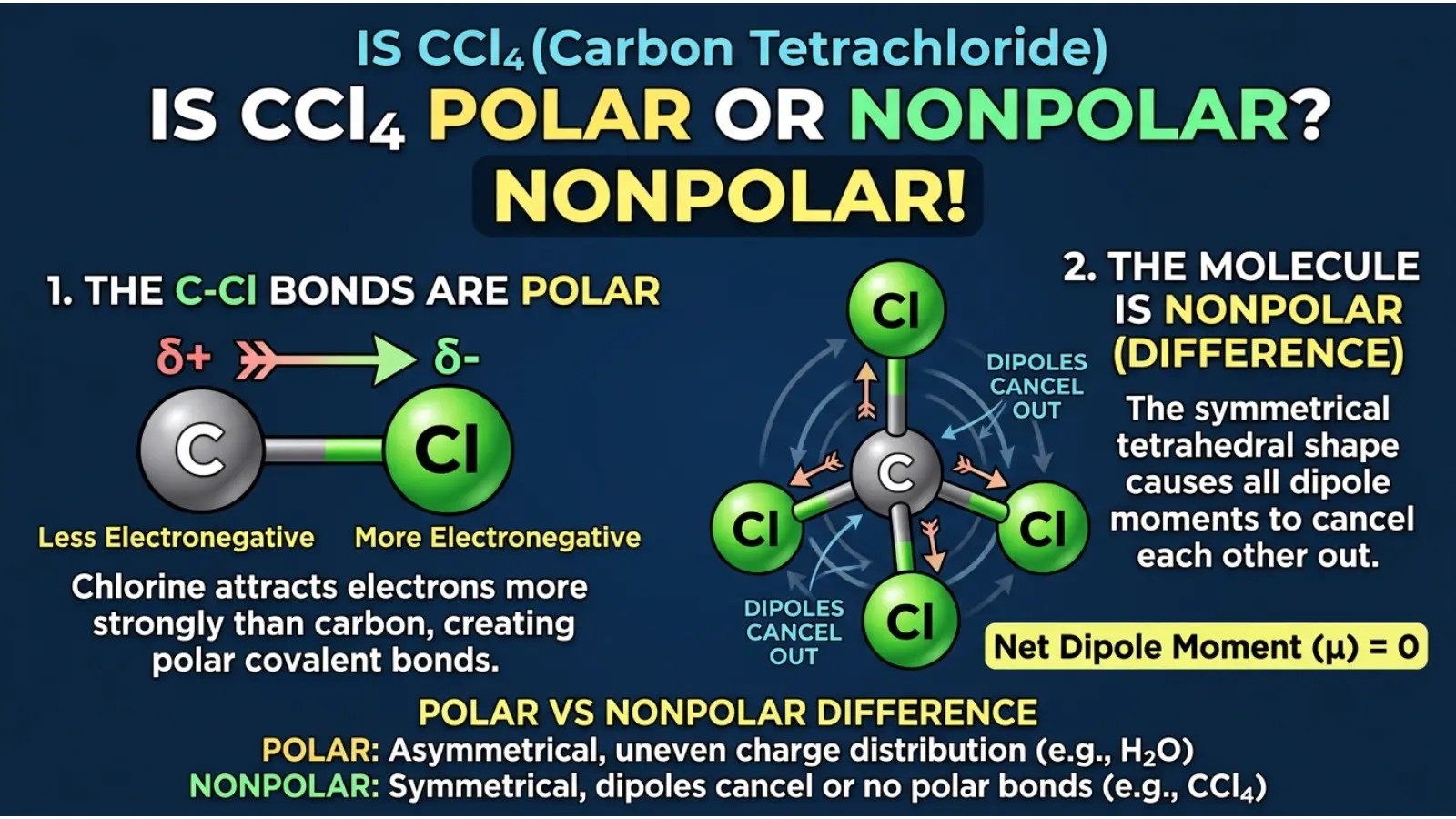
The key is to look at both the C–H bonds and the three-dimensional shape of methane. CH4 has a tetrahedral shape, which makes the small bond dipoles cancel each other out. As a result, the molecule has no overall dipole.
You may see this topic in school chemistry, college classes, science websites, homework, exams, and internet searches. Understanding molecular polarity also helps when learning about solubility, intermolecular forces, boiling points, and other chemical properties.
So, is CH4 polar or nonpolar? The short answer is simple: CH4 is a nonpolar molecule.
IS CH4 POLAR OR NONPOLAR – QUICK ANSWER
👉 CH4 is nonpolar.
CH4, or methane, is a nonpolar molecule because its four C–H bonds are arranged symmetrically around the central carbon atom.
Carbon and hydrogen have slightly different electronegativities, so the C–H bonds can have a small amount of bond polarity. However, methane has a tetrahedral shape, and the bond dipoles point in different directions and cancel out.
Examples
- CH4 (methane) → Nonpolar
- CO2 (carbon dioxide) → Nonpolar
- H2O (water) → Polar
Simple rule:
👉 A molecule can contain slightly polar bonds but still be nonpolar if its shape makes the bond dipoles cancel.
For CH4, the symmetrical tetrahedral shape causes the overall dipole moment to be zero.
THE ORIGIN OF CH4
CH4 is the chemical formula for methane, the simplest alkane and one of the simplest hydrocarbons.
The formula tells us that one carbon atom is connected to four hydrogen atoms:
CH4 = 1 carbon + 4 hydrogen atoms
Methane is found naturally in places such as wetlands and can also be produced during the breakdown of organic matter. It is also a major component of natural gas.
The name “methane” follows the chemical naming system used for simple hydrocarbons. The ending “-ane” is used for alkanes, which contain single carbon-carbon bonds.
The question “Is CH4 polar or nonpolar?” became especially common in chemistry education because methane is a simple example of how molecular shape affects polarity.
BRITISH ENGLISH VS AMERICAN ENGLISH USAGE
There is no meaningful British-American difference in the chemistry term CH4.
The chemical formula, molecular structure, and polarity of methane are the same in both British and American English.
| Feature | British English | American English | Notes |
|---|---|---|---|
| Chemical formula | CH4 | CH4 | Same |
| Name | Methane | Methane | Same |
| Polarity | Nonpolar | Nonpolar | Same scientific result |
| Molecular shape | Tetrahedral | Tetrahedral | Same |
| Bond type | C–H | C–H | Same |
Scientific formulas do not change based on English spelling conventions.
WHICH ONE SHOULD YOU USE?
If you are answering a chemistry question, use the complete statement:
👉 CH4 is a nonpolar molecule.
When explaining your answer, it is useful to mention both the bonds and the molecular shape.
- Use “nonpolar molecule” when describing the overall CH4 molecule.
- Use “tetrahedral shape” when explaining its structure.
- Mention symmetry when explaining why the dipoles cancel.
- In school or college answers, explain that the bond dipoles cancel because of the symmetrical arrangement.
- In a short multiple-choice question, nonpolar is the correct choice.
It is also important not to confuse bond polarity with molecular polarity. They are related, but they are not always the same thing.
COMMON MISTAKES WITH CH4
Mistake 1: Saying CH4 is polar because carbon and hydrogen are different
❌ Incorrect: “CH4 is polar because carbon and hydrogen have different electronegativities.”
✔ Correct: Carbon and hydrogen have a small electronegativity difference, but the tetrahedral arrangement makes the bond dipoles cancel overall.
Mistake 2: Ignoring molecular shape
❌ Incorrect: “Only the atoms determine whether CH4 is polar.”
✔ Correct: Molecular shape is very important. CH4 has a symmetrical tetrahedral structure.
Mistake 3: Thinking every C–H bond makes the molecule strongly polar
❌ Incorrect: “Every C–H bond is strongly polar, so methane must be polar.”
✔ Correct: C–H bonds have only a small electronegativity difference, and the bond dipoles cancel in methane.
Mistake 4: Confusing CH4 with NH3
❌ Incorrect: “CH4 and NH3 are both nonpolar because they both have hydrogen atoms.”
✔ Correct: CH4 is nonpolar, while NH3 is polar. Their shapes and electron arrangements are different.
Mistake 5: Looking only at electronegativity
❌ Incorrect: “Electronegativity alone tells us the polarity of every molecule.”
✔ Correct: Electronegativity helps explain bond polarity, but molecular shape determines whether those bond dipoles cancel.

CH4 IN EVERYDAY EXAMPLES
CH4 is not usually discussed in normal conversations, but it is important in science, energy, and environmental topics.
Work
Scientists and energy workers study methane because it is a major component of natural gas.
Example:
“Researchers measured methane levels in the area.”
School
Students often learn about CH4 when studying covalent bonds and molecular shapes.
Example:
“CH4 has a tetrahedral molecular shape.”
Social Media
Science and education pages may use questions such as:
“Is CH4 polar or nonpolar?”
These questions are often used to explain molecular polarity in a simple way.
Daily Life
Methane is a component of natural gas, which is used as an energy source in many places.
Example:
“Methane is one of the main components of natural gas.”
Text Messages
CH4 is not common slang or texting language. If someone types CH4 in a science discussion, they normally mean methane.
CH4 – GOOGLE TRENDS & USAGE DATA
People commonly search “is CH4 polar or nonpolar” when studying chemistry or checking an answer about molecular polarity.
The search is especially useful for beginners because polarity can be confusing. Students may know that electronegativity matters but may not understand why molecular shape also matters.
Search interest can vary by country, school schedules, exams, and chemistry courses. Exact Google Trends values also change over time, so they should be checked directly for the specific date and region being studied.
The topic can appear in searches from:
- US: Chemistry students often search molecular polarity and Lewis structures.
- UK: Students may search methane structure and molecular polarity.
- India: Chemistry exam preparation can create interest in questions about CH4 polarity.
- Pakistan: Students may search CH4 polarity while studying basic chemistry and molecular shapes.
- Canada: The topic can appear in school and university chemistry searches.
- Australia: Students may encounter it when learning chemical bonding and molecular geometry.
The main reason behind the search is simple: students want to know whether the small polarity of C–H bonds makes the whole methane molecule polar.
The answer depends on the molecule’s overall shape. In CH4, the symmetrical tetrahedral structure causes the bond dipoles to cancel.
COMPARISON TABLE: CH4
| Feature | CH4 | Simple Explanation |
|---|---|---|
| Common name | Methane | A simple hydrocarbon |
| Formula | CH4 | One carbon and four hydrogen atoms |
| Molecular shape | Tetrahedral | Four bonds surround carbon |
| Bond type | Covalent | Electrons are shared |
| C–H bond polarity | Very small | Carbon and hydrogen have similar electronegativities |
| Overall polarity | Nonpolar | Bond dipoles cancel |
| Dipole moment | Zero overall | Symmetrical structure cancels the dipoles |
| Main intermolecular force | London dispersion forces | Typical of nonpolar molecules |
CH4 IN PROFESSIONAL LIFE
Methane is important in several professional fields.
In the energy industry, methane is a major part of natural gas and is used as a fuel.
In environmental science, methane is studied because it is a greenhouse gas. Scientists monitor methane emissions from natural systems and human activities.
In chemistry and education, CH4 is a basic example used to teach:
- Covalent bonding
- Lewis structures
- Electronegativity
- Molecular geometry
- Bond polarity
- Molecular polarity
- Intermolecular forces
Understanding whether CH4 is polar or nonpolar can therefore help students build a foundation for more advanced chemistry.

CH4 FOR STUDENTS OR BEGINNERS
Many beginners struggle with this topic because they focus on only one idea.
They may ask:
“If carbon and hydrogen have different electronegativities, why isn’t CH4 polar?”
The answer is that molecular polarity depends on the whole molecule, not just one bond.
Easy learning tips
- Find the central atom.
In CH4, carbon is in the center. - Look at the bonds.
Carbon forms four C–H bonds. - Find the molecular shape.
CH4 has a tetrahedral shape. - Look for symmetry.
The four hydrogen atoms are arranged symmetrically around carbon. - Check the dipoles.
The bond dipoles cancel each other. - Give the final answer.
CH4 is nonpolar.
A useful study habit is to always check both electronegativity and molecular shape.
SIGNS OR CHARACTERISTICS RELATED TO CH4
Instead of physical “signs,” the important characteristics of CH4 are its molecular features.
- One carbon atom: Carbon is the central atom.
- Four hydrogen atoms: Each hydrogen forms a bond with carbon.
- Tetrahedral shape: The atoms are arranged in a three-dimensional tetrahedral structure.
- Symmetrical structure: The four hydrogen atoms are arranged around carbon in a balanced way.
- Covalent bonds: Carbon and hydrogen share electrons.
- Small C–H electronegativity difference: The bonds have only a small difference in electron attraction.
- Dipoles cancel: The bond dipoles balance each other.
- No overall dipole: The molecule has an overall dipole moment of zero.
- Nonpolar molecule: The final classification of CH4 is nonpolar.
SIMPLE TRICK TO REMEMBER CH4
Here is an easy memory trick:
👉 CH4 = Symmetrical shape = Dipoles cancel = Nonpolar
Think of it this way:
Imagine four people pulling equally in different directions around a center point. If the arrangement is perfectly balanced, there is no overall pull in one direction.
CH4 works in a similar way.
Its four C–H bonds are arranged in a symmetrical tetrahedral shape. The small bond dipoles point in different directions and cancel each other.
Quick memory rule
👉 CH4 → Tetrahedral → Symmetrical → Nonpolar
For comparison:
👉 H2O → Bent → Polar
This is why simply counting polar bonds is not enough. You must also look at the molecular shape.
FAQs:
1. Is CH4 polar or nonpolar?
CH4 is nonpolar. Its tetrahedral shape causes the small bond dipoles to cancel.
2. Why is CH4 nonpolar?
CH4 is nonpolar because its four C–H bonds are arranged symmetrically around the central carbon atom.
3. Does CH4 have polar bonds?
The C–H bonds have a very small electronegativity difference. However, the overall CH4 molecule is nonpolar because the bond dipoles cancel.
4. What is the shape of CH4?
CH4 has a tetrahedral molecular shape, with carbon at the center and four hydrogen atoms around it.
5. Is methane CH4 soluble in water?
Methane is only slightly soluble in water. Its nonpolar nature means it does not interact strongly with polar water molecules.
6. Is CH4 more polar than H2O?
No. H2O is polar, while CH4 is nonpolar. The different molecular shapes explain much of this difference.
7. What is the easiest way to remember CH4 polarity?
Remember: CH4 has a symmetrical tetrahedral shape, so its bond dipoles cancel and the molecule is nonpolar.
CONCLUSION
So, is CH4 polar or nonpolar? CH4 is nonpolar.
Methane contains one carbon atom and four hydrogen atoms. Although the C–H bonds have a small difference in electronegativity, the molecule has a symmetrical tetrahedral shape.
Because the bond dipoles cancel each other, CH4 has no overall dipole moment. That is why methane is classified as a nonpolar molecule.
The easiest rule to remember is:
👉 CH4 = tetrahedral + symmetrical + dipoles cancel = nonpolar.
Once you understand this idea, questions about other molecules such as CO2, H2O, NH3, and BF3 become much easier.

Sara Taylor is a passionate English content writer who specializes in word meanings, spelling comparisons, and modern slang explanations. She creates easy-to-understand articles that help readers avoid common English mistakes and improve their writing skills. Her content focuses on simple learning, real-life examples, and clear explanations for everyday readers.