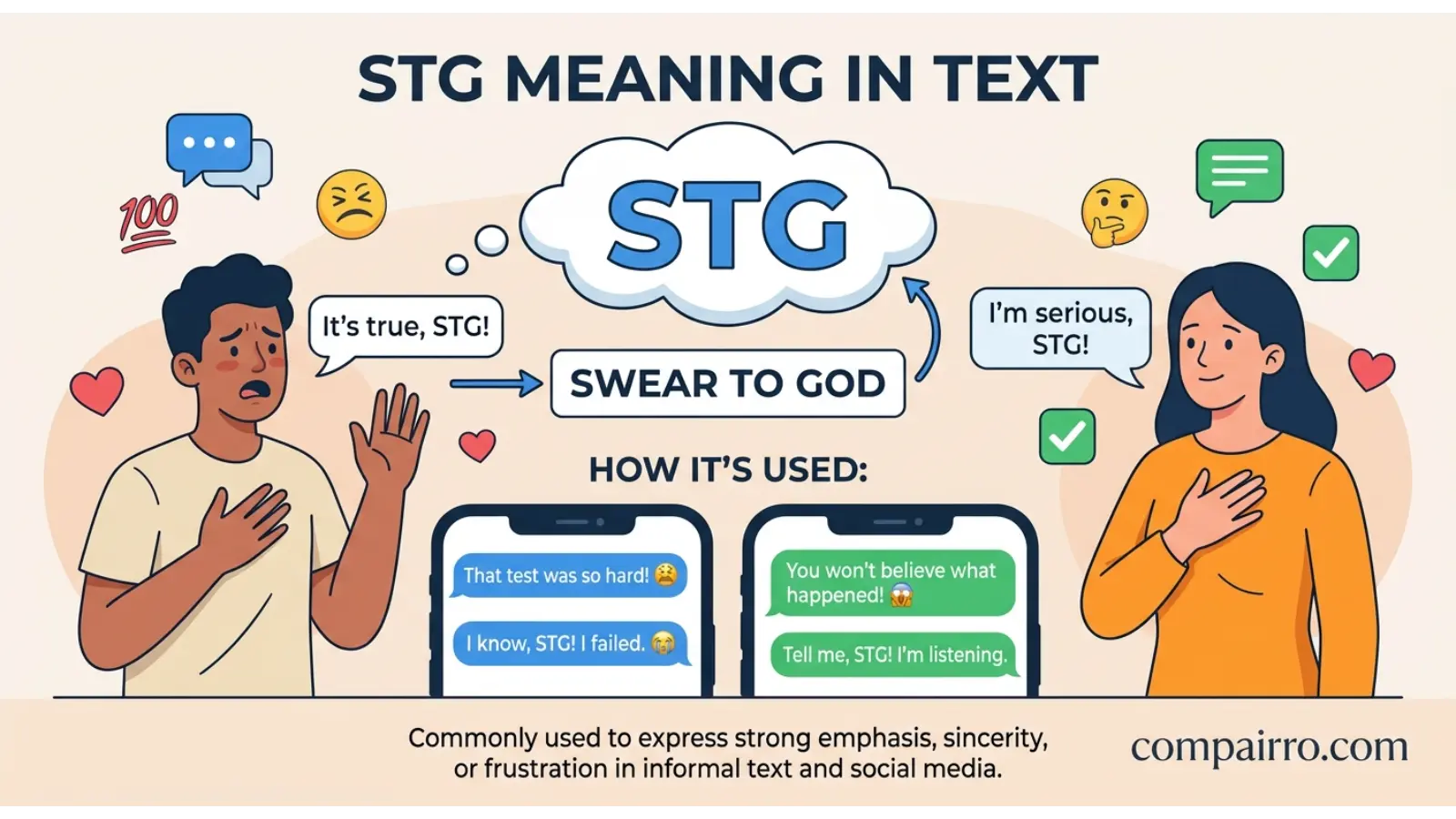
stg meaning in text is usually “swear to God.” If you have seen someone type “stg” in a text, comment, Snapchat message, TikTok caption, or social media conversation, you may wonder what they mean. Like many internet abbreviations, STG saves time while adding emotion to a message.
People commonly use STG when they want to strongly emphasize that they are telling the truth, making a serious statement, or expressing frustration. For example, someone might text, “STG, I didn’t take your charger,” meaning “I swear to God, I didn’t take your charger.”
The exact feeling behind STG depends on the conversation. It can sound serious, surprised, frustrated, funny, or dramatic. Understanding the surrounding words and tone is important before deciding what the sender means.
Quick Answer:
STG usually means “swear to God” in texting and online slang. It is used to emphasize honesty, seriousness, surprise, frustration, or a strong reaction.
What Does STG Mean in Text?
In texting and social media, STG stands for “swear to God.” It is an informal abbreviation used when someone wants to strongly emphasize what they are saying.
For example:
“STG, that was the funniest movie ever.”
This means:
“I swear to God, that was the funniest movie ever.”
STG is generally used in casual digital communication rather than formal writing. You may see it in text messages, group chats, comments, gaming conversations, and social media posts.
STG Full Form
The most common STG full form in texting is:
STG = Swear to God
The abbreviation comes from taking the first letters of the three words: Swear To God.

STG Meaning in Different Contexts
The meaning of STG can change slightly depending on the situation.
1. Emphasizing the Truth
Someone may use STG to make it clear that they are being honest.
Example:
“STG, I didn’t know about the party.”
Here, STG adds emphasis to the person’s statement.
2. Showing Frustration
STG can also appear when someone is annoyed.
Example:
“STG, if my internet disconnects again, I’m done.”
The abbreviation adds emotional emphasis to the message.
3. Showing Surprise
People sometimes use STG after something unexpected happens.
Example:
“STG, I just saw the same person at three different places today.”
In this case, it expresses strong surprise.
4. Making a Strong Statement
STG can make an ordinary opinion sound more intense.
Example:
“STG, this is the best pizza I’ve ever had.”
The sender is strongly emphasizing their opinion.
Is STG Rude, Offensive, or Neutral?
STG is generally informal rather than automatically rude or offensive. However, it includes a reference to God, so some people may prefer not to use it because of their religious or personal beliefs.
Its tone also depends on how it is used.
| Situation | Possible Tone |
|---|---|
| “STG, you’re hilarious.” | Friendly |
| “STG, I didn’t do it.” | Defensive |
| “STG, stop doing that.” | Frustrated |
| “STG, that’s unbelievable.” | Surprised |
| “STG, I love this song.” | Excited |
It is usually fine in casual conversations with people who understand your style, but it may not be appropriate for every audience.
Where Is STG Commonly Used?
You may encounter STG in many informal online spaces, including:
- Text messages
- Snapchat
- TikTok comments
- Discord chats
- Gaming conversations
- Group chats
- Casual online discussions
- Memes and social posts
The abbreviation is particularly useful when people want to express a strong reaction without typing the complete phrase.
Real-Life Conversation Examples
Here are some natural examples of how STG can appear in everyday texting:
Friend: “Did you really finish the whole assignment?”
You: “STG, I finished it at 3 a.m.”
Friend: “You forgot your keys again.”
You: “STG, I thought you had them.”
Friend: “That restaurant was amazing.”
You: “STG, the food was so good.”
These examples show that STG does not have one fixed emotional meaning. The context determines whether it sounds serious, funny, excited, or frustrated.
Emotional and Psychological Meaning of STG
STG does not have a specific psychological meaning. Instead, it is a communication shortcut that can strengthen the emotion behind a message.
When someone writes STG, they may be trying to:
- Emphasize honesty
- Make their statement sound stronger
- Express frustration
- Show surprise
- Convince someone
- Add dramatic emphasis
- Make a casual message more expressive
For example, “I told you” is fairly simple, while “STG, I told you” places much more emphasis on the statement.
Origin and Background of STG
STG developed as part of the broader culture of internet and text-message abbreviations. As texting and online messaging became common, people began shortening frequently used phrases to communicate faster.
The phrase “swear to God” existed long before the internet. STG is simply a shortened digital form that became useful in casual online communication.
Like other texting abbreviations, its popularity is connected to informal digital conversations where people often prefer short, quick expressions.

STG vs. Similar Slang Terms
swear to God is sometimes confused with other expressions that show emphasis or seriousness.
| Slang | Meaning | Common Use |
|---|---|---|
| STG | Swear to God | Strong emphasis or assurance |
| ISTG | I swear to God | Stronger personal emphasis |
| FR | For real | Agreement or seriousness |
| TBH | To be honest | Giving an honest opinion |
| NGL | Not gonna lie | Introducing an honest statement |
| ONG | On God | Emphasizing truth or agreement |
STG vs. ISTG
swear to God means “swear to God,” while ISTG means “I swear to God.” They are very similar.
For example:
- “STG, that’s true.”
- “ISTG, that’s true.”
Both can communicate strong emphasis, although ISTG directly includes “I.”
When Should You Use STG?
STG works best in casual conversations with friends, classmates, or people who commonly use internet slang.
You can use it when:
- You want to emphasize that something is true.
- You are reacting strongly to something.
- You are joking with friends.
- You want to express frustration or surprise.
- The conversation is informal.
However, avoid relying on STG in formal situations such as school assignments, professional emails, job applications, or official communication.
Instead of writing:
“STG, I completed the report.”
A professional message would simply say:
“I can confirm that I completed the report.”
Polite Alternatives to STG
If you do not want to use religious language or informal slang, several alternatives can communicate a similar idea.
You could say:
- “Honestly”
- “I promise”
- “I really mean it”
- “For real”
- “Seriously”
- “I can assure you”
- “I’m telling the truth”
For example:
Informal: “STG, I didn’t do it.”
Polite: “I promise, I didn’t do it.”
Why Do People Use STG?
People use STG because it is short, recognizable, and expressive. Texting often involves quick communication, so abbreviations can make messages easier and faster to type.
STG can also add emotion. Compare these two messages:
“That was crazy.”
“STG, that was crazy.”
The second message sounds more emphatic and emotionally charged.
Impact of STG on Communication
Slang can make communication feel more natural between people who share the same online language. It can help messages sound relaxed, personal, and expressive.
However, slang can also cause confusion. Someone unfamiliar with STG may not know what it means or may interpret its tone differently.
This is why context matters. The same abbreviation can sound funny in one conversation and serious in another.
Is STG Safe for Social Media?
STG is generally a common informal abbreviation and is not inherently unsafe to use on social media. However, remember that its meaning and tone may not be understood by everyone.
Before using it publicly, consider:
- Who will see your post?
- Is the conversation casual?
- Will readers understand the abbreviation?
- Could the religious reference bother someone?
- Is a more neutral phrase clearer?
For professional or public communication, spelling out your meaning is usually clearer.

STG Examples in Different Tones
Friendly
“STG, you’re one of the funniest people I know.”
Here, STG adds friendly emphasis.
Casual
“STG, I forgot my headphones again.”
This is a normal casual use among friends.
Argumentative
“STG, I already told you about this.”
In an argument, STG can make the statement sound more forceful.
Excited
“STG, this game is amazing!”
Here, the abbreviation emphasizes excitement.
Surprised
“STG, I didn’t expect that to happen.”
It highlights the speaker’s strong reaction.
Common Misunderstandings About STG
One common misunderstanding is assuming STG always means the sender is angry. That is not necessarily true.
STG can express many emotions, including:
- Honesty
- Excitement
- Surprise
- Frustration
- Humor
- Seriousness
Another misunderstanding is assuming every use of STG is religious. Although the phrase refers to God, many people use the abbreviation as an informal expression of emphasis rather than making a religious statement.
Variations and Related Forms
The most common related form is ISTG, meaning “I swear to God.”
You may also see:
- STG — Swear to God
- ISTG — I swear to God
- ONG — On God
- FR — For real
- FRFR — For real, for real
- NGL — Not gonna lie
- TBH — To be honest
These expressions can overlap, but they are not always interchangeable. The exact choice depends on the speaker and the context.
How to Respond When Someone Uses STG
Your response depends on what the person is saying.
If they are making a serious claim, you could say:
“Okay, I believe you.”
For they are joking:
“Haha, seriously?”
If they are frustrated:
“I understand. What happened?”
If you are unsure what they mean, simply ask:
“What do you mean by STG?”
There is nothing wrong with asking when an abbreviation is unfamiliar.
Regional and Cultural Usage
STG is mainly associated with informal English-language internet communication. Its meaning is generally recognizable among people familiar with online slang, but not everyone uses or understands it.
Usage can vary by age group, online community, country, and personal communication style. Someone who rarely uses social media slang may be less familiar with STG than someone who frequently communicates through messaging apps.
Frequently Asked Questions
What does STG mean in text?
STG usually means “swear to God.” It is used to emphasize that someone is being honest, serious, surprised, or strongly emotional.
What does STG stand for in slang?
In common texting slang, STG stands for “swear to God.”
Is STG a bad word?
No. STG is an abbreviation rather than a traditional swear word. However, it refers to God, so some people may choose not to use it for personal or religious reasons.
What is the difference between STG and ISTG?
STG means “swear to God,” while ISTG means “I swear to God.” They are closely related and are often used in similar situations.
Can I use STG on social media?
Yes, STG is commonly used in casual online communication. However, consider your audience because not everyone knows internet slang or may be comfortable with the phrase.
What does STG mean on Snapchat or TikTok?
On Snapchat, TikTok, and similar platforms, STG usually has the same meaning: “swear to God.” The exact tone depends on the surrounding conversation.
Conclusion
The stg meaning in text is usually “swear to God.” People use this abbreviation to emphasize honesty, seriousness, surprise, frustration, excitement, or another strong reaction.
STG is most appropriate for informal communication such as texting, social media, gaming chats, and conversations with friends. It is less suitable for formal writing, professional messages, and academic work.
The most important thing to remember is context and tone. STG does not always mean the person is angry or making a religious statement. In many online conversations, it simply adds emphasis to what someone is saying.
If you understand the context around STG, you can usually understand exactly what the sender is trying to communicate.

Sara Taylor is a passionate English content writer who specializes in word meanings, spelling comparisons, and modern slang explanations. She creates easy-to-understand articles that help readers avoid common English mistakes and improve their writing skills. Her content focuses on simple learning, real-life examples, and clear explanations for everyday readers.