Have you ever noticed that someone in your family has cute dimples when they smile, while other family members do not? You may have wondered if dimples come from your mother, your father, or both. This common question leads many people to search for are dimples dominant or recessive.
Dimples are small dents in the skin, usually seen on the cheeks when a person smiles. Some people have them on one cheek, while others have them on both cheeks. Some people have no dimples at all. These differences often make people curious about family traits and genetics.
You may have learned in school that dominant genes control certain traits, while recessive genes appear only under specific conditions. Based on this basic lesson, dimples are often described as a dominant trait. However, real human genetics is more complex than a simple dominant-or-recessive rule.
People search for this topic for many reasons. Students may want a simple biology explanation, while parents may wonder whether their children will inherit dimples. Others may discuss family traits at home, see dimples on social media, or search online for answers about inherited features.
Understanding how dimples develop can help you learn more about DNA, genes, and family inheritance. It also explains why two parents without visible dimples can sometimes have a child with dimples, or why parents with dimples may have a child without them.
In this guide, you’ll learn the meaning, examples, usage, differences, common mistakes, and simple explanations in easy English.
Are Dimples Dominant or Recessive? – Quick Answer
Dimples are traditionally taught as a dominant trait, but scientists do not consider cheek dimples a simple, fully understood dominant-or-recessive trait. Their development likely involves several genetic factors and differences in facial structure.
In simple words, genes help influence whether a person develops dimples, but inheritance does not always follow the basic rules taught in introductory biology lessons.
Examples:
- Example 1: Two parents with dimples may have a child without visible dimples.
- Example 2: Two parents without dimples may sometimes have a child with dimples.
- Example 3: A person may have a dimple on only one cheek.
Simple rule: Dimples are often taught as dominant, but their inheritance is more complicated than one dominant gene.
The Origin of Dimples: A Simple Genetics Explanation
The word dimple refers to a small hollow or dent in the skin. Cheek dimples become noticeable when a person smiles or moves certain facial muscles.
Dimples are linked to the structure of facial muscles and the skin above them. Differences in the way these tissues form can create the small indentations we recognize as dimples.
Genetics plays a role because children inherit DNA from their biological parents. DNA contains genes that help guide the development of the body, including facial features.
For many years, school lessons and popular explanations described dimples as a dominant genetic trait. This model is easy to understand, but it does not fully explain the different patterns seen in real families.
Today, it is more accurate to say that cheek dimples are influenced by inherited factors, while the exact genetic causes and inheritance patterns are not completely established.
Dimples became a popular topic in online discussions because people often compare facial features among parents, children, siblings, and celebrities.
British English vs American English Usage
The word dimples has the same spelling and meaning in British and American English. There is no major difference in how people discuss dimples or their genetics.
| Feature | British English | American English | Notes |
|---|---|---|---|
| Spelling | Dimples | Dimples | Same spelling |
| Meaning | Small skin indentations | Small skin indentations | Same meaning |
| Genetics term | Dominant trait | Dominant trait | Same scientific term |
| Common question | Are dimples inherited? | Are dimples inherited? | Both are natural |
| Everyday use | She has cheek dimples. | She has cheek dimples. | Same sentence |
In the UK, the US, Pakistan, India, Canada, and Australia, people generally use the same words when discussing dimples and inherited facial features.
Which Explanation Should You Use?
When explaining whether dimples are dominant or recessive, choose wording that matches the situation.
- For school biology: You may learn that dimples are a dominant trait in basic genetics examples.
- For accurate science: Explain that cheek dimples do not have a fully established, simple dominant-or-recessive inheritance pattern.
- For family discussions: Say that parents can pass on genetic factors that influence facial features.
- For children: Explain that genes from both parents help shape the way a child’s face develops.
- For formal writing: Avoid claiming that one specific gene always determines whether someone has dimples.
The key is to understand the difference between a simplified classroom model and the more complex nature of human inheritance.
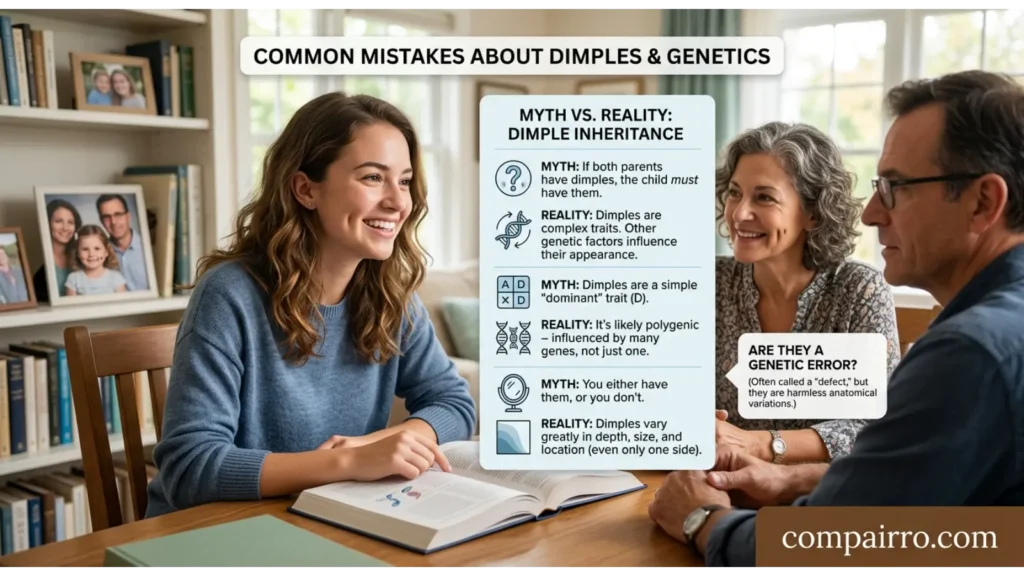
Common Mistakes About Dimples and Genetics
Mistake 1: Saying dimples are always dominant
❌ Incorrect: Everyone with dimples must have inherited one dominant dimple gene.
✔ Correct: Dimples are often taught as dominant, but their inheritance is not fully explained by one simple gene.
Mistake 2: Assuming both parents must have dimples
❌ Incorrect: A child can have dimples only if both parents have them.
✔ Correct: A child’s facial features depend on inherited factors and how those features develop. Parents do not always show every trait that may appear in their children.
Mistake 3: Believing two parents without dimples can never have a child with dimples
❌ Incorrect: If neither parent has dimples, their child cannot have them.
✔ Correct: This conclusion is too simple. The genetics of cheek dimples is not fully understood, so visible family traits do not always follow basic classroom predictions.
Mistake 4: Assuming every child will inherit a parent’s dimples
❌ Incorrect: A mother with dimples will always pass them to her children.
✔ Correct: Inherited facial features can vary among siblings. Having dimples does not guarantee that a child will have them.
Mistake 5: Confusing dimples with freckles
❌ Incorrect: Dimples and freckles are the same type of inherited feature.
✔ Correct: Dimples are small indentations in the skin, while freckles are small areas of increased skin pigmentation. Their development involves different biological processes.

Are Dimples Dominant or Recessive in Everyday Examples?
The genetics of dimples becomes easier to understand when you look at familiar situations.
At Home
Imagine a family where the mother has dimples and the father does not. Their child may have dimples or may not have visible dimples.
This example shows why you should not assume that one parent’s appearance determines a child’s facial features.
At School
A biology teacher may use dimples to explain dominant and recessive traits. This can be a useful starting point for learning genetics, but students should remember that real human traits are not always controlled by a single gene.
On Social Media
You may see posts claiming that dimples always come from one parent or that people with dimples have a particular genetic combination.
These claims may be oversimplified. A social media post is not always a reliable source of scientific information.
In Daily Life
Two siblings may look different even though they have the same biological parents. One sibling may have visible dimples, while the other does not.
This is normal. Siblings inherit different combinations of genetic information, and their features can develop differently.
In Text Messages
Someone might ask, “Are dimples dominant or recessive?”
A simple and accurate reply would be:
“Dimples are often taught as dominant, but their genetics is more complex than a single dominant gene.”
Are Dimples Dominant or Recessive? – Google Trends and Usage Data
People search for this question because they want to understand inherited facial features and predict which traits their children might have.
However, exact search popularity varies over time. Without current Google Trends data, it would not be accurate to claim specific search volumes or rank countries by popularity.
Here are some common reasons people may search for this topic:
- United States: Students and parents may look for simple genetics explanations.
- United Kingdom: Readers may search for information about inherited facial traits.
- India: School biology and family inheritance may lead to questions about dimples.
- Pakistan: Students may look for easy explanations of dominant and recessive traits.
- Canada: People may search for information about genes and family resemblance.
- Australia: Readers may look for beginner-friendly explanations of human genetics.
Search interest may rise when genetics is discussed in school lessons, online quizzes, short videos, or family-related posts.
The most important point is that search popularity does not prove a scientific claim. Reliable biology sources are more useful than viral posts when you want to understand inheritance.
Comparison Table: Dominant vs Recessive Traits and Dimples
To understand the question properly, it helps to compare the basic genetics terms with what scientists know about cheek dimples.
| Feature | Dominant Trait | Recessive Trait | Cheek Dimples |
|---|---|---|---|
| Basic meaning | Can appear with one copy of a particular allele | Usually requires two copies of a recessive allele in a simple inheritance model | Inheritance is not fully understood |
| School example | Often used to teach basic inheritance | Often used to teach basic inheritance | Traditionally presented as dominant |
| Gene pattern | Depends on the specific trait | Depends on the specific trait | May involve more complex genetic factors |
| Family prediction | Possible when the inheritance pattern is known | Possible when the inheritance pattern is known | Difficult to predict precisely |
| Visible in every generation? | Not always | Not always | No fixed pattern can be assumed |
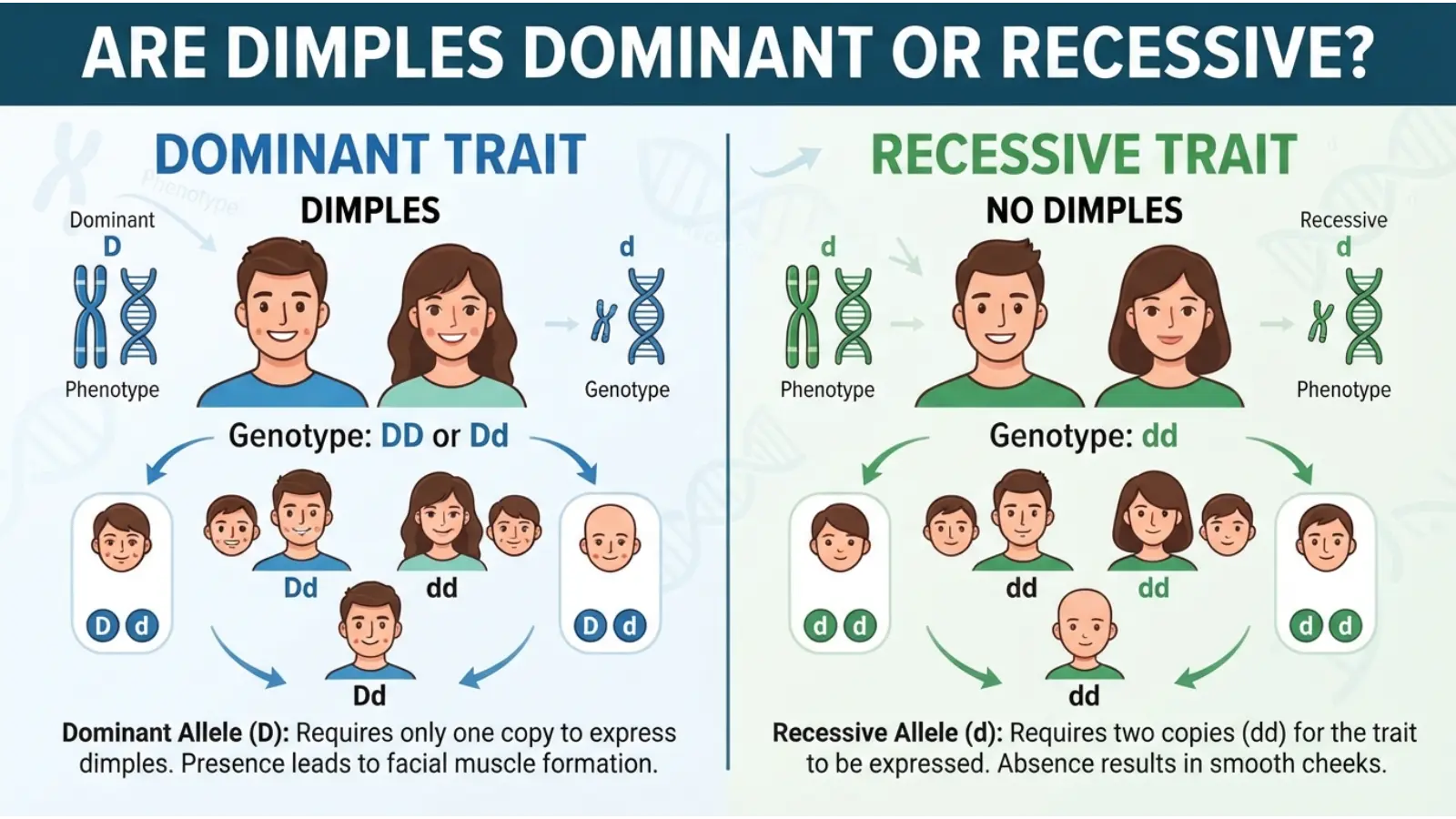
An allele is a version of a gene. In a simple Mendelian example, a dominant allele can affect a trait even when only one copy is present, while a recessive allele usually affects the trait when two copies are present.
However, this simple model should not be treated as a proven explanation for all people with cheek dimples.
Dimples in Professional Life and Real-World Science
In healthcare, genetics research, and biology education, scientists study how genes influence physical features and how traits pass from parents to children.
The question “Are dimples dominant or recessive?” is a useful example of why scientific explanations sometimes change as researchers learn more.
Professionals need to distinguish between a simplified teaching example and evidence supported by research. This is especially important when explaining inherited traits to families.
For example, a genetic counselor would not use the presence or absence of cheek dimples alone to predict a child’s genetic makeup. Dimples are a common facial feature, not a reliable test for a particular gene or health condition.
When writing educational content, use clear wording and avoid presenting uncertain genetic details as established facts.

Dimples for Students and Beginners
Students often find genetics confusing because textbooks use letters such as D and d to explain dominant and recessive traits.
A basic classroom example might use:
- DD: Two copies of a hypothetical dominant allele.
- Dd: One copy of a hypothetical dominant allele and one recessive allele.
- dd: Two copies of a hypothetical recessive allele.
In a simple model, these combinations help explain how an inherited trait may appear.
However, these letters are only a teaching example here. They do not represent a confirmed genetic test for cheek dimples.
To learn this topic more easily:
- Understand what genes and alleles are.
- Learn how parents pass genetic information to children.
- Separate basic inheritance models from real human traits.
- Remember that visible features can have complex causes.
- Use trusted biology textbooks and scientific sources when checking claims.
This approach will help you answer genetics questions without confusing a simple example with a complete scientific explanation.
Signs or Characteristics Related to Dimples
Dimples can look different from one person to another. Their appearance depends on facial structure and how the skin moves.
Common characteristics include:
- Cheek dimples: Small indentations on one or both cheeks.
- One-sided dimples: A visible indentation on only one cheek.
- Smile-related dimples: Dimples that become easier to see when smiling.
- Different depths: Some dimples are more noticeable than others.
- Changes with age: Facial structure and soft tissues can change, so dimples may become more or less visible over time.
- Family resemblance: Dimples may appear in several family members, although this does not establish a simple inheritance pattern.
Not everyone with dimples has the same facial structure. Also, the presence of dimples alone cannot tell you exactly which genetic variants a person carries.
Simple Trick to Remember Whether Dimples Are Dominant or Recessive
Here is an easy way to remember the main idea:
Traditional school lesson = Dominant
More accurate scientific explanation = Complex inheritance
Think of it this way: school lessons often simplify genetics to make it easier to learn. Real human faces develop through many biological processes, so the full picture can be more complicated.
For example, if your father has dimples and you do not, it does not mean you have inherited no facial traits from him. You simply have your own combination of inherited features.
Likewise, if neither parent has visible dimples, you should not assume that a child could never develop them.
Remember: Dimples are commonly described as dominant in basic lessons, but their exact inheritance pattern is not fully established.
FAQs:
1. Are dimples dominant or recessive?
Dimples are traditionally described as dominant in basic genetics lessons. However, cheek dimples do not have a fully established, simple dominant-or-recessive inheritance pattern.
2. Can two parents without dimples have a child with dimples?
It is possible for family traits to appear in unexpected patterns. The genetics of cheek dimples is not fully understood, so a simple dominant-or-recessive model cannot reliably predict every case.
3. Will my child have dimples if I have them?
Not necessarily. Having dimples does not guarantee that your child will have them. A child’s facial features depend on inherited factors and development.
4. Do dimples come from the mother or father?
Dimples are not known to come exclusively from the mother or father. Both biological parents contribute genetic information to their children.
5. Are dimples genetic?
Yes, inherited factors can influence dimples and facial structure. However, the exact genetic basis of cheek dimples is not completely understood.
6. Can dimples disappear as a person grows older?
Their appearance can change with age because facial structure and soft tissues change. Some people’s dimples may become less noticeable, while others remain visible.
7. Are dimples rare or common?
The frequency of dimples varies among populations. Their appearance also differs from person to person, so there is no single rate that applies equally to every population.
Conclusion
So, are dimples dominant or recessive? The traditional answer is that dimples are a dominant trait. However, modern scientific understanding is more cautious because cheek dimples do not have a fully established, simple inheritance pattern.
Genes help shape facial features, but the way dimples appear in families can be more complex than basic classroom examples suggest. Parents with dimples may have children without them, and family traits do not always follow the patterns people expect.
If you are studying genetics, remember that dominant and recessive traits are useful concepts, but not every human feature fits neatly into one category.
Final memory rule: Dimples are traditionally taught as dominant, but their inheritance is more complex than a single-gene rule.

Sara Taylor is a passionate English content writer who specializes in word meanings, spelling comparisons, and modern slang explanations. She creates easy-to-understand articles that help readers avoid common English mistakes and improve their writing skills. Her content focuses on simple learning, real-life examples, and clear explanations for everyday readers.