Imagine you are studying chemistry and your teacher asks, “Is HNO3 a strong acid or a weak acid?” You may know its chemical formula, but you might still feel confused about the correct answer. Do not worry! This is a common question for students learning about acids and bases.
HNO3 is the chemical formula for nitric acid, which is a strong acid. It is often discussed in school chemistry, science exams, laboratory lessons, and online searches. Students commonly compare it with acids such as hydrochloric acid (HCl), sulfuric acid (H₂SO₄), and acetic acid (CH₃COOH).
The main confusion comes from the difference between strong and concentrated acids. These terms may sound similar, but they describe different things. Acid strength tells us how much an acid ionizes in water, while concentration tells us how much acid is present in a certain amount of solution.
Understanding this difference can help you answer chemistry questions correctly and avoid common exam mistakes. It also makes it easier to understand chemical reactions and the behavior of acids in water.
In this guide, you’ll learn the meaning, examples, usage, differences, common mistakes, and simple explanations in easy English.
HNO3 Strong or Weak – Quick Answer
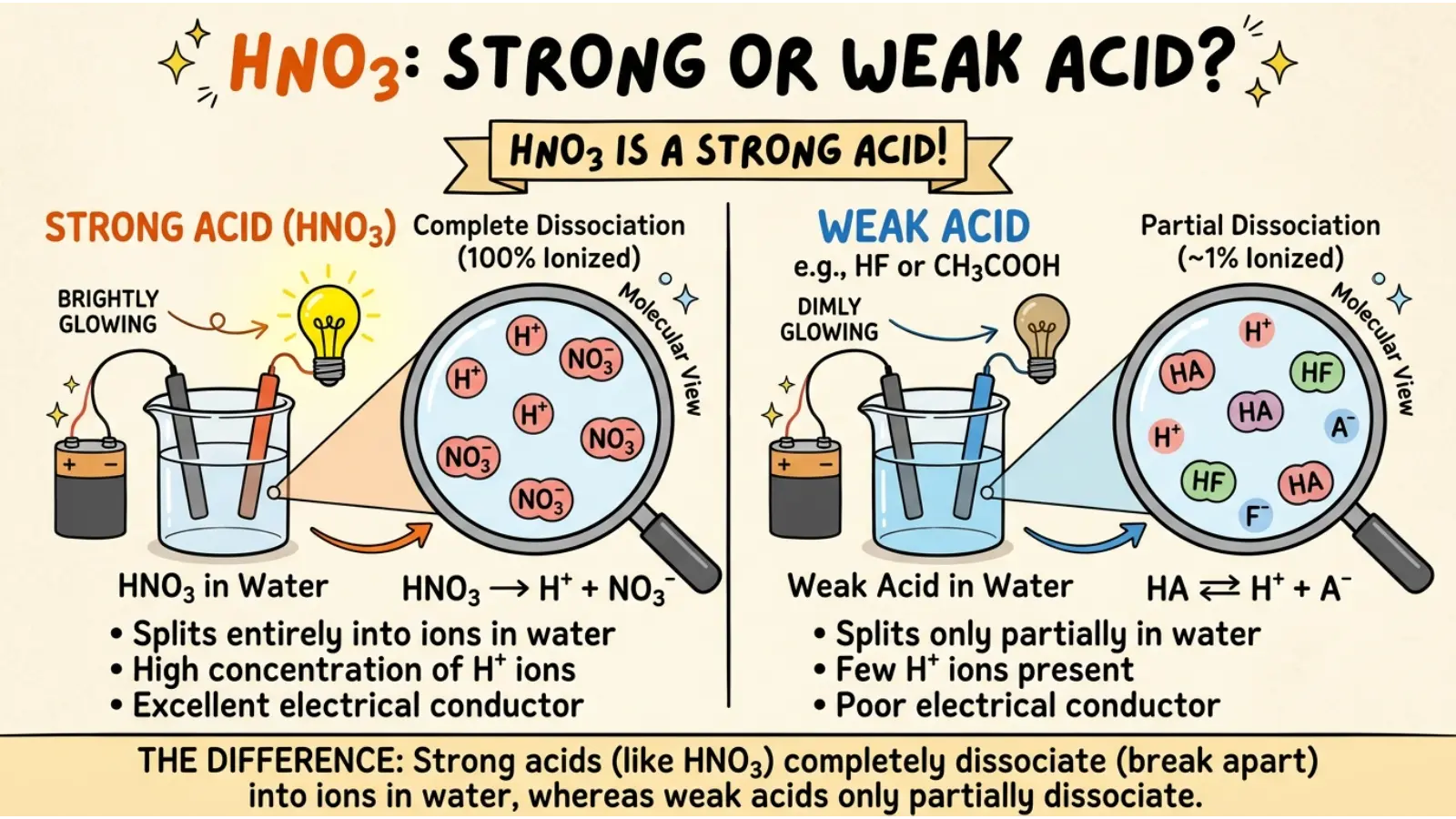
HNO3 is a strong acid because it ionizes almost completely in water. Nitric Acid stands for nitric acid, a chemical that releases hydrogen ions through its reaction with water.
In simple terms:
- HNO3 = Strong acid
- HCl = Strong acid
- CH₃COOH (acetic acid) = Weak acid
When nitric acid dissolves in water, it transfers a proton to a water molecule, forming hydronium ions and nitrate ions.
The reaction is:
\[ \mathrm{HNO_3 + H_2O \rightarrow H_3O^+ + NO_3^-} \]
This reaction shows that nitric acid ionizes almost completely in water.
Simple rule: HNO3 is a strong acid because almost all its molecules ionize in water under normal dilute-solution conditions.
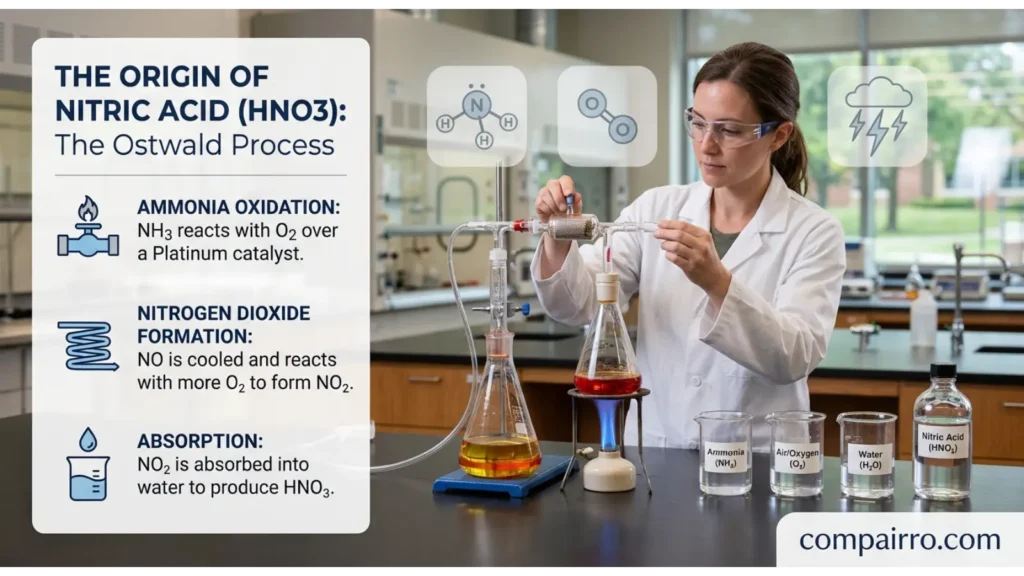
The Origin of HNO3
HNO3 is the chemical formula for nitric acid. Its name comes from the word nitre, an old name associated with naturally occurring nitrate compounds.
Nitric acid has been known for centuries and became important in chemistry because of its ability to react with many substances. Today, it is used in controlled industrial processes, fertilizer production, and chemical manufacturing.
In basic chemistry, HNO3 is mainly studied as an example of a strong acid. Students learn its formula, properties, ionization, and reactions to understand how acids behave in water.
The formula contains three types of atoms:
- H = Hydrogen
- N = Nitrogen
- O₃ = Three oxygen atoms
Together, they form nitric acid.
British English vs American English Usage
The scientific meaning of HNO3 is the same in British English and American English. Both use the formula HNO3 and classify nitric acid as a strong acid.
The main difference is usually in pronunciation or spelling choices for other chemistry terms, not in the chemical formula itself.
| Feature | British English | American English | Notes |
|---|---|---|---|
| Chemical formula | HNO3 | HNO3 | Same formula |
| Chemical name | Nitric acid | Nitric acid | Same name |
| Acid strength | Strong acid | Strong acid | Same classification |
| Scientific writing | HNO3 | HNO3 | Same notation |
| Ionization in water | Almost complete | Almost complete | Same chemical behavior |
Therefore, you can use the same answer in chemistry exams in both countries.
Which One Should You Use?
When answering whether HNO3 is strong or weak, the correct choice is strong acid.
Use this information in the following situations:
- School exams: Write that nitric acid is a strong acid because it ionizes almost completely in water.
- Chemistry homework: Use the ionization equation to explain your answer.
- Acid comparisons: Compare HNO3 with weak acids such as acetic acid.
- Laboratory studies: Remember that acid strength and acid concentration are different properties.
- Scientific writing: Use the correct chemical formula, HNO3, and the name nitric acid.
For a short-answer question, you can write:
“HNO3 is a strong acid because it ionizes almost completely in aqueous solution, producing hydronium ions and nitrate ions.”
This answer is clear and suitable for basic chemistry questions.
Common Mistakes With HNO3
Students sometimes confuse acid strength, concentration, and chemical formulas. Here are four common mistakes to avoid.
Mistake 1: Calling HNO3 a weak acid
❌ Incorrect: HNO3 is a weak acid.
✔ Correct: HNO3 is a strong acid because it ionizes almost completely in water.
Mistake 2: Confusing strength with concentration
❌ Incorrect: Dilute HNO3 must be a weak acid.
✔ Correct: HNO3 remains a strong acid even when diluted. Dilution reduces the amount of acid per unit volume but does not change its classification as a strong acid.
Mistake 3: Confusing HNO3 with HNO2
❌ Incorrect: HNO3 and HNO2 have the same acid strength.
✔ Correct: HNO3 is nitric acid, a strong acid. HNO2 is nitrous acid, a weak acid.
The formulas look similar, but the acids have different chemical properties.
Mistake 4: Saying HNO3 does not ionize in water
❌ Incorrect: HNO3 stays completely in molecular form when dissolved in water.
✔ Correct: HNO3 ionizes almost completely in water, producing hydronium and nitrate ions.

HNO3 in Everyday Examples
Nitric acid is mainly used in industrial and laboratory settings, so you are more likely to encounter it in chemistry lessons than in ordinary household activities.
At School
A teacher may ask whether HNO3 is a strong or weak acid.
Example answer: HNO3 is a strong acid because it ionizes almost completely in water.
In Chemistry Homework
You may need to write its reaction with water.
\[ \mathrm{HNO_3 + H_2O \rightarrow H_3O^+ + NO_3^-} \]
This equation shows the formation of hydronium and nitrate ions.
In a Laboratory
Nitric acid may be used in controlled chemical experiments. Because it is corrosive and can cause serious burns, it should only be handled with proper training, protective equipment, and suitable laboratory procedures.
In Online Searches
Students may search for “HNO3 strong or weak,” “is nitric acid a strong acid,” or “HNO3 acid strength” when preparing for exams.
These questions all point to the same basic chemistry concept.
HNO3 – Google Trends and Usage Data
The keyword “HNO3 strong or weak” is an educational search phrase. People usually search for it to get a quick answer, understand acid strength, or prepare for chemistry tests.
However, exact search popularity and country rankings cannot be confirmed without current Google Trends data.
Here is how this topic may be relevant to students in different countries:
- United States: Students may search for acid strength while studying general chemistry.
- United Kingdom: The topic appears in school chemistry and science revision.
- India: Students may look for simple explanations for chemistry exams.
- Pakistan: Students may search for direct answers and easy chemistry notes.
- Canada: The topic is relevant to chemistry classes and science assignments.
- Australia: Students may study nitric acid as part of acids-and-bases lessons.
Search interest can change around school examinations and revision periods. These are reasonable educational patterns, not verified rankings for this exact keyword.
Comparison Table: HNO3 Strong or Weak?
The easiest way to understand nitric acid is to compare it with other common acids.
| Acid | Chemical Formula | Strength | Reason |
|---|---|---|---|
| Nitric acid | HNO3 | Strong | Ionizes almost completely in water |
| Hydrochloric acid | HCl | Strong | Ionizes almost completely in water |
| Sulfuric acid | H₂SO₄ | Strong for its first ionization | Its second ionization is not complete |
| Acetic acid | CH₃COOH | Weak | Ionizes only partially in water |
| Nitrous acid | HNO₂ | Weak | Ionizes only partially in water |
| Carbonic acid | H₂CO₃ | Weak | Ionizes only partially in water |
Remember that a strong acid does not have to be concentrated. Acid strength describes ionization, while concentration describes how much acid is present in a solution.

HNO3 in Professional Life
Nitric acid has important uses in science and industry. Its strong acidic properties make it useful in several controlled processes.
Common applications include:
- Fertilizer production: Nitric acid is used to make nitrate-based fertilizers.
- Chemical manufacturing: It helps produce certain chemicals used in industry.
- Metal treatment: It is used in specialized metal-cleaning and processing methods.
- Laboratory chemistry: It is used in approved chemical tests and research.
- Education: It helps students learn about strong acids and chemical reactions.
Nitric acid is also a powerful oxidizing agent. This means it can take part in reactions involving the transfer of electrons. Its use requires care because it can be highly corrosive and may react dangerously with other materials.
HNO3 for Students or Beginners
Beginners sometimes find acid strength confusing because the names and formulas of acids look similar.
The good news is that you can learn the main idea with a few simple steps.
- Learn the formula: HNO3 is nitric acid.
- Remember its classification: Nitric acid is a strong acid.
- Understand ionization: It forms ions almost completely in water.
- Compare it with a weak acid: Acetic acid ionizes only partially.
- Practice the equation: Learn how HNO3 reacts with water.
For exams, focus on the meaning of strong acid rather than simply memorizing the name.
A strong acid ionizes almost completely in water. A weak acid ionizes only partially. This is the main difference you need to understand.
Signs or Characteristics Related to HNO3
Nitric acid has several important chemical properties.
- Strong acid: It ionizes almost completely in water.
- Chemical formula: Its formula is HNO3.
- Ion formation: It produces hydronium ions and nitrate ions in water.
- Corrosive nature: It can damage skin, eyes, and many materials.
- Oxidizing ability: It can take part in oxidation-reduction reactions.
- Industrial use: It is used in fertilizer production and other chemical processes.
- Acidic behavior: Its aqueous solutions can have a low pH, depending on their concentration.
These characteristics help explain why nitric acid is important in chemistry.
Simple Trick to Remember HNO3
Here is an easy memory trick:
HNO3 = Nitric acid = Strong acid
Think of it this way: when you see HNO3 in a school chemistry question asking about acid strength, remember that it is one of the common strong acids.
You can also remember this comparison:
- HNO3 = Strong acid
- HCl = Strong acid
- HNO2 = Weak acid
- CH₃COOH = Weak acid
Notice the difference between HNO3 and HNO2. The formulas look similar, but nitric acid is strong while nitrous acid is weak.
This small comparison can help you avoid mistakes in multiple-choice questions.
FAQs
1. Is HNO3 a strong or weak acid?
HNO3 is a strong acid because it ionizes almost completely in water.
2. Why is HNO3 considered a strong acid?
It transfers protons to water molecules very effectively, producing hydronium and nitrate ions.
3. Is nitric acid the same as HNO3?
Yes. HNO3 is the chemical formula for nitric acid.
4. Is HNO3 stronger than HNO2?
Yes. HNO3 is a strong acid, while HNO2 is a weak acid in water.
5. Is dilute HNO3 still a strong acid?
Yes. Dilution lowers its concentration, but nitric acid remains classified as a strong acid.
6. Does HNO3 completely ionize in water?
It ionizes almost completely in ordinary dilute aqueous solutions. For basic chemistry, it is treated as a strong acid.
7. What is the pH of HNO3?
Its pH depends on the concentration of the solution. A more concentrated solution generally has a lower pH, but concentration must be known to estimate the value.
Conclusion
So, is HNO3 strong or weak? The answer is simple: HNO3 is a strong acid. Its chemical name is nitric acid, and it ionizes almost completely in water to produce hydronium and nitrate ions.
The most important thing to remember is that acid strength and acid concentration are not the same. Even dilute nitric acid is classified as a strong acid.
For your chemistry exams, remember this simple rule: HNO3 = strong acid, while HNO2 = weak acid. Understanding this difference will help you answer questions about acids, ionization, and chemical reactions with greater confidence.

Sara Taylor is a passionate English content writer who specializes in word meanings, spelling comparisons, and modern slang explanations. She creates easy-to-understand articles that help readers avoid common English mistakes and improve their writing skills. Her content focuses on simple learning, real-life examples, and clear explanations for everyday readers.