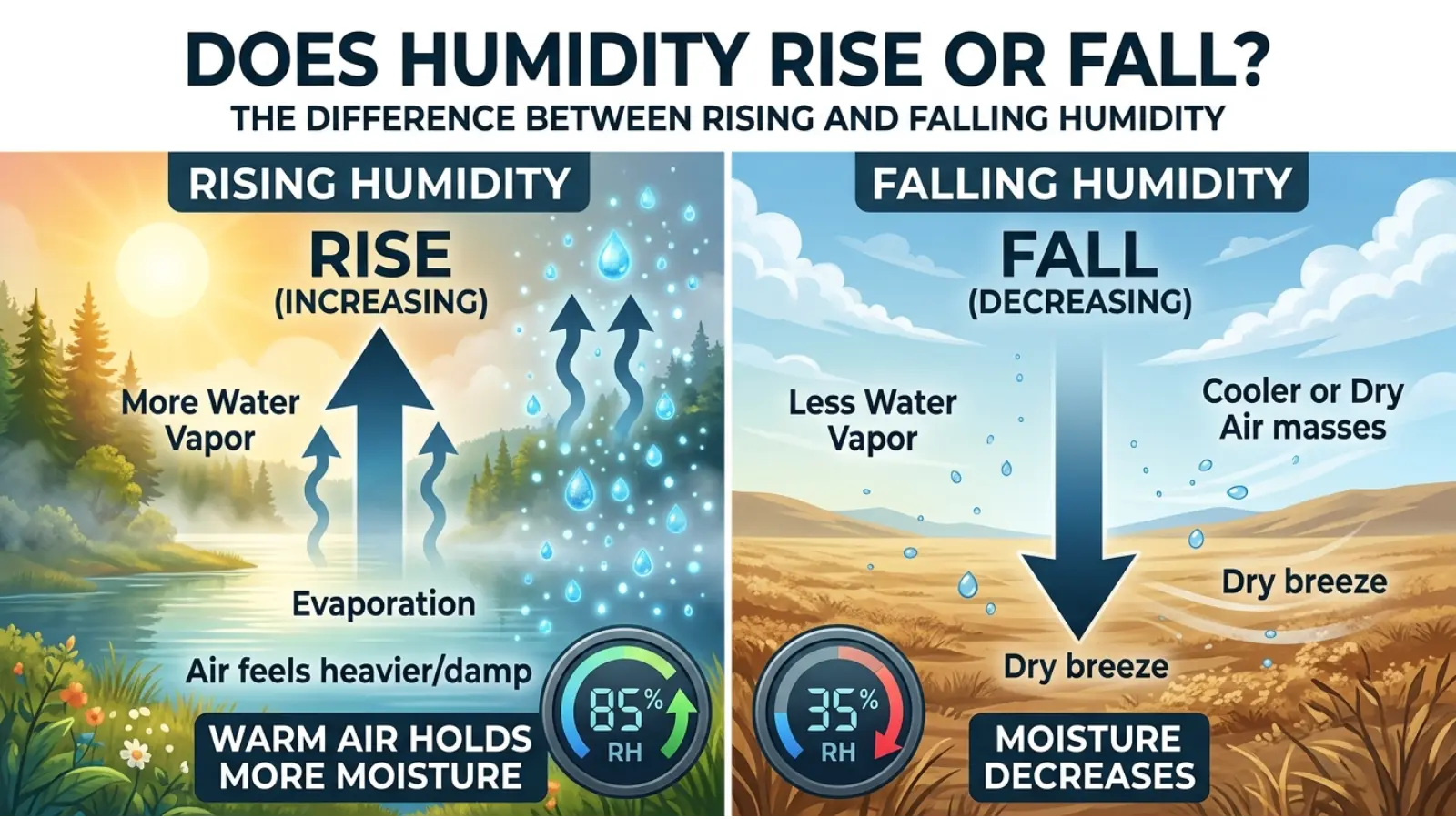
Does Humidity Rise or Fall is a common question for anyone curious about weather, air moisture, and temperature changes. You may notice that the air feels damp in the morning but becomes drier or more comfortable later in the day. So, does humidity rise or fall, and what causes these changes?
The answer is not as simple as saying that humidity always rises or always falls. Humidity does not move upward or downward on its own in the same way that a solid object does. Instead, the movement of moist air depends on temperature, air movement, and the amount of water vapor in the air.
For example, warm, moist air may rise because it is less dense than the cooler air around it. However, cool air can also contain water vapor, and moisture can spread throughout a room through air movement. This is why humidity levels may differ between the floor, the middle of a room, and the ceiling.
Understanding this idea can help you make better choices about ventilation, air conditioners, dehumidifiers, and home comfort. It can also help students understand basic weather science and learn how humidity affects everyday life.
People often search for this question when dealing with damp basements, condensation on windows, humid bedrooms, or hot summer weather. Knowing how moisture behaves makes these problems easier to understand.
In this guide, you’ll learn the meaning, examples, usage, differences, common mistakes, and simple explanations in easy English.
Does Humidity Rise or Fall? – Quick Answer
Humidity can increase at higher or lower levels, but water vapor does not always rise or fall by itself. Warm, moist air often rises because it is less dense than cooler air. However, air movement, temperature differences, and other conditions affect where moisture collects.
Humidity means the amount of water vapor in the air. Relative humidity tells you how close the air is to being saturated with water vapor at its current temperature.
Here are three simple examples:
- Warm, moist air: It often rises because it is less dense than cooler air around it.
- Cool basement air: It may have high relative humidity, especially when the basement is damp or poorly ventilated.
- A humid bathroom: Steam from a hot shower rises with warm air, but moisture can spread throughout the room.
Simple rule: Warm air often rises, carrying water vapor with it. However, humidity itself does not always rise.
The Origin of Humidity
The word humidity comes from the Latin word humidus, which means moist or wet. Today, it describes the amount of water vapor present in the air.
Humidity has been an important part of weather science for centuries. Scientists study it to understand clouds, rain, storms, temperature changes, and how comfortable people feel in different conditions.
As weather reports, indoor climate systems, and home moisture controls became more common, people started paying more attention to humidity levels.
Today, humidity is discussed in weather apps, classrooms, workplaces, and social media. People also search for questions such as “Does humidity rise or fall?” to understand why some rooms feel damp while others feel dry.
British English vs American English Usage
There is no important difference between British and American English when using the word humidity. Both use it to describe moisture in the air.
| Feature | British English | American English | Notes |
|---|---|---|---|
| Spelling | Humidity | Humidity | Same spelling |
| Meaning | Water vapor in the air | Water vapor in the air | Same meaning |
| Weather reports | High humidity | High humidity | Same usage |
| Indoor conditions | Indoor humidity | Indoor humidity | Same usage |
| Common phrase | Humid weather | Humid weather | Same phrase |
The word is also used in Pakistan, India, Canada, and Australia. Although accents and some weather terms may vary, the basic meaning stays the same.

Which One Should You Expect: Rising or Falling Humidity?
The correct answer depends on what is happening around you. Humidity is not a substance that simply sinks or floats. It is a measure of moisture in the air.
Consider these situations:
- On a hot day: Warm air can rise and carry water vapor upward.
- In a cold room: Relative humidity can increase when the air cools, even if no extra water vapor enters.
- In a bathroom: Warm, moist air from a shower often rises, while some moisture spreads through the room.
- In a basement: Cool surfaces and poor ventilation can encourage condensation and dampness.
- Near an open window: Wind and ventilation can move moist air in different directions.
For formal science writing, it is best to say that warm, moist air often rises rather than claiming that humidity always rises.
Common Mistakes About Humidity
Mistake 1: Thinking humidity always rises
❌ Incorrect: Humidity always moves toward the ceiling.
✔ Correct: Warm, moist air often rises, but humidity can be distributed throughout a room.
Mistake 2: Thinking humidity always falls
❌ Incorrect: Water vapor is heavy, so it always settles near the floor.
✔ Correct: Water vapor mixes with air. Its movement depends on airflow and temperature conditions.
Mistake 3: Confusing humidity with temperature
❌ Incorrect: If the air feels hot, humidity must be high.
✔ Correct: Temperature and humidity are different. A hot day can be dry, while a cool day can be humid.
Mistake 4: Assuming cold air always has low relative humidity
❌ Incorrect: Cold air always means low relative humidity.
✔ Correct: Cold air can have high relative humidity, even though it generally holds less water vapor at saturation than warm air does.
Mistake 5: Thinking high relative humidity always means more water vapor
❌ Incorrect: A room with higher relative humidity must contain more water vapor than a warmer room.
✔ Correct: Relative humidity depends on both the amount of water vapor and the air temperature. A cooler room can have higher relative humidity without containing more water vapor.

Does Humidity Rise or Fall in Everyday Examples?
Humidity behaves differently in different places. Here are some common examples.
1. At Work
Offices can have different humidity levels because of heating, cooling, ventilation, and the number of people in a room.
For example, a warm office with poor ventilation may feel stuffy. An air conditioner may lower the air temperature and remove some moisture, depending on how it operates.
2. At School
Students often learn about humidity in geography and science lessons.
A simple classroom experiment can compare temperature and relative humidity at different heights. However, measurements may not show a clear pattern because air movement, sunlight, and heating affect the results.
3. On Social Media
Weather videos and home improvement posts often discuss humidity, especially during summer.
Some posts suggest that humidity always rises. This is an oversimplification because moisture moves with air and does not follow one fixed direction.
4. In Daily Life
Imagine taking a hot shower in a small bathroom.
The warm, moist air often rises toward the ceiling. When it touches a cool mirror or window, some water vapor may condense into tiny water droplets.
This shows that warm air can carry moisture upward, while cooling can cause that moisture to form liquid water on surfaces.
5. In a Basement
Basements often feel damp because they may have cool walls, limited sunlight, water entering from outside, or poor ventilation.
Moisture can condense on cold surfaces when the surrounding air reaches its dew point. A dehumidifier and better moisture control may help, depending on the source of the dampness.
Does Humidity Rise or Fall? – Google Trends and Usage Data
People search for “does humidity rise or fall” because they want a clear answer to a practical science question. They may be trying to understand weather, indoor moisture, condensation, or how to place a humidity sensor.
The topic can be useful for readers in many countries:
- United States: People may search for humidity during hot summers or when managing indoor comfort.
- United Kingdom: Damp homes, condensation, and changing weather can make humidity a common concern.
- India: Hot weather and monsoon conditions often lead to questions about moisture in the air.
- Pakistan: Humid summers, air conditioning, and damp indoor spaces can make the topic useful.
- Canada: People may want to understand indoor humidity during cold winters.
- Australia: Warm weather, coastal conditions, and home ventilation can lead to humidity questions.
These are possible reasons for interest, not verified rankings of search popularity.
To check actual interest over time, use Google Trends and compare related searches such as “humidity levels,” “relative humidity,” and “does humidity rise or fall.”
Seasonal weather, local climate, and common indoor moisture problems can influence when people search for this topic. However, exact search volume and country rankings require current data.

Comparison Table: How Humidity Behaves
| Situation | What Happens? | Why? |
|---|---|---|
| Warm, moist air | Often rises | It is usually less dense than cooler air |
| Cool air | May have high relative humidity | Cooler air reaches saturation with less water vapor |
| Hot shower | Moist air often rises | The air is warmed by the shower |
| Cold window | Water droplets may form | Water vapor condenses on a cool surface |
| Damp basement | Moisture may collect on surfaces | Cool surfaces and excess moisture can cause condensation |
| Windy room | Moisture may spread in different directions | Moving air carries water vapor |
| Air-conditioned room | Relative humidity may change | Cooling and moisture removal affect the reading |
The key point is that air movement and temperature affect humidity. There is no universal rule that humidity must rise or fall.
Humidity in Professional Life
Humidity matters in many workplaces because it can affect comfort, products, buildings, and equipment.
For example:
- Construction: Workers monitor moisture to help prevent dampness and material damage.
- Warehouses: Some products need controlled humidity to protect their quality.
- Agriculture: Farmers monitor humidity to understand growing conditions and plant diseases.
- Weather forecasting: Meteorologists use humidity measurements to study clouds, fog, and rainfall.
- Museums and libraries: Staff may control humidity to protect books, artwork, and other objects.
In homes and offices, humidity sensors help people check moisture levels. However, a single reading does not tell you whether moisture is rising or falling. You need measurements taken over time and, if necessary, at different heights.
Humidity for Students or Beginners
Students may find this topic confusing because humidity, temperature, and air density are related but not identical.
The easiest way to understand them is to learn these three terms:
- Humidity: The amount of water vapor in the air, or a measure related to it.
- Relative humidity: The percentage showing how close the air is to saturation at its current temperature.
- Air density: How much mass is packed into a given volume of air.
Warm air at the same pressure is generally less dense than cooler air. As a result, warm air often rises. If it contains water vapor, that moisture travels with it.
However, water vapor itself is actually lighter than dry air at the same temperature and pressure. This contributes to the lower density of moist air, but real air movement also depends on heating, cooling, wind, and pressure differences.
Easy Learning Tips
- Remember that humidity measures moisture, not heat.
- Learn the difference between relative humidity and the actual amount of water vapor.
- Observe steam rising from warm water.
- Notice how water droplets form on cold windows.
- Use a hygrometer to measure relative humidity rather than guessing by feel.
Signs or Characteristics Related to Humidity
You cannot reliably tell exactly where humidity is highest just by looking at a room. However, some signs can help you identify moisture problems.
- Condensation on windows: Moist air may be cooling against a cold surface.
- A musty smell: This can indicate damp materials or possible mold growth.
- Damp walls: Water may be entering through leaks, the ground, or condensation.
- A sticky feeling: High humidity can slow the evaporation of sweat, making you feel warmer.
- Fog or mist: Water droplets can form when moist air cools.
- Changing humidity readings: A hygrometer may show different levels as temperature, ventilation, or moisture sources change.
These signs do not prove that humidity is rising or falling. They show that moisture and temperature conditions may need attention.
If you notice persistent dampness or mold, look for the source of the moisture and improve ventilation where appropriate. Simply warming the room may not solve the problem.
Simple Trick to Remember: Does Humidity Rise or Fall?
Here is an easy way to remember the answer:
Warm air rises; water vapor moves with the air.
Think of it this way:
- Warm air = often rises.
- Cool air = can sink when it is denser than the surrounding air.
- Humidity = moisture in the air, not a force that always moves upward or downward.
For example, when you boil water, warm air and water vapor rise from the pot. When that vapor touches a cool lid, it can turn into water droplets.
The direction of the air movement affects where moisture travels. Cooling, mixing, and ventilation can then change the humidity level in different parts of a room.
FAQs:
1. Does humidity rise or fall in a room?
Humidity does not always rise or fall. Warm, moist air often rises, but air circulation and temperature differences can spread moisture throughout the room.
2. Is humidity higher near the ceiling?
It can be higher near the ceiling in some conditions, especially when warm, moist air collects there. However, this is not always the case because ventilation and mixing affect humidity levels.
3. Does humidity rise in a house during winter?
Indoor humidity can rise or fall during winter. Cooking, showers, breathing, heating, and ventilation affect moisture levels. Cold windows and walls can also cause condensation.
4. Does cold air increase humidity?
Cooling air can increase its relative humidity if the amount of water vapor stays the same. However, cooling does not automatically add water vapor to the air.
5. Does humidity rise with heat?
Warm air can rise because it is often less dense than cooler air. If that air contains water vapor, it carries moisture upward. However, temperature and humidity are not the same thing.
6. Is humidity higher near the floor or ceiling?
There is no single answer for every room. Humidity may vary with temperature, air movement, moisture sources, and ventilation. Measurements at different heights can help you find out.
7. How can I reduce humidity indoors?
Use kitchen and bathroom exhaust fans, repair leaks, improve suitable ventilation, and consider a dehumidifier when needed. If dampness continues, find and fix the source of the moisture.
Conclusion
So, does humidity rise or fall? Humidity does not always move in one direction. Warm, moist air often rises because it is less dense than cooler air, carrying water vapor with it. However, air circulation, temperature changes, and ventilation affect how moisture spreads through a room.
Understanding humidity can help you manage indoor comfort, recognize condensation, and learn basic if science. It also explains why a room can feel damp even when it is not very warm.
The easiest memory rule is simple: Warm air often rises, and moisture travels with the air. Humidity itself does not always rise or fall.

Sara Taylor is a passionate English content writer who specializes in word meanings, spelling comparisons, and modern slang explanations. She creates easy-to-understand articles that help readers avoid common English mistakes and improve their writing skills. Her content focuses on simple learning, real-life examples, and clear explanations for everyday readers.