Imagine you are writing a school assignment and want to mention your favorite book. You write, I enjoyed reading Harry Potter and the Sorcerer’s Stone. However, when you mention a short story, you may need quotation marks instead. This can make you wonder: are books italicized or quoted?
Many students, writers, bloggers, and English learners ask this question because book titles follow specific writing rules. The correct format depends on the type of work you are mentioning. For example, full-length books are usually italicized, while short stories and individual poems are generally placed inside quotation marks.
You may come across these rules in school assignments, workplace reports, academic papers, social media posts, blog articles, and everyday conversations. Knowing how to format titles makes your writing look clear, professional, and easy to read.
There is also a small difference between writing by hand and typing on a computer. When you cannot use italics, such as in some handwritten work, underlining a book title is often an acceptable alternative. Different style guides may also have their own rules for special cases.
The good news is that you do not need to memorize every grammar rule to get started. Once you understand the difference between a complete work and a smaller part of a work, choosing the right format becomes much easier.
In this guide, you’ll learn the meaning, examples, usage, differences, common mistakes, and simple explanations in easy English.
Are Books Italicized or Quoted? – Quick Answer
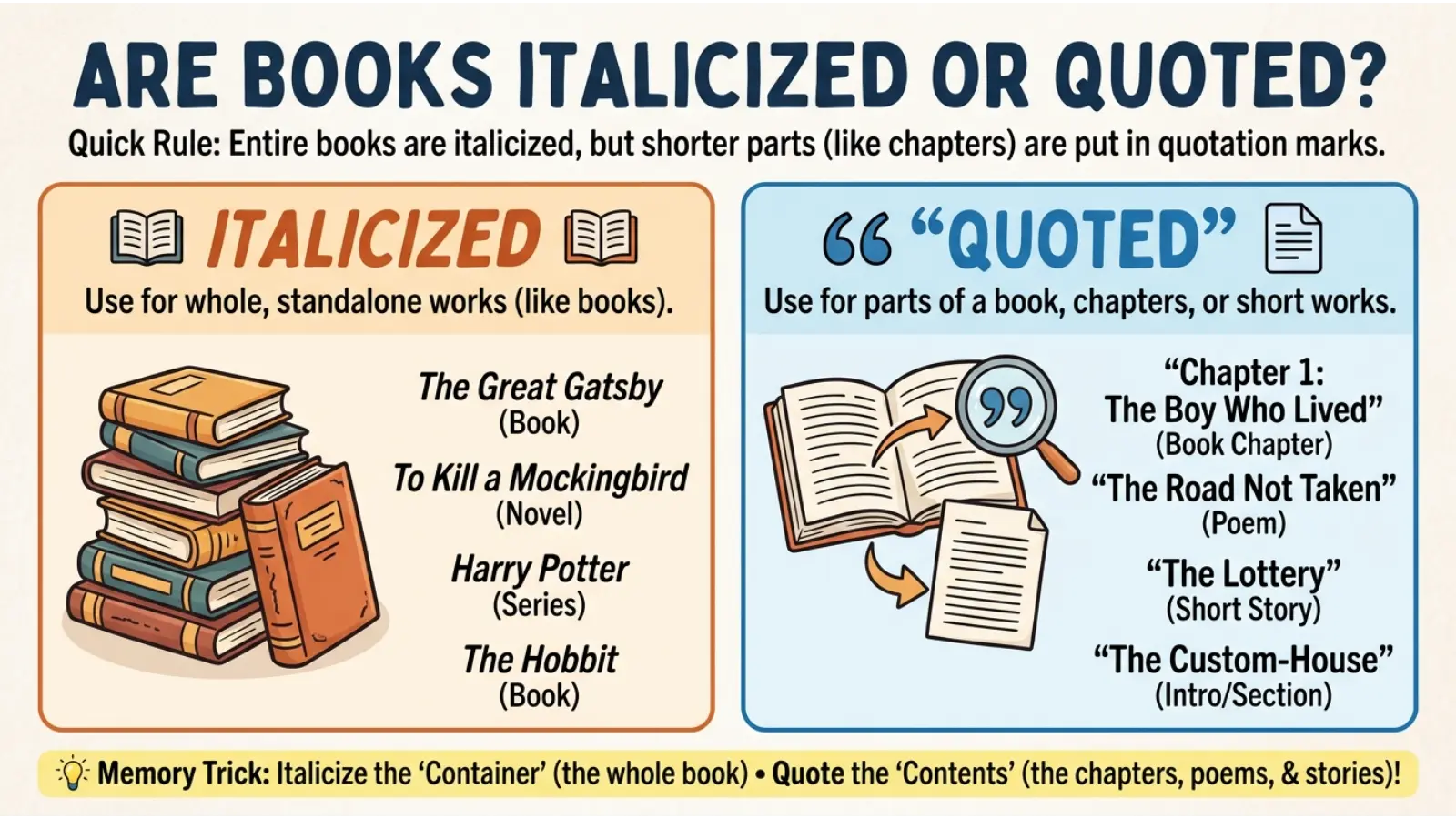
Book titles are usually italicized, not placed inside quotation marks. This rule applies to complete books, novels, textbooks, and many other standalone works.
Examples:
- I am reading Pride and Prejudice.
- She bought a copy of The Great Gatsby.
- Our class is studying To Kill a Mockingbird.
Shorter works, such as short stories, poems, and individual chapters, are generally placed inside quotation marks.
Examples:
- We read “The Tell-Tale Heart” in class.
- My favorite poem is “The Road Not Taken.”
- I enjoyed the chapter “The Boy Who Lived.”
Simple rule: Italicize the title of a complete book. Use quotation marks for a smaller work that appears inside a larger work.
The Origin of Book Title Formatting
The rules for book titles developed as writing and printing practices changed over time. Early printed books often used different lettering styles to make titles and important words stand out.
As printing became more common, writers and publishers developed ways to distinguish complete works from shorter pieces. Italics became a useful way to show the title of a standalone work, while quotation marks helped identify shorter works within a larger publication.
Today, these conventions are widely used in English writing. Style guides such as MLA, APA, and Chicago provide detailed instructions for formatting titles in different types of documents.
Online writing has made these rules even more important. Students and content writers need to format titles correctly in essays, articles, websites, and digital documents.
British English vs. American English Usage
The basic rule for book titles is generally the same in British and American English: full-length books are commonly italicized.
However, some punctuation and quotation mark styles may differ between the two varieties of English.
| Feature | British English | American English | Notes |
|---|---|---|---|
| Full book titles | Usually italicized | Usually italicized | Same basic rule |
| Short story titles | Usually single or double quotation marks, depending on style | Usually double quotation marks | Follow your style guide |
| Book titles when handwritten | Often underlined | Often underlined | Useful when italics are unavailable |
| Quotation mark style | Often single quotation marks in some publishing styles | Usually double quotation marks | Not an absolute rule |
| Academic writing | Depends on the required style guide | Depends on the required style guide | Check assignment instructions |
Example in Both Varieties
British English:
I recently read Jane Eyre.
American English:
I recently read Jane Eyre.
The main formatting rule is the same. When writing for a school, university, or publisher, always follow the style guide you have been given.
Which One Should You Use?
When deciding whether to italicize or quote a title, first identify what kind of work you are mentioning.
Use Italics for Complete Books
Italicize the titles of standalone books, including:
- Novels, such as The Hobbit
- Textbooks, such as Biology
- Biographies, such as Steve Jobs
- Autobiographies and memoirs
- Complete reference books and dictionaries
- Many other standalone publications
For example:
- I bought The Alchemist yesterday.
- My teacher recommended Animal Farm.
- She uses The Oxford English Dictionary for research.
Use Quotation Marks for Shorter Works
Quotation marks are generally used for titles of smaller works that form part of a larger publication.
Examples include:
- Short stories: “The Lottery”
- Poems: “If—”
- Book chapters: “The Escape”
- Individual articles: “How to Improve Your Writing”
- Essays and individual songs: “The Importance of Reading” and “Imagine”
The exact treatment of some titles can depend on the style guide and publication type.
What About Formal and Informal Writing?
- Academic writing: Follow the required style guide, such as MLA, APA, or Chicago.
- Blog writing: Italicize complete book titles and use quotation marks for shorter works.
- Social media: The same conventions are helpful, although plain-text platforms may not support italics.
- Handwritten assignments: Underline complete book titles if you cannot show italics.
- Workplace reports: Keep title formatting consistent throughout the document.

Common Mistakes With Book Titles
Here are five mistakes to avoid when formatting book titles.
Mistake 1: Putting a Full Book Title in Quotation Marks
Incorrect: I enjoyed reading “The Great Gatsby.”
Correct: I enjoyed reading The Great Gatsby.
Why? A complete book title is normally italicized.
Mistake 2: Italicizing a Short Story Title
Incorrect: We discussed The Tell-Tale Heart in class.
Correct: We discussed “The Tell-Tale Heart” in class.
Why? A short story is a shorter work, so its title is generally placed inside quotation marks.
Mistake 3: Using Both Italics and Quotation Marks
Incorrect: I am reading “Pride and Prejudice.”
Correct: I am reading Pride and Prejudice.
Why? You generally do not need both formats for the same title.
Mistake 4: Forgetting to Format Book Titles Consistently
Incorrect: I read The Hobbit and then started “The Lord of the Rings.”
Correct: I read The Hobbit and then started The Lord of the Rings.
Why? Both are complete books, so they should normally be italicized.
Mistake 5: Forgetting the Rules for Handwritten Work
Incorrect: Writing a book title without any special marking when your assignment requires titles to be distinguished.
Correct: Underline the complete book title when handwriting and italics are unavailable.
Why? Underlining is a traditional alternative to italics in handwritten work.

Are Books Italicized or Quoted in Everyday Examples?
Let’s look at how the rule works in different situations.
At School
A student writes:
- Our teacher assigned Of Mice and Men.
- We discussed “The Necklace” during English class.
- My essay compares Animal Farm and 1984.
These examples show the difference between complete books and shorter works.
At Work
A professional preparing a report might write:
- The team reviewed The Lean Startup.
- I found useful advice in the chapter “Build-Measure-Learn.”
The book title is italicized, while the chapter title is placed inside quotation marks.
On Social Media
A person sharing a reading recommendation might write:
- Just finished The Alchemist. What a memorable story!
- My favorite poem is “The Road Not Taken.”
If a social media platform does not support italics, you can still write the title clearly. Avoid adding quotation marks to a complete book title simply because italics are unavailable.
In Daily Life
You might say:
- My brother gave me The Little Prince.
- I borrowed Pride and Prejudice from the library.
- She recommended “The Gift of the Magi,” a short story.
The same basic rule works in most everyday writing situations.
In Text Messages
You can use simple wording when messaging friends:
- “I started reading Harry Potter today.”
- “Have you read The Hobbit?”
- “Our teacher assigned ‘The Lottery’ for homework.”
The quotation marks around the message itself are only used here to show the example. They are not part of the book title.
Are Books Italicized or Quoted? – Google Trends and Usage Data
People search for “are books italicized or quoted” because they want a quick answer to a common writing question. It often comes up while completing assignments, editing articles, preparing reports, or checking grammar rules.
This is an informational grammar keyword rather than a social media trend. Without current Google Trends data, it would not be accurate to claim which countries search for it the most or whether its popularity is rising.
However, the question is relevant to English learners and writers in several countries.
- United States: Students often encounter title formatting in school essays and college papers.
- United Kingdom: Writers use similar conventions, although quotation mark styles can vary.
- India: Students and English learners may search for help with academic writing.
- Pakistan: Students, bloggers, and content writers can use these rules in English assignments and online articles.
- Canada: Academic and professional writers follow the style guide required for their work.
- Australia: Students and publishers use title formatting conventions in books, essays, and other writing.
The main reason for this search is simple: people want to know whether a title needs italics, quotation marks, or underlining.
Comparison Table: Italics vs. Quotation Marks
Use this table as a quick reference when formatting different titles.
| Type of Work | Usual Formatting | Example |
|---|---|---|
| Complete novel | Italics | The Hobbit |
| Complete textbook | Italics | Biology |
| Biography | Italics | Steve Jobs |
| Short story | Quotation marks | “The Lottery” |
| Individual poem | Quotation marks | “If—” |
| Book chapter | Quotation marks | “The Escape” |
| Newspaper article | Quotation marks | “How to Improve Your Writing” |
| Complete film | Italics | Finding Nemo |
| Complete magazine | Italics | National Geographic |
| Magazine article | Quotation marks | “The Power of Reading” |
These are common conventions, not a substitute for a required style guide. Some special cases, including religious texts, series, and reference works, may follow different rules.
Book Title Formatting in Professional Life
Correct title formatting matters in many professional settings. Writers, editors, teachers, journalists, and researchers often need to mention books and shorter works.
For example, a blogger reviewing a novel should italicize the novel’s title. If the blogger discusses a particular chapter, the chapter title generally goes inside quotation marks.
Editors also check consistency. If one book title is italicized, other complete book titles in the same document should normally follow the same rule.
Correct formatting helps readers understand what is being discussed. It also makes articles, reports, reviews, and academic papers look more polished.
If you work in SEO or content writing, this rule can help you prepare cleaner blog posts and educational articles. Although title formatting is not a direct ranking trick, clear and well-edited content supports a better reading experience.

Book Title Formatting for Students and Beginners
Students often struggle with this topic because books, chapters, poems, and stories can all have titles. The easiest way to learn the rule is to group them by type.
Easy Learning Tips
- Remember that a complete book is usually italicized.
- Remember that a short story is usually placed inside quotation marks.
- Check whether the title names a complete work or a smaller part of a larger work.
- Follow your teacher’s instructions if a particular style guide is required.
- Review examples before submitting your assignment.
For instance, if your essay mentions Harry Potter and the Philosopher’s Stone and the chapter “The Boy Who Lived,” format the novel in italics and the chapter title in quotation marks.
This small difference can make your writing more accurate and easier to understand.
Signs or Characteristics Related to Book Title Formatting
You can identify the correct formatting by looking at the type of title.
- Complete books: Usually appear in italics.
- Novels and memoirs: Usually italicized as standalone works.
- Short stories: Usually enclosed in quotation marks.
- Individual poems: Usually enclosed in quotation marks.
- Book chapters: Usually enclosed in quotation marks.
- Consistency: Titles of the same type should follow the same formatting rule.
- Handwritten work: Complete book titles may be underlined when italics are not possible.
- Style guides: Academic and publishing rules may contain special cases.
The most important characteristic is whether the title refers to a complete work or a smaller piece within another work.
Simple Trick to Remember Book Title Formatting
Here is an easy memory trick:
Complete work = Italics
Smaller work = Quotation marks
Think of it this way: a whole book stands on its own, so its title usually gets italics. A short story or chapter is part of a smaller category of writing, so its title usually gets quotation marks.
For example:
- Complete book: The Hobbit
- Short story: “The Lottery”
- Complete collection: The Complete Poems
- Individual poem: “If—”
Remember that these are general rules. When your teacher or publisher provides a style guide, follow that guide first.
FAQs:
1. Are book titles italicized or put in quotation marks?
Book titles are usually italicized. Quotation marks are generally used for shorter works, such as short stories, poems, and book chapters.
2. Should I italicize a novel title?
Yes. Novel titles are usually italicized, such as Pride and Prejudice and The Great Gatsby.
3. Are short story titles italicized or quoted?
Writers generally place short story titles inside quotation marks, such as “The Tell-Tale Heart.”
4. Do you underline book titles when writing by hand?
Yes, underlining is a traditional alternative when italics are unavailable in handwritten work. Follow your teacher’s instructions if they specify another format.
5. Are book titles italicized in MLA format?
Yes. MLA style generally italicizes complete book titles and places shorter works, such as poems and short stories, inside quotation marks.
6. Are book titles italicized in APA format?
Yes. APA style generally italicizes book titles when they appear in the text. The exact formatting of reference-list entries follows APA’s specific rules.
7. Do book titles need italics on websites?
When the website editor supports italics, complete book titles should generally be italicized. If it does not, write the title clearly and follow any applicable style requirements.
Conclusion
So, should you italicize or quote book titles? Usually, italicize complete book titles and place short stories, poems, and chapter titles inside quotation marks.
This rule applies to many types of writing, including school assignments, blog posts, professional reports, and academic papers. British and American English follow the same basic principle, although punctuation styles and specific guidelines may vary.
Before submitting your writing, check that every title is formatted consistently and follow the required style guide when one is provided.
Final memory rule: Whole book = italics. Short work = quotation marks.

Sara Taylor is a passionate English content writer who specializes in word meanings, spelling comparisons, and modern slang explanations. She creates easy-to-understand articles that help readers avoid common English mistakes and improve their writing skills. Her content focuses on simple learning, real-life examples, and clear explanations for everyday readers.