Imagine you or a family member needs health insurance but cannot afford expensive medical bills. Someone tells you to check Medicaid, a government health coverage program. You start searching online, but one question comes to mind: Is Medicaid state or federal?
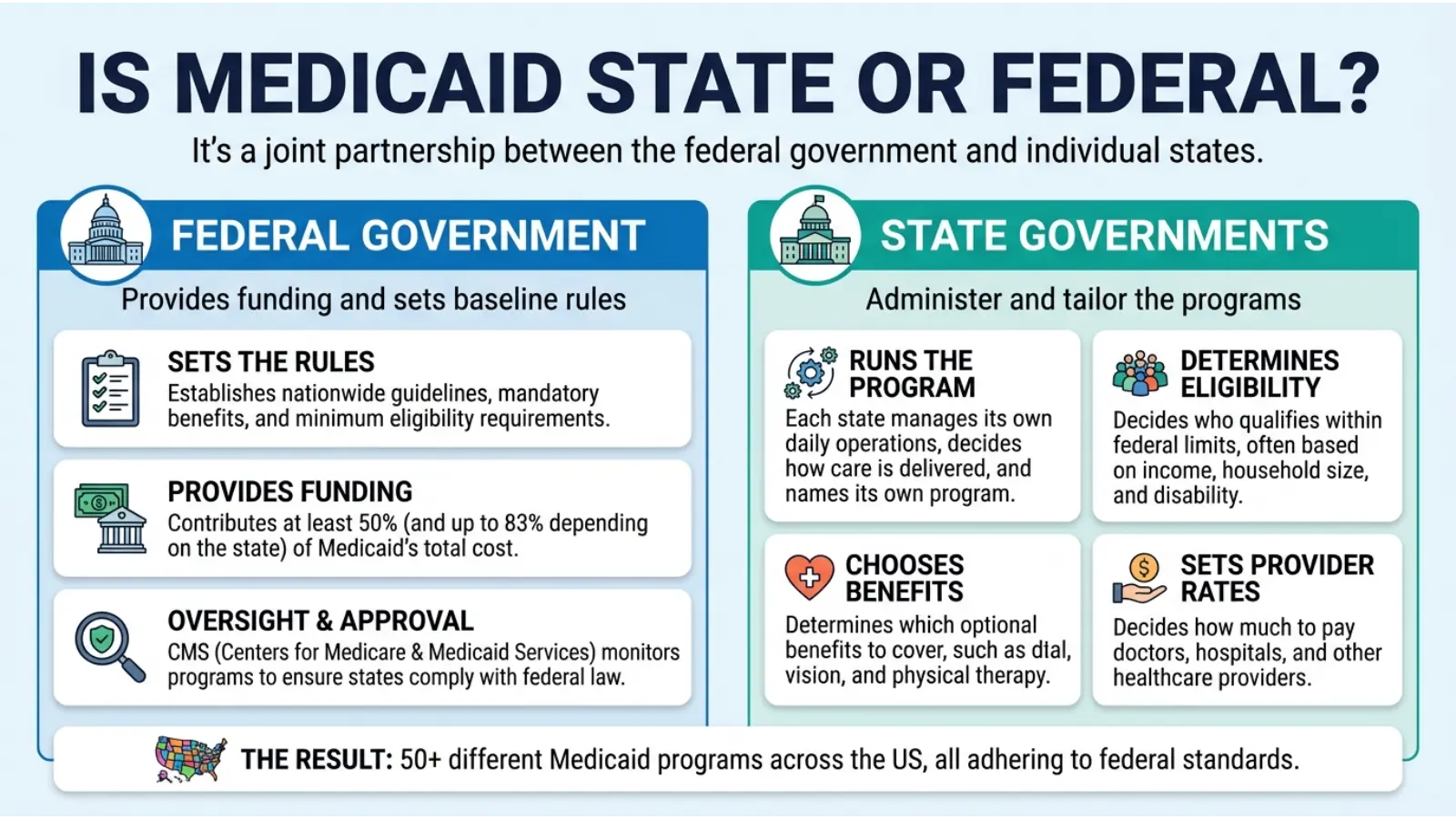
This is a common question because Medicaid involves both the federal government and individual state governments. Unlike some health programs that are managed mainly at one level, Medicaid is a joint program. The federal government provides funding and sets basic rules, while each state runs its own program within those federal guidelines.
You may hear about Medicaid at a doctor’s office, in a hospital, at work, or during a conversation about health insurance. Students, families, older adults, and people with disabilities may also search for information about it. Online searches can make things confusing because Medicaid rules, income limits, and covered services can differ from one state to another.
Understanding who controls Medicaid matters because it can help you find the right application, learn whether you may qualify, and understand what health services your state covers. It can also help you avoid confusing Medicaid with Medicare, which is a different government health insurance program.
The good news is that the basic idea is simple. Both levels of government have important roles, although states have flexibility in how they manage the program.
In this guide, you’ll learn the meaning, examples, usage, differences, common mistakes, and simple explanations in easy English.
Is Medicaid State or Federal? – Quick Answer
Medicaid is both a federal and state program. The federal government and state governments share its funding, and states administer their own Medicaid programs under federal requirements.
In simple words:
- Federal government: Provides part of the funding and sets basic program rules.
- State government: Runs the program locally, handles applications, and makes many decisions about eligibility and services within federal guidelines.
Examples:
- A person in Texas applies through Texas’s Medicaid system.
- A person in California applies through California’s Medicaid system.
- Both states receive federal funding to help pay for covered Medicaid services.
Simple rule: Medicaid is shared by the federal and state governments. The federal government helps fund and guide it, while states manage their programs.

The Origin of Medicaid
Medicaid began in 1965 when the United States created it through amendments to the Social Security Act. Its purpose was to help eligible people with limited income and resources access health care.
Over time, the program expanded. It now serves many eligible groups, including children, pregnant people, some low-income adults, older adults, and people with disabilities. Exact eligibility depends on federal rules and the state where a person lives.
Medicaid became a shared federal-state program because the federal government could support health coverage financially while states could organize services for their residents.
Today, the Centers for Medicare & Medicaid Services (CMS), part of the U.S. Department of Health and Human Services, oversees Medicaid at the federal level. State Medicaid agencies handle daily program administration.
Medicaid is not a social media trend or a casual phrase. People commonly search for it when they need health coverage, compare insurance options, or try to understand government benefits.
British English vs American English Usage
Medicaid is a United States government program. It does not have a separate British version with different rules.
British English and American English speakers may discuss Medicaid, but the program itself applies to eligible people in the United States. The United Kingdom has a different health care system, including the National Health Service (NHS).
| Feature | British English | American English | Notes |
|---|---|---|---|
| Program name | Medicaid | Medicaid | Same name |
| Main location | Not a UK program | United States | U.S.-specific program |
| Health system comparison | NHS | Medicaid and other insurance options | Different systems |
| Spelling | Medicaid | Medicaid | No spelling difference |
| Main purpose | May discuss it as a U.S. program | Helps eligible people pay for health care | Program rules are U.S.-based |
The important point is that Medicaid is an American program, regardless of which version of English someone uses.
Which One Should You Use?
If you are trying to understand Medicaid, the answer depends on what you need to know.
- For general information: Learn about Medicaid’s federal rules and funding.
- For eligibility: Check your state’s Medicaid agency because income limits and other requirements can vary.
- For an application: Use the official state Medicaid website or an approved application channel.
- For coverage details: Review your state’s rules about doctors, prescriptions, hospital care, and other services.
- For federal policy questions: Visit the official Centers for Medicare & Medicaid Services website.
Medicaid is a formal government program, not an informal term. In applications, official documents, school assignments, and workplace discussions, use the name Medicaid correctly.
One key detail is that states have flexibility, but they cannot simply ignore the federal requirements that apply to the program.
Common Mistakes About Medicaid
People often misunderstand Medicaid because it involves two levels of government. Here are four common mistakes and how to avoid them.
Mistake 1: Thinking Medicaid is only a federal program
❌ “The federal government runs every part of Medicaid.”
✔ Correct: The federal government sets requirements and contributes funding, but states administer their own Medicaid programs.
Mistake 2: Thinking Medicaid is only a state program
❌ “Medicaid is paid for entirely by my state.”
✔ Correct: The federal government and states share Medicaid costs. The federal share varies according to program rules and other factors.
Mistake 3: Assuming every state has identical eligibility rules
❌ “If I qualify for Medicaid in one state, I will automatically qualify in every state.”
✔ Correct: States follow federal requirements but may have different eligibility pathways and income limits. Moving to another state may require a new application.
Mistake 4: Confusing Medicaid with Medicare
❌ “Medicaid and Medicare are the same health insurance program.”
✔ Correct: Medicaid generally helps eligible people with limited income and resources, while Medicare mainly provides health coverage for people aged 65 or older and certain younger people with qualifying disabilities or conditions. Some people qualify for both.
Medicaid in Everyday Examples
Medicaid can affect everyday life in several ways. These examples show how the federal-state partnership works.
1. At Work
Imagine an employee in Florida earns a low income and wants to know whether they qualify for Medicaid.
The employee checks Florida’s eligibility rules and applies through the state’s system. Federal funding helps support the program, but the state processes the application under applicable rules.
2. At School
A college student is studying how the U.S. government works. The teacher asks whether Medicaid is a state or federal program.
The student answers that it is a joint federal-state program. This answer explains why both levels of government have important responsibilities.
3. On Social Media
Someone posts, “Medicaid rules are different in every state.”
A reader wants to know if this is true. The accurate explanation is that states administer their programs within federal requirements, so some eligibility rules, benefits, and procedures can differ.
4. In Daily Life
A family moves from Ohio to Pennsylvania and needs health coverage.
The family should contact Pennsylvania’s Medicaid agency to check eligibility and application steps. Medicaid coverage does not automatically transfer simply because someone moves.
5. In a Text Message
A friend asks, “Is Medicaid state or federal?”
You can reply: “It’s both! The federal government helps fund it and sets basic rules, while each state manages its own program.”
This short answer captures the main idea without using difficult language.
Medicaid – Google Trends and Usage Data
Why do people search for “is Medicaid state or federal”? Most want to understand how the program works, who manages it, and where to apply.
Common reasons include:
- Checking whether they qualify for health coverage.
- Understanding the difference between federal and state responsibilities.
- Comparing Medicaid rules after moving to another state.
- Learning about Medicaid funding and government policy.
- Understanding the difference between Medicaid and Medicare.
People in the United States are the most directly affected because Medicaid is a U.S. program. Interest may also come from students, researchers, and people living abroad who want to understand American health care.
The keyword may be relevant to searches in these countries:
- US: People may need eligibility information, application help, or details about state policies.
- UK: Students and readers may compare Medicaid with the National Health Service.
- India: Students and researchers may study the U.S. health insurance system.
- Pakistan: English learners, students, and readers may search for simple explanations of U.S. government programs.
- Canada: Readers may compare Medicaid with Canadian provincial and territorial health coverage.
- Australia: People may research the U.S. system alongside Australia’s Medicare program.
These are likely reasons for interest, not verified rankings of search volume by country. Actual search popularity changes over time. Google Trends can help compare interest across locations and dates, but it does not automatically provide exact numbers of searches.
For SEO content, related questions such as “Who funds Medicaid?”, “Who runs Medicaid?”, and “Is Medicaid different in every state?” can help answer the wider topic naturally.
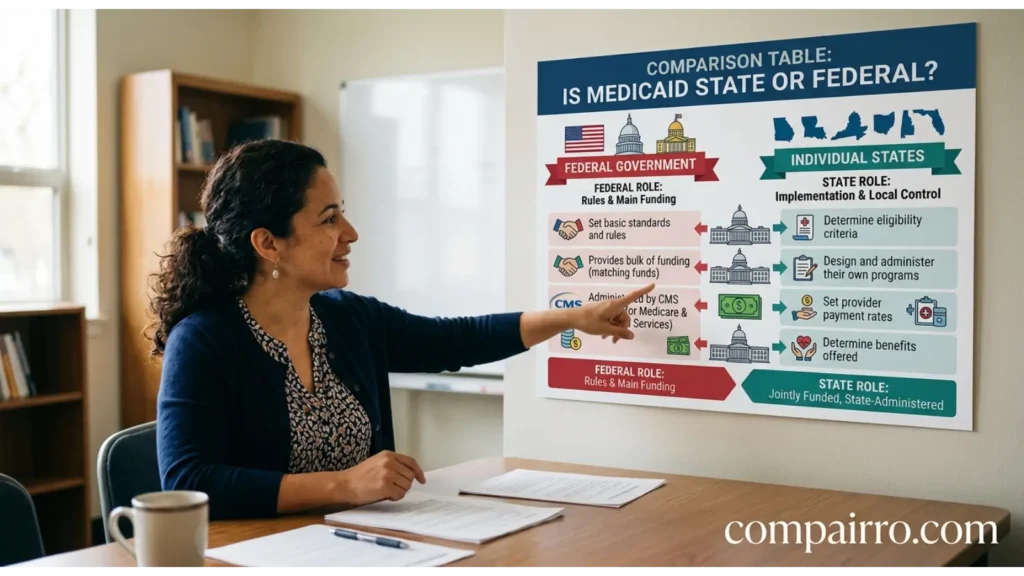
Comparison Table: Is Medicaid State or Federal?
The following table summarizes the main responsibilities of each level of government.
| Feature | Federal Government | State Government |
|---|---|---|
| Funding | Pays a share of program costs | Pays a share of program costs |
| Basic rules | Sets federal requirements | Follows federal requirements |
| Daily administration | Oversees the program nationally | Runs the state’s program |
| Eligibility | Sets certain federal standards | Applies rules and determines eligibility under its program |
| Benefits | Establishes required coverage standards | May cover additional services within federal rules |
| Applications | Provides national guidance and resources | Usually processes applications through state systems |
| Oversight | Monitors compliance with federal requirements | Manages operations and works with federal oversight |
| Program name | Medicaid | Medicaid |
The exact division of responsibility can be more detailed than this table suggests. For example, states may work with private managed-care organizations to deliver covered services, while federal rules continue to apply.
The main takeaway is that neither level of government works alone.
Medicaid in Professional Life
Understanding Medicaid can be useful in health care, public policy, education, and social services.
For example, health care workers may help patients understand their coverage. Social workers may guide eligible families toward application resources. Researchers may study how Medicaid funding affects access to health services.
People working in government or insurance-related roles may also need to understand federal requirements and state-specific rules.
For employers and health care organizations, Medicaid knowledge can help explain coverage options to patients and clients. However, employees should refer people to official sources rather than promise that someone qualifies without checking the relevant rules.
A useful professional habit is to identify the state involved before giving detailed Medicaid information. This small step can prevent confusion because requirements are not identical nationwide.
Medicaid for Students or Beginners
Medicaid can seem confusing at first because it includes federal funding, state administration, and different eligibility rules. Beginners sometimes assume that a program must belong to only one level of government.
Here are some easy ways to understand it:
- Learn the two roles: The federal government helps pay for Medicaid and sets basic requirements. States manage their programs.
- Remember the shared funding: Both federal and state governments contribute money.
- Study one state at a time: If you need real eligibility information, begin with the state where the person lives.
- Do not confuse the names: Medicaid and Medicare are different programs.
- Use official sources: The federal Medicaid website explains national rules, while state websites provide local information.
For a school assignment, you could write:
“Medicaid is a joint federal-state health coverage program in the United States. The federal government provides funding and sets requirements, while states administer their own programs.”
This sentence is simple, accurate, and suitable for a beginner-level explanation.

Signs or Characteristics Related to Medicaid
How can you recognize Medicaid as a federal-state program? Look at these main characteristics.
- Shared funding: The federal government and states both contribute to the program’s costs.
- Federal oversight: The Centers for Medicare & Medicaid Services oversees Medicaid at the national level.
- State administration: Each state operates its own Medicaid program under applicable federal requirements.
- Different eligibility pathways: Eligibility depends on factors such as income, household circumstances, age, disability, and state rules.
- State-specific details: Covered services, application procedures, and some eligibility rules may vary.
- Support for eligible groups: Medicaid covers many eligible low-income children and adults, pregnant people, older adults, and people with disabilities.
- Health coverage: Depending on the person’s eligibility and state program, covered care may include doctor visits, hospital services, and prescription drugs.
- Connection to other programs: Some people may qualify for both Medicaid and Medicare.
These characteristics show why it is not accurate to call Medicaid only a federal program or only a state program.
Simple Trick to Remember: Is Medicaid State or Federal?
Here is an easy memory trick:
Federal = Funding and framework
State = Local program management
Think of it this way: the federal government helps build the framework and pays part of the cost. The state operates the program for its residents within the rules that apply.
Imagine a school project shared by two partners. One partner provides resources and sets basic requirements, while the other organizes the daily work. Both contribute to the result.
Medicaid works in a similar way, although its actual rules and responsibilities are more complex than a school project.
Remember this short phrase:
“Medicaid is shared: federal support, state administration.”
That is the easiest way to answer the question without mixing up the two roles.
FAQs:
1. Is Medicaid a federal or state program?
Medicaid is both. The federal government helps fund and regulate the program, while states administer their own programs under federal requirements.
2. Who pays for Medicaid?
The federal government and state governments share Medicaid costs. The federal share varies by state and other factors under federal law.
3. Does every state have Medicaid?
Yes. All 50 states and the District of Columbia operate Medicaid programs, although their eligibility rules and program details can differ.
4. Who controls Medicaid?
The federal government oversees national requirements through the Centers for Medicare & Medicaid Services. State agencies manage day-to-day operations and apply the rules in their states.
5. Is Medicaid the same in every state?
No. States must follow applicable federal requirements, but eligibility pathways, covered services, and administrative procedures can vary.
6. Can I use Medicaid if I move to another state?
You generally need to apply in your new state and meet its eligibility requirements. Contact both states’ Medicaid agencies to understand how to handle the move and avoid coverage gaps.
7. What is the difference between Medicaid and Medicare?
Medicaid is a joint federal-state program that helps eligible people with health care costs. Medicare is a federal health insurance program mainly for people aged 65 or older and certain younger people who meet specific disability or medical requirements. Some people qualify for both.
Conclusion
So, is Medicaid state or federal? The simple answer is both. Medicaid is a joint program in which the federal government provides funding and sets basic requirements, while state governments administer their own programs.
This partnership helps eligible people access health coverage across the United States. However, eligibility rules, benefits, and application steps can vary by state.
If you need Medicaid for yourself or a family member, start by checking the official Medicaid website and the agency for your state. This will help you find accurate information about eligibility and coverage.
Final memory rule: Federal government = funding and framework. State government = program administration. Medicaid works through both.
Meta Description: Is Medicaid state or federal? Learn how the federal government and states share costs, set rules, and provide health coverage.

Sara Taylor is a passionate English content writer who specializes in word meanings, spelling comparisons, and modern slang explanations. She creates easy-to-understand articles that help readers avoid common English mistakes and improve their writing skills. Her content focuses on simple learning, real-life examples, and clear explanations for everyday readers.