Have you ever written a sentence and noticed that you used the word “or” too many times? Perhaps you are writing a school assignment, preparing a work email, or creating a blog post. You may want to find another word for or to make your writing clearer and more interesting.
The word “or” is one of the most common words in English. We use it to offer choices, show different possibilities, and ask questions. For example, you might ask, “Would you like tea or coffee?” However, using the same word repeatedly can sometimes make your writing sound boring.
That is why learning synonyms for “or” can be helpful. Words and phrases such as “alternatively,” “otherwise,” “either,” and “if not” may work in certain situations. However, they do not all have exactly the same meaning. Choosing the wrong replacement can change your sentence or make it confusing.
You may need another word for or when writing essays at school, communicating in the workplace, posting on social media, or improving your everyday conversations. The best choice depends on what you want to say and how formal your writing needs to be.
In this guide, you’ll learn the meaning, examples, usage, differences, common mistakes, and simple explanations in easy English.
Another Word for Or – Quick Answer
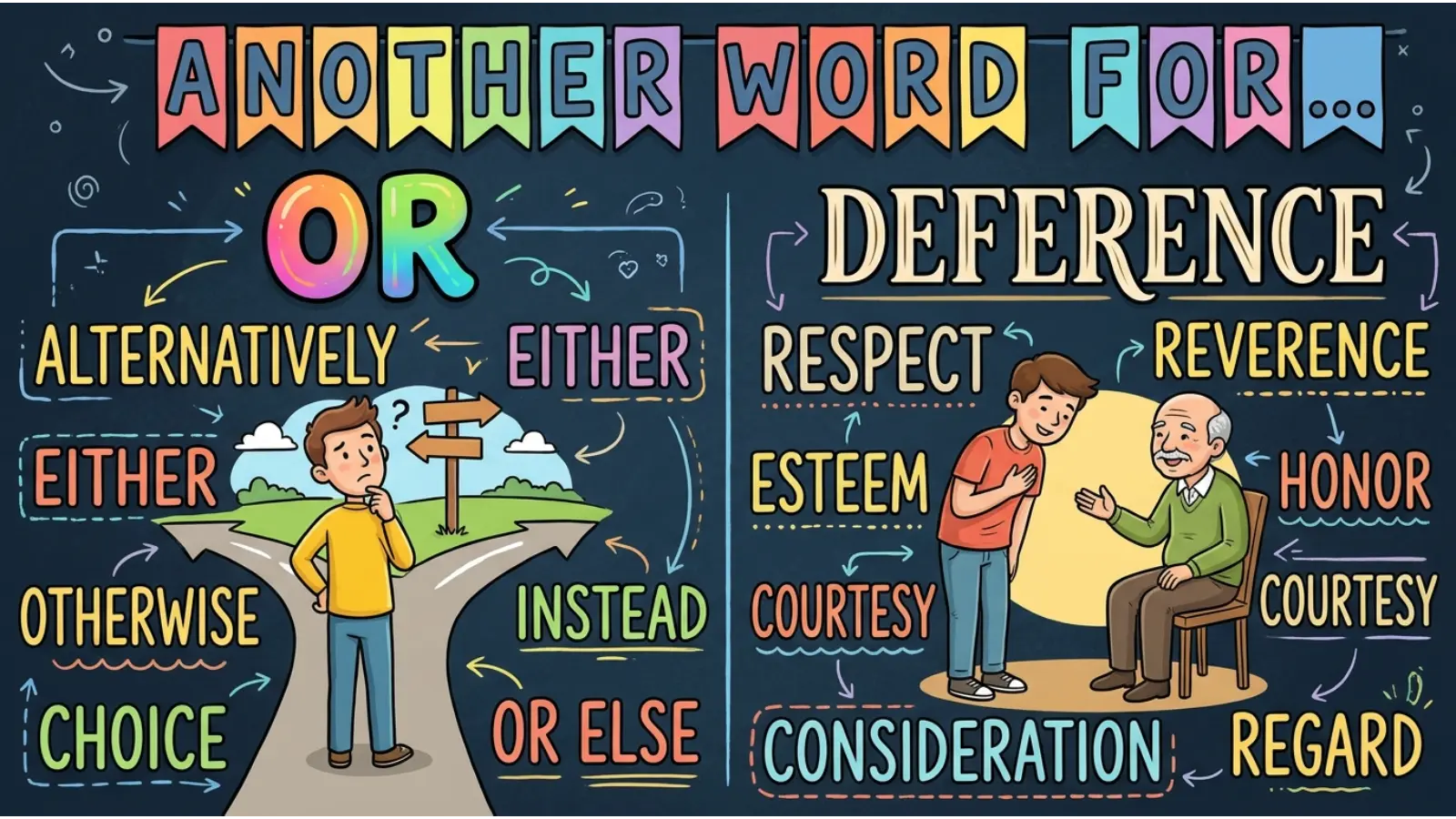
Another word for or depends on the meaning of your sentence. Common alternatives include alternatively, otherwise, either, if not, or else, and as an alternative.
The word “or” usually connects two choices or possibilities.
Examples:
- Would you like tea or coffee? → Would you prefer tea or coffee?
- Take a bus, or walk to school. → Take a bus; alternatively, walk to school.
- Hurry up, or you will miss the train. → Hurry up; otherwise, you will miss the train.
Simple rule: Use “alternatively” to offer another option and “otherwise” to explain what may happen if something does not occur.
Remember that some alternatives work only in certain sentences. There is no single replacement for “or” that fits every situation.
The Origin of Or
The word “or” has a long history in the English language. It developed from older forms of English and is related to similar words in other Germanic languages.
Over time, “or” became a basic connecting word used to show choices, alternatives, and possibilities.
Today, people use it in almost every type of communication, including books, schoolwork, emails, text messages, websites, and social media posts.
Unlike modern internet slang, “or” is not a new trend. It is a standard English word that has been used for centuries.
British English vs American English Usage
The word “or” has the same basic meaning in British English and American English. There is no major spelling difference between the two varieties.
However, some alternative expressions may sound more natural in certain situations or types of writing.
| Feature | British English | American English | Notes |
|---|---|---|---|
| Or | Tea or coffee | Tea or coffee | Same meaning |
| Alternatively | Alternatively, take the bus | Alternatively, take the bus | Common in formal writing |
| Otherwise | Leave now; otherwise, you’ll be late | Leave now; otherwise, you’ll be late | Shows a possible result |
| Or else | Hurry up, or else! | Hurry up, or else! | Can sound like a warning |
| Either…or | Either Monday or Tuesday | Either Monday or Tuesday | Presents two choices |
Important: These expressions are understood in both countries. The main difference is often the situation and tone, not the meaning of the word “or.”

Which Another Word for Or Should You Use?
Choosing the right alternative depends on your sentence. Some words work well in formal writing, while others are better for everyday conversations.
Here are some useful options.
1. Alternatively
Use “alternatively” when you want to introduce another choice or option.
Example:
– You can travel by train. Alternatively, you can take a bus.
This word is especially useful in essays, reports, instructions, and professional writing.
2. Otherwise
Use “otherwise” when you want to explain what may happen if someone does not do something.
Example:
– Finish your homework now; otherwise, you may forget it later.
It often describes a possible result rather than simply presenting two equal choices.
3. Or Else
Use “or else” to show a possible consequence or warning.
Example:
– Put on your coat, or else you may feel cold.
Be careful when using this phrase. Depending on your tone, it can sound forceful or threatening.
4. If Not
Use “if not” when you want to suggest a different possibility or describe a condition.
Example:
– We can meet on Friday, if not Saturday.
This means Friday is one possibility, with Saturday as another option.
5. As an Alternative
This phrase introduces another possible choice.
Example:
– You can use a laptop. As an alternative, you can work on a tablet.
It is useful in formal writing, guides, and explanations.
6. Either…Or
Use “either…or” to connect two choices clearly.
Example:
– You can either read a book or watch a movie.
This structure is especially useful when you want to make the available options clear.
Common Mistakes When Using Another Word for Or
Learning synonyms is useful, but replacing “or” without checking the meaning can lead to mistakes.
Mistake 1: Using “Otherwise” for Every Choice
❌ Incorrect: Would you like tea otherwise coffee?
✔ Correct: Would you like tea or coffee?
Why? “Otherwise” usually describes what happens if something else does not happen. It does not normally replace “or” when asking a simple question.
Mistake 2: Using “Alternatively” Without Clear Punctuation
❌ Incorrect: You can walk alternatively you can take a taxi.
✔ Correct: You can walk. Alternatively, you can take a taxi.
Why? “Alternatively” often introduces a separate sentence or follows suitable punctuation.
Mistake 3: Forgetting “Either” in a Paired Structure
❌ Incorrect: You can either study at home and at the library.
✔ Correct: You can either study at home or at the library.
Why? The standard paired structure is “either…or,” not “either…and.”
Mistake 4: Using “Or Else” in Formal Writing
❌ Incorrect: Submit the report today, or else you will face a penalty. (in a polite routine email)
✔ Better: Please submit the report today to avoid a delay.
Why? “Or else” may sound too strong for a professional message. Choose polite language when making requests.
Mistake 5: Assuming Every Synonym Has the Same Meaning
❌ Incorrect: Would you like coffee otherwise tea?
✔ Correct: Would you like coffee or tea?
Why? Synonyms can have different uses. Always check whether the alternative fits the meaning of your sentence.

Another Word for Or in Everyday Examples
The following examples show how to use alternatives in different situations.
At Work
Professional writing often benefits from clear and polite language.
- Original: Send the report today or tomorrow.
- Alternative: You can send the report today. Alternatively, send it tomorrow.
- Original: Finish the task, or the project will be delayed.
- Alternative: Finish the task; otherwise, the project may be delayed.
Choose the version that keeps your message clear without sounding too demanding.
At School
Students can use alternatives to make essays and assignments more varied.
- Original: You can write an essay or prepare a presentation.
- Alternative: You can write an essay. Alternatively, you can prepare a presentation.
- Original: Study now or you may forget the lesson.
- Alternative: Study now; otherwise, you may forget the lesson.
On Social Media
Short, simple expressions usually work best in captions and posts.
- Tea or coffee? → Which would you prefer: tea or coffee?
- Watch a movie or listen to music. → Watch a movie; alternatively, listen to music.
- Join us or miss the fun! → Join us, or else you’ll miss the fun!
The last example is playful, but “or else” can sound serious in other contexts.
In Daily Life
- Original: Walk or take a bus.
- Alternative: Walk; alternatively, take a bus.
- Original: Call me or send a message.
- Alternative: Call me. If not, send me a message.
The second alternative can sound less natural than the original. In everyday English, keeping “or” is often the clearest choice.
In Text Messages
- “Pizza or burgers?” → “Would you prefer pizza or burgers?”
- “Come now or call me later.” → “Come now; otherwise, call me later.”
You do not always need to replace “or.” Simple wording is often best in casual messages.
Another Word for Or – Google Trends and Usage Data
People search for “another word for or” because they want to improve their vocabulary, avoid repetition, and write more clearly.
The search may also come from students completing assignments, bloggers editing articles, or English learners looking for simple synonyms.
Why Do People Search for This Keyword?
Common reasons include:
- Finding synonyms for essays and school assignments.
- Improving grammar and sentence structure.
- Making professional emails sound more natural.
- Learning the difference between “or,” “otherwise,” and “alternatively.”
- Finding better words for articles, captions, and everyday communication.
Which Countries Search for It?
English vocabulary questions can interest people in many countries, including the United States, United Kingdom, India, Pakistan, Canada, and Australia.
Students and English learners may search for synonyms to improve their reading, writing, and speaking skills.
However, exact rankings, search volumes, and country-by-country trends should not be assumed without checking current Google Trends or keyword research data. The examples above describe likely reasons for searching, not verified search statistics.
Comparison Table: Another Word for Or
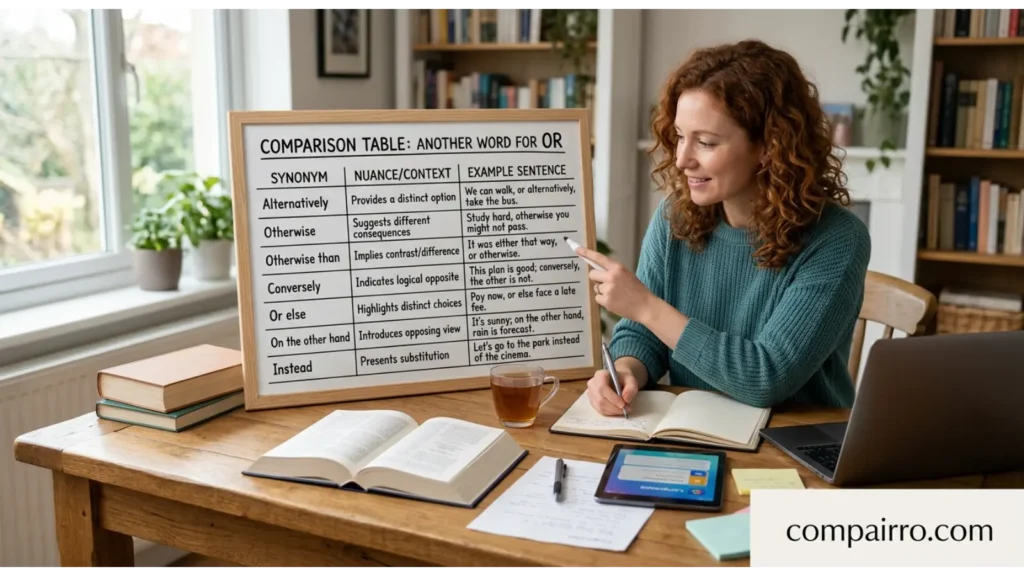
Here is a simple comparison of common alternatives and when to use them.
| Alternative | Main Meaning | Example | Best Use |
|---|---|---|---|
| Alternatively | Another option | Alternatively, take a taxi. | Formal writing |
| Otherwise | If not; in a different situation | Hurry up; otherwise, you’ll be late. | Consequences |
| Or else | Another possibility or a warning | Leave now, or else! | Casual speech; warnings |
| If not | If the first option does not happen | Friday, if not Saturday. | Suggestions |
| As an alternative | Another possible choice | Use a tablet as an alternative. | Explanations |
| Either…or | One choice or another | Either call or text me. | Clear choices |
| Instead | In place of something | Walk instead of driving. | Replacing an action |
| Rather than | In preference to something | Read rather than watch TV. | Comparing actions |
| Whether | Introduces possibilities or uncertainty | I don’t know whether he will come. | Indirect questions |
| Or | Connects choices | Tea or coffee? | General use |
Remember: “Instead,” “rather than,” and “whether” can be useful alternatives in some sentences, but they cannot replace “or” in every situation.
Another Word for Or in Professional Life
In professional communication, clarity is more important than using complicated vocabulary.
You can use “alternatively” in reports, business proposals, and emails when suggesting another option.
For example:
Simple version: We can hold the meeting on Monday or Tuesday.
Alternative version: We can hold the meeting on Monday. Alternatively, we can schedule it for Tuesday.
You can also use “otherwise” when explaining a possible result.
Example:
“Please approve the design by Friday; otherwise, the launch may be delayed.”
When writing to clients or managers, avoid expressions that sound threatening. A polite and direct sentence usually creates a better impression.
Another Word for Or for Students or Beginners
English learners sometimes struggle with synonyms because words that look similar may have different meanings.
The easiest way to learn them is to study complete sentences rather than memorizing word lists.
Try these simple learning tips:
- Learn one alternative at a time: Start with “alternatively” and “otherwise.”
- Read examples: Notice how each word works in a sentence.
- Practice rewriting: Change one sentence without changing its meaning.
- Check the tone: Decide whether the sentence is formal, casual, or polite.
- Use a dictionary: Check unfamiliar words before using them in an essay.
For example, rewrite “You can call me or text me” as “You can either call me or text me.”
Both sentences offer two choices and sound natural.
Signs or Characteristics Related to Another Word for Or
Different alternatives have different features. Understanding these features helps you choose the correct expression.
- Alternatively: Introduces another option.
- Otherwise: Shows what may happen if something does not occur.
- Or else: Can introduce a consequence or warning.
- If not: Presents another possibility or condition.
- Either…or: Connects two choices.
- Instead: Shows that one thing replaces another.
- Rather than: Highlights a preference or choice between actions.
- Whether: Introduces uncertainty or different possibilities.
These expressions can make your writing more varied. However, using the simplest word is often the best choice when it communicates your meaning clearly.
Simple Trick to Remember Another Word for Or
Think of the purpose of your sentence before choosing a synonym.
- Another choice = Alternatively
- If not = Otherwise
- One of two choices = Either…or
- Replace one thing = Instead
- Preference between actions = Rather than
Think of it this way:
Suppose you are deciding how to travel to school.
- “Take a bus or walk.” — Two choices.
- “Take a bus. Alternatively, walk.” — Another option.
- “Leave now; otherwise, you may be late.” — A possible result.
- “Walk instead of taking a bus.” — One action replaces another.
This simple method helps you choose the right expression without changing the meaning of your sentence.
FAQs:
1. What is another word for or?
Common alternatives include “alternatively,” “otherwise,” “or else,” “if not,” and “as an alternative.” The best choice depends on the sentence.
2. What is a formal word for or?
“Alternatively” is a useful formal expression when introducing another option. However, “or” is also correct and professional in most situations.
3. Can I use “otherwise” instead of “or”?
Sometimes. “Otherwise” works when you mean “if not” or want to show a possible result, but it does not replace “or” in every sentence.
4. What is another word for or in an essay?
You can use “alternatively,” “as another option,” or “on the other hand” when the meaning fits. Do not replace every “or” just to avoid repetition.
5. Is “either…or” the same as “or”?
They are closely related. “Either…or” is a paired structure that clearly presents two choices, while “or” can connect choices without “either.”
6. What is another word for or in a sentence?
In “You can walk or take a taxi,” you could write, “You can walk. Alternatively, you can take a taxi.” The best replacement depends on the sentence structure.
7. Should I always replace “or” with a synonym?
No. “Or” is simple, natural, and grammatically correct. Use an alternative only when it improves clarity, flow, or tone.
Conclusion
Finding another word for or can help you improve your English writing, expand your vocabulary, and express choices more clearly. Useful alternatives include “alternatively,” “otherwise,” “or else,” “if not,” and “as an alternative.”
However, each expression has its own purpose. “Alternatively” introduces another option, while “otherwise” often explains what may happen if something does not occur. “Either…or” clearly connects two choices.
The most important lesson is to choose a word that matches your meaning instead of replacing “or” automatically.
Easy memory rule: Use “alternatively” for another option, “otherwise” for a possible result, and “or” whenever it expresses your meaning clearly.

Sara Taylor is a passionate English content writer who specializes in word meanings, spelling comparisons, and modern slang explanations. She creates easy-to-understand articles that help readers avoid common English mistakes and improve their writing skills. Her content focuses on simple learning, real-life examples, and clear explanations for everyday readers.