When studying organic chemistry, you may come across the question, “Is cysteine S or R?” If you are learning about amino acids, chiral molecules, or the R/S naming system, this question can be confusing at first.
Most amino acids found in proteins have an S configuration under the usual naming rules. However, cysteine is a well-known exception. Its configuration is R, even though it belongs to the group of amino acids commonly associated with the L form.
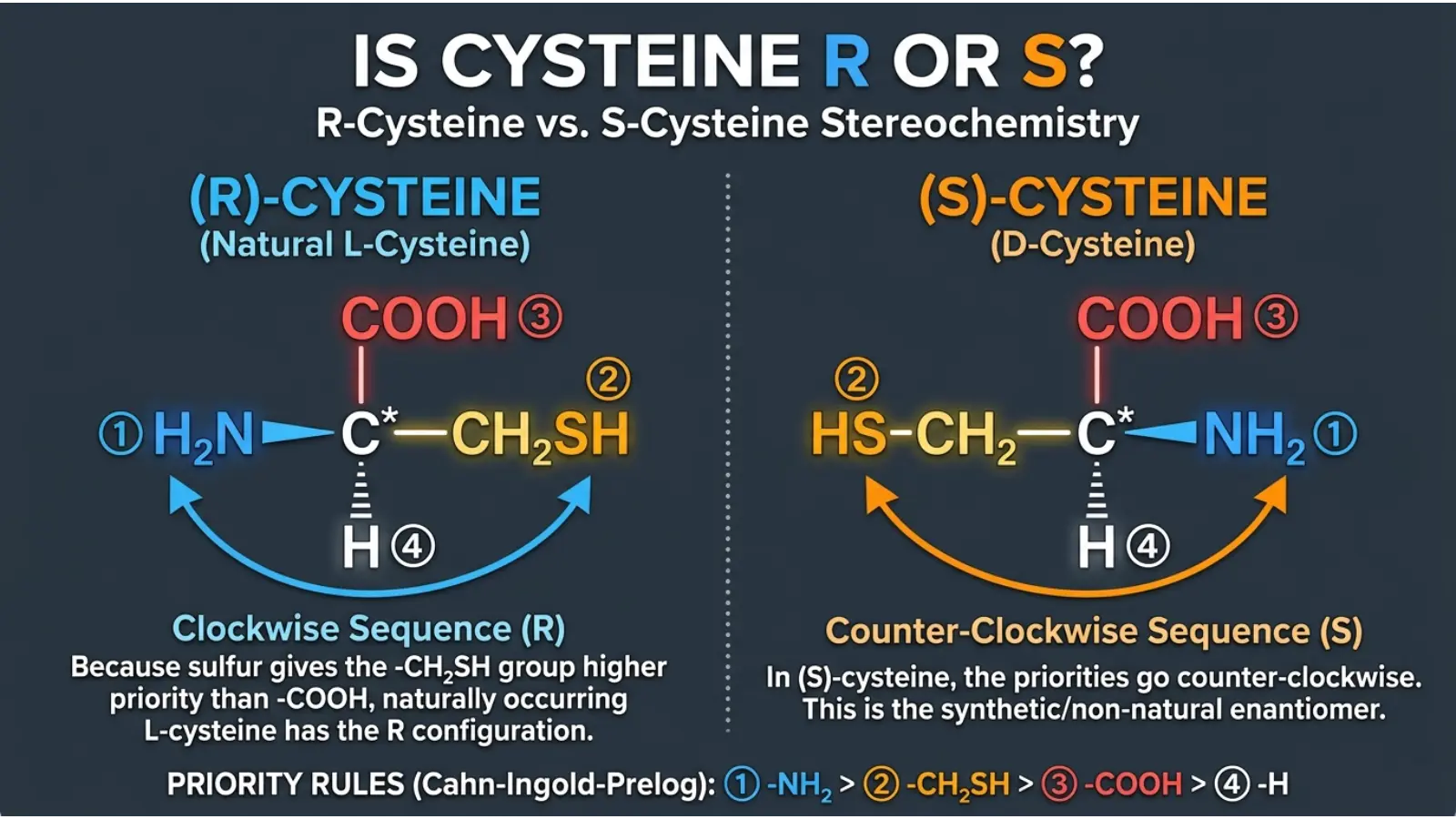
Why does this happen? The answer comes from the way chemists rank the atoms attached to a chiral carbon. The R/S system uses the Cahn–Ingold–Prelog (CIP) priority rules, which depend on atomic numbers. Because cysteine has a sulfur-containing side chain, its priorities differ from those of many other amino acids.
You may encounter this topic in school, college, university chemistry classes, biology lessons, laboratory work, or internet searches. Understanding it can help you solve stereochemistry questions and avoid common exam mistakes.
The key is to remember that L/D and R/S are different naming systems. One cannot always predict the R/S configuration from the L/D label alone.
In this guide, you’ll learn the meaning, examples, usage, differences, common mistakes, and simple explanations in easy English.
Is Cysteine S or R? – Quick Answer
Cysteine is R at its alpha carbon in its usual L form found in proteins. It is an exception to the common pattern in which most standard L-amino acids have an S configuration.
Cysteine is an amino acid with a sulfur-containing side chain, written as –CH₂–SH. The sulfur atom affects how the attached groups are ranked under the CIP rules.
Examples:
- L-cysteine: R configuration at the alpha carbon.
- L-alanine: S configuration at the alpha carbon.
- L-serine: S configuration at the alpha carbon.
Simple rule: L-cysteine is R because the sulfur atom in its side chain changes the priority ranking. Remember that L does not automatically mean S.
The Origin of Cysteine’s R Configuration
Cysteine is one of the 20 standard amino acids used to build proteins. Its structure contains an amino group, a carboxyl group, a hydrogen atom, and a side chain attached to its central alpha carbon.
The side chain of cysteine is –CH₂–SH. This group contains sulfur, which is the main reason cysteine has an R configuration in its usual L form.
Chemists developed the R/S naming system to describe the three-dimensional arrangement of atoms around a chiral center. The system ranks attached groups according to the CIP priority rules.
In cysteine, sulfur has a higher atomic number than oxygen. This changes the ranking of the side chain compared with the groups attached to the central carbon.
As a result, L-cysteine receives the R label instead of the S label.
British English vs American English Usage
There is no difference between British and American English in the scientific use of cysteine, R configuration, or S configuration.
| Feature | British English | American English | Notes |
|---|---|---|---|
| Amino acid name | Cysteine | Cysteine | Same spelling |
| Configuration | R or S | R or S | Same scientific system |
| Chemical rules | CIP rules | CIP rules | Same priority method |
| Pronunciation | May vary slightly | May vary slightly | Scientific meaning stays the same |
The R/S system is used worldwide. Students in the UK, US, Pakistan, India, Canada, and Australia follow the same basic rules.
Which One Should You Use: R or S for Cysteine?
When answering a chemistry question, use the configuration that matches the molecule’s actual structure.
For the usual amino acid forms:
- L-cysteine: R at the alpha carbon.
- L-alanine: S at the alpha carbon.
- L-serine: S at the alpha carbon.
- D-cysteine: S at the alpha carbon, assuming the standard amino acid structure and configuration.
Use these labels correctly in different situations:
- In school exams: State that L-cysteine is R because of the sulfur-containing side chain.
- In stereochemistry problems: Rank the groups using the CIP rules before assigning R or S.
- In biology: Remember that L/D describes a different naming system from R/S.
- In laboratory work: Check the exact molecular structure because a compound can have more than one stereocenter.
Do not guess the configuration just because an amino acid is labeled L or D.
Common Mistakes With Cysteine R/S Configuration
Here are four mistakes students often make when studying cysteine.
Mistake 1: Assuming every L-amino acid is S
❌ Incorrect: Every L-amino acid must have an S configuration.
✔ Correct: Most standard L-amino acids have an S configuration, but L-cysteine is R.
Mistake 2: Ignoring sulfur
❌ Incorrect: Cysteine follows the same priority order as alanine.
✔ Correct: Cysteine has sulfur in its side chain, which changes the CIP priority ranking.
Mistake 3: Confusing L/D with R/S
❌ Incorrect: L always means S, and D always means R.
✔ Correct: L/D and R/S describe different things. The configuration must be determined using the appropriate rules.
Mistake 4: Guessing R/S without ranking the groups
❌ Incorrect: A molecule is R simply because its side chain contains sulfur.
✔ Correct: Sulfur affects the ranking, but the final R/S label depends on the full three-dimensional arrangement of the groups.
Cysteine in Everyday Examples
Although cysteine is a chemistry term, you may encounter it in several areas of study and daily life.
- School: A student learns why cysteine is an exception in amino acid stereochemistry.
- College: A chemistry student uses CIP rules to identify the configuration of a chiral molecule.
- Biology: A learner studies how amino acids form proteins.
- Laboratory work: A researcher checks the structure and stereochemistry of an amino acid.
- Health and nutrition: Someone reads about cysteine in discussions of protein, food, or supplements.
For example, a student might ask, “If most L-amino acids are S, why is cysteine R?” The answer is that the sulfur-containing side chain changes the priority order used to assign the configuration.
Cysteine R/S – Google Trends and Usage Data
People may search for “is cysteine S or R” when preparing for chemistry exams, completing homework, or reviewing amino acid structures.
Common reasons for this search include:
- Confusion between L/D and R/S naming systems.
- Difficulty applying CIP priority rules.
- Questions about sulfur’s role in stereochemistry.
- A need for a short answer before an exam.
Students in the US, UK, India, Pakistan, Canada, and Australia may encounter this question in chemistry or biology courses. However, without current Google Trends data, it is not possible to confirm which country has the highest search interest or whether searches are increasing.
The topic is mainly educational rather than a social media trend. Its value comes from helping students understand a key exception in organic chemistry.

Comparison Table: Cysteine R vs S
| Feature | R configuration | S configuration |
|---|---|---|
| Meaning | Rectus, meaning right | Sinister, meaning left |
| Assignment | Based on CIP priority rules | Based on CIP priority rules |
| L-cysteine | Correct at the alpha carbon | Incorrect at the alpha carbon |
| L-alanine | Incorrect at the alpha carbon | Correct at the alpha carbon |
| How to identify | Rank groups, then check their arrangement | Rank groups, then check their arrangement |
R and S do not mean that a molecule rotates light to the right or left. They describe the arrangement of groups around a chiral center.
Cysteine R/S Configuration in Professional Life
Understanding cysteine’s configuration is useful in fields that study molecules and living systems.
- Biochemistry: Helps explain the structures of amino acids and proteins.
- Pharmaceutical science: Stereochemistry can affect how a drug behaves in the body.
- Molecular biology: Supports the study of protein structure and function.
- Chemical research: Helps researchers describe and identify molecules correctly.
- Education: Builds a foundation for advanced organic chemistry.
Cysteine’s R configuration is a useful example of why scientists must follow priority rules instead of relying on simple memory patterns.

Cysteine R/S for Students and Beginners
Beginners often find stereochemistry difficult because molecules are three-dimensional, while diagrams are drawn on flat pages.
The good news is that you can solve these questions by following a clear process.
- Find the chiral carbon.
- Identify the four groups attached to it.
- Rank those groups using the CIP rules.
- Place the lowest-priority group away from you.
- Follow the direction from priority 1 to 2 to 3.
- Clockwise gives R; counterclockwise gives S, when the lowest-priority group points away.
For cysteine, the sulfur-containing side chain receives higher priority than the carboxyl group because sulfur has a higher atomic number than oxygen at the first point of difference.
Practice with alanine and serine as well. Comparing these amino acids with cysteine makes the exception easier to understand.
Signs or Characteristics Related to Cysteine’s Configuration
Cysteine’s R configuration has several important characteristics:
- Chiral center: Its alpha carbon is attached to four different groups.
- Sulfur-containing side chain: Its side chain contains a thiol group, –SH.
- Unusual priority order: The sulfur-containing side chain ranks above the carboxyl group under CIP rules.
- L/R exception: L-cysteine has an R configuration at its alpha carbon.
- Protein connection: L-cysteine is one of the standard amino acids used to build proteins.
- Rule-based identification: Its configuration can be determined by applying the same CIP method used for other chiral molecules.
These characteristics explain why cysteine is often used as a teaching example in stereochemistry.
Simple Trick to Remember Cysteine R/S
Here is an easy memory trick:
Cysteine = Sulfur = Special = R
Think of it this way: most standard L-amino acids have S configurations, but cysteine contains sulfur in its side chain. That sulfur changes the priority ranking and makes L-cysteine R.
Remember these examples:
- L-cysteine = R
- L-alanine = S
- L-serine = S
This trick is useful for quick revision, but always use the CIP rules when solving a new molecule.
FAQs:
1. Is cysteine R or S?
L-cysteine has an R configuration at its alpha carbon because its sulfur-containing side chain changes the CIP priority order.
2. Why is cysteine R instead of S?
Sulfur has a higher atomic number than oxygen. This gives cysteine’s side chain higher priority than its carboxyl group at the first point of difference.
3. Is L-cysteine an exception?
Yes. L-cysteine is a well-known exception to the common pattern of standard L-amino acids having S configurations.
4. Is D-cysteine R or S?
D-cysteine has an S configuration at its alpha carbon in the standard amino acid structure.
5. Does L always mean S?
No. L/D and R/S are separate naming systems. The R/S configuration depends on the CIP priority rules and the molecule’s three-dimensional structure.
6. What is the side chain of cysteine?
Cysteine has a –CH₂–SH side chain. The sulfur atom in this group is important for its unusual R/S assignment.
7. How can I remember cysteine’s configuration?
Remember that L-cysteine is R, while L-alanine and L-serine are S. Then use the CIP rules to confirm the answer.
Conclusion
So, is cysteine S or R? The answer is R for L-cysteine at its alpha carbon. Its sulfur-containing side chain changes the CIP priority ranking, making it an exception to the usual pattern for L-amino acids.
The most important point is that L/D and R/S are different systems. Never assume that every L-amino acid must be S.
Final memory rule: L-cysteine = R because sulfur changes the priority order.

Sara Taylor is a passionate English content writer who specializes in word meanings, spelling comparisons, and modern slang explanations. She creates easy-to-understand articles that help readers avoid common English mistakes and improve their writing skills. Her content focuses on simple learning, real-life examples, and clear explanations for everyday readers.