Imagine you are studying chemistry and your teacher asks, “Is SF6 polar or nonpolar?” You may know that chemical bonds can be polar, but finding the polarity of a whole molecule can still be confusing. The good news is that you can solve this question by understanding the molecule’s shape.
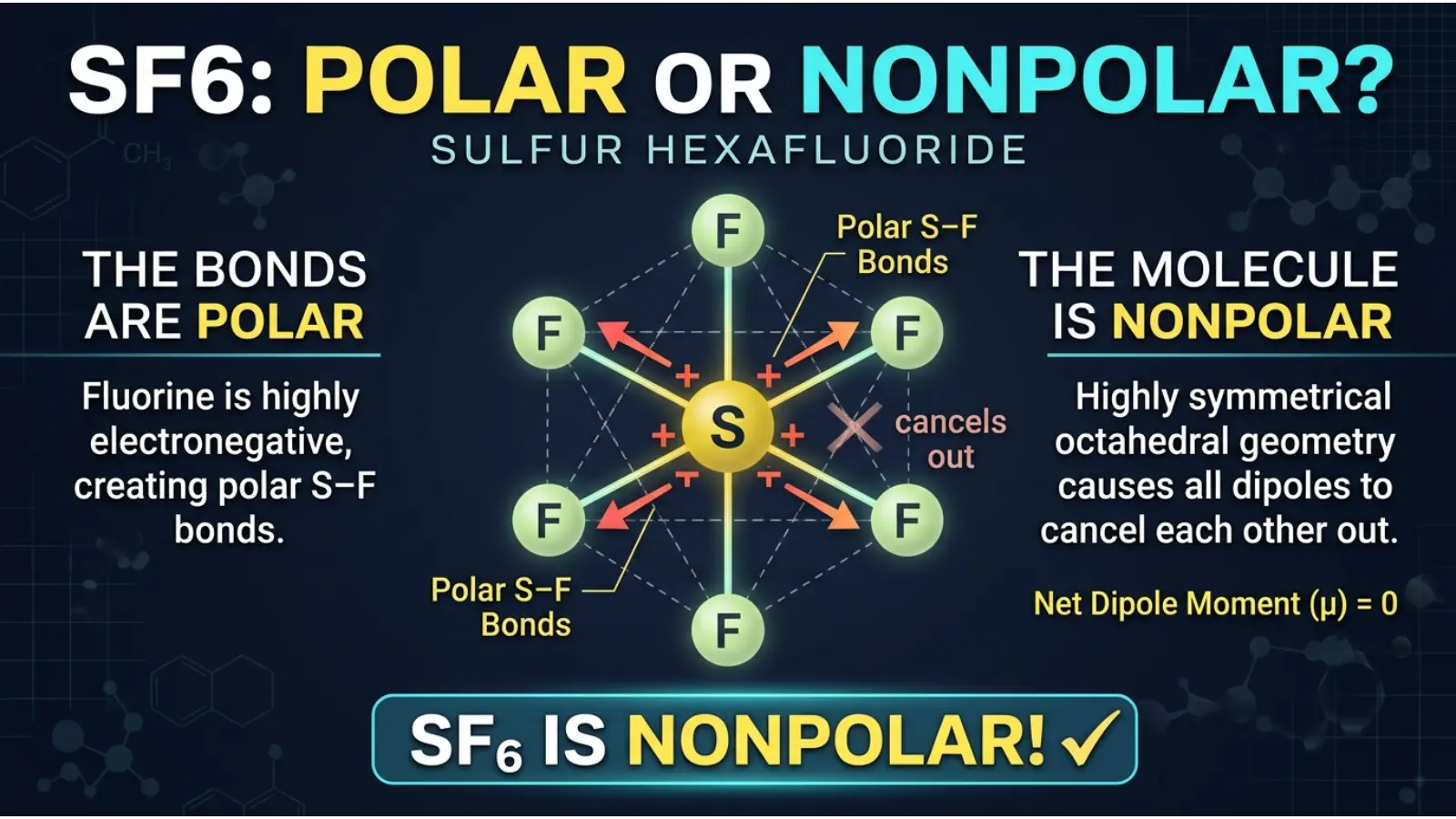
SF6 stands for sulfur hexafluoride. It is a chemical compound made of one sulfur atom and six fluorine atoms. Fluorine attracts shared electrons more strongly than sulfur does, so each sulfur-fluorine bond is polar. However, this does not mean that the entire SF6 molecule is polar.
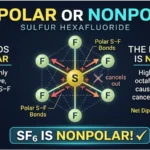
The key is the arrangement of its atoms. SF6 has a symmetrical, octahedral shape. Its six fluorine atoms are arranged evenly around the central sulfur atom. Because of this balanced structure, the effects of the individual bond dipoles cancel each other out.
You may come across this topic in school chemistry, college exams, science books, online lessons, or chemistry discussions on social media. Understanding it helps you answer questions about molecular polarity, chemical bonds, molecular geometry, and electron distribution.
In this guide, you’ll learn the meaning, examples, usage, differences, common mistakes, and simple explanations in easy English.
SF6 Polar or Nonpolar – Quick Answer
SF6 is a nonpolar molecule because it has a symmetrical octahedral shape that causes all six S–F bond dipoles to cancel out.
SF6, or sulfur hexafluoride, contains one sulfur atom and six fluorine atoms. Each sulfur-fluorine bond is polar because fluorine attracts electrons more strongly than sulfur. However, the molecule as a whole has no net dipole moment.
Examples:
- SF6: Nonpolar because its bond dipoles cancel out.
- H2O (water): Polar because its bent shape prevents its bond dipoles from canceling completely.
- CO2 (carbon dioxide): Nonpolar because its linear shape allows its two bond dipoles to cancel.
Simple rule: A molecule can contain polar bonds and still be nonpolar if its shape makes the bond dipoles cancel.

The Origin of SF6
SF6 is the chemical formula for sulfur hexafluoride. The name comes from two parts:
- Sulfur (S): The central atom in the molecule.
- Hexafluoride: Six fluorine atoms are bonded to the sulfur atom. The prefix “hexa-” means six.
Sulfur hexafluoride is a colorless, odorless gas used in certain electrical equipment because it has strong insulating properties. It is also a greenhouse gas, so its release into the atmosphere is an environmental concern.
In chemistry, SF6 is often studied to explain molecular geometry, covalent bonding, and polarity. Its symmetrical shape makes it a useful example of a nonpolar molecule with polar bonds.
British English vs American English Usage
There is no meaningful difference between British and American English when discussing whether SF6 is polar or nonpolar. The chemical formula, molecular shape, and scientific explanation are the same worldwide.
| Feature | British English | American English | Notes |
|---|---|---|---|
| Chemical formula | SF6 | SF6 | Same formula |
| Compound name | Sulfur hexafluoride | Sulfur hexafluoride | “Sulfur” is the standard modern spelling in both |
| Molecular polarity | Nonpolar | Nonpolar | Same scientific result |
| Molecular shape | Octahedral | Octahedral | Six fluorine atoms surround sulfur |
| Bond polarity | Polar S–F bonds | Polar S–F bonds | Fluorine attracts electrons more strongly |
In both countries, students use the same scientific rules to determine molecular polarity.
Which One Should You Use? Understanding Polar and Nonpolar Molecules
When answering “SF6 polar or nonpolar,” you should choose nonpolar when describing the whole molecule. However, remember that its individual S–F bonds are polar.
Use these rules when solving chemistry questions:
- For the whole molecule: SF6 is nonpolar because its bond dipoles cancel.
- For individual bonds: S–F bonds are polar because fluorine is more electronegative than sulfur.
- For molecular geometry: SF6 has an octahedral shape.
- For school exams: Write that SF6 has a symmetrical structure and a net dipole moment of zero.
- For formal chemistry writing: Use terms such as bond dipole, electronegativity, molecular geometry, and net dipole moment.
The distinction matters because bond polarity and molecular polarity are related, but they are not the same thing.
Common Mistakes With SF6 Polarity
Students often make a few mistakes when learning about molecular polarity. Here are four common ones and how to avoid them.
Mistake 1: Thinking SF6 Is Polar Because Fluorine Is Highly Electronegative
❌ Incorrect: SF6 is polar because fluorine attracts electrons strongly.
✔ Correct: Each S–F bond is polar, but the six bond dipoles cancel because of the molecule’s symmetrical shape.
Mistake 2: Thinking Nonpolar Means Every Bond Is Nonpolar
❌ Incorrect: SF6 is nonpolar, so its S–F bonds must also be nonpolar.
✔ Correct: SF6 contains polar S–F bonds. The molecule is nonpolar because the bond dipoles balance each other.
Mistake 3: Confusing Molecular Shape With Bond Type
❌ Incorrect: SF6 is octahedral, so each S–F bond is nonpolar.
✔ Correct: Octahedral describes the arrangement of atoms. Bond polarity depends on the difference in electronegativity between sulfur and fluorine.
Mistake 4: Assuming All Molecules With Six Atoms Are Nonpolar
❌ Incorrect: Any molecule with six surrounding atoms must be nonpolar.
✔ Correct: Polarity depends on both bond polarity and molecular geometry. A molecule’s shape and the arrangement of its atoms determine whether the bond dipoles cancel.

SF6 in Everyday Examples
Although SF6 is not a gas that most people handle in daily life, its polarity is useful for understanding chemistry in school, laboratories, and industry.
1. At School
A chemistry teacher may ask whether SF6 is polar or nonpolar in a test.
Example answer: SF6 is nonpolar because its octahedral geometry is symmetrical, causing its six S–F bond dipoles to cancel.
2. In College Chemistry
Students may need to explain the relationship between molecular shape and dipole moment.
Example: Even though fluorine attracts electrons more strongly than sulfur, SF6 has a net dipole moment of zero because its bond dipoles balance in all directions.
3. In Science Lessons Online
A science video might compare SF6 with water or carbon dioxide.
Example: Water is polar because of its bent shape, while SF6 is nonpolar because of its symmetrical octahedral shape.
4. In Electrical Equipment
SF6 has been used as an insulating gas in some high-voltage electrical equipment. Its electrical properties make it useful in certain applications.
However, SF6 is a very powerful greenhouse gas. Its use and release require careful management to reduce environmental harm.
5. In Study Notes and Text Messages
Students may use short forms when sharing revision notes.
Example:
Student A: “Is SF6 polar?”
Student B: “No, it’s nonpolar. The six S–F bond dipoles cancel because the molecule is symmetrical.”
This short explanation includes the answer and the reason.
SF6 – Google Trends and Usage Data
People search for “SF6 polar or nonpolar” mainly to understand molecular polarity, prepare for chemistry exams, or check homework answers.
The topic is also connected to longer search phrases, such as:
- Is SF6 a polar molecule?
- Why is SF6 nonpolar?
- Is SF6 polar or nonpolar and why?
- What is the molecular geometry of SF6?
- Does SF6 have a dipole moment?
- Are S–F bonds polar?
Students in the United States, United Kingdom, India, Pakistan, Canada, and Australia may encounter this question in school or college chemistry courses.
However, search interest can change over time, and exact rankings or search volumes for these countries should not be assumed without checking current Google Trends or keyword data.
The topic remains useful for educational content because it connects three important ideas: electronegativity, molecular geometry, and dipole moment. Beginners often struggle because they focus on the polar bonds but overlook the molecule’s overall shape.
Comparison Table: SF6 Polar or Nonpolar?
The following table compares SF6 with other common molecules to show how bond polarity and molecular shape affect the final result.
| Molecule | Shape | Bond Polarity | Overall Polarity |
|---|---|---|---|
| SF6 | Octahedral | Polar S–F bonds | Nonpolar |
| H2O | Bent | Polar O–H bonds | Polar |
| CO2 | Linear | Polar C=O bonds | Nonpolar |
| NH3 | Trigonal pyramidal | Polar N–H bonds | Polar |
| CH4 | Tetrahedral | Nearly nonpolar C–H bonds | Nonpolar |
| BF3 | Trigonal planar | Polar B–F bonds | Nonpolar |
The important lesson is that polar bonds do not always make a polar molecule. The arrangement of those bonds matters.
SF6 in Professional Life
Understanding SF6 polarity is useful in chemistry education, laboratory work, and some industrial applications.
Chemistry students and teachers use SF6 as an example of how a molecule can have polar bonds but no overall dipole moment. This helps explain molecular geometry and electron distribution.
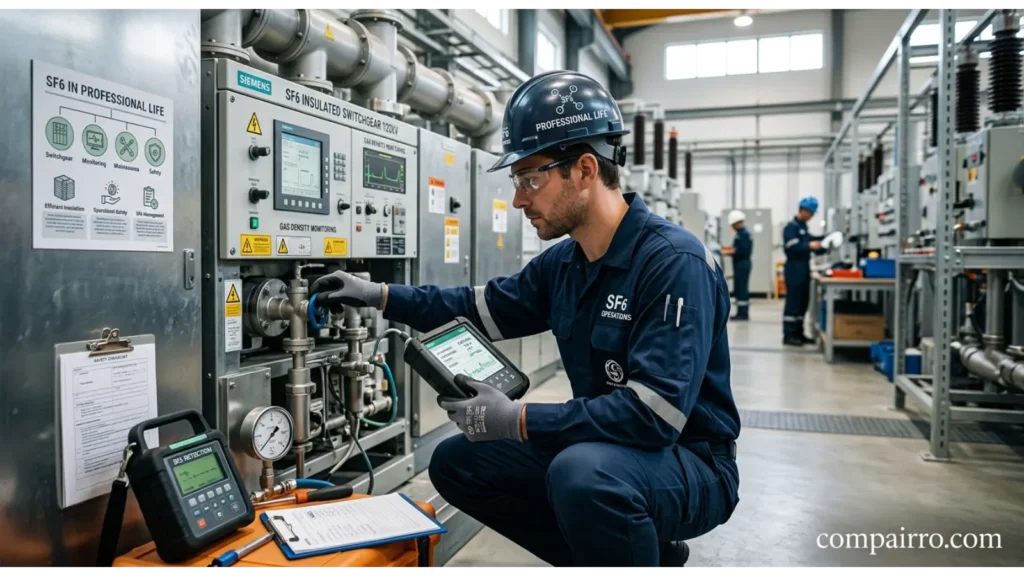
In electrical engineering, SF6 has been used in high-voltage switchgear and circuit breakers because of its insulating and arc-quenching properties. Its industrial use, however, is subject to environmental concerns because it is a highly potent greenhouse gas.
Professionals working with SF6 must follow suitable safety, handling, leak prevention, and recovery procedures. The gas should not be released carelessly into the atmosphere.
Remember that its nonpolar nature does not mean it is harmless or environmentally safe.
SF6 for Students or Beginners
If you are new to chemistry, the easiest way to understand SF6 polarity is to learn three things: bond polarity, molecular shape, and dipole cancellation.
Why Do Beginners Find SF6 Confusing?
- Fluorine attracts electrons more strongly than sulfur.
- This makes each S–F bond polar.
- Students may assume that polar bonds always create a polar molecule.
- They may forget to check the molecule’s three-dimensional shape.
Easy Tips for Learning
- Draw sulfur in the center and six fluorine atoms around it.
- Remember that SF6 has an octahedral shape.
- Imagine each S–F bond dipole as an arrow pointing toward fluorine.
- Notice that the arrows balance because of the symmetrical arrangement.
- Conclude that the net dipole moment is zero, so SF6 is nonpolar.
For exams, explain both the bond polarity and the molecular shape. This makes your answer more complete than simply writing “nonpolar.”
Signs or Characteristics Related to SF6 Polarity
SF6 has several important characteristics that explain why it is nonpolar.
- Chemical formula: SF6 contains one sulfur atom and six fluorine atoms.
- Central atom: Sulfur is the central atom.
- Molecular geometry: The molecule has an octahedral shape.
- Bond type: The sulfur-fluorine bonds are polar covalent bonds.
- Symmetry: The six fluorine atoms are arranged symmetrically around sulfur.
- Dipole cancellation: The bond dipoles cancel each other because of the molecule’s geometry.
- Net dipole moment: SF6 has a net dipole moment of zero.
- Overall polarity: The molecule is nonpolar.
These characteristics show why you must consider the complete structure of a molecule rather than looking only at its individual bonds.
Simple Trick to Remember SF6 Polarity
Here is an easy memory trick:
Polar bonds + symmetrical shape + complete dipole cancellation = nonpolar molecule.
Think of it this way: imagine six people pulling equally in balanced directions around a central point. Even though everyone is pulling, the overall effect is balanced.
SF6 works in a similar way. Each S–F bond has a dipole, but the symmetrical arrangement balances the effects in every direction.
Compare these examples:
- SF6: Symmetrical octahedral shape → nonpolar.
- H2O: Bent shape → polar.
- CO2: Symmetrical linear shape → nonpolar.
Remember, symmetry alone is not always enough. The bond dipoles must also be arranged so that they cancel.
FAQs:
1. Is SF6 polar or nonpolar?
SF6 is nonpolar because its symmetrical octahedral shape causes all six S–F bond dipoles to cancel.
2. Why is SF6 nonpolar even though fluorine is highly electronegative?
Fluorine attracts shared electrons more strongly than sulfur, making the S–F bonds polar. However, the six bond dipoles cancel because of the molecule’s symmetrical structure.
3. What is the molecular shape of SF6?
SF6 has an octahedral molecular shape. Six fluorine atoms surround one central sulfur atom.
4. Are the bonds in SF6 polar?
Yes. Each sulfur-fluorine bond is polar because sulfur and fluorine have different electronegativities.
5. Does SF6 have a dipole moment?
SF6 has a net dipole moment of zero because its individual bond dipoles cancel one another.
6. Is SF6 more polar than H2O?
No. SF6 is nonpolar, while H2O is polar. Water’s bent shape prevents its O–H bond dipoles from canceling completely.
7. How can I quickly tell whether SF6 is polar or nonpolar?
Remember its octahedral shape. Its six identical S–F bonds are arranged symmetrically, so their dipoles cancel and the molecule is nonpolar.
Conclusion
So, is SF6 polar or nonpolar? SF6 is a nonpolar molecule, even though its individual sulfur-fluorine bonds are polar.
The reason is its symmetrical octahedral geometry. Six fluorine atoms surround the central sulfur atom, and the bond dipoles cancel in every direction. As a result, the molecule has a net dipole moment of zero.
To answer similar chemistry questions, always consider both bond polarity and molecular shape. A molecule can have polar bonds without being polar overall.
Final memory rule: SF6 has polar bonds, a symmetrical octahedral shape, and zero net dipole moment. Therefore, SF6 is nonpolar.

Sara Taylor is a passionate English content writer who specializes in word meanings, spelling comparisons, and modern slang explanations. She creates easy-to-understand articles that help readers avoid common English mistakes and improve their writing skills. Her content focuses on simple learning, real-life examples, and clear explanations for everyday readers.